Every commercial truck on the road is sitting on a clock. Three hundred and sixty-five days after its last annual inspection, that vehicle becomes a liability waiting to happen. Miss the deadline by even one day, and a routine roadside stop turns into an automatic out-of-service order under 49 CFR 396.17, no exceptions, no grace period. For fleet managers juggling dozens or hundreds of trucks, tracking every vehicle's individual 12-month inspection window by hand is where compliance quietly falls apart, and where the fines start piling up.
Every commercial motor vehicle with a GVWR of 10,001 pounds or more must pass a full Appendix A inspection at least once every 12 months under 49 CFR 396.17. Proof of that inspection must stay on the vehicle at all times. A missing or expired inspection sticker triggers an automatic out-of-service order at roadside, and penalties can climb to 19,277 dollars per instance. Annual inspection violations are the second most common FMCSA citation nationally, with roughly 133,000 issued every year.
Why Annual DOT Inspection Tracking Is Harder Than It Sounds
On paper, the rule is simple: inspect every commercial vehicle once every 12 months and keep the paperwork on hand. In practice, fleets rarely run on a single clean calendar. A tractor and its semi-trailer each carry their own inspection cycle, a dolly in a multi-trailer combination needs its own record, and every vehicle's window starts from a different purchase or last-inspection date. Multiply that across a 50, 100, or 300 vehicle fleet, and you have a sprawl of expiration dates that no spreadsheet survives for long.
The cost of losing track is not abstract. Operating a commercial vehicle with no current annual inspection results in an automatic out-of-service order the moment a roadside officer checks the sticker, and that single missed date can carry fines up to 19,277 dollars. It also lands directly on your CSA Vehicle Maintenance score, the same score that insurance underwriters and shippers quietly check before deciding whether to do business with you.
What Counts As A Vehicle Requiring Annual Inspection
The federal requirement under 49 CFR 396.17 applies broadly. Any vehicle with a gross vehicle weight rating, gross combination weight rating, or actual weight of 10,001 pounds or more falls under the rule, along with any vehicle hauling placarded hazardous materials and any passenger vehicle designed to carry more than eight people for hire or more than fifteen people if not for hire. If your fleet moves freight or passengers across state lines, almost every unit you operate needs this inspection on a recurring 12-month cycle.
FleetRabbit watches every vehicle's 12-month inspection clock automatically, sends advance reminders before deadlines hit, and keeps every certificate organized in one place. Sign up free and stop chasing expiration dates manually.
The 15 Categories Inspectors Actually Check
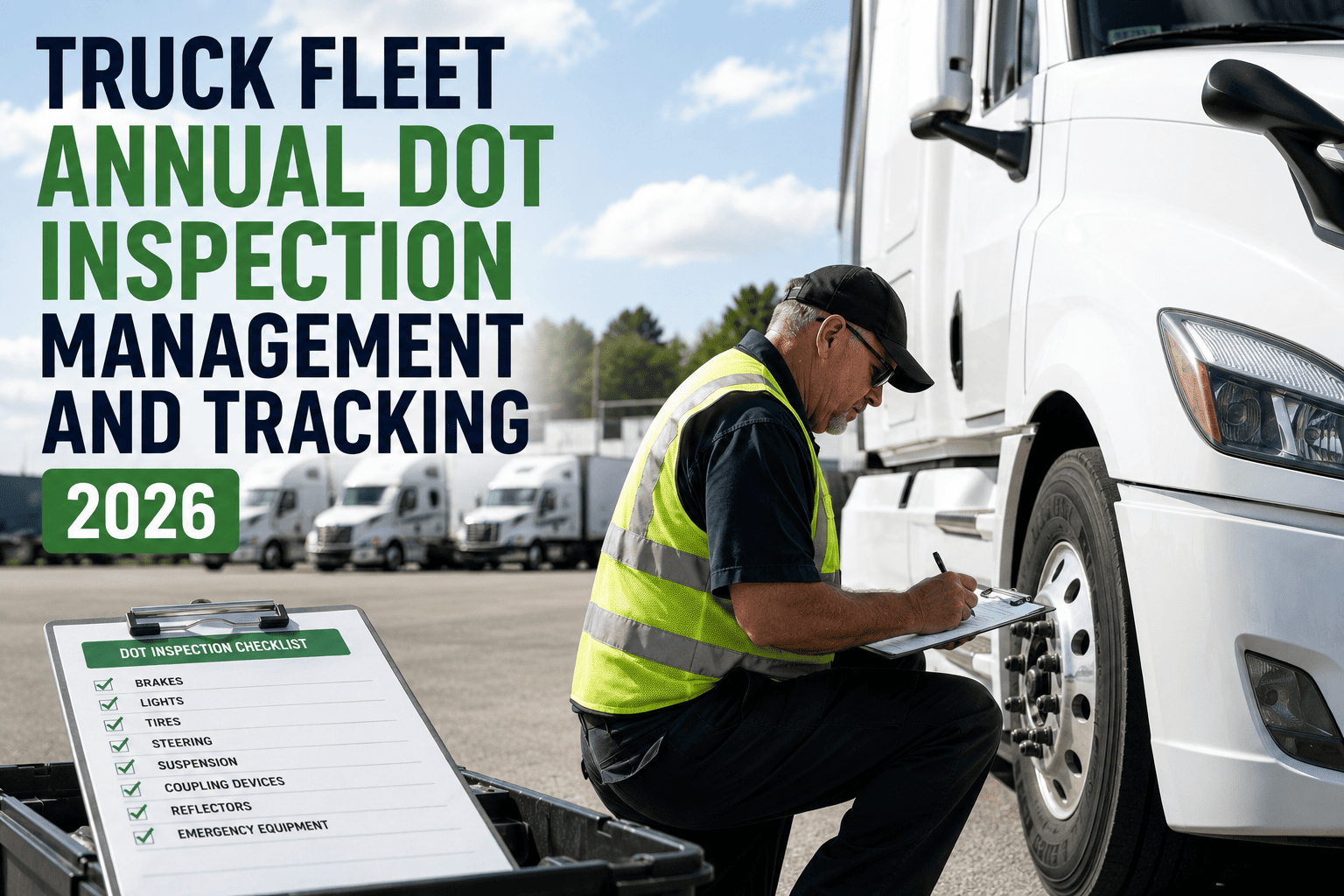
An annual DOT inspection is not a quick walk-around. It is a hands-on, component-by-component evaluation covering every item listed in Appendix A to Part 396, performed by an inspector qualified under 49 CFR 396.19. Understanding what gets checked helps fleet teams prepare vehicles in advance instead of discovering a defect the day the inspector arrives.
Why Brake Pushrod Travel Trips Up So Many Fleets
Brake adjustment out of specification is one of the most common reasons a vehicle fails its annual inspection or gets placed out of service at roadside. Pushrod stroke has to be measured physically, with reservoir pressure between 80 and 90 psi and brakes fully applied, against the manufacturer's readjustment limit. A visual glance is not enough, which is exactly why fleets that rely on informal pre-checks get caught off guard during the real inspection.
Planned Inspection Versus A Roadside Surprise
The financial gap between scheduling your annual inspection proactively and getting caught without current proof is enormous. A planned inspection costs normal shop labor and lets you fix any defect on your own timeline. An expired sticker discovered at roadside means the truck sits, the load stops moving, and the fine clock starts immediately.
| Scenario | What Happens | Financial Risk |
|---|---|---|
| Inspection Scheduled In Advance | Vehicle inspected during planned shop time, defects corrected before deadline, certificate filed | Standard shop labor only, no fines, no lost load time |
| Sticker Expires Unnoticed | Vehicle flagged at next roadside stop or audit, automatic out-of-service order issued | Up to 19,277 dollars penalty plus lost revenue while parked |
| Defect Found Uncorrected | Vehicle cannot be certified until repaired and re-verified by the inspector | Fines up to 19,277 dollars for operating with known uncorrected defects |
| Missing Documentation At Audit | Citation issued per occurrence even if the inspection was actually performed | Direct hit to CSA Vehicle Maintenance score and audit outcome |
Recordkeeping Rules Fleets Often Get Wrong
Passing the inspection is only half the requirement. The original or a copy of the annual inspection report must be retained for 14 months from the inspection date, and a copy or valid certificate must stay on the vehicle at all times. If an officer cannot find proof at roadside, you get cited regardless of whether the inspection actually happened. Inspector qualification records also need to be kept for as long as that inspector is active, plus one additional year after they leave.
Self-Inspection Versus Third-Party Inspection
Carriers can perform annual inspections in-house under 49 CFR 396.17(d) as long as the inspector meets the qualification standards in 396.19, including knowledge of Part 393 and Appendix A. Alternatively, a commercial garage, fleet leasing company, or truck stop can perform the inspection as the carrier's agent under 396.17(e). Either path works, but the carrier remains ultimately responsible for proving the inspection was completed and documented correctly.
State Inspections Can Satisfy The Federal Requirement
If a vehicle passes a periodic inspection performed under a State government program that meets the minimum standards in Appendix A, that inspection counts toward the federal annual requirement for 12 months from the last day of the month it was performed. Not every state program qualifies, so it is worth confirming your state's status rather than assuming.
FleetRabbit stores every inspection certificate, defect correction, and inspector qualification record in one searchable place, ready the moment FMCSA asks. Book a demo to see how fast audit prep becomes.
Building A Tracking System That Actually Holds Up
Most fleets that fall behind on annual inspections are not ignoring the rule, they are simply tracking it manually until the volume of vehicles overwhelms the system. A reliable tracking process needs four pieces working together: a live record of every vehicle's next due date, automatic reminders well before that date arrives, a digital home for every completed certificate, and a clear escalation path when a defect is found and needs correcting before certification.
Set Reminder Windows Before The Deadline, Not On It
Waiting until the expiration date to react leaves no room for scheduling shop time or sourcing parts for a defect. Staggered alerts at 90, 60, 30, and 7 days before each vehicle's inspection expires give maintenance teams enough runway to book the inspection during a planned downtime window instead of scrambling. This single habit is often the difference between a fleet with zero inspection violations and one that racks up citations every quarter.
This is exactly the gap FleetRabbit was built to close. Instead of relying on a spreadsheet someone has to remember to update, the platform tracks every vehicle's individual 12-month cycle automatically and surfaces upcoming deadlines before they become emergencies. You can sign up and connect your fleet roster in minutes to see your own inspection calendar laid out clearly.
Frequently Asked Questions
Take Control Of Your Fleet's Inspection Calendar
An expired annual inspection sticker is one of the most preventable violations in trucking, yet it remains one of the most common. The rule itself has not changed in years, but the consequence of missing it, lost revenue from an out-of-service order, fines that can reach five figures, and a dent in your CSA score, gets more expensive every year enforcement tightens. The fleets that stay ahead are the ones that stopped tracking deadlines by memory and started tracking them automatically.
FleetRabbit tracks every vehicle's 12-month inspection cycle, sends reminders before deadlines hit, and keeps your certificates organized and audit ready. Start free and see your entire fleet's compliance status in one view.