A truck rolls into the bay with a failed alternator. The technician walks to the parts cage and finds an empty bin. What follows is a rush order at premium pricing, a vehicle sitting idle for the better part of a day, and a driver pulled off a paying route. This single scene plays out across fleets every day, and it is almost never a supply problem. It is an inventory strategy problem, and it is entirely fixable with the right approach to what gets stocked, how much, and where.
The average commercial fleet wastes 19 to 24 percent of its parts budget on rush orders, duplicate stock, and obsolete inventory sitting unused for years. A single stockout that extends a repair by a day can cost 448 to 760 dollars in pure downtime, on top of the emergency parts premium. Fleets that move to structured, criticality-based inventory management report 47 percent fewer stockouts and 31 percent lower carrying costs within the first year.
Why Most Fleet Storerooms Get This Backwards
The common failure pattern in fleet parts management is not too little inventory or too much. It is the wrong inventory in the wrong place. Storerooms accumulate large quantities of cheap, easily replaceable items while the long-lead-time components that actually cause downtime sit at zero stock. This happens because reordering decisions get made by gut feel and habit rather than by actual usage data and operational risk, so the loudest recent stockout drives the next purchase rather than a systematic view of what the fleet truly needs on hand.
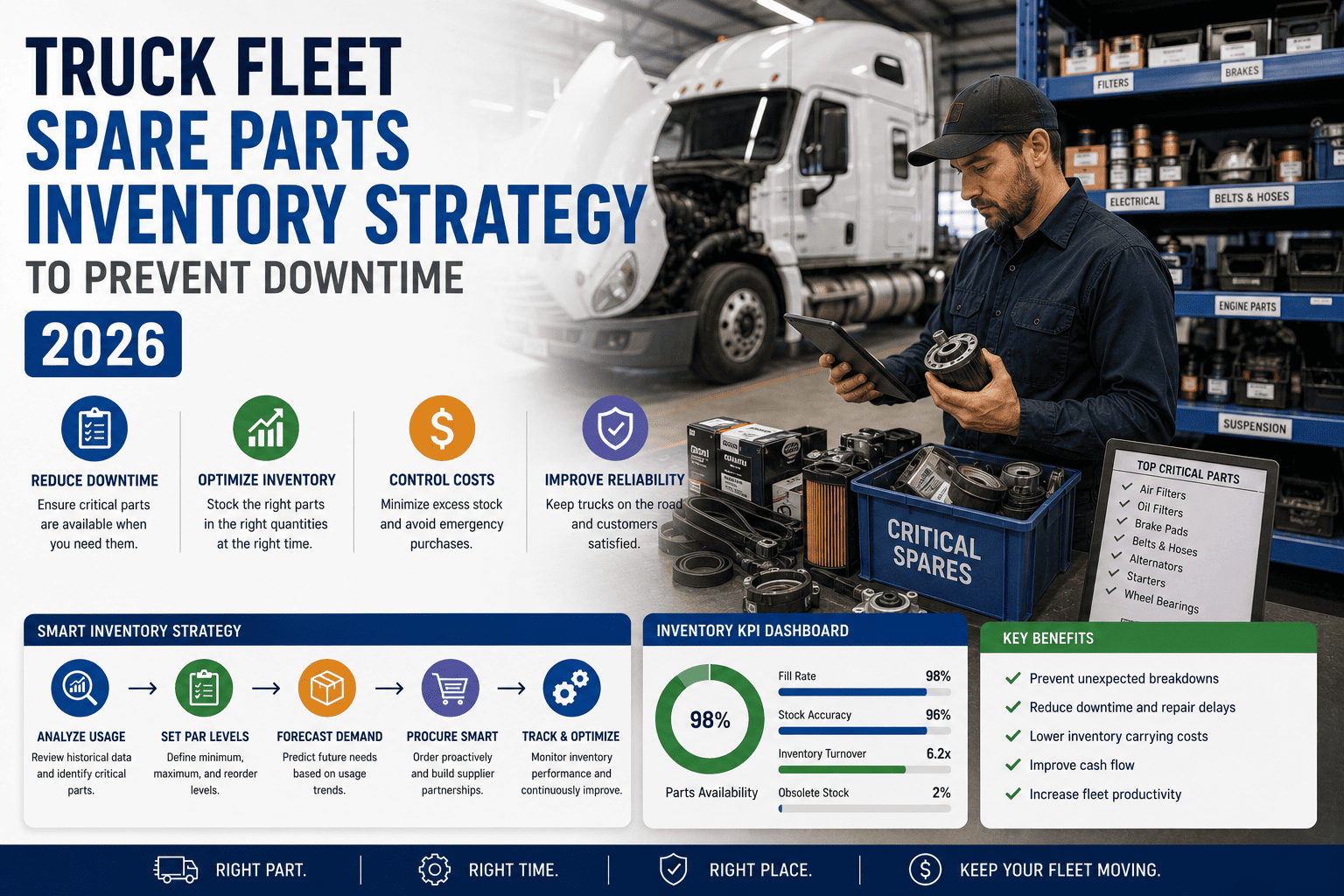
Across the top twenty parts that most often cause downtime when missing, such as brake pads, filters, and belts, the impact share is dramatically higher than their share of total inventory value. This is exactly why treating every part with the same stocking rule wastes money on the wrong items while leaving the truly critical ones exposed.
The Real Cost Of Getting It Wrong
Carrying excess inventory is not free. Holding spare parts typically costs 20 to 30 percent of their value every year in storage space, capital tied up, and obsolescence, with 15 to 25 percent of a typical storeroom eventually becoming surplus that never gets used. On the other side of the ledger, a stockout on a part needed mid-repair doesn't just delay that one job, it can add 24 or more hours to total downtime, with each hour translating directly into lost revenue and an idle driver.
Classifying Parts By What They Actually Cost You
The single most effective framework for fixing this imbalance is ABC classification, which sorts every part by its consumption value and operational impact rather than by what feels familiar. Roughly 15 to 20 percent of parts typically account for 75 to 80 percent of total inventory value or downtime risk, and those are the parts that deserve close attention, tight reorder rules, and guaranteed minimum stock.
FleetRabbit links every part to the vehicles it serves and triggers reorders automatically based on actual consumption, not gut feel. Sign up free to load your parts catalog in minutes, or book a demo to see automated ABC classification on your own fleet data.
Setting Reorder Points That Actually Prevent Stockouts
A reorder point should never be a static number copied from last year's purchase order. It is a calculated threshold built from how fast a part gets used and how long it takes to arrive once ordered. The standard formula is straightforward: average daily usage multiplied by supplier lead time, plus a safety stock buffer to absorb demand spikes or delivery delays.
Lead time changes the math more than most fleet managers expect. A part that takes two days to arrive and gets used at a steady pace needs only a small buffer. The same usage rate on a part with an eight-week delivery window requires a far larger reorder threshold, since running short means weeks of exposure rather than days. Treating every part with the same reorder rule, regardless of how long it takes to restock, is one of the most common and costly mistakes in fleet parts management.
Why Demand Predictability Matters As Much As Value
Pairing ABC classification with a demand-predictability layer sharpens the picture further. A high-value part with steady, predictable usage can run on tight, efficient stock levels. The same value part with erratic, unpredictable demand needs a larger safety buffer to avoid the same downtime risk, even though both parts might sit in the same value tier on paper.
| Inventory Metric | Industry Benchmark | What It Signals |
|---|---|---|
| Service Level / Fill Rate | 95 to 97 percent for well-managed storerooms | The share of parts requests fulfilled immediately from existing stock |
| Stockout Rate | Below 2 percent fleet-wide | How often a needed part is unavailable when a work order requires it |
| Carrying Cost Of Inventory | 20 to 30 percent of total inventory value annually | Storage, capital, and obsolescence cost tied up in parts on the shelf |
| Emergency Order Percentage | Under 20 percent of total parts purchases | A high ratio points directly to demand forecasting and reorder timing gaps |
| Inventory Record Accuracy | 95 percent or higher match to physical counts | Whether reorder triggers can be trusted without a manual storeroom check |
Linking Parts To Vehicles, Not Just To A Shelf
The most common breakdown in fleet inventory is not the parts themselves, it is the disconnect between the parts catalog and the vehicle records that actually need them. When a technician opens a work order, they should immediately see which parts are compatible, in stock, and ready for that specific vehicle, rather than walking to the storeroom to check by hand. A parts catalog that isn't connected to vehicle and work order history routinely adds significant search time to every single repair event, time that adds directly to total downtime without ever showing up as a parts cost.
This connection also unlocks pre-staging. When a scheduled service interval is approaching for a specific truck, a connected system already knows which parts that vehicle is likely to need and can flag them in advance, rather than discovering the need the moment the truck rolls into the bay. This single shift, from reactive parts requests to predictive pre-staging, is one of the fastest ways to compress repair time without adding a single dollar of extra inventory.
Reclaiming Capital From Obsolete Stock
Every storeroom accumulates parts for vehicles that have since been retired, sold, or replaced with a different component design. Industry data consistently shows that 15 to 25 percent of a typical fleet's parts inventory falls into this obsolete or surplus category, representing tied-up capital that is unlikely to ever turn into a completed repair. A regular obsolescence review, scrapping or returning parts that no longer match any active vehicle in the fleet, frees up both shelf space and budget that can be redirected toward the critical parts that actually prevent downtime.
Every empty bin is a truck sitting idle and a budget bleeding into rush orders. FleetRabbit connects your parts catalog to vehicle records and automates reorder points based on real usage, so the right part is on the shelf before the work order is even opened. Sign up free to load your fleet's parts catalog today, or book a demo to see automated inventory optimization in action.