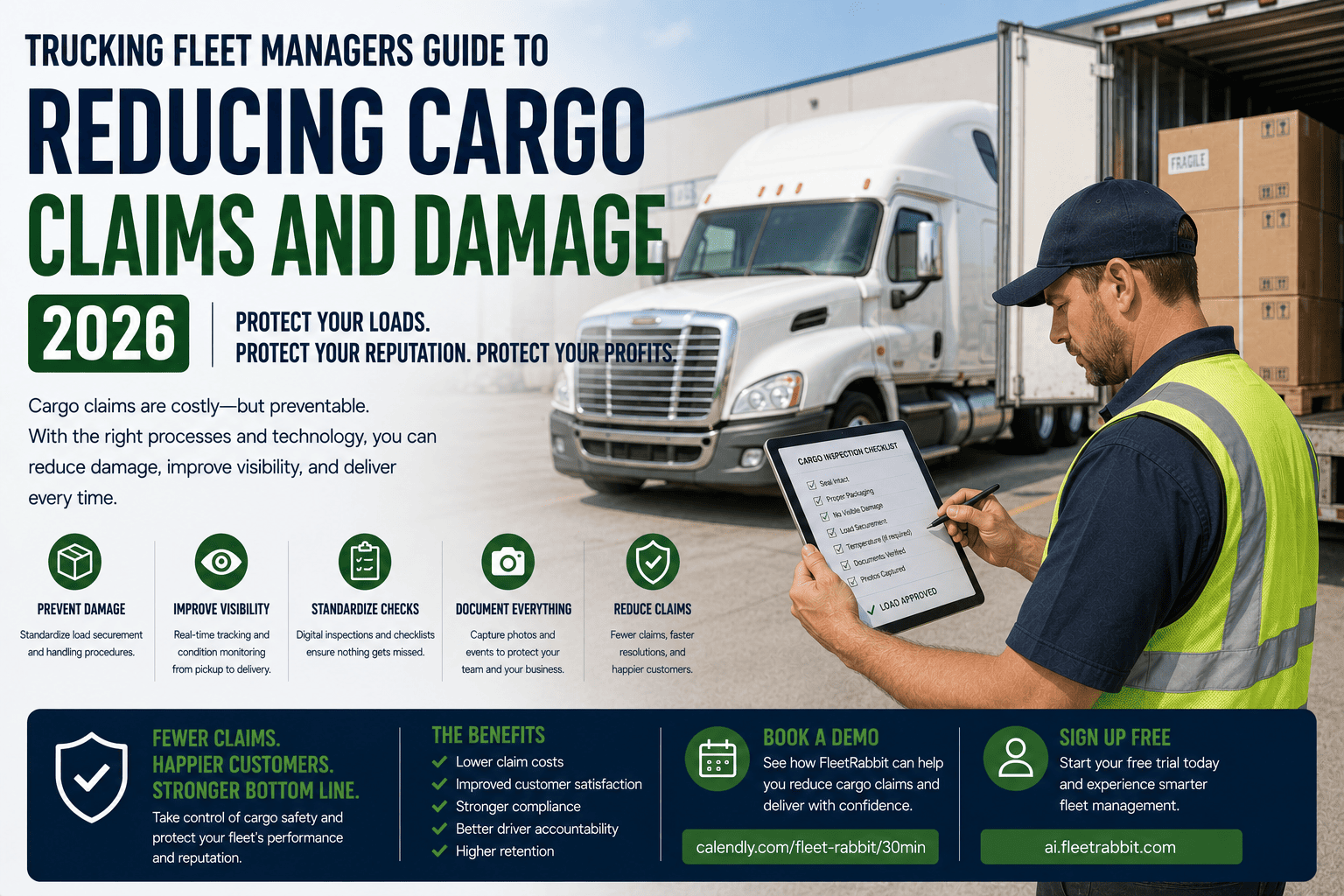
A single damaged pallet can undo a week of margin. Across U.S. transportation, freight claims now drain an estimated 50 billion dollars a year from shippers and carriers, and most of that money is lost not because freight was destroyed beyond recognition, but because paperwork was missing, photos were never taken, or nobody could prove what condition the load was in when it left the dock. For a fleet manager, cargo claims are not a paperwork inconvenience. They are a direct hit to revenue, insurance premiums, and the customer relationships that keep freight coming back. The good news is that claims are one of the most preventable costs in trucking, and fleets that build a documented, digital process around inspections and delivery confirmation are settling claims faster and losing far less along the way. If you want to see how this works on your own fleet, you can sign up for a free trial or book a live demo before you finish reading.
Freight claims cost U.S. shippers and carriers more than 50 billion dollars every year, and missing or incomplete documentation is behind roughly 35 to 40 percent of every denied claim. Carriers using automated, photo and timestamp-backed claim submissions see denial rates cut nearly in half compared to manual paper processes. Digital proof of delivery and inspection tools are turning cargo protection from a reactive scramble into a measurable, defensible system.
The Real Price of Cargo Claims and Freight Damage
Every cargo claim carries two costs: the value of the freight itself, and everything that happens around it. When a load arrives damaged or short, someone has to inspect it, photograph it, file paperwork, negotiate with the carrier or insurer, and often re-source the product for the customer. Freight claims cost U.S. shippers an estimated 50 billion dollars or more annually, and much of that figure comes from claims that should have been simple to resolve but got tangled in disputes over documentation, timing, or condition at drop-off.
Insurance costs compound the pain. Motor truck cargo coverage for general dry freight commonly runs 500 to 2,000 dollars per truck per year for a 100,000 dollar limit, but reefer loads, high-value commodities, and high-theft lanes can push that number past 8,000 dollars annually. A fleet with a rough claims history doesn't just pay for the damaged freight. It pays a premium penalty on every load it hauls afterward, which is exactly why reducing claim frequency has a compounding financial return.
Why This Is a Fleet Management Problem, Not Just an Insurance One
Cargo claims are frequently treated as an insurance or claims-department issue, but the root causes sit squarely inside fleet operations: how a load is inspected before it leaves the yard, how it's secured, how the driver documents condition at pickup and delivery, and whether that documentation is captured in a system anyone can retrieve later. Fleet managers who close those gaps see fewer claims filed in the first place and win the ones that do get filed.
FleetRabbit captures timestamped photos, e-signatures, and GPS-verified delivery records automatically, so every claim you file is backed by evidence instead of memory. Start your free trial and see your first documented delivery in minutes.
The Seven Reasons Claims Get Denied
Before a fleet can prevent claims, it has to understand how carriers and insurers evaluate them. Denial patterns are remarkably consistent across LTL, full truckload, parcel, and air freight, and almost every trigger traces back to a gap in documentation or timing rather than a genuine dispute over what happened to the freight.
| Denial Trigger | Why It Happens | How Fleets Prevent It |
|---|---|---|
| Incomplete Documentation | Missing bill of lading, no damage notation, no value invoice on file | Digital inspection checklist required before pickup and delivery is marked complete |
| No Photo Evidence | Damage reported verbally with nothing to show original packaging condition | Mandatory photo capture built into the driver workflow at every stop |
| Late Claim Filing | Damage discovered days later, past the carrier's notice window | Instant digital delivery record with timestamp starts the clock immediately |
| Disputed Condition At Delivery | Driver and receiver disagree on load condition with no independent record | E-signature plus geotagged photo at drop-off removes the guesswork |
| Temperature Disputes | Reefer claims with no verifiable cold-chain data | Downloadable temperature logs attached directly to the delivery record |
| Securement Failure | Shifted or crushed freight from inadequate load securement | Pre-trip securement checks logged and verified before departure |
| Weight Or Count Discrepancy | Shortage claims with no verified count at pickup | Digital piece count and weight certificate captured at origin |
Documentation Gaps Are the Number One Culprit
Across every mode of freight, incomplete or missing documentation accounts for roughly 35 to 40 percent of all claim denials, more than any other single cause. That means the fastest, cheapest way to protect revenue isn't a new insurance policy. It's making sure the bill of lading, damage notation, value invoice, and photographic evidence exist and are attached to every load, every time, without relying on a driver to remember.
What a Denial-Proof Claim File Actually Contains
Carriers and insurers consistently pay claims faster when the file includes the original bill of lading, proof of delivery with any damage clearly noted, an invoice establishing cargo value, timestamped photographs of the damage in its original packaging, and a weight or count certificate. Fleets that generate this file automatically at the point of delivery rarely find themselves negotiating over whether a claim is legitimate.
Digital Proof of Delivery: Your First Line of Defense
Proof of delivery has quietly become the single most important document in cargo claims management. A digital proof of delivery record replaces the handwritten, easily lost paper slip with a verified digital receipt that captures exactly what happened at the moment freight changed hands.
What Modern ePOD Captures
A strong electronic proof of delivery record includes a recipient e-signature, a geotagged photo of the freight and its condition, an exact timestamp, and GPS coordinates confirming where the delivery occurred. Together these four elements turn a delivery dispute from a he-said-she-said argument into a matter of simply pulling up the record.
From Paper Waybill to Digital Record
Fleets moving from paper to digital proof of delivery typically see returns within three to six months, driven by faster billing cycles, fewer disputed claims, and less administrative time spent chasing signatures. The transition is also low-risk for drivers, since a well-designed mobile workflow is faster than filling out a paper waybill, not slower.
Capture signatures, photos, GPS location, and timestamps automatically on every stop, then sync straight into your claims and billing workflow. Book your demo to see how quickly disputes disappear once every delivery has a digital record.
Load Securement, Route Visibility, and Damage Prevention
Documentation wins claims after damage happens. Securement and visibility prevent the damage from happening at all, which is always the cheaper outcome. Shifted freight, improper blocking and bracing, and undetected temperature excursions are among the most common physical causes of in-transit damage, and each one is detectable before it becomes a claim.
Securement Checks That Actually Prevent Damage
A digital pre-trip inspection that requires drivers to confirm strapping, blocking, and bracing before departure creates two benefits at once. It reduces the chance freight shifts in transit, and it produces a timestamped record proving the load was properly secured if a claim is ever filed anyway.
Real-Time Visibility Closes the Loop
Route and temperature visibility tools let dispatchers spot a reefer excursion or an unplanned stop in a high-theft corridor while the truck is still moving, not after the freight has already arrived compromised. Acting on that alert in real time is often the difference between a minor adjustment and a total loss claim.
Building a Systematic Cargo Protection Program
Fleets that consistently keep claims low share the same habit: they treat cargo protection as a measurable process with benchmarks, not a fire drill that starts after something goes wrong. Tracking a small set of metrics monthly reveals problems long before they show up as a spike in insurance premiums.
| Metric | What It Tells You | Healthy Benchmark |
|---|---|---|
| Claim Frequency | How often damage or shortage claims are filed per hundred loads | Trending down quarter over quarter |
| Denial Rate | Share of claims rejected by carriers or insurers | Well below the 25-40 percent industry range |
| Documentation Completeness | Percentage of deliveries with full digital proof of delivery on file | Close to 100 percent |
| Average Resolution Time | Days from filing to settlement | Days, not weeks |
Why This Pays Off Beyond the Claim Itself
A lower claim and denial rate feeds directly into better insurance renewal terms, since underwriters price cargo coverage based heavily on loss history and documentation quality. It also protects the customer relationships that generate repeat freight, because shippers remember which carriers make damage claims easy and which ones make them fight for every dollar.
Frequently Asked Questions
Stop losing valid claims to missing paperwork and start winning disputes with timestamped photos, signatures, and GPS-verified delivery records captured automatically on every load. FleetRabbit helps fleets cut denial rates and protect revenue from day one.