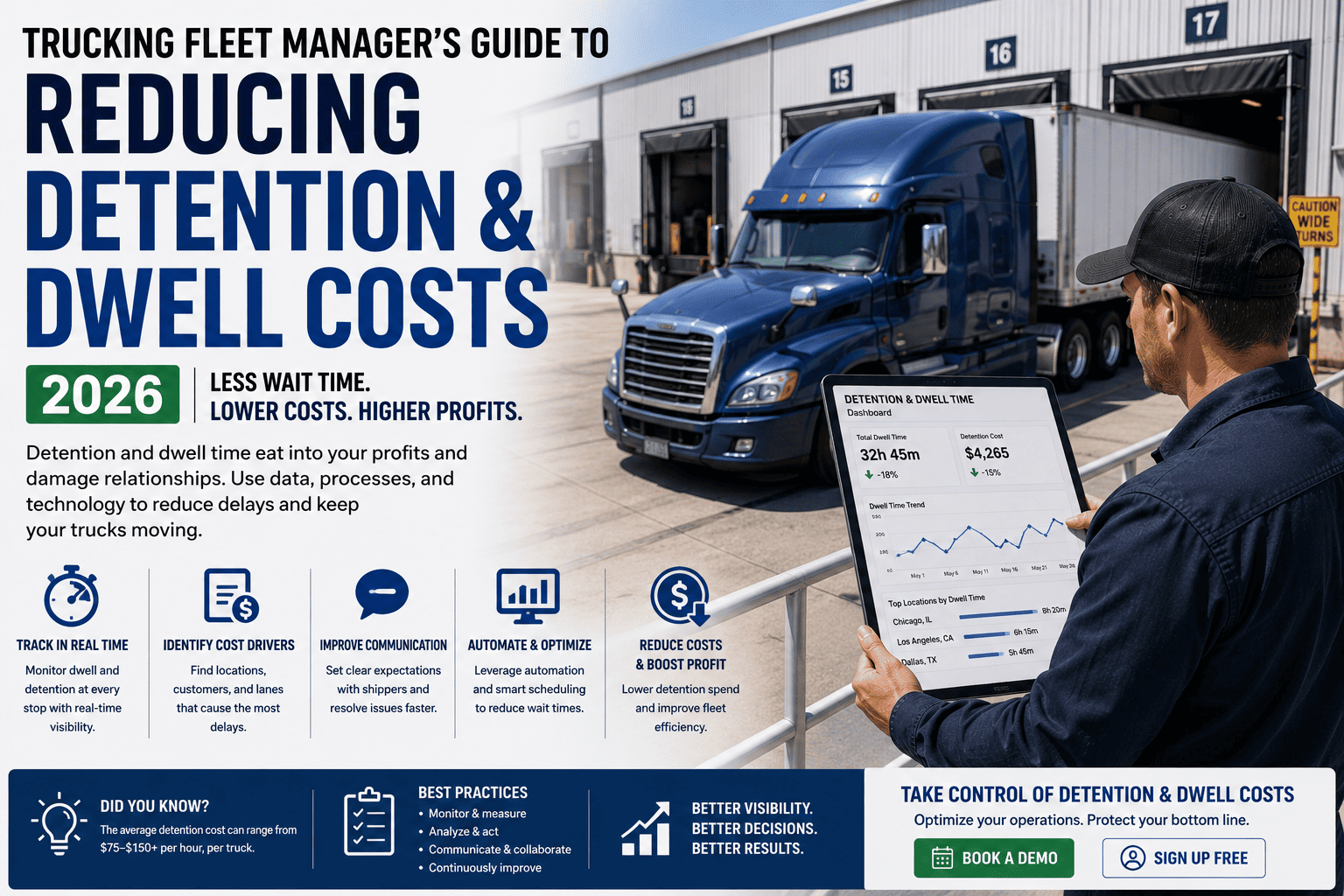
Ask any dispatcher what keeps them up at night and detention time is near the top of the list. A truck that should be back on the road in an hour instead sits at the dock for four, five, sometimes six hours, and every one of those hours is a mix of lost driver pay, lost fuel efficiency, and a missed delivery slot somewhere down the line. Dwell time - the total time a truck spends at a facility, loaded or not - is the quiet number that erodes fleet profitability without ever showing up as a single dramatic incident. It just adds up, week after week, until a fleet manager finally sits down with the numbers and realizes how much money has been sitting in a parking lot.
Industry research points to detention costing the trucking sector well over a billion dollars a year in lost productivity, with average driver wait times at shipper and receiver facilities running from 3 to 6 hours. Most contracts allow only 1 to 2 hours of free time before detention fees apply, yet fewer than half of valid detention invoices ever get paid. Fleets using GPS geofencing and automated arrival and departure timestamps recover far more of that owed revenue and cut average dwell time significantly within months.
Detention vs. Dwell Time: Why the Distinction Matters
Fleet managers often use detention and dwell time interchangeably, but treating them as the same thing hides where the real money is leaking. Dwell time is the entire duration a truck spends at a facility, from the moment it arrives in the yard to the moment it departs, whether that includes waiting, loading, unloading, or paperwork. Detention time is the portion of that dwell that exceeds the contractually agreed free period, and it is the piece that should generate a billable fee. A truck can have four hours of dwell time but only two hours of billable detention if the contract allows two hours free. Understanding this split is the first step toward accurately pricing lanes and holding shippers accountable.
Why Contracts Rarely Get Enforced
Most rate confirmations already specify a free time window and an hourly detention rate, so the contract language usually isn't the problem. The gap shows up in enforcement. Drivers rely on a paper log or a memory of when they checked in, dispatch finds out about a long wait after the fact, and by the time an invoice goes out, the receiver has no way to verify the claim and simply denies it. Without a timestamped, GPS-backed arrival and departure record, a fleet is negotiating from a position of "trust me" instead of "here is the data," and receivers know exactly which carriers will let it slide.
The Compounding Effect on Fleet Schedules
A single long detention event rarely stays contained to one load. A truck that sits three extra hours at a receiver arrives late to its next pickup, which pushes that shipper's appointment window, which then risks detention at the next stop too. Dispatchers scramble to re-sequence routes, other drivers absorb the schedule shift, and what started as one dock's inefficiency becomes a ripple across the day's entire route plan. Fleets that track dwell time patterns by location can see this coming and build buffer time into schedules before it becomes a daily fire drill.
FleetRabbit uses GPS geofencing to timestamp every arrival and departure automatically, so detention claims are backed by data instead of driver memory. Fleet managers can sign up here and see dwell time by dock in real time, or book a demo to walk through your own detention data.
Where Detention and Dwell Costs Actually Come From
Breaking dwell time down by cause shows fleet managers exactly where to focus improvement efforts instead of treating every long stop the same way.
| Cost Driver | Typical Impact | Root Cause | How Visibility Helps |
|---|---|---|---|
| Dock Congestion | 1 to 3 hours added wait | Too many appointments booked in the same window with limited dock doors | Historical dwell data reveals which appointment slots consistently run long |
| Understaffed Yards | 1 to 2 hours added wait | Fewer loading crew members than trucks arriving during peak hours | Pattern reports flag which facilities need earlier or later appointment times |
| Missing Paperwork | 30 to 90 minutes added wait | Manual bills of lading and check-in processes at the guard shack | Digital check-in and geofenced arrival data removes guesswork on timing |
| Unbilled Detention | 25 to 100 dollars per hour lost | No timestamped proof of arrival or departure to support an invoice | Automated geofence logs create receiver-ready evidence for every claim |
| Schedule Cascade | Missed next-stop appointments | One long dwell event delays every subsequent stop on the route | Live dwell alerts let dispatch re-route or notify the next stop early |
Calculating What Detention Is Really Costing Your Fleet
Most fleet managers underestimate their detention exposure because they only count the hours they actually invoiced, not the hours that occurred. Start by pulling geofenced arrival and departure data, or manual driver logs if that's all you have, for the last 90 days. Subtract the contracted free time from each stop's total dwell to find billable detention hours. Multiply those hours by your applicable detention rate, then compare that number to what was actually invoiced and collected. The difference between what you were owed and what you received is your recovery gap, and for most fleets that gap is larger than expected.
Building the Full Picture
Add in the secondary costs that rarely make it onto an invoice: the extra hours of service burned that could have gone toward another load, the fuel spent idling, and the schedule disruption to the next pickup or delivery. A fleet running 40 trucks with even one avoidable two-hour detention event per truck per week is looking at thousands of dollars a month in pure lost capacity, separate from anything billed or unbilled.
A Simple Starting Formula
Billable detention hours multiplied by your detention rate, plus estimated idle fuel cost, plus the value of the driving hours lost to hours-of-service limits, gives a realistic per-incident cost. Running that formula across a month of stops turns a vague frustration into a number that justifies investment in tracking technology.
How Technology Closes the Detention Gap
The tools available to fleets today make it possible to catch detention as it happens instead of arguing about it weeks later.
GPS Geofencing for Arrival and Departure
A geofence drawn around a shipper or receiver's property automatically logs the exact minute a truck enters and exits, removing any dispute over when the clock started. This single feature is often the difference between a detention invoice that gets paid and one that gets ignored.
Automated Detention Reporting
Instead of a dispatcher manually calculating hours from memory, automated reports generate a receiver-ready summary the moment a truck leaves the yard, with the free time already subtracted and the billable rate already applied.
Dock Performance Analytics
Looking across every stop over time reveals which facilities are chronically slow, which appointment windows run over, and which lanes need to be repriced or renegotiated before the next contract cycle.
FleetRabbit's dock performance analytics show exactly which shippers and receivers are costing your fleet the most dwell time, with automated reports ready to send. You can start free with 3 vehicles or schedule a walkthrough to see your own lanes analyzed.
Benchmarks Worth Tracking
A handful of metrics separate fleets that manage detention proactively from fleets that simply absorb the cost.
Frequently Asked Questions
The Bottom Line on Detention and Dwell Time
Detention and dwell time are not a cost of doing business that fleets have to accept. They are a measurable, trackable, and recoverable part of fleet operations once the right visibility is in place. The fleets losing the most money are not the ones with the worst shippers, they are the ones with the least data. A timestamped, geofenced record of every arrival and departure turns a vague argument into an invoice that gets paid, and turns a chronically slow dock into a lane that gets repriced instead of repeated.
Every hour of unbilled detention is revenue your fleet already earned but never collected. FleetRabbit automatically tracks arrival, dwell, and departure at every stop so you can invoice with confidence and reprice the lanes that keep costing you time. Sign up free and connect your first vehicles today, or book a short demo to see your own dock performance data walked through live.