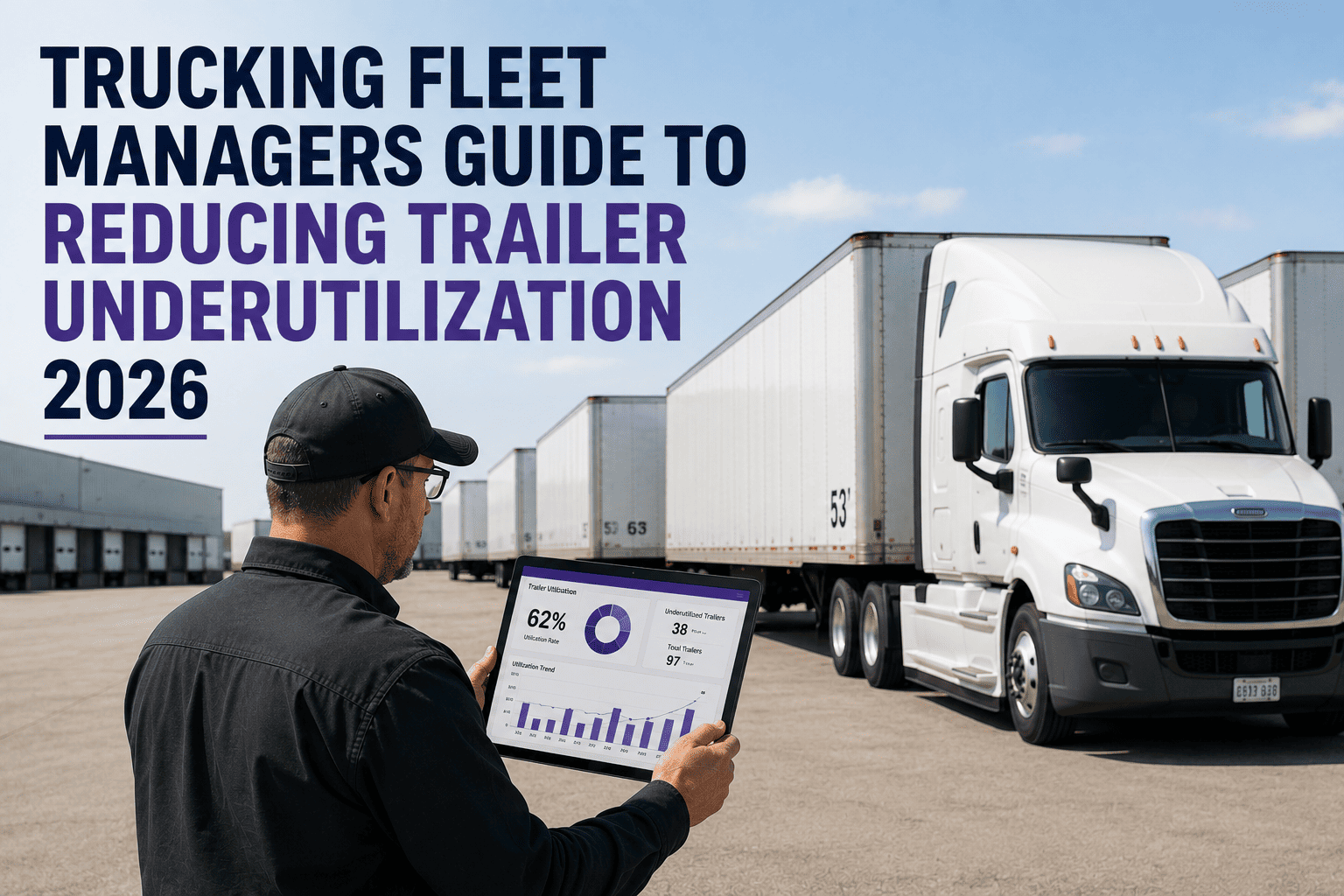
Somewhere in your yard right now, there is probably a trailer that has not moved in days. Nobody stole it, nobody lost it on paper, it is just sitting, quietly costing money while it waits for a load that dispatch does not even know is possible yet. Trailer underutilization rarely looks like a crisis. It looks like a normal Tuesday. But industry data now shows the average trailer sits idle for nearly half of every operating day, and in 2026 that invisible cost has become one of the easiest places for fleets to recover real margin without buying a single new asset.
The average trailer across U.S. fleets runs at roughly 60 percent utilization, meaning it sits idle for close to four out of every ten operating hours. For a fleet of 200 trailers, even a modest 15 percent idle rate can translate into tens of thousands of dollars in lost daily revenue and, over a year, into millions in stranded capital sitting quietly in a yard.
Where Your Trailers Actually Stand Today
Utilization targets vary by trailer type and freight model, but the direction is the same everywhere: fleets that track utilization per trailer, not as one fleet-wide blend, consistently outperform those that do not. A fleet averaging a healthy number can still be hiding individual trailers running at a third of that rate, quietly draining fixed costs while contributing almost nothing back.
Signs Your Trailer Fleet Is Quietly Underperforming
Most fleet managers do not discover underutilization through a report, they discover it through a feeling that something is off. These are the signals worth paying attention to before they show up as a bigger number on a balance sheet.
FleetRabbit gives you live location, dwell time, and utilization data for every trailer in the fleet, so underused assets get flagged automatically instead of discovered by accident. Sign up for free and see your first utilization report within days.
What's Actually Causing the Gap
Trailer underutilization is almost never one problem. It is a handful of small, boring inefficiencies that compound quietly over months until they show up as a real number on a spreadsheet.
Lost Visibility Between Stops
Trailers move between yards, customer docks, and drop lots constantly, and without live tracking, that movement quickly becomes a guessing game. Industry research suggests that 10 to 20 percent of trailers in a typical fleet are effectively unaccounted for at any given moment, not stolen, just sitting somewhere without anyone actively managing them.
Dwell Time Creep
A trailer that sits an extra day at a customer dock rarely triggers alarm bells on its own. But dwell time creep adds up fast across a fleet, and without automatic monitoring, those extra hours quietly become extra days, and extra days become a trailer that has functionally disappeared from active rotation.
A Quick Way to Spot Dwell Creep
Pull average dwell time by customer location for the last 90 days and compare it against your contracted free time. Locations consistently running over that window are the ones costing you both trailer capacity and uncollected detention revenue.
Load Assignment Guesswork
Without utilization data at the individual trailer level, dispatch defaults to habit rather than optimization, repeatedly assigning the same trailers while others sit untouched. This is how a fleet ends up buying new trailers to solve a capacity problem that was actually a visibility problem all along.
Putting a Real Number on the Cost
The math behind trailer underutilization is easier to see than most fleet managers expect. An idle trailer typically represents 150 to 400 dollars in lost daily revenue potential depending on trailer type and market rate. Run that across a fleet-wide idle rate and the number stops looking small very quickly.
How Tracking Technology Closes the Gap
Solving trailer underutilization is not about buying fewer trailers or pushing drivers harder, it is about seeing what is already happening across the fleet in real time. GPS-based tracking, automated dwell alerts, and per-trailer utilization scoring turn a guessing game into a data-driven dispatch decision, and fleets that adopt this visibility layer commonly see utilization gains of 25 to 40 percent within the first few months.
The starting point does not need to be complicated. Fleets can begin with a small pilot group of trailers, confirm the visibility and dwell data match what dispatch already suspects, and expand from there. Teams ready to move past the guessing stage can book a demo to see exactly how the dashboard flags underused trailers before they become a bigger problem.
Trailer underutilization does not announce itself, it just accumulates quietly in the background until it shows up as an unexplained gap in revenue or an unnecessary equipment purchase. The fleets closing that gap in 2026 are not the ones with the most trailers, they are the ones with the clearest picture of what every trailer is doing right now.
FleetRabbit gives you live location, dwell alerts, and utilization scoring for every trailer in your fleet, so idle assets get found and reassigned instead of forgotten. Get started free with no credit card required.