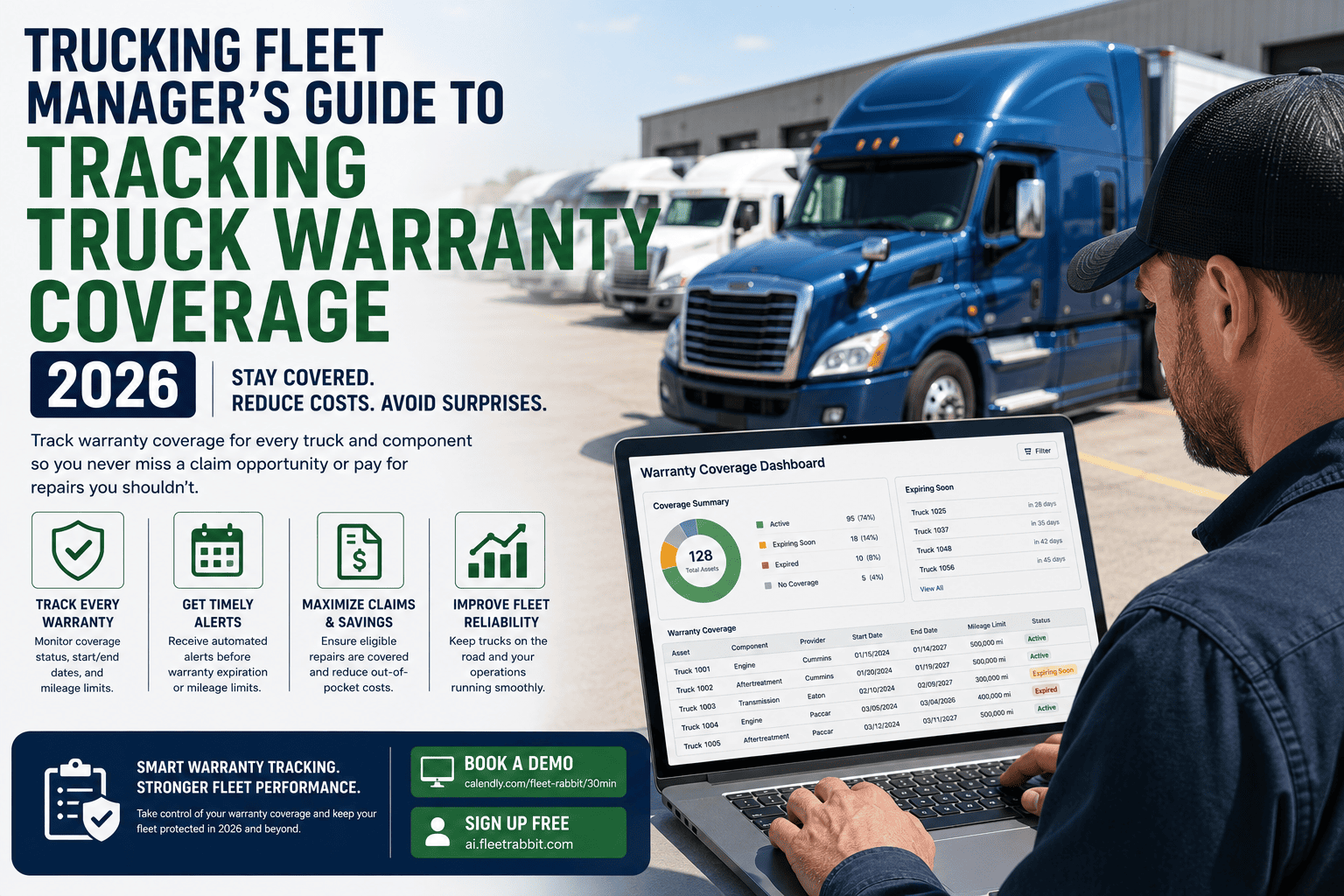
Somewhere in your maintenance budget right now, there is money that was already paid once and belongs back in your pocket. Every commercial truck rolls off the lot carrying multiple overlapping warranties, and every one of those warranties has a mileage limit, a calendar expiration, and a documentation requirement that is easy to miss in the middle of a busy shop day. Industry data shows the average commercial fleet leaves somewhere between 12 and 18 percent of its warranty entitlement unclaimed every year, not because the repairs were not covered, but because nobody was tracking when coverage applied.
A 50-vehicle fleet operating without systematic warranty tracking commonly writes off 15000 to 40000 dollars a year in recoverable repair costs. Fleets using manual, spreadsheet-based tracking typically recover only 40 to 60 percent of eligible warranty claims, while fleets on automated tracking platforms recover 85 to 95 percent of what they are owed.
Why Warranty Coverage Quietly Slips Away
The money rarely disappears in one dramatic event. It leaks out a few hundred dollars at a time, every time a coverage window passes unnoticed, a defective part gets scrapped before being photographed for a claim, or a technician completes a repair without checking whether the component was still under manufacturer coverage. Across a full year and a full fleet, that steady drip becomes a meaningful share of the total maintenance budget.
There is a second, less obvious risk on top of the missed reimbursements. Fleets can accidentally void an active warranty through improper service tasks or by failing to document maintenance the way the manufacturer requires. In other words, poor tracking does not just cost you claims you should have filed, it can also cost you coverage you already had.
The Three Most Common Failure Points
Repairs Authorized Before Warranty Status Is Checked
Technicians move fast under shop pressure, and without an automatic check against coverage records, warrantable repairs get billed straight to the fleet instead of the manufacturer.
Missing Evidence At The Point Of Failure
Photographs of the defective part, diagnostic fault codes, and technician notes are typically required to support a claim. Once a part is scrapped without this evidence, the claim opportunity is gone.
Deadlines Passing While Paperwork Sits Unfiled
With a 30 to 60 day filing window per claim, a stack of unprocessed paperwork can quietly convert into permanently lost reimbursements.
FleetRabbit links every vehicle's warranty coverage to its maintenance history, so eligible repairs are flagged before an invoice is ever approved. Start your free trial and see how much recoverable coverage your fleet may be missing right now.
The Warranty Types Every Fleet Manager Should Track
Commercial trucks rarely carry just one warranty. Understanding what each coverage type protects, and how long it lasts, is the foundation of a tracking system that actually recovers money instead of quietly letting it expire.
| Warranty Type | What It Covers | Typical Limit | Common Tracking Mistake |
|---|---|---|---|
| Basic Vehicle Warranty | General defects in materials and workmanship across the base vehicle | 1 to 2 years or set mileage cap | Repairs authorized without checking remaining mileage or age |
| Powertrain Warranty | Engine, transmission, and drivetrain components | Often 3 to 5 years or higher mileage cap | High-value repairs like transmissions paid out of pocket unnecessarily |
| Federal Emissions Warranty | Emissions control components and systems | Set by federal regulation, varies by component | Overlooked because it is separate from the standard vehicle warranty |
| Component-Specific Warranty | Individual parts like brakes, axles, or electrical systems | Varies by manufacturer and part | Not linked to the vehicle record, so coverage is forgotten after purchase |
| Extended Service Contract | Additional coverage purchased beyond the factory warranty | Custom terms set at purchase | Fleets simply forget the extended contract was purchased at all |
Building A Warranty Tracking System That Pays For Itself
A working warranty tracking process does not need to be complicated, but it does need to be consistent. The goal is simple: check coverage before authorizing a repair, capture the required evidence at the time of failure, and file the claim inside the deadline every single time.
Start With A Complete Coverage Inventory
Pull acquisition records for every vehicle and list every warranty type attached to it, including any extended service contracts that are easy to forget after the purchase paperwork is filed away. This inventory becomes the reference point every technician checks before a repair begins.
Link Fault Codes Directly To Coverage Records
Telematics fault codes generate a timestamped, VIN-linked record the moment a component begins failing. When that fault code is automatically checked against active coverage, it creates the exact evidence an OEM cannot dispute, and it flags a warrantable repair before the invoice is approved.
Track Every Claim From Submission To Reimbursement
Filing a claim is not the finish line. Claims should be followed through approval and reimbursement, since claims that stall in review are easy to lose track of without a dedicated log tied to each vehicle.
A Quick Warranty Recovery Checklist
Verify mileage and age against active coverage before labor is authorized. Photograph defective parts and record fault codes before scrapping anything. File every eligible claim within the first 30 days. Track claims through to final reimbursement rather than assuming they were paid.
FleetRabbit tracks every warranty type per vehicle, alerts your team before coverage expires, and builds the documentation trail your claims need to get approved. Book a demo and walk through your fleet's current warranty exposure with our team.
Benchmarks For A Healthy Warranty Program
Fleet managers who consistently recover what they are owed track a small set of numbers rather than reviewing warranty status only when a big repair comes up. Aim to verify warranty status on every repair before labor is authorized, not after the invoice arrives. Track your claim approval rate and investigate any pattern of denials, since repeated denials often point to a documentation gap rather than a coverage gap. Measure how many days pass between repair completion and claim filing, and push toward filing within the first two weeks rather than waiting until the deadline approaches. Fleets hitting these benchmarks consistently land in the 85 to 95 percent recovery range instead of the 40 to 60 percent range typical of manual tracking.
Frequently Asked Questions
Warranty coverage is money your fleet already paid for once. Tracking it properly is not an administrative afterthought, it is one of the simplest ways to lower your real cost per mile without changing a single thing about how your trucks are driven or maintained.
FleetRabbit connects warranty coverage, maintenance history, and repair records into one system, so your team knows exactly what is covered before a single invoice is approved. Start your free trial with no credit card required, or book a short call with our team to review your fleet's warranty exposure today.