A truck crash lawsuit rarely turns on the crash itself. It turns on what happens next, when a plaintiff's attorney subpoenas every record your fleet has ever kept and asks a single question: can you produce one consistent story, or four contradictory ones? For fleets that keep telematics in one system, maintenance logs in a spreadsheet, driver qualification files in a cabinet, and dash cam footage in a separate app, that question is nearly impossible to answer cleanly. And in 2026's litigation climate, that gap is exactly what juries are being asked to punish.
Nuclear verdicts of 10 million dollars or more against trucking companies have climbed roughly 300 percent over the past decade, with median awards now in the 36 to 51 million dollar range. Plaintiff attorneys do not need to prove a driver made a mistake. They need to prove your company could not produce a unified, documented safety record when it mattered. Fleets that centralize telematics, maintenance, inspection, and driver data into one defensible system close the exact gap that turns an ordinary accident into a catastrophic verdict.
Why Nuclear Verdicts Are Rising and Data Is the Battleground
Nuclear verdicts, jury awards of 10 million dollars or more against trucking defendants, have grown roughly 300 percent over the past ten years according to the US Chamber Institute for Legal Reform. In 2024 alone, more than 130 companies faced nuclear verdicts, a 52 percent jump from the prior year, with total awards exceeding 31 billion dollars across the year. The median award has climbed into the 36 to 51 million dollar range, and awards exceeding 100 million dollars, sometimes called thermonuclear verdicts, are becoming far more common than they were even five years ago.
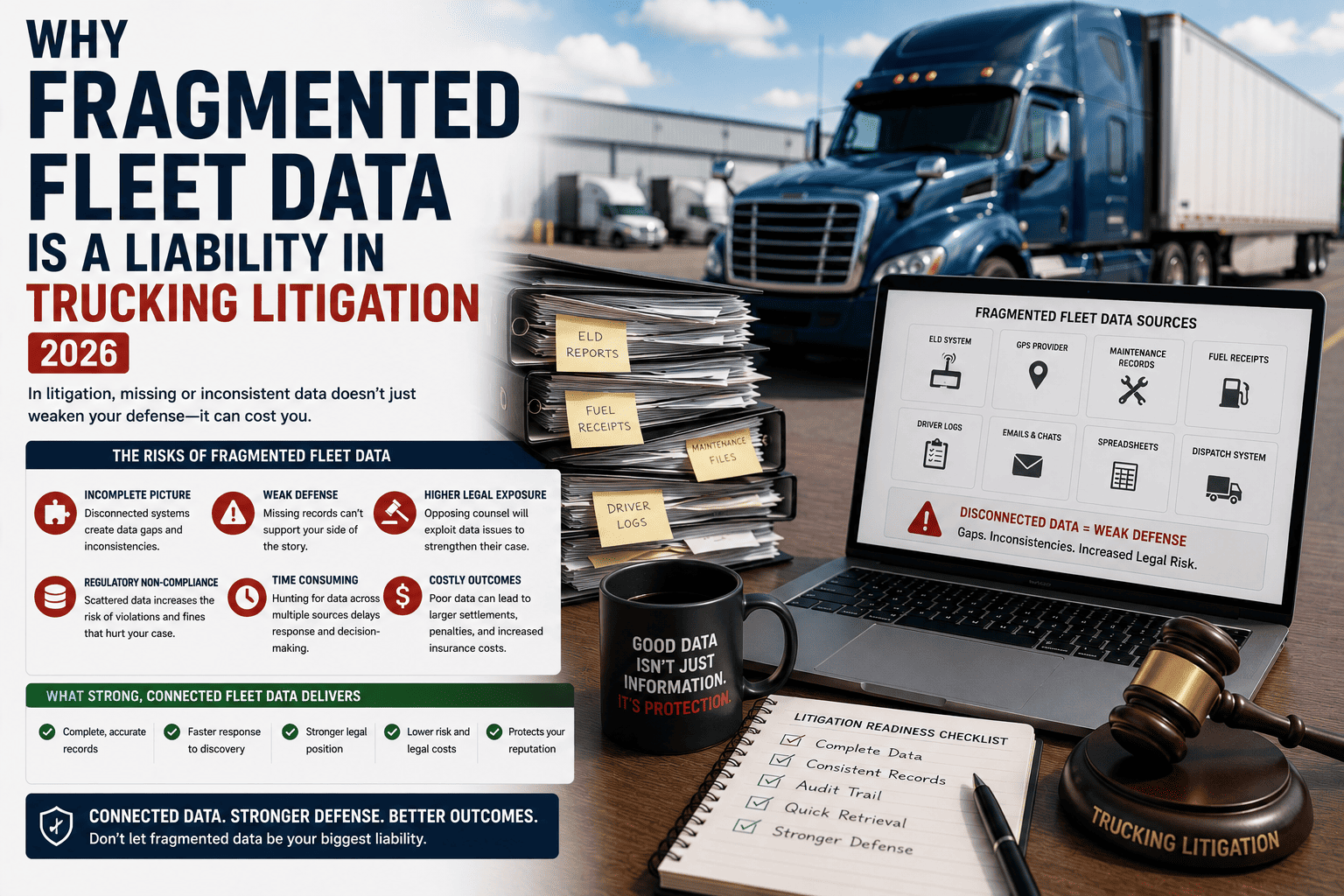
What changed is not how often trucks crash. What changed is how trial attorneys build their cases. Instead of arguing that one driver made one mistake, they argue that a corporation created the conditions for that mistake through weak hiring, ignored alerts, and undocumented training. That argument requires evidence, and fragmented fleet data is where the evidence writes itself. If your telematics data lives in one tool, your DVIR inspection reports in another, and your driver files in a folder nobody has opened in months, you are not proving diligence. You are handing opposing counsel the exact inconsistency they are trained to find.
FleetRabbit brings telematics, maintenance history, inspections, and driver records into a single platform so your fleet always has one consistent, defensible story. Start your free trial and see what a unified safety record looks like, or book a 30-minute demo to walk through your current gaps.
Where Your Fleet Data Actually Lives
Most fleets do not lack data. They lack a single place to find it. The following breakdown shows the records plaintiff attorneys request first, where those records typically sit today, and the exposure created when they cannot be produced together.
| Data Type | Where It Usually Lives | Risk When Isolated |
|---|---|---|
| Telematics and GPS | Dedicated tracking platform, separate login | Speeding or hard braking events with no linked coaching record look ignored, not addressed |
| Maintenance history | Shop paperwork, spreadsheets, or a separate CMMS tool | Cannot show a mechanical failure was preceded by proper inspection and timely repair |
| Driver qualification files | HR filing cabinet or a standalone compliance tool | A missed license renewal or lapsed medical certificate becomes the centerpiece of the case |
| DVIR and roadside inspections | Paper logs or driver-submitted forms | Defects reported but not tied to a completed repair suggest the report was never acted on |
| Dash cam footage | Separate video platform with its own retention window | Exonerating footage that cannot be located quickly is functionally the same as footage that does not exist |
| Training and coaching logs | Trainer notes, emails, or nothing at all | A coaching conversation that was never documented is treated in court as a conversation that never happened |
Real Cases Where Data Gaps Cost Millions
These are not hypothetical risks. Trial attorneys and industry analysts have documented specific cases where the deciding factor was not the crash, but the paper trail around it.
The Speed Monitor That Was Never Enforced
A small four-truck flooring company was hit with a 26 million dollar verdict after a driver drifted off the road during a nighttime run and struck a parked vehicle. The company had installed a speed monitoring device on its trucks. The problem was that nobody used the data. Attorney Doug Marcello, who discussed the case publicly, explained that the unused monitoring data became the detonator for the verdict, because it proved the company had the information needed to prevent the crash and simply never acted on it.
The Background Check That Sat Unread
A Florida jury returned a 141.5 million dollar verdict against a regional carrier after a multi-vehicle collision. The driver involved had a documented history of reckless driving visible on his motor vehicle record before he was ever hired. That history was available. It simply was not reviewed as part of a connected hiring and safety process, and the disconnect between available data and actual practice became the foundation of the case.
The Carrier Held Liable Without a Cited Driver
In a widely referenced Texas case, a commercial driver was traveling below the speed limit, made a controlled stop, and was not cited for any wrongdoing after a fatal crash caused by another vehicle losing control on icy roads. The trucking company still faced a verdict near 90 million dollars. When a driver's own conduct is not the weak point, attorneys shift focus entirely to whether the company's broader safety systems and documentation can withstand scrutiny.
Building a Unified, Litigation-Ready Data System
Closing this exposure does not require predicting every lawsuit. It requires making sure that if one happens, your fleet can produce a single, timestamped, cross-referenced record within hours instead of weeks.
Centralize before you need it
Telematics, maintenance, inspections, driver files, and dash cam events should sit in one platform, not four. If a subpoena arrives, the fleets that struggle most are the ones assembling records for the first time under deadline pressure instead of exporting a report that already exists.
Link alerts to action
A speeding event or hard-braking alert with no attached coaching note is worse than having no telematics at all, because it proves the company was watching and chose not to respond. Every flagged event needs a visible, dated resolution.
Treat documentation gaps as safety gaps
An expired medical certificate, a late DVIR follow-up, or an undocumented training session rarely causes a crash directly. But plaintiff attorneys use exactly these details to argue a culture of indifference, and a large repository of ignored data signals negligence rather than diligence.
Make the record retrievable in hours, not weeks
A unified system should let you pull a driver's complete history, vehicle maintenance timeline, and relevant footage from a single search. Fleets that can hand a defense attorney a clean, chronological packet on day one change the entire tone of a case before it reaches a courtroom.
FleetRabbit connects telematics, maintenance, inspections, driver qualification files, and coaching records into a single searchable history. Sign up for a free trial today, or book a free demo and we will show you exactly what a plaintiff's attorney would find in your current records.
What a Defensible Data Program Looks Like
Fleets that hold up well under legal scrutiny tend to share a small set of habits rather than an expensive tech stack. Every telematics alert has a linked coaching entry within days, not months. Driver qualification files are reviewed on a recurring schedule rather than at hiring only. DVIR defects are matched to a completed repair ticket automatically. Dash cam footage is retained and searchable long enough to cover typical litigation timelines. And every record, regardless of source, carries a consistent timestamp so investigators and attorneys can reconstruct events without guessing which system is accurate.
None of this requires predicting the future. It requires treating your data the way a courtroom eventually will: as one continuous record of how your fleet actually operates, not four disconnected folders assembled after the fact.
Every day your fleet's data stays split across separate tools is another day a plaintiff's attorney has an easier job. FleetRabbit unifies telematics, maintenance, inspections, and driver records into one defensible history you can produce in minutes, not weeks.