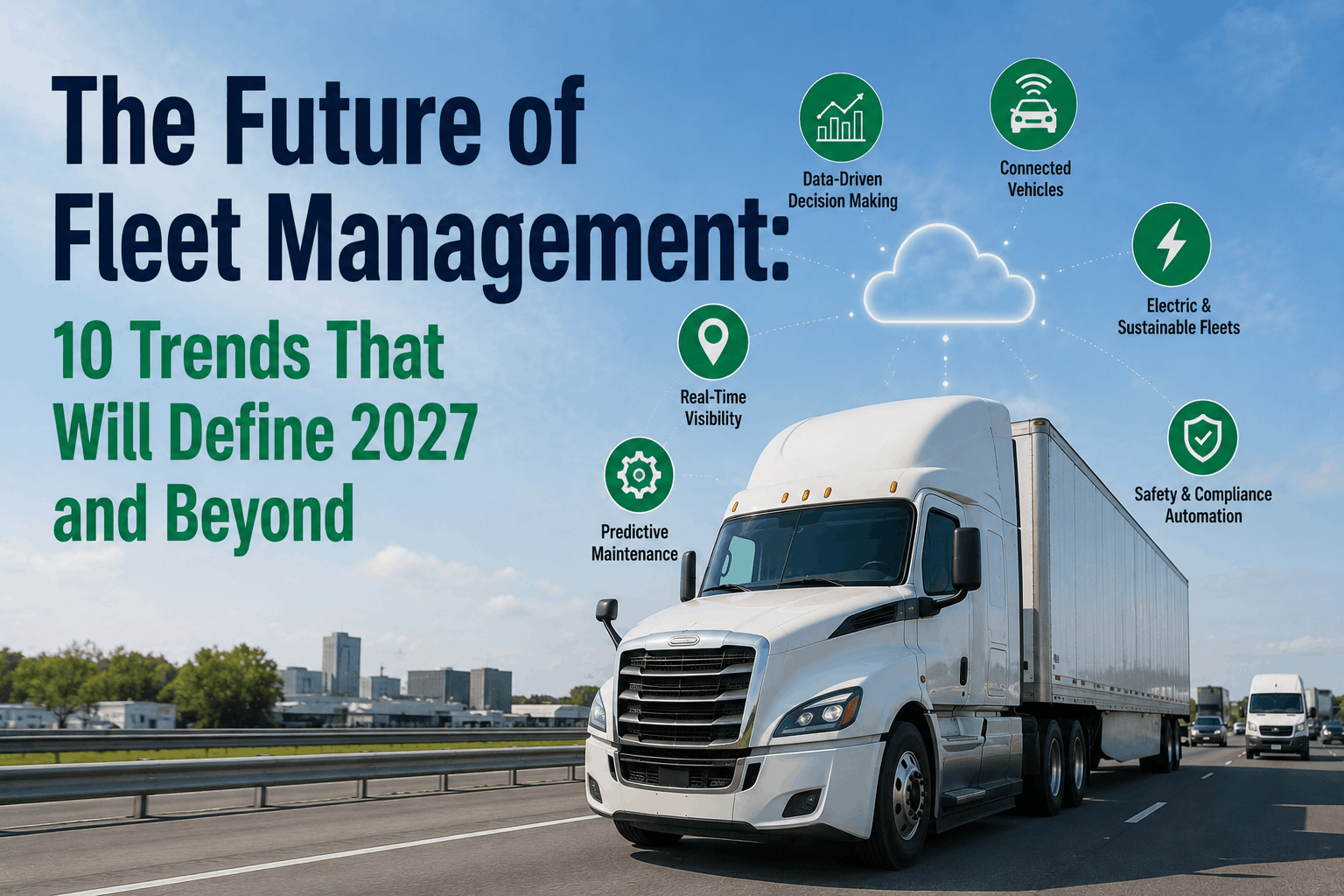
Fleet management is standing at an inflection point. A prolonged freight recession, tariff-driven cost increases of up to $35,000 per new truck, and the expiration of federal EV tax credits worth up to $40,000 per vehicle have reshaped the operating landscape [citation:5]. Yet amid this turbulence, a clear pattern emerges: fleets that diversify powertrains and embrace AI are demonstrating measurably greater resilience. The State of Sustainable Fleets 2026 report confirms that AI-powered fleet management has moved from experimentation to mainstream operations, with nearly half of fleets now using AI for route optimization, predictive maintenance, and dispatching [citation:5]. As we look toward 2027, ten distinct trends will define the next era of fleet operations — and the fleets that adapt will lead the industry.
The Future of Fleet Management: 10 Trends That Will Define 2027 and Beyond
1. AI-Powered Fleets Go Mainstream
Artificial intelligence is transitioning from pilot projects to core operational infrastructure. Survey respondents project that 35% of their fleets will be AI-enabled by 2027, nearly doubling from an estimated 20% in 2025 [citation:5]. Half of fleets already report using AI for route optimization, dispatching, predictive maintenance, and diagnostics — with measurable cost savings and improved vehicle uptime [citation:5].
Platforms like Netradyne Intelligence are advancing from systems that report on past events to systems that actively drive what should happen next. With a foundation of more than 30 billion miles of driving data, these platforms continuously analyze patterns, identify risk, and determine effective interventions before incidents occur [citation:8]. AI agents now handle execution directly — coaching drivers, compiling incident records, and generating reports automatically [citation:8].
To understand how AI can transform your fleet operations, book a demo with FleetRabbit and explore our AI-powered management platform.
2. Autonomous Trucks Enter Commercial Service
Heavy-duty autonomous trucks entered commercial freight service in 2025, with broader rollouts expected across more routes and regions by the end of 2026 [citation:5]. The science confirms the trajectory: autonomous road transport is gaining momentum, with autonomous trucks increasingly deployed on hub-to-hub routes in the United States [citation:7].
Mobileye has announced plans to launch a fully driverless robotaxi service in a major US city in 2027, deploying roughly 100 vehicles initially and targeting 17,000 vehicles over five years [citation:10]. The service combines Mobileye's self-driving technology stack with its Moovit mobility platform and fleet management infrastructure [citation:10].
Autonomous vehicles confer benefits including improved safety, reduced environmental impact, lower fuel and labor costs, and more rapid delivery [citation:7]. For fleet managers, the question is no longer if autonomy will arrive, but when and how to integrate it.
3. EV Infrastructure Expands
India's National Highways for Electric Vehicles (NHEV) is accelerating plans to expand its e-highway infrastructure across 26 corridors by 2027, working toward a 5,500-km nationwide EV highway network under the Bharatmala and Sagarmala programmes [citation:1]. The initiative addresses one of the biggest challenges facing long-haul electric transportation: operational reliability and safety [citation:1].
AI-powered safety solutions are integral to this expansion. NHEV has partnered with Netradyne to deploy real-time fleet visibility, driver behavior analytics, and predictive risk detection across commercial electric vehicles operating on supported corridors [citation:1]. The technology detects driver fatigue, unsafe driving behavior, and vehicle distress in real-time [citation:1].
For fleets transitioning to electric, these developments signal that infrastructure and intelligence layers are evolving together. To stay ahead of the EV transition, sign up with FleetRabbit and access our EV fleet management tools.
4. Autonomous Supply Chains
Autonomous supply chains are emerging as the next frontier of supply chain value. Nearly two-thirds of companies surveyed by Accenture plan to significantly advance their supply chain autonomy in the next decade, with 40% aspiring to reach levels where systems make most operational decisions independently [citation:3].
These supply chains harness AI, machine learning, IoT, robotics, and advanced analytics to enable real-time visibility and decision-making [citation:3]. Expected benefits include 27% reduction in order lead times, 25% increase in productivity, and 60% faster recovery times from disruptions [citation:3]. The human role shifts from managing routine tasks to overseeing systems, guiding strategic decisions, and ensuring governance [citation:3].
To position your fleet for the autonomous supply chain era, book a demo with FleetRabbit and see how our platform supports real-time visibility and decision-making.
5. Powertrain Diversification
The defining strategy for 2027 is diversification rather than concentration. Fleets managing total cost of ownership across a portfolio of powertrain technologies — rather than relying on a single solution — are demonstrating measurably greater resilience [citation:5].
Renewable diesel and biodiesel are displacing conventional diesel at scale, replacing 74% of conventional diesel in California transportation in 2024 [citation:5]. Renewable natural gas accounted for 97% of all natural gas fuel used in California transportation in 2025 [citation:5]. Battery electric vehicles continue to grow, with BEVs now representing 22% of China's heavy-duty truck market [citation:5].
The EPA's Clean Trucks Plan establishing 2027 NOx and particulate matter standards remains on track, with incremental per-vehicle costs ranging from $8,000 to $18,000 [citation:5]. This regulatory certainty, combined with more than $5 billion in annual state, local, and utility funding through 2028, supports continued investment in clean technologies [citation:5].
6. AI Agents for Fleet Operations
The next evolution of AI in fleet management is the AI agent — systems that execute multi-step workflows on behalf of managers based on policies they set [citation:8]. These agents reduce the burden on safety teams and dramatically scale their impact [citation:8].
Coaching agents identify which drivers need attention based on manager-defined goals and prepare sessions with driver history and recommended improvement plans. Incident response agents automatically compile complete collision records — video, first notice of loss details, crash reconstruction, and driver history — and deliver them to stakeholders without manual packaging [citation:8]. Rewards and reporting agents generate KPIs, dashboards, and leadership narratives that keep safety programs aligned [citation:8].
To implement AI agents in your fleet operations, sign up with FleetRabbit and explore our intelligent automation capabilities.
7. Wind-Assisted Maritime Transport
The global fleet of large commercial vessels equipped with wind propulsion has surpassed 100 ships, representing over 5 million deadweight tons [citation:2]. The fleet has grown almost fivefold since 2022 and is estimated to save over 100,000 tonnes of CO₂ annually [citation:2]. Tankers lead adoption, followed by bulk carriers, ro-ro vessels, and general cargo ships [citation:2].
Industry projections suggest wind propulsion could eventually power up to 15% of the global fleet by the early 2030s, rising to 40-45% by mid-century [citation:2]. The growth has been driven by sustained testing, verification, and commercial validation [citation:2].
While this trend primarily affects maritime transport, the principle of harnessing natural energy sources will increasingly influence land-based freight operations as well.
8. Predictive Risk Detection
AI-powered predictive risk detection is becoming standard for fleet safety. Netradyne's platform has analyzed more than 30 billion miles and 150 billion minutes of driving data, using edge AI that processes 100% of drive time on the device with approximately 99% alert accuracy [citation:8].
For drivers, this means correction happens in the cab at the point of risk. For managers, full-context scoring captures both safe and risky driving, with AI-recommended coaching [citation:8]. Video LiveSearch allows quick retrieval of relevant footage, resulting in productive safety teams and effective programs that drivers engage with [citation:8].
To implement predictive risk detection in your fleet, book a demo with FleetRabbit and explore our safety analytics tools.
9. EV-Centric Fleet Management Platforms
Specialized platforms for electric fleet management are emerging to address the unique challenges of EV operations. Zypp Electric's FleetEase.ai, built on experience managing more than 20,000 electric vehicles, offers real-time data from GPS devices, drivers, delivery trips, vendors, EV batteries, and payments — all consolidated onto a single dashboard [citation:4].
The platform introduces predictive maintenance alerts, battery optimization tools, driver behavior analytics, and automated digital settlements [citation:4]. Early adopters report 30% reduction in downtime and 25% cost savings [citation:4]. The platform supports two-wheelers, three-wheelers, and four-wheel electric vehicles, as well as internal combustion engine fleets [citation:4].
10. Sustainability Funding Landscape
Despite federal rollbacks of clean transportation incentives, more than $5 billion in state, local, and utility program funding remains available annually through 2028 [citation:5]. The expiration of federal ZEV tax credits is offset by sustained state-level commitments and private investment [citation:5].
The EPA has finalized record-high Renewable Fuel Standard volume obligations for 2026 and 2027, requiring approximately 60% increase in biodiesel and renewable diesel production compared to 2025 levels [citation:5]. This regulatory push, combined with market-driven adoption, ensures that sustainability remains central to fleet strategy.
Prepare Your Fleet for 2027 and Beyond
FleetRabbit's AI-powered platform helps you navigate the future of fleet management — from autonomous integration to EV optimization and predictive analytics.
Frequently Asked Questions
Stay Ahead of the Curve with FleetRabbit
The future of fleet management is AI-driven, autonomous, and sustainable. Sign up with FleetRabbit and position your fleet for the trends that will define 2027 and beyond.