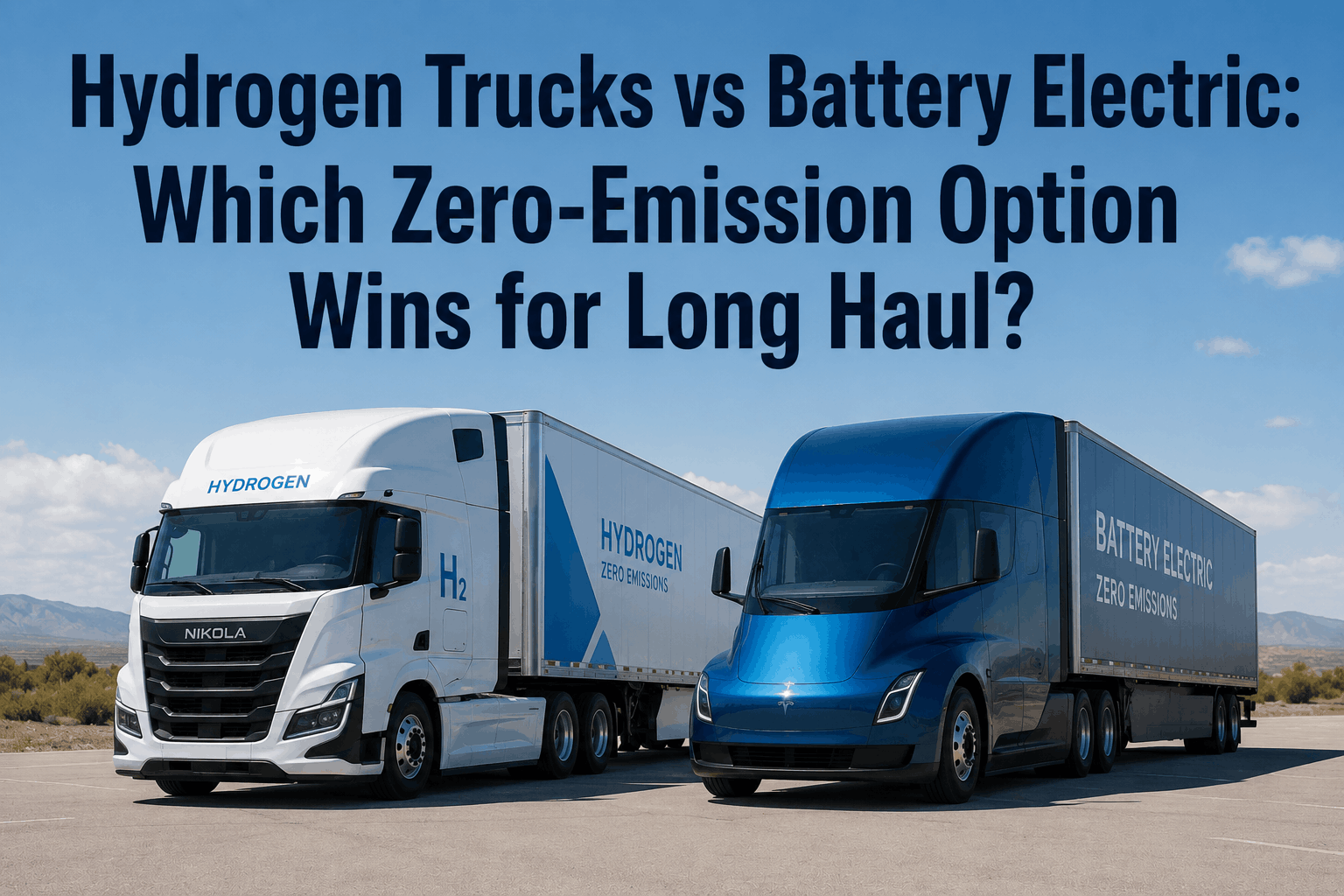
The battle for zero-emission long-haul freight is intensifying. On one side, battery electric trucks (BEVs) like the Tesla Semi and Freightliner eCascadia promise low operational costs and maturing charging networks. On the other, hydrogen fuel cell trucks (FCEVs) from Nikola, Hyzon, and Daimler offer rapid refueling and extended range. But which technology truly wins for long-haul applications in 2026? Drawing from real fleet data, energy economics, and infrastructure rollouts, this analysis gives fleet managers a definitive framework. Sign up for FleetRabbit's zero-emission TCO simulator or book a demo to see custom comparisons for your routes.
Total cost of ownership showdown: 2026 data
According to NACFE's latest report and real-world fleets, BEVs have a lower TCO for routes under 350 miles, mainly due to electricity prices ($0.10-$0.15/kWh) and minimal maintenance. For long-haul exceeding 450 miles daily, hydrogen starts to compete, but only with hydrogen prices below $6/kg. Currently, hydrogen averages $8-12/kg, making fuel costs 2x higher than BEV. However, with DOE's Hydrogen Shot targeting $2/kg by 2028, the gap narrows. To model your exact TCO, sign up for FleetRabbit's predictive analytics. Book a demo to see how 40+ fleets optimized their ZEV mix.
Infrastructure reality: charging vs hydrogen stations
As of 2026, the US has over 3,200 DC fast charging locations suitable for heavy trucks (partial), but only 68 public heavy-duty hydrogen stations, mostly in California. Megawatt Charging System (MCS) corridors along I-5, I-10, and I-80 are expanding rapidly. Hydrogen hubs (ARCHES in California, Midwest Alliance) aim to add 150 stations by 2028. For fleets running regular routes, depot charging is cheaper and simpler. For unscheduled long-haul, hydrogen offers flexibility without hours of downtime. FleetRabbit's infrastructure planner overlays both networks. Book a demo to optimize your network strategy.
Payload and range: the physics trade-off
Battery weight remains a challenge: a 500-mile BEV requires ~1,200 kWh battery weighing ~10,000 lbs, reducing payload by 2–4 tons vs diesel. Hydrogen tanks (carbon fiber) weigh less per unit of energy, allowing FCEVs to carry heavier loads over extreme distances. For bulk freight or high-density cargo, hydrogen preserves payload margin. However, modern lightweight battery tech (semi-solid state) will reduce BEV battery weight by 30% by 2027. Meanwhile, hydrogen's volumetric density requires large tanks, impacting trailer length. A holistic choice depends on your cargo weight sensitivity.
Real-world fleet case studies: PepsiCo (BEV) vs. Walmart (FCEV pilot)
PepsiCo's Tesla Semis have logged 2.5 million miles with 98% uptime, average range 410 miles, but they only operate regional routes. Walmart Canada's hydrogen fuel cell truck pilot (Nikola) achieved 580 miles on a single fill at 70,000 lbs in -15°C conditions, demonstrating superior cold-weather performance. Both fleets report high driver satisfaction. The key takeaway: BEV works for predictable, shorter distance; hydrogen excels in extreme environments and nonstop operations. Sign up for FleetRabbit's case study library to access 12 detailed pilot reports.
FleetRabbit combines live energy pricing, route topography, and infrastructure availability to recommend BEV, FCEV, or hybrid mix. More than 350 fleets use our decision engine.
Environmental impact: green hydrogen vs renewable electricity
Both technologies are zero tailpipe, but upstream emissions differ. BEVs using grid mix (25% renewable avg) still produce 70% lower CO2 than diesel. Hydrogen's carbon intensity depends entirely on production method: grey hydrogen (from natural gas) emits 10 kg CO2/kg H2, while green hydrogen (electrolysis with renewables) drops below 1 kg CO2/kg. Scaling green H2 remains slow. Renewable electricity is already abundant and cheap. For fleets prioritizing immediate decarbonization, BEVs offer a lower carbon footprint today. For long-term zero-carbon freight, green hydrogen will complement BEVs, especially for heavy, long-haul applications. FleetRabbit's ESG dashboard tracks both Scope 1 and 2 emissions across technologies. Book a demo to align sustainability goals with tech choices.
Maintenance and reliability comparison
BEVs have significantly fewer moving parts: no oil changes, exhaust, transmission. Maintenance savings average 40% compared to diesel. FCEVs add a fuel cell stack, air compressor, and high-pressure hydrogen system, increasing complexity and maintenance cost (approximately 20% higher than BEV but still lower than diesel). Real-world data shows BEV uptime above 98%, while early FCEVs have faced stack durability issues (approx 15,000-20,000 hours before replacement). However, 2026 models promise 30,000+ hours. For fleets that prioritize absolute simplicity and low maintenance, BEV is currently superior. Sign up for FleetRabbit's predictive maintenance module to track component health across both technologies.
Future outlook 2027-2030: convergence or competition?
Industry consensus: there is no single winner. By 2030, 50% of regional haul will be BEV, while 20-30% of long-haul (over 500 miles daily) will adopt FCEV, especially where renewable hydrogen hubs emerge. Battery swapping and megawatt charging could extend BEV range, but hydrogen has fundamental advantage for weight-sensitive, ultra-long routes. Fleets should prepare for mixed ZEV fleets, requiring unified management software. FleetRabbit is purpose-built to manage BEV and FCEV assets side-by-side: energy monitoring, fueling logs, range prediction, and grant tracking. Sign up today to future-proof your fleet strategy.
Join leading carriers using FleetRabbit's zero-emission modeling suite. Get personalized BEV vs FCEV recommendations based on your actual duty cycles.