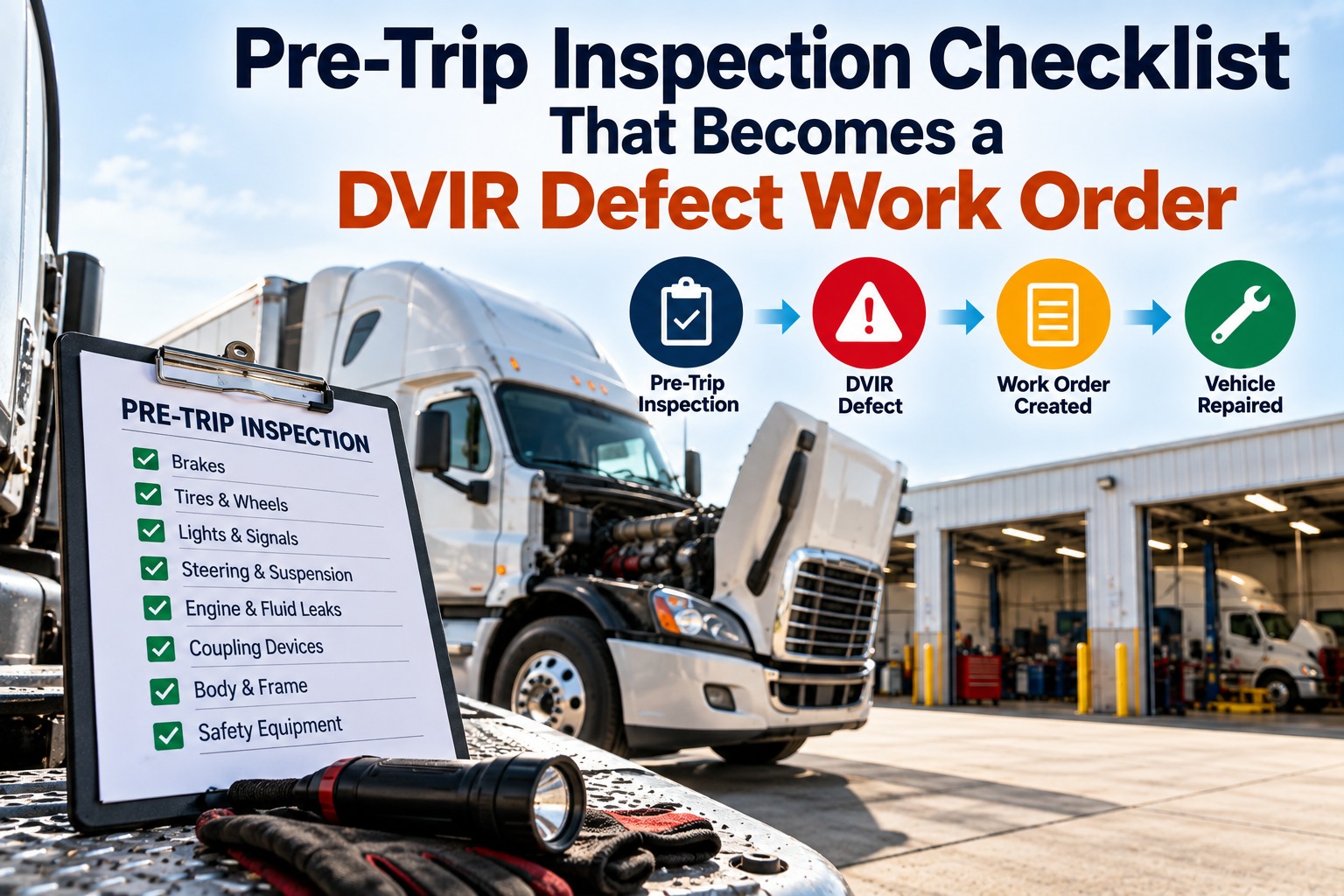
A pre-trip inspection and a driver vehicle inspection report are two different legal things that cover the same eleven components. The pre-trip sits in 49 CFR 392.7: a driver may not operate a commercial vehicle unless satisfied its parts and accessories are in good working order, and no written report is required. The DVIR sits in 396.11: a written report of defects discovered during the day's work, which since the 2014 rule change property-carrying carriers only have to file when a defect is found. What matters operationally is what happens after a defect is written down — the repair certification under 396.11 and the next driver's review under 396.13 form a chain, and a truck dispatched with a link missing is the violation auditors find most easily. This guide covers the eleven components with their dispatch consequences, how to write a defect a technician can act on, the three-signature chain, what the 2026 electronic DVIR rule changed, and how a checklist becomes a work order without anyone retyping it. Book a 30-minute demo to see a defect become a work order on your own units, or start free with 3 vehicles.
The Checklist Is the Easy Part. The Chain That Starts When a Driver Ticks "Defect" Is Where Fleets Get Cited.
For safety managers, shop leads and fleet managers: how to build a pre-trip and DVIR workflow where every defect gets a repair, a certification and a next-driver review — without anyone retyping it into a work order.
Break any link and the truck is dispatched on an uncertified defect.
TWO RULES, ONE WALK-AROUND
Why the Pre-Trip and the DVIR Cover the Same Truck but Answer Different Questions
Drivers conflate these constantly, and the difference shows up in an audit rather than at the curb. One asks whether the truck is safe to drive right now. The other asks whether the defects found that day were written down, repaired and acknowledged. You can run both from one record on a free account.
Pre-trip inspection, 49 CFR 392.7
Driver vehicle inspection report, 49 CFR 396.11
Sources: 49 CFR 392.7, 396.11 and 396.13; FMCSA's 2014 final rule rescinding no-defect DVIRs for property-carrying CMVs. Many carriers still require a daily no-defect report as company policy because it evidences that inspections happened.
THE ELEVEN
The Components a DVIR Must Cover, and What Each One Means for Dispatch
The federal list is a minimum, not a ceiling — most fleets add fluid levels, body damage and securement. What the list does not tell you is the consequence of each defect, which is the part your drivers actually need. We'll map these to your dispatch rules in a demo. Swipe the table on mobile.
| Component | Typical consequence when defective | Dispatch rule |
|---|---|---|
| Service brakes, including trailer brake connections | Out of service if defective | Never dispatch |
| Parking brake | Out of service if it won't hold | Never dispatch |
| Steering mechanism | Out of service if defective | Never dispatch |
| Lighting devices and reflectors | Depends on lamp and time of day | Same day |
| Tires | Out of service below tread or with sidewall damage | Never dispatch |
| Horn | Repair on schedule | Next PM |
| Windshield wipers | Depends on weather and visibility | Same day |
| Rear-vision mirrors | Depends on damage | Same day |
| Coupling devices | Out of service if defective | Never dispatch |
| Wheels and rims | Out of service with cracks or missing fasteners | Never dispatch |
| Emergency equipment | Replace before dispatch | Same day |
Components as listed in 49 CFR 396.11. Dispatch rules are our assessment of common fleet practice — set your own against the CVSA out-of-service criteria and your policy.
WRITING IT DOWN
How to Write a Defect a Technician Can Act on Without Calling the Driver
The single cheapest improvement to a DVIR program is better defect text. Four elements — component, symptom, condition and when — turn a line that triggers a phone call into one that triggers a repair. Put this guidance in your inspection app free.
No component, no side, no condition. The technician starts from zero and the truck waits.
Component, side, symptom, condition and when. The shop can pull parts before the truck arrives.
THE HAND-OFF
Turning a Ticked Box Into a Work Order Nobody Has to Retype
Most fleets already collect the defect. What they lose is the twenty minutes between collecting it and someone creating a job from it — and the detail that disappears in the retyping. Each step below is mechanical and belongs to the software, not to a person. We'll run one of your own defects through this in the demo.
Bring Last Month's DVIRs. We'll Find the Defects That Never Became Work Orders.
We'll load a sample of your inspection records, apply your dispatch rules, and show which defects were repaired, which were certified, and which trucks went back out with a link in the chain missing.
2026 CHANGE
What the Electronic DVIR Rule Changed for Paper-Based Fleets
FMCSA published a final rule under docket FMCSA-2025-0115 in February 2026, effective 23 March 2026, making explicit that driver vehicle inspection reports may be prepared and maintained electronically under 396.11 and 396.13. For fleets still running carbon books, that removes the last reason to keep them — and an electronic record carries the timestamp, photo and location that a paper page never did. Move your DVIRs electronic free on 3 vehicles.
When and where the inspection happened, rather than a date written at the end of a shift.
The technician sees the damage before the truck arrives.
Report, certification and next-driver review sit on one record instead of three pieces of paper.
Reports kept three months, with the repair record on its own longer clock.
REPEATS
The Defect Patterns Worth Watching Across Units and Drivers
A single defect is a repair. The same defect returning is information — about the repair, the component or the inspection itself. Group them before they become roadside findings: at CVSA's 2025 International Roadcheck, brake systems accounted for 24.4% and tires 21.4% of vehicle out-of-service violations, both of which are on the eleven-component list a driver walks past every morning. See repeat detection in a demo.
The repair didn't hold, or the cause was never found. Escalate rather than reopening the same job.
Points at a parts batch, a route condition or a shared maintenance practice.
Either an unusually good truck or an inspection that isn't happening. Both are worth knowing.
Usually a scheduling or capacity problem rather than a mechanical one.
MEASURE
The Numbers That Show Your Inspection Program Is Actually Working
Track these five from the first month. The cost of a broken chain is not theoretical: a truck dispatched on an uncertified safety defect is both a violation and the failure the inspection was meant to prevent, and industry benchmarking puts unplanned downtime at roughly $448 to $760 per truck per day before towing and repair. Feed the pattern back into preventive maintenance so repeat defects pull the next service forward. Start your baseline free.
QUESTIONS
Pre-Trip and DVIR Workflow Questions Fleets Ask Most
Is a written pre-trip inspection report required?
No. Under 49 CFR 392.7 the pre-trip is a physical check with no federal written report; the written report is the DVIR under 396.11, required when a defect is found. Drivers still acknowledge the previous DVIR under 396.13. See both in one workflow.
Do we have to file a DVIR when nothing is wrong?
Property-carrying carriers have not been federally required to file no-defect DVIRs since the 2014 rule change, though many fleets still require them as policy because they evidence that inspections happened. Log every inspection free.
What has to happen before a truck with a reported defect is dispatched?
The carrier must repair the defect or certify that repair was unnecessary, and the next driver must review and sign the report. Dispatching before that chain is complete is the violation auditors find first. See the chain enforced in a demo.
Are electronic DVIRs acceptable?
Yes. FMCSA's final rule under docket FMCSA-2025-0115, effective 23 March 2026, makes explicit that DVIRs may be prepared and maintained electronically under 396.11 and 396.13. Move to electronic free.
How long do DVIRs have to be kept?
Three months from the date written, under 396.11. The maintenance record produced by the repair has its own longer retention under 396.3. Review retention with our team.
How do we get drivers to write useful defect descriptions?
Ask for four things — component, symptom, condition and when — and make a photo one tap. Shops stop calling drivers, and the truck spends less time waiting for a diagnosis. Set up the template free.
Every Defect Repaired, Certified and Acknowledged Before the Truck Leaves
FleetRabbit takes the defect straight from the inspection with its photo, applies your dispatch rules, opens the work order with the unit's history attached, and holds the DVIR chain together so nothing goes out uncertified.
Component, description and photo, at the truck.
Severity applied, shop notified, history attached.
Certification and next-driver review on the same record.
No credit card required. Works on the phones your drivers already carry.