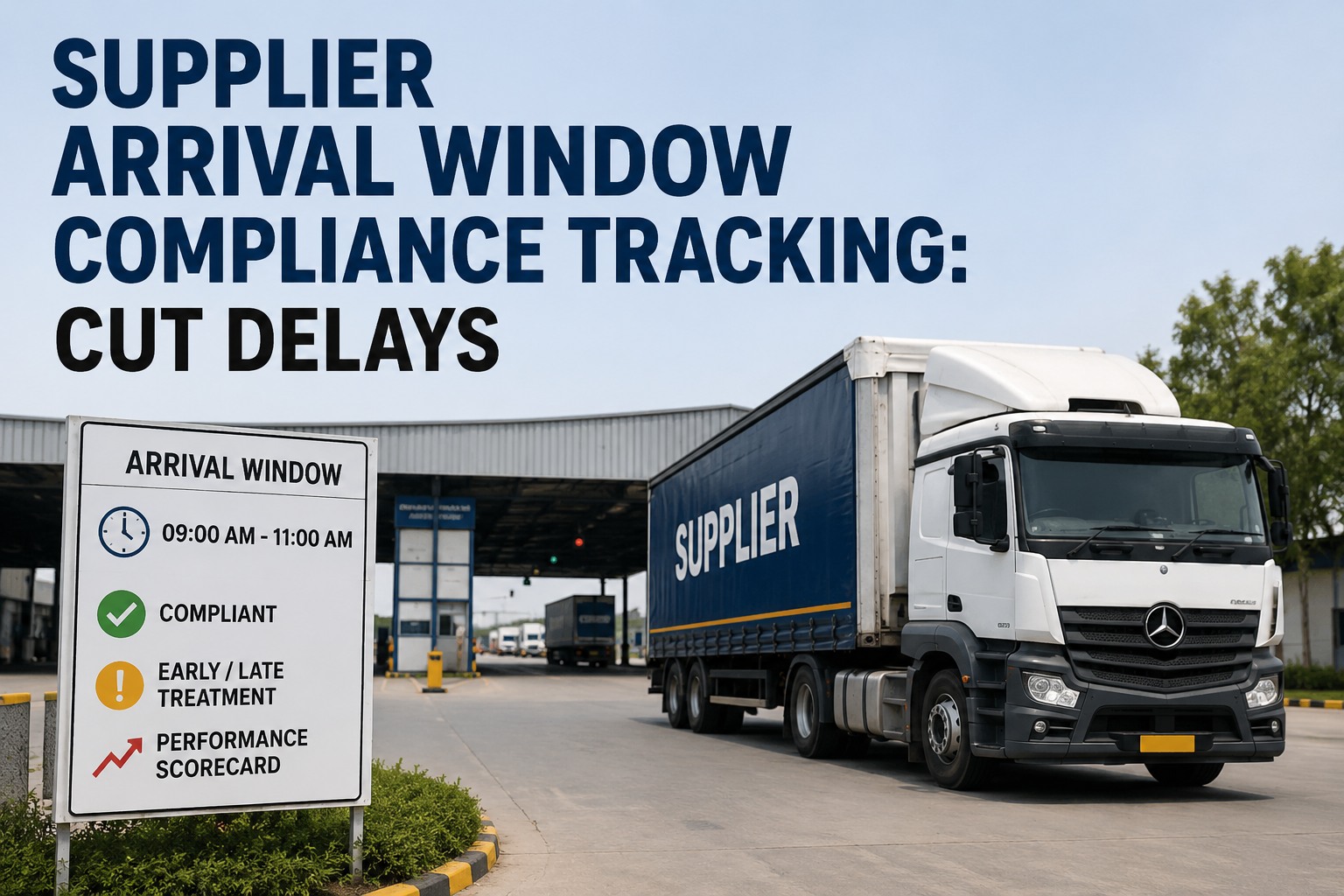
Arrival window compliance fails on definitions long before it fails on suppliers. Two teams look at the same delivery and reach opposite conclusions because one is measuring gate-in and the other is measuring dock-in; a supplier reports 97% on-time while your scorecard shows 89%, and the quarterly review dissolves into an argument about clocks. The fix is unglamorous and entirely upstream: decide which timestamp is authoritative, publish the tolerance bands, state in writing how early arrivals are treated, and build the escalation ladder before you need it rather than during the incident that forces it. Get those four right and the scorecard becomes leverage. Get them wrong and it becomes a monthly negotiation you lose. This is the mechanics — window definitions, early and late treatment, scoring formulas with the thresholds that matter in automotive, and the escalation ladder enterprise teams actually run. Request the integration datasheet to see how the timestamps are captured and exported.
ENTERPRISE GUIDE · INBOUND GOVERNANCE
Supplier Arrival Window Compliance, End to End
Which timestamp is authoritative, how tolerance bands are defined, why early is scored as hard as late, how the composite is calculated, and the escalation ladder with exit criteria at every rung.
Step One: Decide Which Clock Counts
Nearly every compliance dispute traces back to this. A single delivery generates five candidate timestamps, and they can differ by hours. Until one is written into the supplier manual as authoritative, the scorecard is contestable by design — and a contestable scorecard cannot support escalation.
Five timestamps, one authority
T1ASN sentSupplier despatch advice transmitted
T2Site arrivalVehicle reaches queue or holding area
T3Gate-inBarrier crossed, identity confirmedRecommended authority
T4Dock-inSpotted at assigned door
T5Receipt postedGoods receipt confirmed in ERP
Gate-in is the defensible choice because it is the last event entirely within the supplier's control. Everything after it — queue order, door assignment, unload sequence — is your operation, and scoring a supplier on your own dock congestion destroys the credibility of the whole programme. Score T3, but capture all five: the T3-to-T4 gap is your yard's performance, and you will want that number when a supplier pushes back.
Tolerance Bands and Their Treatment
Publish these. All of them, with the treatment attached, in the supplier logistics manual rather than in an email thread. A band nobody can quote is a band nobody complies with.
More than 60 min early
Non-compliant. Held off site under call-forward; hold duration counts toward free time. Recorded as a separate early-arrival count, not silently absorbed.
15–60 min early
Tolerated but tracked. Admitted only if yard utilisation permits. Repeated instances flagged to supplier logistics as a pattern, not an incident.
Within ±15 min
Compliant. This is the on-window band and the only one that scores clean. Tighten toward ±10 for sequence-critical lanes.
1–30 min late
Non-compliant, recoverable. Triggers automatic reslot and a scorecard deduction. No manual intervention needed at this level.
More than 30 min late
Non-compliant, escalating. Deduction plus notification to the planner and, for sequence-critical lanes, to line feed. This is the band that reaches production.
No-show or unannounced
Treated as a failed delivery regardless of what arrives later. Unannounced arrivals are diverted to an exception lane rather than queued.
The 30-minute convention
Premium OEMs already score inbound at 30-minute granularity, tracking arrivals within the contracted window, 1–30 minutes early, 1–30 minutes late, and beyond 30 minutes late as four distinct outcomes. If your supply base ships to those OEMs, they can already report at that resolution — which removes the most common objection to tightening your own bands.
Why Early Is Scored as Hard as Late
This is the part that generates the most internal resistance, and the reasoning is worth having ready. Nobody believes an early delivery is as damaging as a late one. That is not the argument. The argument is about what tolerating earliness does to behaviour over two or three quarters.
Untreated earliness
Supplier ships when ready rather than when scheduled, because nothing penalises it
Goods-in absorbs inventory it did not plan for and has nowhere to put
Yard positions consumed by trailers with no active demand against them
Supplier's internal on-time number looks healthy while your composite falls
JIT discipline erodes quietly across the supply base, one lane at a time
Untreated lateness
Immediate, visible, and already escalated by whoever it hurt
Recovered by expedite, sort or overtime with a cost that gets attributed
Self-correcting in the short term because the pain is felt at once
Rarely under-reported — the line remembers
Damaging per event, but does not reshape supplier behaviour the same way
Hence the standard automotive position: score early with meaningful weight, keep the early tolerance narrow — at most a day in general supply, effectively zero on the early side for JIT and JIS lanes — and report early-arrival count as a separate line that management is expected to act on rather than folding it invisibly into a composite.
A scorecard is only as strong as the timestamp behind it.
The integration datasheet covers how gate-in, dock-in and receipt events are captured, how they map to your ERP and EDI records, and what the export looks like when a supplier disputes a score.
Scorecard Mechanics
Keep the formula simple enough that a supplier can reproduce it from their own data. If they cannot recalculate your number, every review becomes a reconciliation exercise instead of an improvement conversation. Our analytics and reporting module is where the composite gets built and distributed.
Then attach thresholds. These are the automotive reference points — the values that convert a number into a defined action rather than a topic of discussion.
← Swipe to see all columns →
The Escalation Ladder
Every rung needs four things written down before you need them: what triggers it, who owns it, what the supplier must do, and how they get off it. Ladders without published exit criteria become one-way — suppliers stop engaging because they cannot see a route back, and the mechanism loses its force.
L1
Operational notification
TriggerSingle window miss beyond tolerance
OwnerInbound planner
Supplier actionAcknowledge, state cause
ExitAutomatic after clean period
L2
Tactical review
TriggerScore below 97%, or repeat misses in a rolling month
OwnerSupplier logistics manager
Supplier actionRoot-cause submission within a stated deadline
ExitAccepted root cause plus one clean month
L3
Formal improvement plan
TriggerScore below 95%, or L2 exit not achieved
OwnerPurchasing lead, jointly with logistics
Supplier actionDocumented plan with milestones, owner and dates
ExitMilestones met plus a defined recovery period
L4
Containment
TriggerLine impact, or improvement plan failed
OwnerDivisional purchasing or quality director
Supplier actionSupplier-funded containment — dedicated transport, buffer stock, third-party monitoring
ExitSustained compliance over a stated number of weeks
L5
Business hold
Trigger">Containment failed, or repeated production impact
OwnerExecutive sourcing governance
Supplier actionNo new business awarded; existing awards may be suspended
ExitFormal de-escalation review only
Borrow the quality ladder's structure, not its content
Automotive already runs a mature escalation model on the quality side — controlled shipping at Level 1 with internal containment, Level 2 with an OEM-approved third party, and a business-hold state above it where no new projects are awarded. Logistics escalation works best when it mirrors that shape, because supplier organisations already understand the grammar. What you should not copy is the content: a window miss is not a defect, and applying quality containment language to a logistics problem produces resistance without producing arrivals.
Build the Evidence Pack Before the First Dispute
Assume every escalated score will be challenged. The supplier's first move is almost always to question the timestamp, and if your answer is a screenshot, the conversation is over. These are the artefacts that make a score hold. Our compliance and documentation layer is where they are retained.
1Booked window, with the timestamp it was issued and any subsequent reslot history
2All five event timestamps, not just the authoritative one
3Despatch advice reference and its validation acknowledgement
4Carrier and vehicle identity as captured at the barrier
5Gate-in to dock-in gap, so your own contribution is visible and not disputed later
6Clock source and synchronisation method, stated once in the supplier manual
7Exclusion log — force majeure, plant-side cancellations, closures — applied consistently
8Supplier-accessible view of their own data, refreshed on the same cadence as yours
That last one carries more weight than it looks. The single strongest predictor of a scorecard programme surviving its first year is whether suppliers can see their own number continuously rather than receiving it monthly. A gap between the supplier's view and yours is what turns reviews into reconciliation — and mature collaboration programmes consistently outperform transactional supplier management on inbound reliability by a wide margin.
Six Decisions to Settle Before Go-Live
Each of these will be decided one way or another. Better deliberately, in a document, than accidentally, in an argument three months in.
Which timestamp is authoritative?Gate-in, unless you have a specific reason otherwise. Write it down.
What is the compliant band?±15 minutes general, tighter for sequence-critical lanes.
How is early treated?Scored and reported separately. Never silently absorbed.
What is excluded, and who approves it?A named owner, or the exclusion list becomes an escape hatch.
What is the volume floor for publishing?Below it, no score. Small-volume noise discredits the whole set.
Who owns each rung of the ladder?By name and role. Unowned rungs are never actually climbed.
Get the Integration Datasheet
Covers timestamp capture at gate and dock, the mapping to your ERP delivery and goods-receipt records, EDI despatch advice reconciliation, scorecard export formats, and the supplier-facing view. Written for enterprise integration teams rather than as a product overview.
Five-timestamp capture
ERP and EDI mapping
Scorecard export schema
Supplier-facing portal view
Frequently Asked Questions
Should we measure at gate-in or at the dock?
Gate-in, in almost all cases. It is the last event the supplier fully controls, which makes it the only timestamp that survives challenge. Measuring at dock-in means you are scoring suppliers partly on your own door assignment and queue order, and the first supplier to notice that will say so in a review — correctly. Capture dock-in anyway, because the gate-in to dock-in gap is the honest measure of your own yard, and having that number ready is what stops the conversation becoming a stand-off.
Is penalising early arrivals really justified?
Not on the grounds that an early delivery is as damaging as a late one — it usually is not. The justification is behavioural. Tolerated earliness teaches suppliers to ship when ready rather than when scheduled, floods goods-in with unplanned inventory, and consumes yard positions that have no demand against them, all while the supplier's internal on-time number continues to look healthy. Automotive scorecards weight early deliveries precisely to stop that pattern forming, and the practical form is a narrow early tolerance plus a separately reported early-arrival count.
What compliance rate should we target?
Direct automotive supply typically runs 98–99% against a composite delivery performance measure, with 97% as the point where formal escalation begins and 95% as the trigger for a documented improvement plan. What matters more than the absolute figure is consistency across quarters and the size of the gap between the supplier's self-reported number and your scorecard. A stable 94% with a one-point gap is a healthier relationship than a volatile 97% with an eight-point gap, because the second one means you disagree about reality.
How do we handle suppliers who dispute the timestamp?
By having built the evidence pack before the dispute rather than during it. Booked window with reslot history, all five event timestamps, despatch advice reference and its acknowledgement, vehicle identity at the barrier, and a stated clock source. The most effective single measure is giving suppliers a live view of their own data on the same refresh cadence you see — most disputes are not challenges to the number but to being surprised by it.
Do we need a separate ladder for logistics and quality?
Separate ladders, shared structure. Supplier organisations already understand the quality escalation grammar — containment at Level 1 with internal resources, Level 2 with an OEM-approved third party, and a business-hold state above where no new work is awarded — so mirroring that shape for logistics saves a great deal of explanation. What does not transfer is the content. A window miss is not a non-conformance, and applying defect containment language to an arrival problem generates resistance without generating arrivals.
What should be excluded from the score?
Genuine force majeure, plant-side cancellations, unplanned site closures and window changes you issued late. The critical discipline is not the list but the ownership: name one person who approves exclusions and publish the criteria. Exclusion processes without a named owner degrade into an escape hatch within about two quarters, at which point the score means nothing and the ladder cannot be enforced.
How long before the scorecard changes behaviour?
Expect one quarter of definitional argument, one quarter of visible improvement, and sustained gains from the third. The first quarter is unavoidable and should be planned for — suppliers will test the timestamp, the exclusions and the volume floor, and the programme's credibility is set by how consistently those challenges are answered. Publishing the bands and the ladder in advance shortens that phase considerably, because there is nothing left to discover. A
datasheet review is the fastest way to pressure-test your definitions before they are published.
Define It Once, Enforce It Everywhere
Authoritative timestamps, published tolerance bands, symmetric early and late treatment, a reproducible composite and an escalation ladder with exit criteria at every rung — with the capture and export mechanics documented for your integration team.
Works alongside existing EDI · Supplier-facing view included · Site-level configuration