Most manufacturers know exactly who supplied a component and considerably less about what went into it. That gap has been tolerable for years because nothing depended on closing it. From 2027 that changes: a battery passport becomes mandatory for relevant batteries placed on the European market, and it must carry verified data on carbon footprint, recycled content, material composition, due diligence and supply chain actors — information drawn from multiple supplier tiers and independently verified. No amount of tier-one cooperation produces that. It has to come from companies you have no contract with, through a partner who may regard their own supply base as commercially sensitive. Which makes sub-tier visibility a question of incentive design rather than software procurement, and worth being honest about where its limits actually sit. Talk to a solutions engineer about what your current records could evidence today.
Supply Chain Transparency · Sub-Tier Visibility
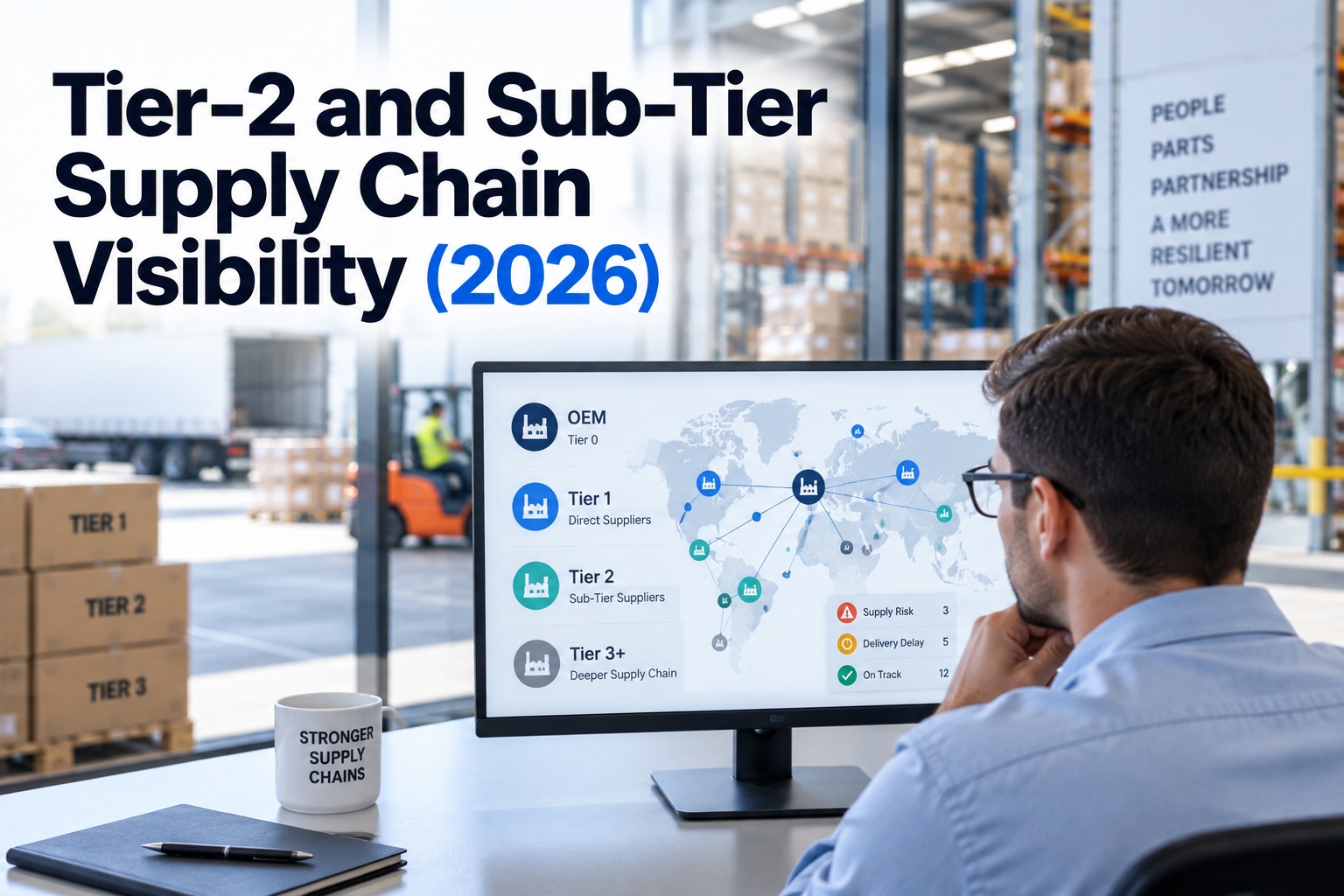
Tier-2 and Sub-Tier Supply Chain Visibility
Practical mapping that stops at the layer where the data is real, incentives that make sharing rational for a supplier two steps removed from you, risk signals worth monitoring rather than collecting, and a clear account of what sub-tier visibility genuinely cannot deliver.
Youfull record
Tier 1contracted, measured
Tier 2known by name at best
Tier 3+inferred
The Shape of the Gap
Three statements that between them describe why this problem has resisted solution for so long.
You know the supplier, not the contents
A manufacturer typically knows which tier-one supplier provided a component while having far less visibility of the materials and sub-components that went into it further down the chain. The relationship is documented; the composition is not.
There is no contract to compel it
Your agreement is with tier one. Tier two has no obligation to you, no commercial relationship with you, and reasonable grounds to treat its own supply base as confidential — because that supply base is part of how it competes.
And the requirement is arriving anyway
Regulation is making the gap urgent rather than merely inconvenient. Where a passport must carry verified data drawn from multiple tiers, the absence of a mechanism to obtain it becomes a compliance exposure rather than a visibility preference.
The Calendar Doing the Forcing
Dates matter more than arguments here. These are the obligations shaping what manufacturers must be able to demonstrate.
One observation about how this actually reaches suppliers, worth passing on to your own supply base: exposure usually arrives through the requirements specification rather than directly from the regulator. A tier-two supplier is rarely regulated into providing carbon or material data — they are asked for it by a customer who has been, and their commercial position depends on being able to answer.
Why a supplier two steps removed would actually share
The reasonable objection
- Our supplier list is how we compete
- Pricing and volumes are inferable from material data
- We serve several customers who are rivals
- One integration per customer is unsustainable
- We have no contract with the manufacturer asking
What the industry approach answers
- Data is exchanged rather than surrendered to a central platform
- Commercially sensitive information stays under its owner's control
- Selected information is shared through common standards, not full disclosure
- Connect once to interoperable standards instead of building point-to-point links for every partner
- Participation increasingly arrives written into supplier contracts, which supplies the missing relationship
What to Map, and What Each Layer Tells You
Mapping for its own sake produces a diagram. Mapping against a specific risk produces a decision.
The third row earns its place through recent experience. A semiconductor disruption in 2025 demonstrated exactly this pattern — concentration risk that only becomes visible when you map beyond the tier you contract with, and by which point the alternatives take months to qualify rather than weeks.
On your own bill of materials
Which of your parts could you evidence to passport standard today?
Not in principle — against the actual records you hold. Bring a bill of materials for one product line to a 30-minute session and we'll work through it in Fleet Rabbit, marking what you can evidence at part level, what exists only at plant level, and where the chain stops at tier one. That distinction is the real scope of the work ahead of you.
The Honest Limits
Four of them. Any programme sold without acknowledging these will disappoint the people who fund it.
No platform produces clean dataJoining an ecosystem provides a mechanism for exchange. The underlying work — accurate material and carbon data per part — stays with each supplier either way, and no membership substitutes for it.
Participation is not a legal obligationThe industry data ecosystem is an approach to standardised exchange rather than a statutory requirement. Whether joining makes sense for any given supplier depends on what their customers ask of them.
Depth degrades with distanceCoverage at tier two is achievable with effort and contractual leverage. Tier three and beyond is a matter of cascade — you are relying on your supplier's supplier to have asked the same question, which they will do only if it was asked of them.
Coverage will be partial for yearsNetworks are still working toward critical mass, and the honest position is that a map will be complete for some part families and thin for others. Plan for a programme that produces a defensible answer on your highest-exposure parts rather than a complete answer everywhere.
What Actually Scales It
Three mechanisms, and none of them is persuasion.
Contract
Written into new supplier agreements
As more manufacturers write participation into supplier contracts, momentum builds toward critical mass. A requirement in an agreement achieves in one negotiation what a programme of engagement will not achieve in a year.
Cascade
Tier one brings its own suppliers
Suppliers who join tend to bring their own supply base with them, which is why onboarding effort concentrated on tier one produces disproportionate depth. You are not recruiting tier two directly — you are recruiting the company that already has the relationship.
Reuse
One connection, several networks
Comparable ecosystems are emerging for chemicals, manufacturing, aerospace and semiconductors, raising the prospect that a supplier serving several industries connects once and reuses that investment. For a supplier weighing the cost, that changes the calculation materially.
If You Are the Tier-2 Supplier Being Asked
Three concrete moves. The second is the one that determines whether you can answer at all.
1Map customer requirements onto your parts rangeWork out which of your parts fall inside which product groups and which customer specifications, rather than treating the regulation as a general obligation. Exposure is part-specific and so is the answer.
2Build material and carbon data per part number, not per plantThis is the structural decision. Plant-level figures cannot be apportioned credibly to individual parts after the fact, and a customer asking about one part number will not accept a site average. Almost every supplier currently holds the data at the wrong granularity.
3Establish a repeatable response processRequests will arrive from several customers in different formats. Those who can answer when asked defend their position on the supplier panel — which makes this a commercial capability rather than a compliance cost.
See where your chain actually stops
We'll take one product line's bill of materials and map what you can evidence today — part-level against plant-level, tier one against tier two, and the specific part families where a passport requirement would find you short. You keep the map either way, and it is usually the document that sizes the programme honestly.
The Benefit Nobody Puts in the Business Case
Compliance funds this work. Quality is where it repays.
Faster identification of a quality problem's source
Better information across multiple tiers helps identify the source and scope of a quality problem much faster. When a defect traces to an upstream input rather than to your supplier's process, the difference between knowing that in days and weeks is the difference between a contained population and a precautionary one.
Narrower recall scoping
The same data that satisfies a passport requirement also defines an affected population. A scope drawn from material and lot traceability is narrower than one drawn from a date range, and every unit outside it is a vehicle you do not have to inspect.
Earlier disruption warning
A mapped network supports proactive decisions on expediting shipments, reallocating inventory and qualifying alternate suppliers before an event reaches production. The value there is entirely a function of lead time, which is entirely a function of having mapped it beforehand.
Frequently Asked Questions
Why is sub-tier visibility suddenly urgent?
Because regulation now requires data manufacturers cannot obtain from tier one alone. A battery passport becomes mandatory from 18 February 2027 for electric vehicle, light transport and industrial batteries above 2 kWh placed on the EU market, and it must carry verified information on carbon footprint, recycled content, material composition, due diligence and supply chain actors — drawn from multiple tiers and independently verified. Battery labelling with measured capacity and expected lifetime arrives earlier, from August 2026.
Why would a tier-two supplier share anything with us?
Because the mechanism is designed around sovereignty rather than disclosure. Data is exchanged through common standards while commercially sensitive information stays under the control of its owner, and participants contribute selected information rather than surrendering it to a central platform. Add the commercial reality — those who can deliver data when a customer asks defend their place on the supplier panel — and sharing becomes rational rather than altruistic.
What should we actually map?
Four things: sub-tier relationships behind each tier-one supplier, production dependencies where several of your parts rely on the same upstream input, shared manufacturing sites where two nominally different suppliers produce in the same facility, and geographic concentration across a part family. The third is the least intuitive and often the most valuable, because it reveals dual sourcing that is not actually dual.
Does joining an industry data ecosystem solve the problem?
No, and it is worth being clear about that. Participation provides a standardised mechanism for exchange, but the real work — clean material and carbon data per part — stays with each supplier either way. Nor is participation a legal obligation; it is an industry approach, and whether it makes sense for any given company depends on what its customers require. The platform question and the data question are separate, and only one of them is solved by signing up.
How deep can we realistically get?
Tier two is achievable with contractual leverage and concentrated onboarding effort. Beyond that you are relying on cascade — your supplier's supplier will have asked the same question only if it was asked of them. Expect coverage to be strong on some part families and thin on others for several years, and plan a programme that produces a defensible answer on your highest-exposure parts rather than a complete answer everywhere.
What scales participation fastest?
Contracts rather than engagement programmes. As manufacturers write participation into new supplier agreements, momentum builds toward critical mass — and tier-one suppliers who join tend to bring their own supply base with them, which is why onboarding effort concentrated at tier one produces disproportionate depth. There is also a reuse argument emerging, with comparable ecosystems developing for chemicals, manufacturing, aerospace and semiconductors.
We are the tier-two supplier. Where do we start?
Three moves. Map customer requirements and the relevant product groups onto your specific parts range rather than treating this as a general obligation. Build material and carbon data per part number rather than per plant — this is the structural decision, because site averages cannot be apportioned credibly to individual parts afterwards. Then establish a repeatable response process, since requests will arrive from several customers in different formats.
Start free with three assets and get the granularity right first.
Map to the Depth Your Data Can Defend
Concentrate onboarding at tier one and let the cascade carry it, design for sovereignty so sharing is rational rather than requested, map relationships and shared sites rather than drawing an org chart, and hold material data per part number — because the requirement arriving in 2027 asks about a part, and a plant average will not answer it.
Regulatory dates and scope reflect published expectations at the time of writing and remain subject to change through delegated acts and formal adoption — confirm the requirements applying to your own products and markets with qualified advisers.
September 8, 2026
By Alex Rowan
All Articles