Every tire on your fleet is losing pressure right now. It is not dramatic — no hissing, no warning lights, no obvious signs. Just a slow, silent drain of 1 to 2 PSI per month per tire, compounded across every wheel on every truck, every single day. And by the time your driver notices something feels off, your fleet has already burned thousands of dollars in wasted fuel, accelerated tire wear, and elevated blowout risk. Tire Pressure Monitoring Systems (TPMS) exist precisely to stop this invisible drain — and the numbers behind their return on investment have become impossible to ignore.
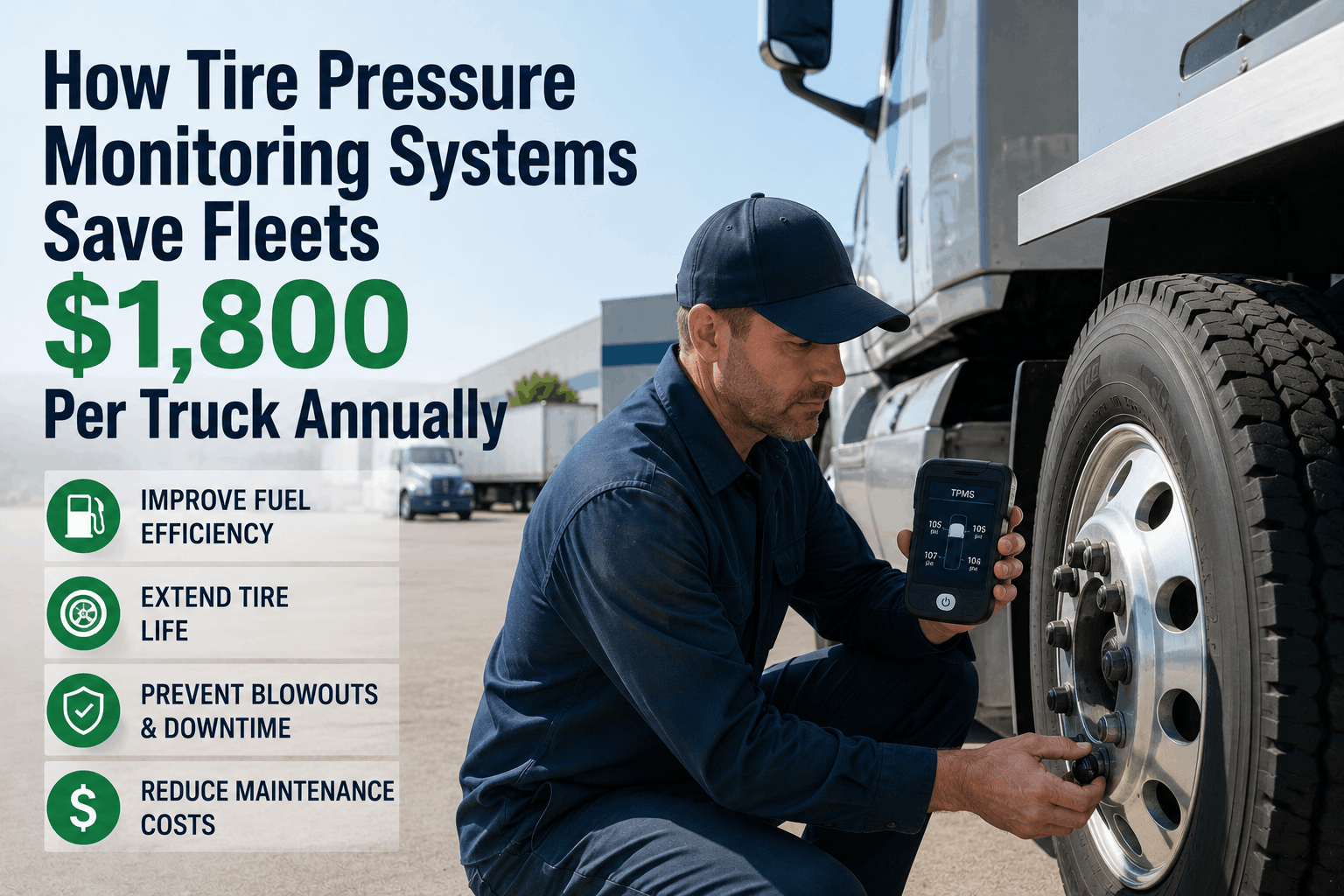
How Tire Pressure Monitoring Systems Save Fleets $1,800 Per Truck Annually
The Silent Budget Drain Most Fleet Managers Miss
Tires account for only about 2% of a fleet's operating budget on paper — but underinflated tires quietly destroy the other 28% that goes to fuel. According to the U.S. Department of Energy, every 1 PSI drop in tire pressure reduces fuel efficiency by 0.2%. A truck running 10 PSI below optimal burns 2 to 3% more fuel per mile. A diesel truck traveling 100,000 miles annually at 6 miles per gallon can waste over 1,500 gallons of fuel per year from this single oversight alone.
According to FMCSA data, 55% of commercial vehicles have at least one tire running 10 or more PSI below optimal. One in five tractors carries a tire underinflated by 20 PSI or more. For a 50-truck operation, this invisible pressure loss translates to an estimated $87,000 to $175,000 in annual waste. Fleet operators who have adopted TPMS consistently report that the technology pays for itself within 12 months or less. Want to see what your fleet's potential savings look like? Sign up with FleetRabbit and connect your fleet data in minutes.
How TPMS Works — and Why Real-Time Matters
A fleet TPMS uses sensors mounted on each tire valve stem to continuously measure both pressure and temperature, transmitting wireless data to a cab-mounted receiver and — in connected systems — to a fleet management dashboard accessible by your maintenance team in real time. Unlike manual walkaround checks that happen once per shift at best, TPMS catches underinflation, overinflation, slow leaks, and sudden pressure drops at the moment they occur — not hours later when a tire is already failing on the highway.
A slow leak caught by TPMS at the yard costs a valve stem replacement. The same slow leak caught by a roadside blowout costs $600 to $1,200 in emergency service, hours of downtime, potential cargo damage, and a CSA violation. Book a FleetRabbit demo to see how real-time tire monitoring integrates with your existing fleet management workflow.
Direct pressure and temperature sensors on each tire transmit readings every 60–180 seconds, flagging deviation from set thresholds instantly.
Data streams wirelessly to the cab display and simultaneously to your fleet management cloud dashboard — accessible from any device, anywhere.
Alerts are categorized by severity — a slow 2 PSI drop triggers a maintenance queue; a rapid 20 PSI loss triggers an immediate driver warning.
Managers see every tire on every truck in a single dashboard — pressure history, temperature trends, and maintenance records unified.
FleetRabbit's TPMS integration gives your maintenance team real-time tire health data across your entire fleet — before problems become breakdowns.
Breaking Down the $1,800 Per Truck Savings
The $1,200 to $1,800 annual savings figure cited by commercial fleet operators using predictive TPMS systems does not come from a single source — it is the accumulation of four distinct cost categories that underinflation affects simultaneously.
The FMCSA documented a 1.4 to 1.8% fuel economy improvement across tractor-trailer fleets after TPMS deployment. At 100,000 miles per year and $4.50 per gallon diesel, that improvement translates to $700 to $900 recovered per vehicle annually.
Underinflation generates excess heat that accelerates sidewall degradation, reducing tire lifespan by 10 to 25%. Proper inflation through TPMS extends tire life and preserves casing integrity for 2 to 3 retread cycles, saving $450 to $900 per vehicle annually.
Fleet operators average 2 to 4 tire-related roadside events per vehicle per year at $600 to $1,200 each, plus $448 to $760 per day in vehicle downtime. TPMS prevents an estimated 50% of these events through early pressure detection.
NHTSA data shows tires underinflated by more than 25% are three times more likely to contribute to a crash. TPMS creates continuous compliance documentation that protects both your drivers and your DOT standing.
For a 50-truck fleet, applying even the conservative end of these savings ranges produces an annual benefit of $60,000 to $90,000 — well within the first operating year. NACFE rates fleet TPMS with "high confidence" ROI of under 12 months. Sign up with FleetRabbit to model your fleet's specific savings potential.
Direct vs. Indirect TPMS: What Fleet Operators Need to Know
Not all TPMS solutions deliver equal precision. Direct TPMS uses physical sensors in each tire that transmit real pressure and temperature readings. Indirect TPMS infers pressure changes from wheel speed differences measured by the ABS system — a less reliable method that cannot detect gradual pressure loss or identify which specific tire is affected. For commercial fleet applications, direct TPMS is the standard because it provides the actionable, tire-specific data that maintenance planning requires.
Modern direct TPMS platforms now integrate AI-driven predictive analytics that analyze pressure trend patterns to identify which tires are likely to require service in the coming days — allowing maintenance teams to plan interventions during scheduled downtime rather than reacting to roadside emergencies. Book a demo with FleetRabbit to explore how predictive tire analytics fits into your maintenance schedule.
The Market Is Shifting — and Regulation Is Accelerating It
The global TPMS market was valued at $8.94 billion in 2024 and is projected to grow at a 12.91% CAGR through 2032. The EU's General Safety Regulation expanded mandatory TPMS coverage to virtually all new light and heavy commercial vehicles from July 2024. The U.S. Department of Transportation estimates that improved tire management systems could save the transportation industry up to $5 billion annually — reflecting how widespread and costly the underinflation problem remains. Fleets that build TPMS into their standard operating infrastructure now are positioning themselves ahead of what is increasingly a baseline expectation for professionally managed commercial operations. Start your free FleetRabbit account and get ahead of this shift today.
FleetRabbit unifies TPMS data, maintenance scheduling, and fault monitoring into one platform — so your team acts on tire issues before they become costly roadside events.
What TPMS Data Looks Like Inside a Fleet Platform
Standalone TPMS hardware generates alerts at the cab level — useful for the driver, but disconnected from the maintenance workflow back at the yard. The real operational value of TPMS emerges when sensor data flows into a fleet management platform where it can be correlated with vehicle mileage, maintenance history, route profiles, and compliance records. A maintenance manager who receives a push notification that Truck 14's left front tire has dropped 8 PSI over the past 72 hours can schedule a pre-emptive service stop before that vehicle's next outbound run — turning a $12 repair into the alternative to a $1,200 roadside call.
Fleet managers using integrated platforms report identifying systemic pressure loss patterns — specific tire positions, certain vehicle models, or seasonal trends — that manual checks would never surface. This data-driven visibility turns tire management from a reactive task into a proactive operational strategy. If this is the visibility your fleet has been missing, sign up with FleetRabbit and start connecting your tire data today.