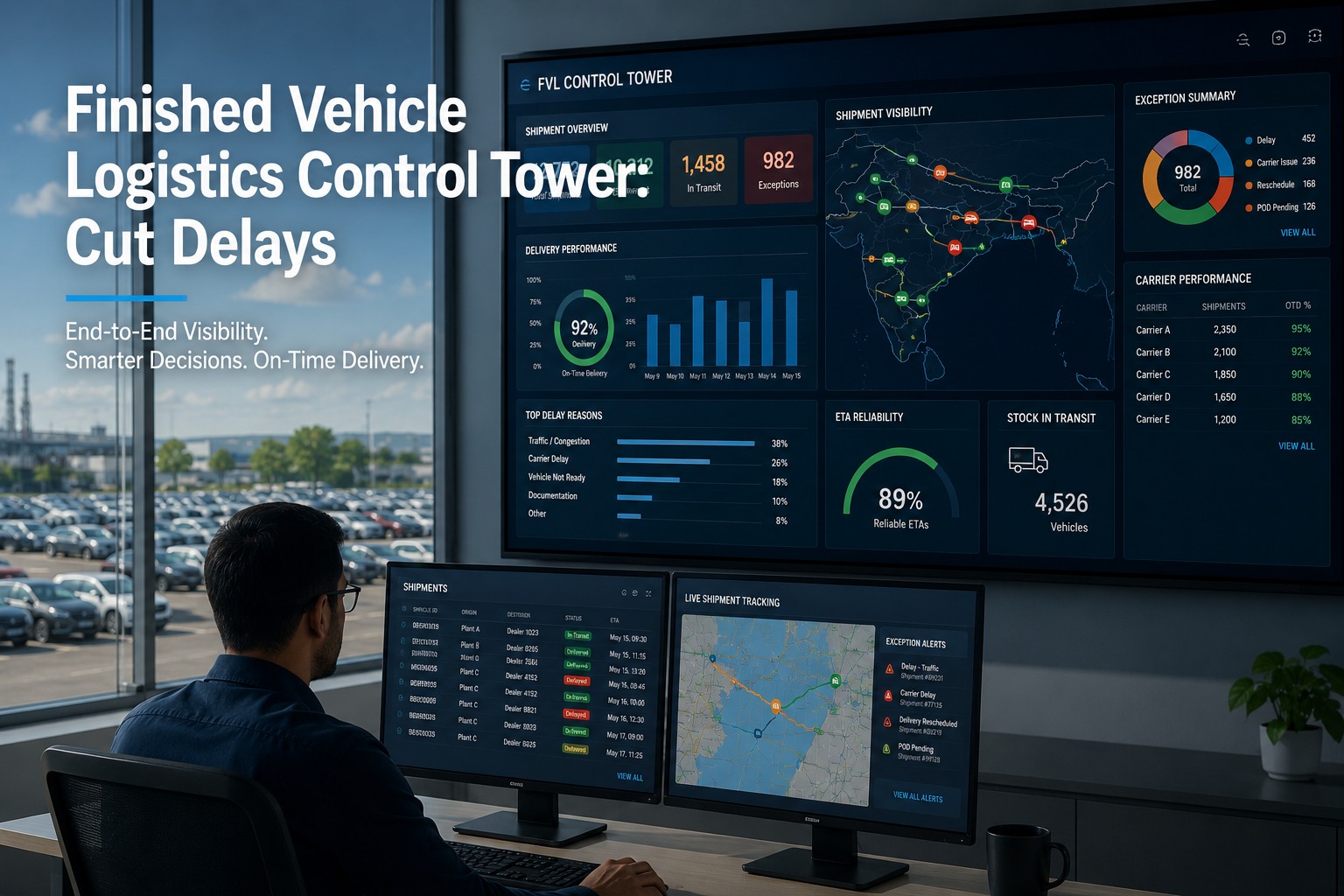
Most finished vehicle control towers fail in the same way: they surface everything. A dashboard reporting four hundred exceptions on a Monday morning has told the team nothing, because nobody can act on four hundred of anything. The useful question is not what is late — it is which lateness will move a dealer delivery date, and who has until when to fix it. That distinction has become commercially significant rather than merely operational, because visibility and exception management are moving into contract terms: manufacturers increasingly judge providers on how quickly disruptions are identified, communicated and corrected before dealer timelines are affected. Speed of response is now the service being bought. Request an enterprise demo to see exceptions tiered by consequence rather than listed by timestamp.
FVL · CONTROL TOWER
Finished Vehicle Logistics Control Tower
Plant-to-dealer visibility across every mode, exceptions ranked by what they cost rather than when they occurred, ETAs that survive contact with a rail schedule, and reporting the sales side will actually open.
Tier 1
Dealer delivery date at risk
Same shift
Tier 2
A leg is late but the date is still recoverable
Same day
Tier 3
Deviation worth knowing, no date impact
Review weekly
Same four hundred events. Sorted by consequence rather than by timestamp, and suddenly there are eleven things to do today instead of four hundred things to read.
Why Small Delays Get Expensive Fast
Finished vehicle movement is a multi-stage network under constant pressure on both speed and cost, and short delays do not stay small. One missed handoff produces four separate costs, only one of which is a transport cost.
01
The handoff is missed
A rail cut departs without the units, or a carrier arrives to find the load not ready. In itself, a few hours.
02
Downstream deliveries derail
Everything scheduled behind that handoff moves. A single missed rail connection cascades across the deliveries that depended on it, and the recovery is rarely proportionate to the original delay.
03
The yard absorbs it
Idle inventory clogs the compound, straining space and disrupting the workflows that depend on it. Units that should have left are now competing for positions with units that have just arrived.
04
Recovery costs money and goodwill
Overtime to work the backlog, premium freight to catch the schedule up, and dissatisfied dealers at the end of it. The transport line shows the premium freight; nothing shows the other three.
The shift the sector is making
From reactive coordination to real-time visibility, predictive arrival accuracy and orchestrated execution across yards, ports, rail, carriers and dealers — because traditional tools cannot keep up with the number of handoffs involved. The operational requirement is specific: know where every vehicle is, predict when it will actually arrive, update that as conditions change, and intervene on exceptions before they become costly failures rather than reporting them afterwards.
Every Leg Needs an Owner and a Signal
Plant to dealer involves several custody transfers and at least two modes on most lanes. Visibility fails at the joins, not in the middle of a leg.
Plant release
Buy-off, quality inspection and dispatch by destination. The first event, and the one that starts every downstream clock.
Signal: release status per VIN
Compound and yard
Inventory position, dwell and readiness. Where units wait, and where an unnoticed hold becomes a missed connection.
Signal: location, dwell, hold status
Rail
The leg with the least native visibility and the largest cascade when it slips. VIN-level rail tracking is now available across the North American network, which closes a longstanding gap.
Signal: VIN-level movement events
Ocean and port
Gate-in, loaded on board, discharge and release. Long intervals with few events, which makes each event disproportionately valuable.
Signal: milestone confirmations
Road and final mile
Carrier assignment, load, transit and delivery. The leg dealers experience directly, and the one they ask about.
Signal: load, position, delivery confirmation
The joins between them
Every custody transfer is a point where a unit can go quiet. Most visibility programmes cover the legs well and the handoffs poorly, which is precisely backwards — the cascade starts at a join.
Signal: matched departure and arrival events
Plant
Compound
Rail — quiet
Dealer
Which of your legs goes dark, and for how long?
Every network has one. Bring a month of shipment records to a 30-minute session and we'll plot the gaps in Fleet Rabbit — how long units go without an event on each leg, and which of those silences preceded a missed dealer date. The quiet leg is almost never the one people expect.
Designing the Exception Hierarchy
The single most valuable design decision in a control tower, and the one most often skipped in favour of alerting on everything. Four rules.
← Swipe to see all columns →
The test for whether the hierarchy is working is not how many exceptions were raised. It is what share of tier one exceptions were resolved inside their window, and whether dealer dates held as a result. A tower generating more alerts each month while that figure stays flat is producing noise with increasing efficiency.
What Makes an ETA Credible
A date that changes hourly is not visibility, it is anxiety. Five inputs separate a predicted arrival from a scheduled one.
1Actual dwell, not planned dwellHow long units genuinely wait at each compound on this lane, drawn from history rather than from the standard assumption in the routing guide.
2Modal reality on the specific legRail schedules, port congestion and carrier availability behave differently by lane and by season. An ETA built on a network average is wrong in a predictable direction on most lanes.
3Conditions along the routeTraffic, weather and known disruption, applied continuously rather than at dispatch. The value of a prediction is that it updates when the world does.
4Historical patterns for this laneWhat actually happened on the last hundred moves, which is a better predictor than any published transit time and improves as the record grows.
5Honest confidence, published with the dateA firm date on a leg that is genuinely uncertain damages credibility more than a wider window would. Dealers plan staffing around these — an ETA presented with its confidence is more useful than a precise one that moves three times.
What better ETAs actually buy
Three things, in the order they appear on a budget. Fewer manual ETA updates, which is direct labour. Fewer status inquiries, which is more labour plus dealer irritation. And less premium freight, because a delay identified early enough is recovered by rescheduling rather than by paying to catch up. The third is the one that funds the programme; the first two are what the team notices.
The Reporting the Sales Side Will Open
Logistics reporting and commercial reporting are different products built from the same data. Five things the sales and dealer-facing side actually want, none of which are on a typical logistics dashboard.
Where is this VIN, in plain language
Not a status code. Self-service access at VIN level lets dealers track their own units, manage inventory, adjust staffing and prepare for arrivals — which removes the inquiry rather than answering it faster.
When will it arrive, and how sure are we
A date with a confidence attached, updated automatically when it changes. Proactive notification of delays and exceptions is worth considerably more to a dealer than an accurate dashboard they have to check.
What is arriving this week, in total
Inbound volume by dealer and by period, so staffing and preparation can be planned. This is the report that gets forwarded internally, which is the only real measure of whether reporting works.
Which of my units are held, and why
Campaign holds, quality holds and documentation gaps stated plainly. A dealer chasing a unit that is deliberately held is a conversation nobody needed to have.
How reliable have you been to me
Delivery performance to that specific dealer over time. Uncomfortable to publish and disproportionately effective — a dealer who can see the trend stops arguing about individual units, and a network that publishes it tends to improve it.
Dashboard or Control Tower
The distinction is not cosmetic. A monitoring system tells you what happened; an orchestration layer does something about it. Four capabilities mark the difference.
01
End-to-end visibility, every leg and status
Every unit, every leg, every status, across road, rail, ocean and final mile — unified into one view rather than assembled from carrier portals. This is the entry requirement, not the differentiator.
02
Predictive arrival rather than scheduled arrival
Arrival times derived from dwell, conditions and historical patterns, updating continuously. A schedule restated is not a prediction.
03
Exception detection with automatic identification
Late, at-risk and failed movements identified by the system and ranked by the hierarchy, rather than found by someone scanning a list looking for problems.
04
Dynamic re-planning
The ability to reroute, reassign or reschedule in response to a disruption — detecting an exception, evaluating the options and executing a correction. This is what separates a current control tower from a dashboard of a few years ago, and it is where the recovered cost sits.
Worth being honest about sequencing. Capability four is unreachable without one, two and three underneath it, and most programmes that fail do so by attempting orchestration on incomplete event data. Fix the joins first — the handoffs where units go quiet — because every layer above depends on knowing where things actually are.
What Good Looks Like
Published operator results give a sense of the range, and of what integrated visibility is worth when it is actually working.
98%
On-time delivery reported by one operator alongside doubled yard productivity, attributed to end-to-end visibility and automated processes
<1.5 days
Yard dwell at a plant handling around 2,500 vehicles a day on a fully integrated logistics system
600
Railroads covered by VIN-level rail tracking now available in North America, closing the leg with the least native visibility
Twenty minutes on your exception queue and your quiet legs
On a demo we'll take a month of shipment data into Fleet Rabbit, tier your exceptions by dealer date impact rather than by timestamp, plot how long units go without an event on each leg, and show which silences preceded a missed date. You keep the tiering model either way — and it usually reduces the daily queue by an order of magnitude on the first pass.
Frequently Asked Questions
What makes a control tower different from a visibility dashboard?
Orchestration rather than observation. A dashboard reports status; a control tower detects an exception, evaluates the options and executes a correction — rerouting, reassigning or rescheduling in response to disruption. The supporting capabilities are end-to-end visibility across every leg and mode, predictive rather than scheduled arrival times, and automatic exception identification. The re-planning layer is what distinguishes a current platform from one built a few years ago, and it is where recovered cost sits.
Why does our exception list feel useless?
Almost certainly because it is ranked by lateness rather than by consequence. A four-hour delay threatening a committed dealer date matters more than a two-day delay with float behind it, and a list sorted by timestamp buries the first among the second. Rank by consequence, give each tier a named owner and a response window, and require every exception to close in a recorded action. The daily queue usually shrinks by an order of magnitude without anything being ignored.
Where does visibility usually break?
At the joins rather than in the middle of a leg. Every custody transfer between plant, compound, rail, port and carrier is a point where a unit can go quiet, and most programmes cover the legs well and the handoffs poorly. That is backwards, because the cascade always starts at a handoff — a missed rail connection derails the deliveries scheduled behind it, and the recovery costs overtime and premium freight far exceeding the original delay.
What makes an ETA reliable?
Building it from actual dwell rather than planned dwell, the modal reality of that specific leg, live conditions along the route, and historical patterns for the lane — updated continuously rather than set at dispatch. Publish the confidence alongside the date: a firm date on a genuinely uncertain leg damages credibility more than a wider window, and dealers plan staffing around these figures. An ETA that moves three times is worse than one that was honest about its range.
What does better visibility actually save?
Three things. Fewer manual ETA updates and fewer status inquiries, both direct labour costs, plus the dealer irritation that comes with the second. And less premium freight, because a delay identified early is recovered by rescheduling rather than by paying to catch up — that is the line that funds the programme. Published operator results include one reporting 98% on-time delivery with doubled yard productivity, and a plant handling around 2,500 vehicles daily holding yard dwell below a day and a half.
Is this becoming a contract requirement?
It is moving that way. Visibility and exception management are increasingly central to how manufacturers judge logistics providers — specifically on how quickly disruptions are identified, communicated and corrected before dealer delivery timelines are affected. Dynamic routing, arrival prediction, yard optimisation and live capacity reservation are now described as defining production-grade platforms rather than as advanced features, which means the baseline has moved.
Where should we start?
With the joins. Measure how long units go without an event on each leg, identify which leg goes quiet longest, and check how often those silences preceded a missed dealer date. That analysis costs nothing beyond the data you already hold and it determines everything above it, since predictive arrival and automated re-planning both depend on knowing where things actually are.
Book a session with a month of shipment records and we'll plot the gaps with you.
Rank by Consequence, Not by Timestamp
Cover the handoffs before the legs, build arrival times from what actually happens on the lane, tier every exception by whether it moves a dealer date, give each tier an owner and a window — and give the sales side a view they will open without being asked to.
Works alongside existing TMS, yard and carrier systems · Bring a month of shipment records to the call
August 31, 2026
By Emily Davis
All Articles