Every WEX fill asks the driver for two things before the pump releases fuel: a PIN and a current odometer reading. That second prompt is the most undervalued data point in fleet operations. It is a meter reading, taken by the person standing at the vehicle, on a cadence set by actual consumption rather than by whoever remembers to do a stock check — and on assets without telematics it may be the only reliable mileage feed you have. Most fleets treat it as a formality, which means it lands in a fuel report, gets reconciled against a spend total and never reaches the maintenance schedule. Paired with fuel volume it does something else entirely: it tells you what each vehicle is actually achieving per gallon, and a sharp drop means either more fuel went in than the tank holds or the vehicle burned more than it should have since the last fill. One of those is a fraud problem and the other is a mechanical one. Bring a month of WEX transactions and we'll separate the two.
Integration · WEX Fuel Cards
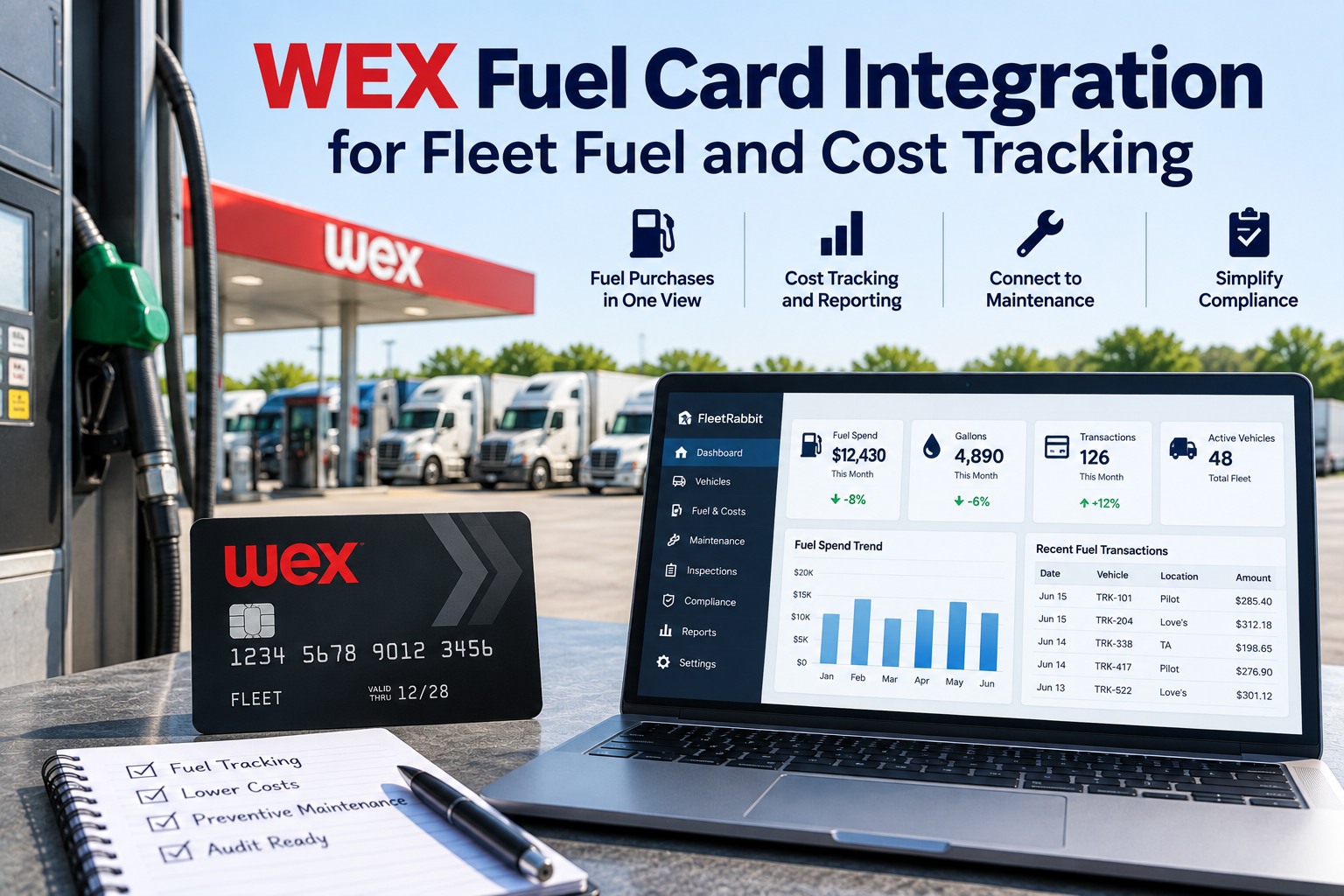
WEX Fuel Card Integration for Fuel and Cost Tracking
Every fill already captures a driver ID, an odometer reading and a location. Routed properly, that is a fuel record, a meter reading and a maintenance signal from one swipe.
PIN
→
Odometer
→
Dispense
Three seconds at the pump. One of them is worth more than the fuel.
One Swipe, Four Facts
Closed-loop processing enables prompts that ordinary credit cards cannot ask for. Each field answers a different question.
Driver IDTies the purchase to a person rather than to a card, which makes activity traceable and — reported as an effect in itself — encourages more responsible use simply by existing.
OdometerA meter reading captured at the vehicle, several times a month, without anyone being asked to collect it. This is the field this page is about, and it is the one most commonly wasted.
Volume and gradeHow much went in and what it was — including whether the transaction was fuel at all, since non-fuel purchases appear distinctly in the record.
Location and timeWhich station, and when according to the pump. Both become verification inputs the moment there is vehicle position data to check them against.
WEX is genuinely strong on capture. Acceptance across around 95% of US stations, closed-loop processing supporting driver and odometer prompts, purchase rules by product type, time of day and geography, and product-level restrictions that block non-fuel items outright. The gap is not what gets recorded — it is where those four fields end up.
The Passive Filter
A single rule, running in the background, that catches both honest mistakes and deliberate ones without anybody reviewing anything.
If the odometer entered at the pump is lower than the last reading recorded for that vehicle
flag and reject
What it catches honestly
Fat-fingered entries, a digit dropped, the wrong vehicle's number typed from memory. These corrupt your mileage record silently and are invisible in a spend report.
What it catches otherwise
A reading entered deliberately to obscure how far a vehicle has actually travelled. Unusual mileage patterns suggesting tampering or false entries are exactly what trigger investigation alerts.
The reason to care beyond data hygiene: a corrupted odometer history breaks preventive maintenance scheduling, cost per mile and fuel economy at the same time. One bad reading propagates into three outputs, and none of them announce the error — the schedule simply fires at the wrong point and the cost figure is quietly wrong.
A Drop in MPG Has Two Explanations
Almost all fuel card content considers one of them. The other is where a maintenance platform earns its place.
Explanation one
More fuel went in than the tank holds
Fuel slippage — a capacity figure above 100% of the vehicle's registered tank indicates more was pumped than the vehicle could physically take. Combined with a location mismatch, that is the classic misuse pattern, and it is what most integrations are built to find.
Explanation two
The vehicle burned more than it should have
Clean location match, correct driver, plausible volume — and consumption steadily worsening. That is not fraud. That is a dragging brake, a failing injector, a clogged filter, a tyre pressure problem or an alignment issue, announcing itself in fuel before it announces itself anywhere else.
This is the distinction worth building your alerting around. A single anomalous transaction is a fraud question. A gradual decline across many transactions on one vehicle is a maintenance question — and a system that only checks transactions individually will never see the second pattern, because no individual fill looks wrong.
Worth checking
Rank every vehicle by MPG trend over six months
The bottom three are a maintenance list, not a driver list
Most fleets have the data to produce that ranking and have never produced it, because fuel reporting is organised by spend and period rather than by asset and trajectory. Send us six months of WEX transactions with your vehicle list and we'll build the ranking — whatever you decide afterwards, the list itself is worth having.
What "Verified" Actually Means
Four specific checks, with the thresholds that decide them. Useful whether you automate them or run them by eye.
Swipe to see all columns
Add the odometer sanity check to those four and you have five passive tests running on every transaction. None requires a human until one of them fails, which is the design principle worth holding: managers should review exceptions, not transactions.
Keep Your Own Evidence
A practical point that has nothing to do with software and everything to do with how disputes go.
Disputes do not always land your way
Published reviews describe cardholders reporting skimming and unauthorised distant transactions, with investigations concluding the loss originated at the cardholder's end and reimbursement declined — including cases where transactions appeared hundreds of miles apart within implausible timeframes. Whether that reflects isolated cases or broader policy is not clear from public information.
Which is an argument for independent records
If a dispute may turn on evidence, the position you want is contemporaneous vehicle position data showing where the truck actually was at the time of the transaction — captured automatically, held by you, and not reconstructed after the fact from a statement.
And for prevention over recovery
Since recovery is uncertain, weight your effort toward controls that stop the transaction — purchase rules by product, time and geography, driver-specific cards, and exception alerts that fire the same day rather than at statement reconciliation.
Use the Controls WEX Already Gives You
Five things available inside the card programme itself, worth configuring properly before adding anything alongside it.
01Product-level restrictionsBlock non-fuel purchases outright rather than catching them afterwards. Fuel cards can be configured to prevent categories that ordinary credit cards permit freely.
02Time and geography rulesLimit use to operating hours and expected regions. A card working at 3am four states away should not need an alert — it should not authorise.
03Level III prompts, actually enforcedDriver identification and odometer entry at the pump. Confirm both are required rather than optional, because a skipped prompt is a missing meter reading you will never recover.
04Exception alerts pushed to operationsReporting tiers exist that benchmark consumption across vehicles and surface irregular usage. Push those to whoever can act rather than leaving them in a portal.
05In-cab payment where it fitsPaying from the cab with electronic receipts and biometric unlock reduces card handling and lost paperwork — worth evaluating for fleets where receipts routinely fail to reach the office.
None of that requires a third-party platform, and all of it is worth doing first. A well-configured card programme prevents transactions; an integration explains them. Fleets that skip the configuration and buy the integration end up detecting misuse they could have blocked.
Inside Fleet Rabbit: Two Paths for Every Transaction
Every WEX transaction takes one of two routes, and the split is the entire design.
A card is swiped
Clean — the large majority
Logged silently to that vehicle's fuel history
Volume, cost, station, driver and odometer recorded
Consumption rate calculated against the previous fill
Odometer advances the preventive maintenance countdown
Cost lands on cost per asset alongside parts and labour
Manager effort: none
Flagged — the exceptions
Alert raised with full context attached
Driver, vehicle, station, position, amount and rule triggered
Reviewed and resolved in one action
Consumption anomalies routed to maintenance, not discipline
Evidence retained in case it is ever needed
Manager effort: the only thing they see
Worth stating the division plainly. WEX tells you what was purchased and where. A maintenance platform tells you whether that purchase makes sense given everything else known about the vehicle — its last fill, its expected consumption, its open defects and where it actually was. Neither answers the other's question.
What This Replaces
Three jobs that stop existing, and one that starts.
StopsMonthly spreadsheet reconciliationMatching statements against vehicles by hand is reported at six to eight hours a week in fleets running it manually — a job that produces no decision, only a tidy file.
StopsChasing paper receiptsA large share of fuel receipts never reach the office at all. Electronic capture at the transaction removes both the chasing and the gaps it leaves in your cost record.
StopsTyping odometer readings into a maintenance sheetBecause the driver already typed one at the pump. Every fill becomes a meter reading, on a cadence set by how hard the vehicle is working.
StartsWatching consumption as a health metricA short weekly look at which vehicles are drifting on fuel economy. That is a new habit rather than a removed one, and it is where the maintenance value actually comes from.
Connect three vehicles and watch a fill turn into a meter reading
Free, no card, no time limit, and nothing changes at the pump. Put three vehicles on it, let real WEX transactions flow for a few weeks, and see the odometer entries advancing service intervals while consumption builds into a trend per asset. If your intervals currently run on readings somebody types in monthly, the difference is visible within the first fortnight.
Frequently Asked Questions
What does the odometer prompt at the pump actually give us?A meter reading captured at the vehicle, by the driver, several times a month without anyone being asked to collect it — on a cadence set by actual consumption rather than by a monthly admin task. Paired with fuel volume it produces expected miles per gallon per vehicle, and it can drive preventive maintenance from real usage. On assets without telematics, it may be the most reliable mileage feed available.
How do we stop bad odometer entries corrupting everything?With a sanity check that runs on every imported transaction: if the reading entered at the pump is lower than the last recorded reading for that vehicle, flag and reject it. That catches honest typing errors and deliberate entries alike, without manual review. It matters because one corrupted reading distorts preventive maintenance scheduling, cost per mile and fuel economy simultaneously — and none of the three announces the error.
Is a drop in MPG always fraud?No, and treating it that way is the common mistake. A sharp drop on one transaction means either more fuel was dispensed than the vehicle could hold or the vehicle burned more than expected since the last fill. The first, especially with a location mismatch, is misuse. The second — clean location, correct driver, plausible volume, consumption steadily worsening — is a dragging brake, a failing injector, a clogged filter or a tyre pressure issue. Single transactions are a fraud question; trends across many are a maintenance one.
What checks should run on every transaction?Five. Location — a vehicle position point within half a mile of the station on the day. Capacity — anything above 100% of the registered tank size indicates slippage. Timing — pump-reported time against card-reported time. Product — whether it was fuel at all. And the odometer sanity check. None needs a human until one fails, which is the point: managers should be reviewing exceptions rather than transactions.
Should we configure WEX controls or just add software?Configure the card programme first. Product-level restrictions, time and geography rules, enforced driver and odometer prompts, and exception alerts pushed to operations are all available within the programme, and a well-configured card prevents transactions while an integration only explains them. Fleets that skip the configuration end up detecting misuse they could simply have blocked.
Why keep our own records if WEX already has them?Because disputes do not always go the cardholder's way. Published reviews describe reported skimming and unauthorised distant transactions where investigations concluded the loss originated at the cardholder's end and reimbursement was declined. Whether that is isolated or broader is not clear publicly — but if a dispute turns on evidence, contemporaneous vehicle position data that you hold is the position you want, and it also argues for weighting effort toward prevention over recovery.
Does anything change for drivers?Nothing. The same card, the same prompts, the same pumps. The change is entirely on the management side, where reconciliation stops being a weekly job and becomes a short review of flagged exceptions — with the odometer entries now advancing service intervals rather than sitting unused in a fuel report. Connect three vehicles free and see it on your own transactions.
The Cheapest Meter Reading You Already Collect
Enforce the odometer prompt rather than leaving it optional, reject any reading lower than the last one, run location, capacity, timing and product checks passively so managers only see failures, treat a gradual consumption decline as a workshop item rather than a driver conversation — and let the reading a driver types at the pump drive the service interval, because you are already paying to collect it.
Card features, verification thresholds and reported customer experiences are drawn from published 2026 sources including WEX documentation and third-party reviews. Programme features and controls vary by card type and tier — confirm what your own account supports with WEX directly, and treat dispute commentary as reported experience rather than as a statement of policy.