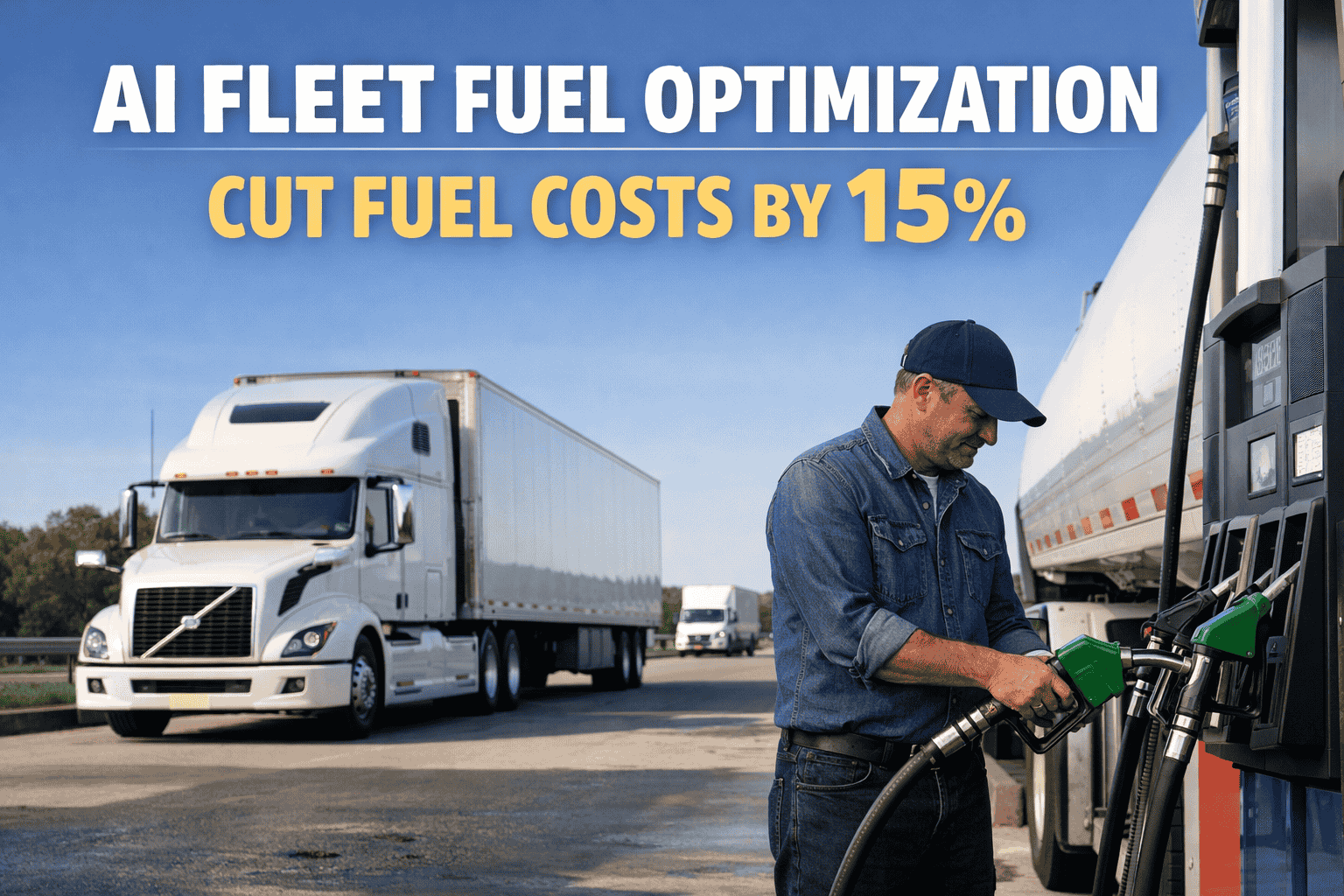
Every morning, your fleet leaves the yard burning money you'll never see again. Somewhere in your operation right now, a driver is idling for 45 minutes waiting at a dock while the engine consumes $1.40 worth of diesel doing absolutely nothing. Another driver just took a route that added 12 unnecessary miles because nobody told him about the construction on Highway 9. And that truck with the sluggish oxygen sensor? It's getting 5.2 MPG instead of 6.8 MPG bleeding $4,800 in extra fuel costs this year alone. This is the invisible fuel crisis hiding inside every fleet. AI fleet fuel optimization makes it visible — and fixable — in real-time.
Here's what fleet managers are discovering in 2026: fuel isn't just your biggest controllable expense — it's your biggest recoverable expense. The average fleet wastes between 5% and 10% of its entire annual operating budget on preventable fuel inefficiencies. For a 50-truck operation spending $500,000 on diesel annually, that's $25,000 to $50,000 disappearing into exhaust fumes. But the fleets deploying AI-powered fuel management aren't just stopping the bleeding — they're achieving 15-25% total fuel cost reductions within 90 days. That's $75,000 to $125,000 back in your budget, with complete ROI payback in 3-6 months. Find out how much you could recover — book a free assessment.
This isn't theoretical. Penske's 2025 Transportation Leaders Survey found that 40% of fleets adopting AI reported improvements of at least 50% in fuel savings. Iron Range Express — a 72-truck long-haul carrier — achieved 22% total fuel optimization, saving over $347,000 in their first year. The technology exists. The results are proven. The only question is how much longer you'll wait while competitors capture these savings and you don't.
Find Out Exactly How Much Your Fleet Is Losing
In a 30-minute demo, we'll connect to your telematics and show you the specific drivers, routes, and vehicles costing you money right now — with dollar amounts attached. No guessing. No estimates. Real data from your actual fleet.
Why Most Fleet Managers Dramatically Underestimate Their Fuel Waste
If you're like most fleet managers, you believe you have a reasonable handle on fuel costs. You've negotiated fuel card discounts. You've set idling policies. You review monthly consumption reports. You might even have telematics installed. So how could you possibly be losing 15-25% of your fuel budget to waste you don't know about?
The answer lies in how traditional fuel management works — and why it's fundamentally broken for catching the inefficiencies that actually cost you money.
Traditional fuel management is backward-looking. You see last month's consumption report in the second week of this month. By then, whatever caused the spike — a driver with a heavy foot, a truck with a developing maintenance issue, a dispatcher routing vehicles through rush-hour traffic — has already burned through thousands of dollars. You're not managing fuel costs; you're documenting them after they've already happened.
Traditional fuel management is aggregate-focused. Your reports show fleet-wide averages: total gallons consumed, average MPG, cost per mile. But fleet averages hide the outliers that actually drive waste. When your fleet averages 6.2 MPG, you don't see that Driver A is getting 7.1 MPG while Driver B is getting 5.4 MPG on the same routes with the same trucks. That 1.7 MPG gap between your best and worst performers represents tens of thousands of dollars annually — invisible in aggregate reporting.
Traditional fuel management is siloed. Your fuel card data sits in one system. Your telematics data sits in another. Your maintenance records are somewhere else entirely. Nobody is connecting these streams to see that Truck #47's declining MPG correlates with a fuel injector issue that's been developing for six weeks. Nobody notices that your highest fuel costs come from routes that consistently hit the same traffic bottlenecks. The patterns are there — but traditional tools can't see them.
This is exactly why fleets using AI-powered fuel management consistently discover 15-25% more waste than they believed existed. The AI connects the data streams, analyzes patterns in real-time, and surfaces the specific inefficiencies that human analysis misses — not next month, but right now, while there's still time to fix them. Book a demo to see what's hiding in your data, or start a free trial and discover your real waste within 48 hours.
The Four Hidden Fuel Drains Destroying Your Budget
After analyzing fuel data from thousands of fleets, we've identified four primary sources of fuel waste that collectively account for 15-25% of total fuel costs in the average operation. Understanding these drains is the first step toward eliminating them.
Excessive Idling: The $2,500-Per-Truck Silent Killer
Accounts for 25-40% of preventable fuel wasteHeavy-duty truck engines consume approximately 0.8 gallons of diesel per hour while idling. At $3.50 per gallon, that's $2.80 per hour of pure waste — fuel burned without moving freight a single inch. But here's what makes idling so insidious: it accumulates in small increments that feel insignificant in the moment.
A driver idles for 20 minutes while completing paperwork. Another 15 minutes waiting at a shipper's gate. Another 30 minutes during lunch because it's easier than restarting the engine. Individually, these feel like nothing. Collectively? That driver just idled for over an hour — consuming 0.8 gallons of diesel that generated zero revenue.
Scale this across your fleet and the numbers become staggering. Research shows that 39% of fleet vehicles idle for 3-4 hours daily, and 14% idle for more than 4 hours. Some fleets have recorded idling as high as 35% of total engine runtime. For a 30-truck fleet, unmanaged idling easily represents $75,000 or more in annual fuel waste.
The challenge? Traditional telematics show you total idle time, but they don't distinguish between necessary idling (PTO operations, temperature-sensitive cargo, extreme weather conditions) and pure waste (waiting at docks, extended breaks, poor habits). Without this distinction, you can't target interventions effectively.
What AI changes: Machine learning analyzes idle patterns by driver, location, time of day, and operational context. It learns which idling is legitimate and which is waste. When drivers exceed thresholds at specific locations, automated alerts fire immediately — while the behavior is happening, not weeks later in a report. One 72-truck fleet reduced idle time from 26% to 11% using AI detection, saving $253,000 annually. Start tracking your idle waste free.
Driver Behavior: The 30% Efficiency Variable You're Not Tracking
Creates massive variance between your best and worst performersHere's a number that should keep every fleet manager awake at night: driver behavior directly influences up to 30% of a vehicle's fuel efficiency. That means two drivers in identical trucks, on identical routes, with identical loads can have fuel costs that differ by thousands of dollars annually — purely based on how they drive.
The behaviors that destroy fuel economy are well-documented: aggressive acceleration (costs up to 33% more fuel), excessive speeding (every 5 MPH over 60 costs approximately 0.7 MPG), poor cruise control usage, unnecessary hard braking followed by re-acceleration, and failure to anticipate traffic patterns. These habits compound throughout every single shift.
But here's the problem with traditional driver coaching: it's based on fleet-wide policies and occasional ride-alongs. You tell all drivers to "drive more efficiently" without showing them specifically what they're doing wrong or how they compare to peers. A driver getting 5.8 MPG might think they're doing fine — until they see that three colleagues on the same routes are consistently getting 6.5 MPG. That peer comparison changes the conversation entirely.
Worse, most fleets only identify problematic drivers through aggregate MPG numbers that take weeks to compile. By the time you recognize that Driver B's fuel consumption is 15% higher than the fleet average, they've already wasted thousands of gallons.
What AI changes: Machine learning creates individual driver scorecards that track acceleration patterns, speed compliance, braking behavior, and cruise control usage in real-time. Each driver sees exactly how they compare to peers — not just that they're "below average," but specifically that their harsh acceleration events are 3x higher than the fleet's top performers. AI identifies which specific behaviors are costing the most fuel for each driver, enabling targeted coaching that actually changes habits. Fleets using AI driver coaching see 8-15% fuel efficiency improvements within 90 days. See driver scorecards in action — book a demo.
Route Inefficiency: The 16.7% Empty Mile Problem
Every unnecessary mile burns fuel while generating zero revenueATRI's 2025 Operational Costs of Trucking report reveals a sobering statistic: the average fleet runs 16.7% empty miles — trucks driving without cargo, burning fuel while generating absolutely no revenue. For a fleet operating 5 million miles annually, that's 835,000 miles of pure overhead.
But empty miles are just the most obvious routing inefficiency. Static route planning — the kind done in the morning before trucks leave the yard — becomes obsolete within hours. Traffic patterns shift. Construction zones appear. Weather changes. A route that took 3 hours yesterday takes 4.5 hours today because of an accident nobody knew about until the driver was stuck in it.
Every additional mile driven is fuel burned. Every hour spent in stop-and-go traffic instead of highway cruise is efficiency destroyed. Every route that sends trucks through predictable congestion is money wasted. And traditional dispatch systems have no way to adapt in real-time because they're based on static maps and historical averages rather than live conditions.
The compounding effect is brutal. A fleet that adds just 5% unnecessary miles through suboptimal routing — well below industry average — burns an extra 250,000 miles of fuel annually on a 5 million mile operation. At 6 MPG and $3.50/gallon, that's $146,000 in fuel you didn't need to burn.
What AI changes: AI route optimization doesn't just plan routes — it continuously adapts them based on real-time traffic, weather, delivery windows, vehicle capacity, and driver hours. When conditions change, routes adjust automatically. When a traffic jam develops, affected vehicles get re-routed around it immediately — not when the driver calls dispatch to complain. AI also optimizes for fuel efficiency specifically, favoring routes with consistent speeds over slightly shorter routes with heavy traffic. Fleets using AI routing see 10-20% fuel savings from mileage reduction alone, with 15% becoming typical within the first quarter. Try AI routing free for 3 vehicles.
Maintenance-Related Efficiency Loss: The Slow Bleed You Don't Notice
Mechanical issues silently destroy MPG for weeks before detectionYour trucks are bleeding fuel efficiency right now through maintenance issues that don't trigger warning lights, don't cause breakdowns, and don't show up until your next scheduled service — if they're caught even then.
Under-inflated tires increase rolling resistance by up to 15%, directly reducing fuel economy. A faulty oxygen sensor can slash mileage by 40%. Dirty air filters, degraded fuel injectors, worn spark plugs, misaligned wheels — each of these issues costs MPG without creating obvious symptoms. The truck still runs. The driver doesn't notice anything wrong. But week after week, you're burning 10%, 15%, even 20% more fuel than the vehicle should consume.
The traditional maintenance approach — time-based or mileage-based service intervals — is designed to prevent breakdowns, not optimize fuel efficiency. A truck can be fully compliant with its PM schedule while still hemorrhaging fuel from issues that fall outside standard inspection checklists. And because fuel data and maintenance data typically live in separate systems, nobody connects the dots between Truck #47's gradually declining MPG and the fuel system issue developing under the hood.
By the time someone notices that a vehicle's fuel efficiency has dropped significantly, weeks or months of excess fuel consumption have already occurred. The waste is baked in before the problem is even identified.
What AI changes: Machine learning correlates fuel efficiency data with vehicle diagnostics in real-time. When a truck's MPG begins declining from its established baseline — even by small percentages — AI flags it immediately. The system connects efficiency changes to diagnostic codes, maintenance history, and known failure patterns to identify the likely cause. Instead of discovering a fuel system issue during a scheduled service six weeks from now, you get an alert today recommending specific investigation. Fleets using AI-triggered maintenance see fuel efficiency improvements of 5-10% simply from catching issues before they compound. Schedule a demo to see predictive fuel alerts.
Which of These Four Drains Is Costing You the Most?
Most fleets have one or two dominant sources of fuel waste — but they don't know which ones until they see the data. Our AI analyzes your actual telematics and shows you exactly where the money is going, ranked by dollar impact.
How AI Fleet Fuel Optimization Actually Works (In Plain English)
You don't need to understand machine learning algorithms to use AI fuel optimization — but understanding what's happening behind the scenes helps you appreciate why it works so much better than traditional approaches.
Everything Connects Into One Intelligence Layer
The moment you activate AI fuel optimization, it begins ingesting data from every source in your operation: telematics (GPS positions, speed, acceleration, engine diagnostics), fuel card transactions (gallons, prices, locations, timestamps), maintenance records, dispatch data, and driver profiles. These streams flow into a unified platform that sees your entire operation in real-time — not as separate silos, but as interconnected systems where patterns emerge.
This connectivity is crucial because fuel waste rarely comes from a single source. A driver's high fuel consumption might result from aggressive driving habits (telematics data) + poor route assignments (dispatch data) + a developing maintenance issue (diagnostic codes). Traditional systems see each piece separately. AI sees them together. Connect your telematics in 15 minutes — start free.
Machine Learning Finds Patterns Humans Can't See
Your fleet generates thousands of data points per vehicle per day. No human analyst could process this volume, identify meaningful patterns, and surface actionable insights — certainly not in real-time. Machine learning algorithms do exactly that.
The AI establishes baselines for every driver, vehicle, and route. It learns what "normal" looks like for your specific operation — not industry averages, but your actual performance patterns. Then it continuously compares current data against those baselines, flagging deviations that indicate waste or developing problems.
When Driver A's fuel efficiency drops 8% over two weeks, the AI notices immediately. When Truck #23's idle percentage spikes at a specific customer location, the AI connects that pattern across multiple visits. When Route 7 consistently shows 15% higher fuel consumption than comparable routes, the AI identifies the bottleneck causing it. These patterns are invisible to human analysis but obvious to properly trained algorithms.
Real-Time Alerts Enable Immediate Intervention
Finding patterns is only valuable if you can act on them before the waste compounds. AI fuel optimization doesn't just analyze data — it triggers alerts and recommendations in real-time, while there's still time to change outcomes.
When a driver exceeds idle thresholds at their current location, an alert fires to dispatch and/or directly to the driver's app. When a fuel purchase doesn't match the vehicle's GPS location, fraud prevention flags it before the transaction even clears. When a truck's MPG drops below its baseline, maintenance gets a work order recommending specific investigation.
This real-time intervention is what separates AI from traditional reporting. You're not reviewing last month's problems — you're preventing today's waste as it happens. See real-time alerts in action — book a live demo.
The System Gets Smarter Every Day
Unlike static rules or policy-based systems, AI continuously learns from new data. Every day, the algorithms refine their understanding of your operation's patterns. Baseline accuracy improves. Anomaly detection becomes more precise. Recommendations become more targeted.
This is why fleets typically see 10-15% fuel savings in the first quarter but 20-25% by year-end. The AI isn't standing still — it's constantly improving its models based on your specific operational reality. What starts as general fuel optimization becomes increasingly customized to your drivers, vehicles, routes, and business patterns. Start your AI learning curve today — free for 3 vehicles.
What Results Actually Look Like: The Iron Range Express Case Study
Theory is one thing. Results are another. Here's what happened when Iron Range Express — a 72-truck long-haul carrier operating 8.6 million miles annually — deployed AI fuel optimization:
The Situation Before AI:
Iron Range was spending over $4.1 million annually on fuel, with costs trending upward. Management knew there was waste in the system but couldn't pinpoint where. Monthly reports showed aggregate numbers that obscured the real problems. Drivers followed company policies — when convenient. Maintenance was scheduled by mileage intervals, not efficiency metrics.
Initial AI analysis revealed the scope of the problem: 26% fleet idle time (industry target: under 15%), 19.2% empty miles (industry average: 16.7%), only 61% speed policy compliance, and significant variance in fuel efficiency between drivers on identical routes.
Results After 16 Weeks:
"We thought we were managing fuel costs. We were actually just documenting them. The AI showed us exactly where the money was going — and gave us tools to stop it. The 22% optimization paid for itself in the first quarter."
— Operations Director, Iron Range ExpressWant results like Iron Range? Book your free assessment or start your free trial now.
Traditional vs. AI Fuel Management: The Complete Comparison
If you're still using spreadsheets, monthly reports, and policy-based fuel management, here's exactly what you're missing — and why fleets using AI consistently capture 3-5x more savings. Book a demo to see the AI advantage firsthand.
Frequently Asked Questions About AI Fleet Fuel Optimization
Every Day You Wait Is Money You'll Never Recover
Your fleet burned through fuel waste today. It'll burn through more tomorrow. And the day after. The inefficiencies hiding in your operation don't pause while you evaluate options — they compound. The fleets that deployed AI fuel optimization 6 months ago have already recovered tens of thousands of dollars you're still losing.
You have two choices: book a demo and see exactly what's hiding in your data, or keep doing what you're doing and hope the waste somehow fixes itself. One of those choices leads to 15-25% fuel savings with 3-6 month payback. The other leads to more of the same.
Free for 3 vehicles forever • 15-minute setup • No credit card required • Cancel anytime