Outbound capacity planning changed character in 2026, and the change is not about price. Tender rejection has climbed to roughly 14% from around 8.5% a year earlier — carriers declining contracted loads because better-paying freight is available — and spot rates have moved above contract levels, sitting around 55% above year-ago benchmarks. The consequence for a compound is that a signed rate no longer guarantees a truck. Contract conversations for the second half of 2026 have shifted accordingly: they are now focused on securing service commitments rather than contesting rate increases. Capacity that was once available on short notice now requires earlier commitment and better relationships to secure at a reasonable rate. Planning from the production plan rather than from last quarter's volumes is no longer a refinement — it is how you get trucks. Ask for the deployment brief to see commitments, coverage and spot exposure tracked against plan.
FVL · OUTBOUND CAPACITY PLANNING
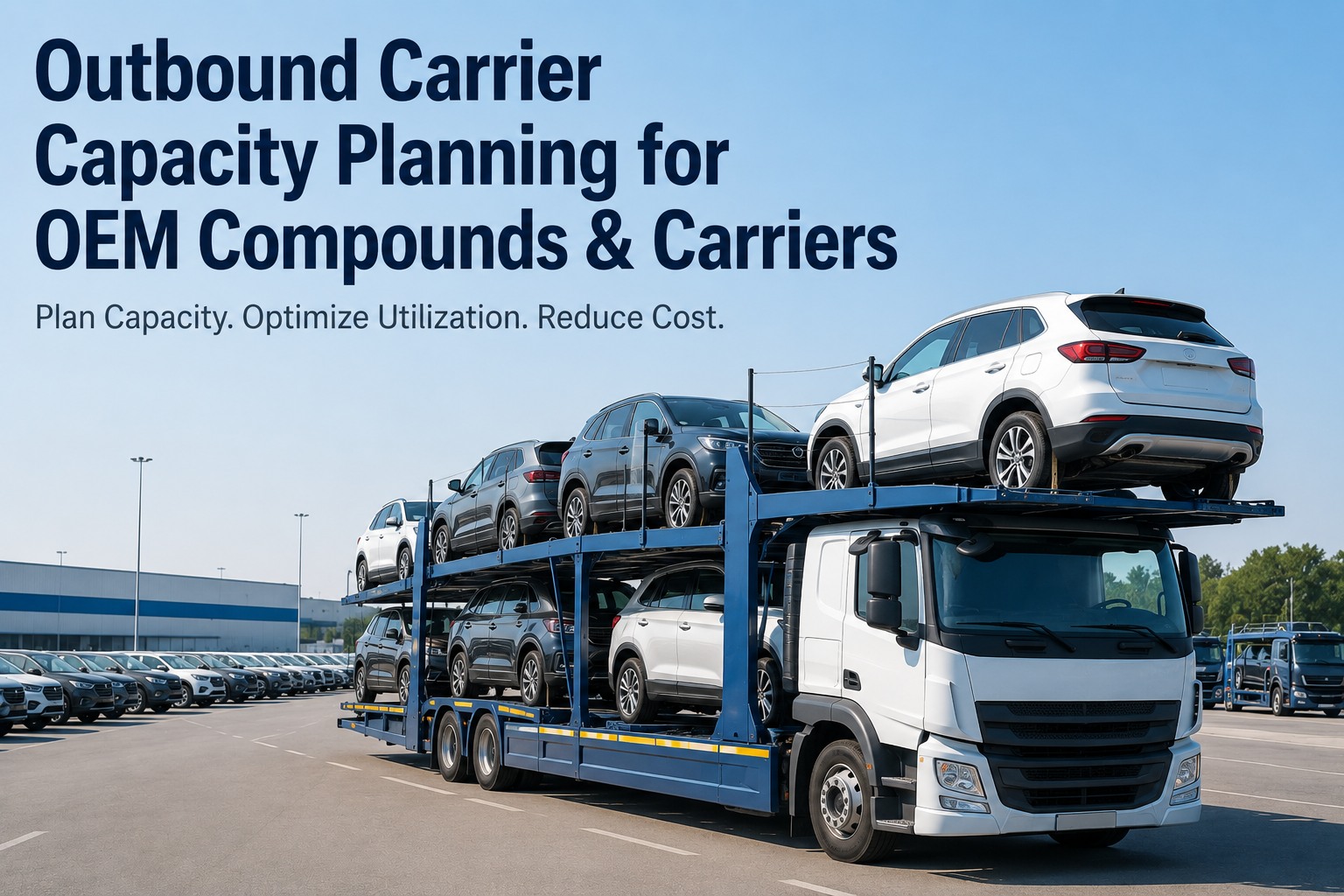
Outbound Carrier Capacity Planning
Commitments set against the production plan, seasonality built in rather than absorbed, carrier mix designed deliberately, and spot exposure priced before it is incurred.
Where next month's volume is actually covered from
Spot
Smallest slice of volume, largest share of the cost variance
Overflow carriers
Contracted but not committed — available when they choose to be
Core committed capacity
Volume matched to a commitment, on lanes the carrier has agreed to serve
Most operations know the total and not the split. The top layer is where the budget breaks, and it grows quietly whenever the bottom layer was planned from last quarter rather than from the build schedule.
What Actually Changed
Four market facts, all current, and none of them about demand. This is a supply-side market and it is behaving like one.
14.2%
Outbound tender rejection in March 2026, up from 8.5% a year earlier — carriers turning down contracted loads because better freight exists
~55%
Spot rates above year-ago benchmarks, with spot moving above contract — shippers paying a premium for spot for the first time since early 2022
~1%
Demand growth in dry van across 2026. The tightness is not coming from freight volume — it is coming from trucks leaving
Record
Contract rates forecast to reach record levels by the end of 2026, with the transportation prices index already at a record high in May
Why this does not unwind quickly
Because the capacity left for structural reasons. Enforcement activity through 2026 has narrowed non-domiciled licence eligibility, revoked electronic logging devices, and closed a very large number of driver training locations, while a Supreme Court decision has exposed brokers to direct liability for hiring unsafe carriers. Trucks that exit through enforcement, licensing revocation or bankruptcy do not come back quickly — and the carriers that left over the past three years have not returned.
Car Haul Is Tighter Than the Headline
General truckload figures understate the position for finished vehicles, for three reasons that compound each other.
Specialised capacity cannot be replaced quickly
Segments requiring particular endorsements and experience face the sharpest constraints, because that capability takes years to build. When a driver leaves specialised work for local delivery, the capacity does not come back the following week — and specialised loads have been commanding premiums of roughly twenty to thirty per cent over standard dry van partly for this reason.
The equipment is purpose-built
A car carrier cannot be redeployed from another segment when demand rises, and cannot be repurposed when it falls. Supply is therefore far less elastic in both directions than the general truckload market, which flexes.
Costs have risen structurally, not cyclically
European analyses put the cost of moving vehicles by road, rail and sea more than 50% higher than in 2019, driven by driver shortages, energy prices and tighter environmental regulation. Providers are locked into higher operating costs for assets, insurance and compliance regardless of where rates go.
And the cost argument is live
Carriers are seeking to pass those costs through in tariffs and surcharge structures while manufacturers push back to protect vehicle affordability. That tension sits inside every negotiation, and it is why a conversation framed purely on rate tends not to secure capacity.
8.5%
→
14.2%
tender rejection, year on year
A signed rate is not a truck.
Roughly one in seven contracted tenders is now being rejected across the market, which turns a coverage plan built on contract rates into an estimate. Bring your commitment schedule and last quarter's actual coverage to a 30-minute session and we'll show the gap in Fleet Rabbit — how much of your plan was covered as intended, and how much quietly went to spot.
Plan From the Build Schedule, Not the Rear-View
Five inputs. The first is the one most capacity plans skip, and skipping it is what produces a plan that is already wrong when it is signed.
Designing the Carrier Mix
Four layers, each doing a different job. The mistake is treating them as a single pool of carriers at different prices.
← Swipe to see all columns →
Dedicated is receiving renewed attention precisely because of this market — shippers are seeking service reliability, capacity assurance and risk mitigation rather than the lowest available rate. The trade is explicit: you pay for certainty in advance instead of paying for scarcity afterwards, and in a market with one in seven tenders rejected, the second option has become the more expensive one on many lanes.
Seasonality, Handled Properly
Four practices. Seasonality is the easiest capacity problem to solve and the one most often absorbed at spot rates instead.
Commit for the peak, not the average
A commitment sized to average monthly volume guarantees a shortfall in every peak month. Size the core layer to something closer to the peak and use the overflow layer for the residual, rather than sizing to the mean and buying the difference in the worst market conditions of the year.
Give carriers the forecast, early
Capacity now requires earlier commitment and better relationships to secure at reasonable rates. A carrier who knows your peak three months out can plan drivers and equipment against it; one told three weeks out is being asked to solve your problem from their spot book.
Separate model-year changeover from ordinary peaks
Changeover produces a volume shape unlike anything else in the year and it is entirely predictable. Treating it as an unforeseeable surge is a choice, not a constraint.
Price the smoothing option
Holding units slightly longer to flatten a dispatch peak has a cost in compound space and working capital — and it may still be cheaper than covering that peak at spot. That comparison is rarely made because the two costs sit in different budgets, which is exactly why it is worth making deliberately.
Contracting has changed shape
Negotiations repricing for the second half of 2026 are focused on securing service commitments rather than contesting rate increases — a genuine reversal from earlier in the cycle. The practical implication is that a rate agreement without an acceptance commitment attached is not a capacity agreement. Ask what volume the carrier is committing to accept, on which lanes, within what notice, and what happens when they do not.
The Real Cost of Spot Exposure
Six costs. Only the first appears on the freight invoice, which is why spot exposure is consistently under-priced in planning.
1The rate premium itselfSpot currently sitting above contract, with the gap wide enough that carriers are actively redirecting capacity toward committed freight and repricing accordingly.
2Budget variance rather than budget levelA predictable high cost is manageable; an unpredictable one is not. Spot exposure converts a planned line into a variable one, which is a finance problem as much as a logistics one.
3Compound space consumed while waitingUnits held because no truck was available occupy positions, extend dwell and push other work down the yard. The freight cost is visible; the space cost is not.
4Unknown carriers, unknown qualitySpot means moving high-value units with parties you have not scored, on equipment you have not seen. Damage exposure and claims complexity both rise, and the carrier verification burden falls on you at the least convenient moment.
5Dealer delivery dates missedThe downstream cost, and the one that damages relationships rather than budgets. It is also the cost that never gets attributed back to a capacity decision made months earlier.
6Position in the next negotiationA shipper visibly dependent on spot has less leverage when contracting, not more. Carriers can see who is covering their plan and who is scrambling — and in a market where they are choosing between customers, that is a commercial disadvantage that compounds annually.
Track spot as a share of units moved and as a share of freight spend, separately. The two figures diverge sharply, and the divergence is the argument: a layer carrying a small fraction of volume while consuming a disproportionate share of cost is the clearest case available for committing earlier next cycle.
Becoming a Customer Carriers Choose
In a market where carriers are selecting between shippers, being easy to serve is a capacity strategy. Five things that cost little and change how you are ranked.
Accurate, early forecastsVolume by lane and by period, shared far enough ahead to be planned against. A carrier who can staff to your requirement will prioritise it over one who cannot be predicted.
Fast loading, short turnsGate throughput, release accuracy and load readiness determine how many loads a driver completes in a week. Compound performance is carrier economics, and carriers price it.
Units that are actually readyReleased, drivable, keys present, sequence correct. A carrier turned away or held while a unit is sorted has lost a day, and they remember which compounds do that.
Prompt, undisputed paymentStraightforward in principle and a genuine differentiator in practice, particularly for the smaller operators that make up the large majority of the industry and feel cashflow most acutely.
Honest performance data, shared both waysScorecards built from your own event data rather than from carrier-supplied figures, discussed openly. Transparency in both directions is increasingly what distinguishes a partner from a buyer.
Twenty minutes on your commitment schedule and last quarter's actual coverage
On a working session we'll map planned volume against how it was genuinely covered — core, overflow and spot — break spot exposure out by units and by spend separately, and identify which lanes are consistently falling through to the spot market. You keep the coverage analysis either way, and it is usually the document that changes how the next commitment cycle is sized.
Frequently Asked Questions
Why is capacity tight when freight demand is flat?
Because the tightness is on the supply side. Demand growth across most sectors has been minimal in 2026 — dry van demand up only around one per cent — while fleet counts have continued falling and carriers that exited over the past three years have not returned. Enforcement activity has narrowed licence eligibility, revoked logging devices and closed a large number of training locations, and trucks leaving through enforcement, revocation or bankruptcy do not come back quickly. It is structural rather than cyclical.
Our rates are contracted. Isn't our capacity secured?
Not any more. Outbound tender rejection reached roughly 14% in March 2026, up from around 8.5% a year earlier — carriers declining contracted loads because better-paying freight is available. With spot moving above contract levels, a rate agreement without an acceptance commitment attached is a price, not a capacity guarantee. Establish what volume the carrier commits to accept, on which lanes, within what notice, and what the consequence is when they decline.
Is car haul tighter than general truckload?
Generally yes, for three compounding reasons. Specialised segments face the sharpest constraints because the endorsements and experience involved take years to build, and specialised work has been commanding premiums of roughly twenty to thirty per cent over standard dry van partly on that basis. Car carrier equipment cannot be redeployed from other segments when demand rises. And the sector faces a documented shortage of specialised transport drivers alongside persistent port and terminal congestion.
Should we be looking at dedicated capacity?
It is worth modelling, and it is receiving renewed attention for exactly this market — shippers are pursuing service reliability, capacity assurance and risk mitigation rather than the lowest rate. The trade is explicit: you pay for certainty in advance instead of paying for scarcity afterwards. On lanes where rejection is frequent and the downstream cost of a missed dispatch is high, the second option has often become the more expensive one.
How should we plan for seasonal peaks?
Commit closer to the peak than to the average, and share the forecast early. A commitment sized to average volume guarantees a shortfall every peak month, which then gets covered at spot in the worst conditions of the year. Capacity now requires earlier commitment and better relationships to secure at reasonable rates, so a carrier given three months of visibility can plan drivers and equipment against your peak — one given three weeks is being asked to solve it from their spot book.
How do we measure spot exposure properly?
As a share of units moved and a share of freight spend, reported separately — because the two diverge sharply and the divergence is the argument. Then add the costs that never reach the freight invoice: compound space consumed while units wait, damage and claims exposure from carriers you have not scored, missed dealer dates, and weakened position in the next negotiation, since carriers can see which shippers are covering their plan and which are scrambling.
What actually makes carriers prioritise us?
Being easy to serve, which in a market where carriers choose between shippers is a capacity strategy rather than a courtesy. Accurate early forecasts, fast gate and loading turns, units genuinely ready when the truck arrives, prompt payment — which matters disproportionately to the smaller operators making up most of the industry — and performance data shared honestly in both directions.
Book a session with your coverage data and we'll show where your compound is costing carriers time.
Commitment Buys Capacity. Price Buys an Argument.
Plan from the build schedule rather than last quarter, size the core layer to the peak, share forecasts early enough to be planned against, track spot by units and by spend separately — and make the compound a place carriers want to load, because that is now part of how capacity gets allocated.
Market figures current at time of writing and subject to change — verify prevailing conditions before contracting · Bring your commitment schedule and coverage data to the call