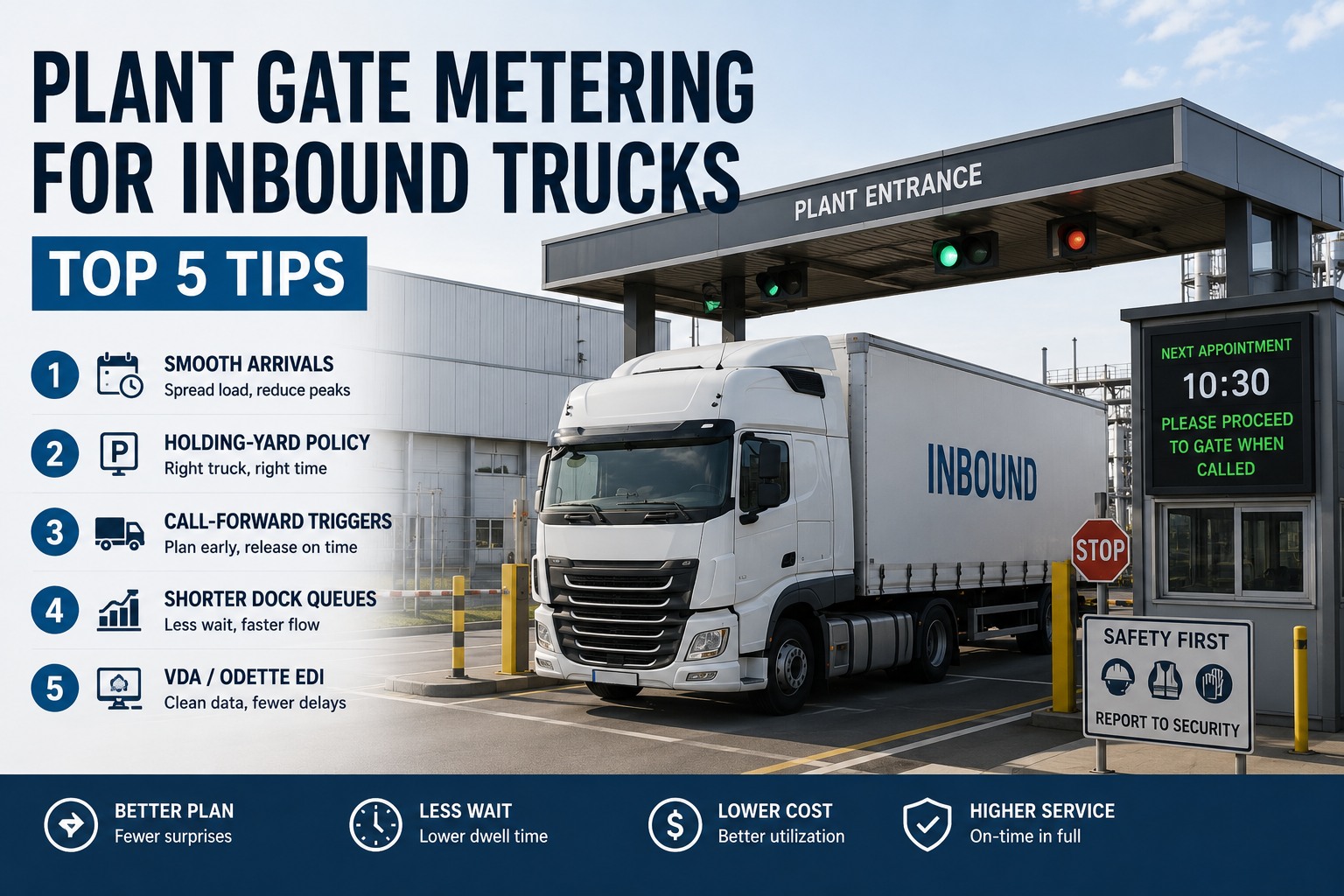
Gate cost does not rise in a straight line. That single fact is the whole argument for metering, and it is the one most plants discover the hard way — you add eight more inbound loads a day, the gate absorbs six of them without complaint, and the seventh turns a fifteen-minute check-in into a forty-minute queue on the access road. Queueing behaviour is non-linear: once a gate passes roughly 90% utilisation, waiting time and queue length climb disproportionately, and past 0.95 they climb steeply. Metering is the discipline of never letting the gate reach that region — shaping arrivals upstream so the barrier operates in its linear range, where every truck costs what it should. Published optimisation work on gate congestion has cut daily truck waiting cost by more than 80% without adding a single lane, purely by controlling arrival rate. Below are the five levers that produce most of that saving in a plant environment, plus the call-forward logic, holding-yard rules and VDA/Odette message backbone that make them work. Talk to a solutions engineer to size them against your own gate volumes.
TOP 5 · INBOUND COST REDUCTION
Plant Gate Metering: Five Ways to Cut Inbound Cost
Arrival smoothing, holding-yard policy and call-forward triggers — with the queue mathematics that explain why each one pays, and the VDA and Odette messages that carry the data underneath.
Why Gate Cost Is Not Linear
Before the five levers, the mechanism. A gate is a queueing system with an arrival rate, a service rate and a number of lanes. Utilisation is simply arrivals divided by capacity — and the relationship between utilisation and waiting is a curve, not a slope. This is why a gate that "coped fine last year" fails this year on a volume increase that looks modest on a spreadsheet.
Gate utilisation against expected waiting
70% utilised
Queue clears between arrivals. Variability absorbed without intervention.
80% utilised
Wait rising but predictable. Peak hours start to show a residual queue.
90% utilised
Waiting climbs disproportionately. One late arrival now propagates all afternoon.
95%+ utilised
Queue length and wait escalate sharply. No amount of gate staffing recovers the shift.
The practical consequence: metering is not about processing trucks faster. It is about keeping the arrival rate low enough that the gate never enters the steep part of the curve. Demand-side control reaches that outcome without capital spend — which is why arrival management consistently outperforms adding lanes on cost per truck avoided.
Where the Inbound Money Actually Leaks
Five cost lines, in the order most plants under-estimate them. Note that only the first is normally on anyone's budget — the other four are absorbed into operations and never attributed to the gate.
Detention and demurrageBilled, visibleCarrier free time expires while a truck sits in queue. The one line finance already sees — and usually the smallest of the five.
Yard labour absorptionHidden in headcountShunt drivers searching, reshuffling and firefighting instead of executing planned moves. Reads as a staffing problem, is actually a metering problem.
Expedite and premium freightHidden in logistics spendAir and dedicated runs bought to recover a part that was physically on site but stuck behind a queue. Attributed to the supplier, caused by the gate.
Line risk and recovery overtimeHidden in productionThe expensive one. Any queue that reaches the sequence window converts directly into sort labour, overtime or a stoppage.
Idling, emissions and carrier goodwillHidden entirelyEngines running in a queue, plus the slower degradation: carriers price your site higher, or decline the lane.
The Top 5 Metering Levers
Ordered by return on effort, not by sophistication. Most plants can implement the first three inside a quarter with no gate hardware at all. Each lever below carries the cost line it attacks and the objection you will hear when you propose it.
01Slot against real capacity, not a static timetable
What it isBooking windows issued against demonstrated gate and dock throughput per hour, recalculated against the day's build plan rather than fixed once and inherited for years.
How to implementMeasure actual gate transactions per hour and per lane for four weeks. Set slot density at a level that holds utilisation near 80%, not 95%. Rebuild the slot grid seasonally.
Cost leverAttacks the entire curve. Every other lever is cheaper once utilisation is out of the steep region.
Objection you will hear"We will lose capacity." You will not — you lose the peak that was already costing you more than it delivered.
02Reslot in transit, before the truck is a gate problem
What it isLive carrier ETA against the booked window, with automatic reslotting when the variance exceeds tolerance — resolved while the vehicle is still on the road.
How to implementIngest ETA from carrier telematics or a driver app. Set a variance threshold, typically 30 minutes, matching the window granularity premium OEMs already score suppliers against.
Cost leverConverts a gate event into a planning event. Planning events cost almost nothing; gate events cost the whole cascade.
Objection you will hear"Our carriers won't share data." Many already do via telematics; the rest can run a driver app with no hardware cost.
03Put earliness outside the fence
What it isA holding yard or nominated truck stop off site, with drivers held there under a call-forward instruction rather than admitted to consume yard positions they do not yet need.
How to implementNominate the location, write the policy (see rules below), push call-forward to the driver's handset. No infrastructure beyond a leased surface and a rule set.
Cost leverAttacks yard labour absorption directly. Off-site square metres cost a fraction of in-yard positions.
Objection you will hear"Drivers will refuse to wait off site." They wait either way — the question is only whether they wait somewhere that costs you yard capacity.
04Pre-match the paperwork to the vehicle
What it isThe despatch advice arrives, is validated and is bound to the expected vehicle before the truck reaches the barrier — so the gate transaction is a confirmation, not a data-entry exercise.
How to implementEnforce ASN discipline on the supply base and scan the transport label at the gate rather than keying a delivery note. This is where the VDA and Odette layer does the work.
Cost leverRaises the service rate, which lowers utilisation at unchanged volume — the only supply-side lever on this list that is genuinely cheap.
Objection you will hear"Some suppliers still send paper." Those are the suppliers generating your longest gate transactions. Measure them and the case writes itself.
05Meter to the dock queue, not to the gate queue
What it isThe release signal is governed by downstream readiness — door availability and sequence-window demand — rather than by whether the barrier happens to be free.
How to implementMake door state and window demand visible to the gate release logic. A truck is only admitted when there is somewhere for it to go within a defined horizon.
Cost leverAttacks line risk. This is the lever that stops queue length translating into sequence exposure.
Objection you will hear"That will slow the gate down." Correct, and deliberately so — a fast gate feeding a full yard just relocates the queue.
Levers one to three need no gate hardware and no ERP change.
A solutions engineer will run your gate volumes, lane count and current transaction times through the utilisation curve and show which of the five moves your number furthest, first.
Call-Forward Trigger Matrix
Metering only works if release is rule-driven rather than discretionary. These are the trigger conditions worth encoding, the action each produces, and who has to be told. Write them down before you automate them — most plants discover during this exercise that their current rules contradict each other. The dispatch and scheduling side handles the carrier half of the same conversation.
← Swipe to see all columns →
Holding-Yard Policy, in Seven Rules
The holding yard fails when it becomes an unmanaged overflow car park — which is what happens without written policy. These seven rules are the minimum viable version.
1Nothing enters the plant yard without an active reason. Earliness is not a reason.
2Hold time counts toward the free window. Publish this so carriers can price it and nobody argues later.
3Call-forward is issued to the driver's device, with a stated travel allowance to the gate.
4Sequence-critical loads bypass hold order. Priority is by window, never by arrival time.
5Every held trailer carries a known state and contents. An unlabelled hold is worse than no hold.
6Facilities are a condition of the policy, not a courtesy. Sanitation and rest access, or carriers stop complying.
7Measure hold duration separately from yard dwell. Merging them hides which of the two is failing.
The VDA and Odette Layer Underneath
Metering depends on knowing what is arriving before it arrives, and in European automotive that knowledge travels on a defined message set rather than a phone call. If your supply base is German or European, this is the backbone that makes lever four possible — and the reason gate transactions at some plants run three minutes while others run twelve. Note that the North American equivalent of the despatch advice is the ANSI X12 856, and that EDIFACT DESADV sits underneath the VDA derivatives.
← Swipe to see all columns →
Practical test: pick your ten longest gate transactions from last month and check how many involved a supplier with no validated despatch advice. The correlation is usually close to total, and it converts an EDI compliance programme from an IT initiative into a gate throughput project with a number attached.
What Changes at the Dock
Metering is judged at the gate but felt at the dock. This is the shift in dock-side behaviour that indicates the levers are actually working — and the pattern that means they are not.
Unmetered
Dock queue length varies wildly by hour, with a morning peak nobody plans for
Door assignment decided on the dock, by whoever is standing there
Unload order follows arrival order, so priority loads sit behind stock
Sequence-critical trailers discovered late, recovered by expedite or sort
Detention invoices arrive monthly and are disputed without evidence
Extra gate staff added at peak, with no measurable effect on queue
Metered
Dock queue held within a narrow band all shift; peaks flattened upstream
Door assigned before the vehicle is called forward
Unload order follows window demand, not arrival order
Sequence-critical trailers held in known state and released on trigger
Detention settled against a timestamped gate-to-gate record
Gate staffing unchanged; utilisation kept out of the steep region instead
Size the Five Levers Against Your Own Gate
Bring your inbound volume, lane count, average transaction time and current dock queue profile. A solutions engineer maps them onto the utilisation curve, identifies which of the five levers moves your number furthest, and sets out what each one costs to implement. No hardware assumptions, no ERP replacement.
Arrival smoothing
Call-forward triggers
VDA / Odette ready
No gate hardware to start
Frequently Asked Questions
Is gate metering just appointment scheduling under another name?
Appointment scheduling is one of the five levers. Metering is the wider discipline of controlling the release rate into the site against downstream readiness — which includes slotting, but also in-transit reslotting, off-site holding, ASN pre-matching and dock-queue-governed release. Plenty of plants have appointments and still congest, because slots were set against a static timetable rather than real capacity, and because nothing throttles admission once the yard is full.
Would adding a gate lane not solve this more simply?
Sometimes, and it is worth modelling. But lanes raise service rate, and the curve is driven by the ratio of arrivals to capacity — so a new lane buys headroom that the next volume increase consumes, at capital cost. Demand-side control moves the same ratio for a fraction of the spend, and published gate optimisation work has cut daily waiting cost by over 80% largely through arrival rate control rather than added capacity. Model both; the lane is usually the second answer, not the first.
What do we need before we can start?
Four weeks of gate transaction timings, arrivals per hour by day of week, current lane count, and a rough dock queue profile. That is enough to place your gate on the utilisation curve and identify which region you are operating in. Everything else — holding-yard policy, trigger rules, ASN discipline — follows from knowing whether you are at 75% or 93%, because the answer changes which lever to pull first.
Do we have to be on VDA 4987 already?
No. Metering works on whatever arrival signal you have, including manual pre-advice. But message quality directly determines gate transaction time, and 4987 replaced the legacy 4913 as the current despatch advice standard — with an APERAK acknowledgement confirming validation, so the gate can trust the record it is matching against. If your supply base is European automotive, migrating the stragglers is usually the cheapest available improvement to service rate. Our
integrations overview covers the wider data surface.
How do we stop the holding yard becoming an overflow car park?
Written policy and a state per trailer. The failure mode is always the same: a location gets nominated, drivers start using it informally, nobody records what is held or why, and within a quarter it is a second unmanaged yard with worse visibility than the first. The seven rules above exist to prevent exactly that — particularly rule five, that every held trailer carries a known state and contents, and rule seven, that hold duration is measured separately from yard dwell.
Will carriers accept being held off site?
Generally yes, provided two things are true: hold time counts toward their free window, and the facility is habitable. Carriers object to unpaid, undignified waiting, not to waiting as such — they are already waiting in your gate queue today, just somewhere that also costs you yard capacity. Publishing the policy up front, including how hold time is treated commercially, removes almost all of the friction and most of the later invoice disputes.
What is a realistic first result?
Flattening the arrival peak is usually visible within a month of reslotting, and it is the result to lead with because it is measurable without any new system. Dock queue variance narrows next. Detention exposure follows once the timestamped record exists to invoice against. Sequence protection is last and largest, because it sits at the end of the chain — plan the case on the early metrics and treat line protection as the compounding return.
Get Your Gate Out of the Steep Part of the Curve
Arrival smoothing, holding-yard policy and rule-driven call-forward — modelled against your inbound volumes and your VDA or Odette message maturity, with the cost line each lever attacks made explicit before anything is committed.
Levers 1–3 need no gate hardware · Works alongside existing EDI · Site-level configuration
August 11, 2026By yaman lam
All Blogs