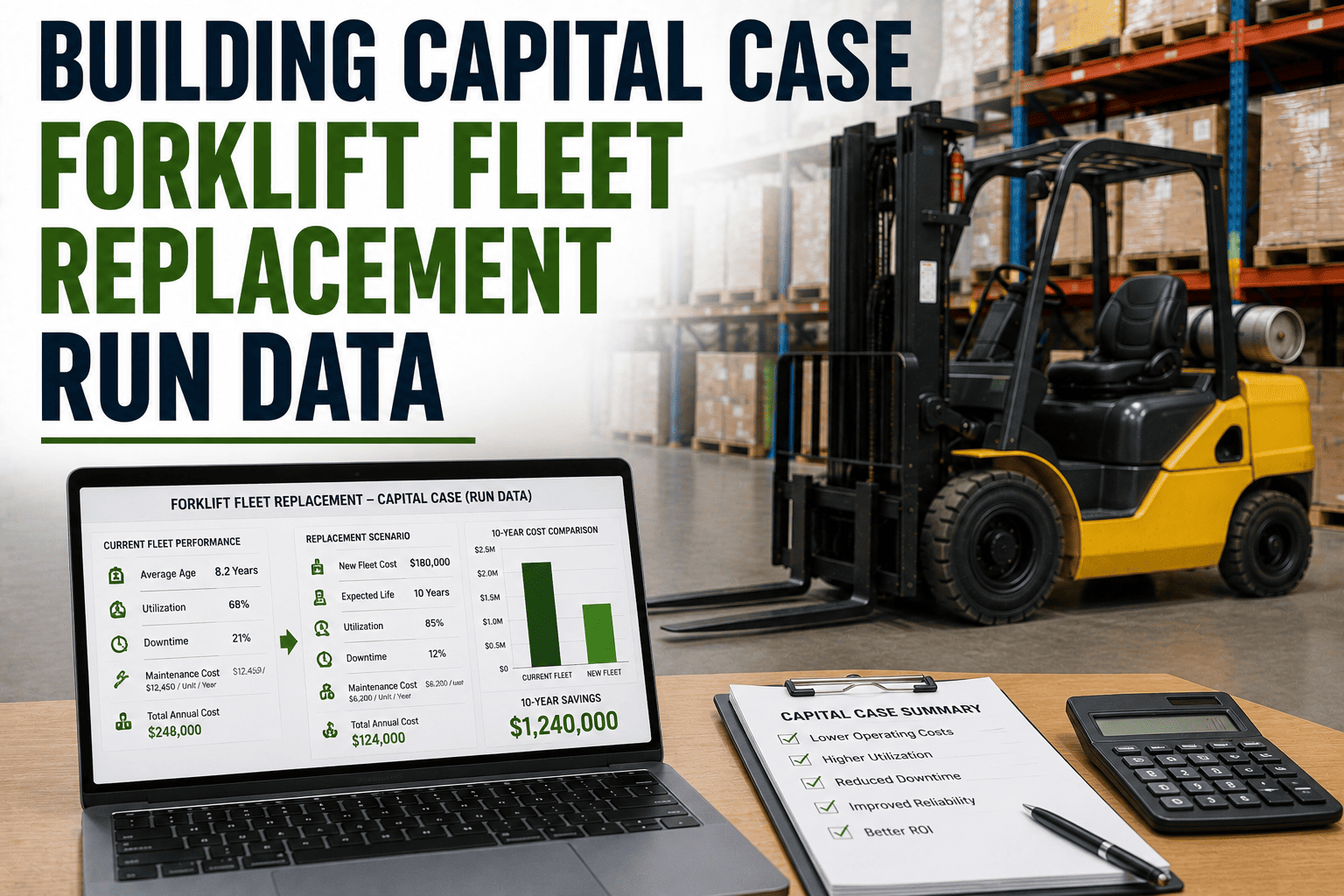
Every plant manager eventually walks into a budget meeting asking for new forklifts, and most walk out empty-handed. Not because the trucks aren't old, and not because the request isn't reasonable, but because "these are getting worn out" is an operations statement, not a financial one. Finance approves capital based on payback periods, cost trends, and risk exposure they can put in a spreadsheet. The plants that get replacement budgets approved on the first ask are the ones that show up with run-hour data, cost-per-hour trends, and a clear before-and-after number, not a feeling that the fleet is due.
A capital case for forklift replacement is built on run-hour and cost-per-hour data, not fleet age. Most forklifts have an economical operating life of 5 to 7 years or 15,000 to 20,000 hours. Sorting the fleet into Retain, Watch, and Replace groups based on actual hours and rising repair costs turns a vague request into a specific, financeable proposal.
What Finance Actually Wants to See
Operations teams tend to lead with mechanical condition. Finance teams lead with payback period. A proposal that states how many months it takes to recover the capital outlay, backed by low, expected, and high savings scenarios rather than a single optimistic number, is far more likely to clear a budget committee than one built around "the forklifts are old."
Lead With the Cost of Doing Nothing
Before presenting the price of new equipment, quantify what the current fleet is already costing through rising maintenance spend, unplanned downtime, and diverted labor. A proposal that opens with the current, documented cost of an aging truck makes the replacement number look like a reduction in spend rather than a new expense.
FleetRabbit tracks cost per hour, run hours, and repair trends automatically, giving you the exact numbers finance needs without weeks of manual spreadsheet work. Start a free trial to pull your own fleet data, or book a demo to see a sample capital case built from your numbers.
The Three-Bucket Method for Sorting Your Fleet
Not every truck in the fleet needs the same decision. Sorting each unit into one of three categories based on run hours and cost trends turns a fleet-wide replacement request into a focused, prioritized capital plan finance can approve in stages rather than all at once.
Run Hours Matter More Than Truck Age
A calendar year tells you almost nothing about how hard a truck has actually worked. A truck logging 2,000 hours a year reaches typical replacement age in about five years, while a truck running only 500 hours a year might last three times as long, even though both trucks are the same model year. Building the capital case around actual run hours rather than purchase date keeps the Watch and Replace buckets accurate instead of arbitrary.
The Hidden Risk: Parts Obsolescence
A truck can be mechanically fine and still be a liability if the manufacturer has stopped supporting its control boards or major components. When technicians start sourcing discontinued parts through secondary markets just to keep a unit running, that is a capital-case argument in its own right, separate from the cost-per-hour trend.
Building the Data Package Finance Can't Argue With
A capital proposal is only as strong as the data behind it. The strongest packages combine hard cost data with a small set of strategic points that matter to the board but resist clean dollar figures.
| Data Point | Why Finance Wants It |
|---|---|
| Cost per operating hour | Shows the real trend line behind a truck's expense, not just its purchase price |
| Run hours vs. economic life | Confirms whether a unit is genuinely near end of life or simply old on paper |
| Payback period, low/expected/high | Gives finance a defensible range instead of a single optimistic estimate |
| Downtime and repair frequency trend | Demonstrates the cost of doing nothing, not just the cost of acting |
| Strategic risk factors | Covers safety exposure and parts obsolescence separately, so they don't weaken the core ROI number |
Keep the strategic risk factors in their own short section of the proposal rather than folding them into the ROI calculation itself. Blending a hard-to-quantify safety concern into a dollar figure invites the finance committee to question the whole model. Presented separately, it becomes the detail that pushes a marginal case toward approval.
FleetRabbit automatically sorts your fleet into Retain, Watch, and Replace, complete with cost-per-hour trends and run-hour history ready to drop into a budget proposal. Sign up free to see your fleet's breakdown, or book a 30-minute demo to walk through building your case.
Frequently Asked Questions
A capital request built on run-hour data and a clear payback range rarely needs a second meeting. Sorting the fleet into Retain, Watch, and Replace turns a vague sense that equipment is aging into a specific, staged plan finance can act on with confidence. The plants that replace equipment on schedule instead of reacting to breakdowns are almost always the ones treating this as an ongoing data exercise rather than a once-a-year scramble before budget season closes.
FleetRabbit gives you the run-hour history, cost-per-hour trends, and replacement priorities finance actually wants to see, without weeks of manual reporting. Sign up free and connect your fleet today, or book a demo to see your own capital case built out.