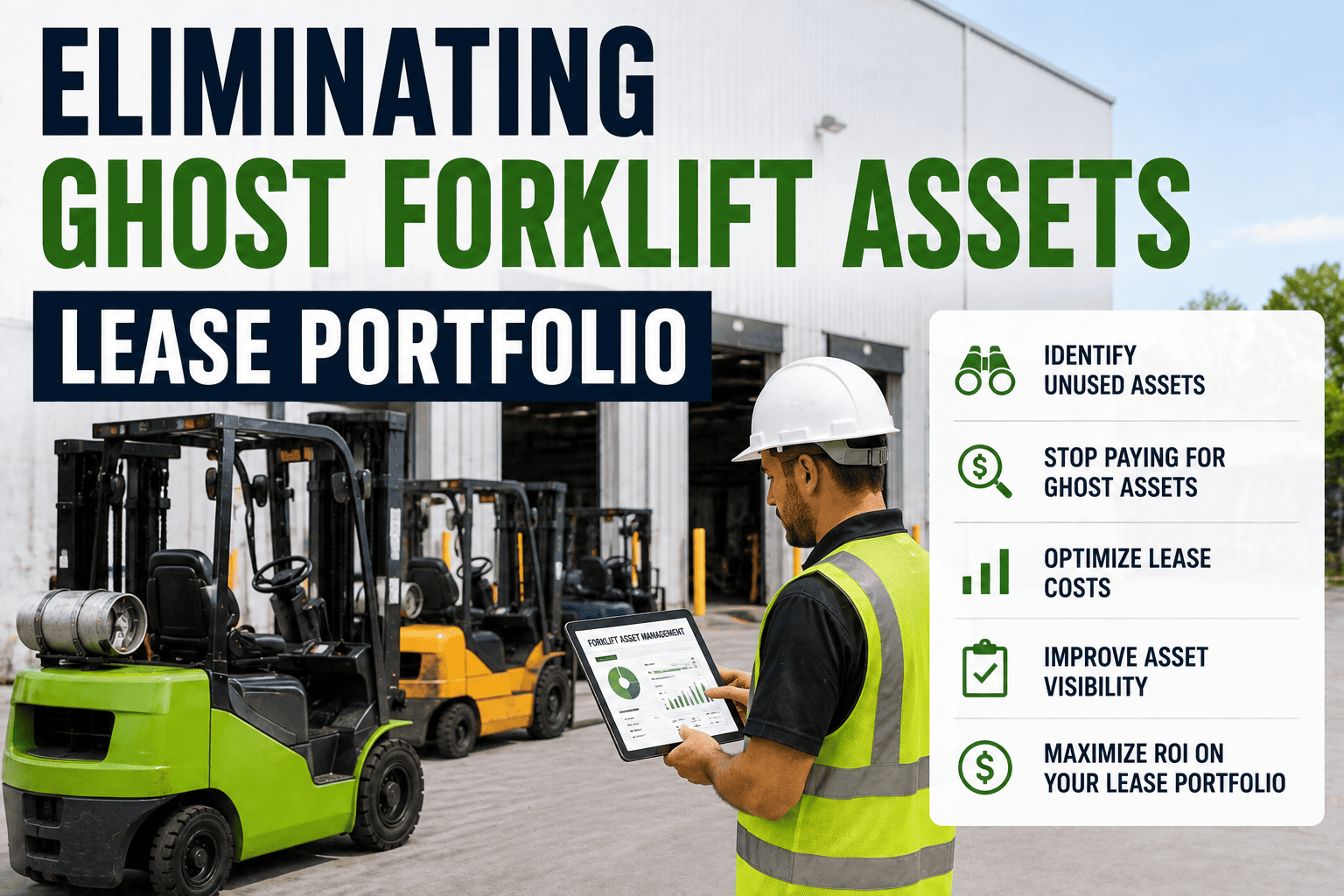
Somewhere on your lease schedule right now, there is probably a forklift you are paying for that almost nobody drives. It shows up on the invoice every month, it depreciates on the books, and finance assumes it is pulling its weight on the floor. In reality it might sit untouched for most of a shift, parked behind a rack because nobody remembers to reassign it. Fleet managers call this a ghost asset: equipment that still costs money but has stopped earning it. Most plants have more of them than anyone realizes, and the only way to find them is to look at actual usage data instead of the lease schedule.
A ghost asset is a leased or owned forklift that keeps generating cost without generating enough productive use to justify it. North American forklift fleets run at an average utilization of roughly 46.9 percent, well below the 60 percent threshold most fleet economics assume, which means nearly half of typical fleet capacity is sitting idle while still being paid for. Identifying and removing chronically underutilized units from the lease portfolio is one of the fastest ways to cut fleet cost without touching a single operating process.
What Actually Makes a Forklift a Ghost Asset
Not every quiet forklift is a ghost asset. A backup unit kept for peak season has a job to do even if it sits still most weeks. The distinction is chronic, unexplained underuse: a unit that keeps showing up on the lease invoice month after month without a demand pattern that justifies its presence on the floor.
Why This Hides So Easily in a Manufacturing Fleet
Ghost assets survive because procurement, maintenance, and floor operations rarely look at the same data. A lease gets signed at the corporate level, the unit gets deployed to a plant, and from that point on its day-to-day usage is tracked nowhere except a whiteboard or an operator's memory. Finance sees a fixed monthly cost and assumes utilization; the floor sees a spare truck and assumes someone else is accounting for it. Neither side has the visibility to catch the gap, which is exactly why ghost assets can sit on a lease portfolio for years without anyone questioning them.
The Utilization Gap, Visualized
Fleet economics generally assume a forklift needs to run at least 60 percent of standard working hours, close to 1,200 hours a year in a single shift, to justify purchasing or long-term leasing over renting. Most fleets fall well short of that line.
The gap between these two numbers is where ghost assets live. Every point below the 60 percent line represents leased capacity the fleet is paying for but not using productively.
FleetRabbit tracks motion hours per unit, per zone, and per shift automatically, so you know exactly which forklifts are earning their lease and which are not. Sign up free and pull your fleet's utilization picture today.
What a Ghost Asset Actually Costs You
A single underused forklift rarely looks expensive in isolation, which is exactly why it survives budget reviews. The real damage shows up when its cost is stacked against the productive output it is delivering, and when it is multiplied across every similar unit hiding in the portfolio.
| Cost Line | How It Shows Up | Why It Keeps Running |
|---|---|---|
| Lease or Financing Payment | Fixed monthly cost continues regardless of hours run | Nobody revisits the lease once the original project ends |
| Depreciation | Book value declines whether the unit works or not | Depreciation schedules are set at acquisition, not reviewed against usage |
| Insurance and Compliance | Premiums and inspection costs apply per unit on the roster | Idle units are rarely removed from insured equipment lists |
| Yard and Floor Space | Physical space held for a unit that rarely moves | Space allocation is set once and rarely re-examined |
| Opportunity Cost | Capital tied up that could fund a genuinely needed unit elsewhere | Underuse in one plant is invisible to teams managing a different plant |
Right-Sizing in Practice
The payoff for closing this gap is not theoretical. One major automotive manufacturer used fleet analytics to identify and remove chronically underutilized forklifts from its portfolio, cutting fleet size by roughly 7 percent while saving about 500,000 dollars a year, alongside more than 2 million dollars in annual labor savings from better-aligned operator scheduling. The units were not idle by accident. They were idle because nobody had visibility into which forklifts were actually working and which were not, until utilization data made the pattern impossible to ignore.
- Lease decisions made by memory and habit
- Underused units renewed automatically
- Utilization tracked, if at all, by spreadsheet
- Idle capacity spread invisibly across shifts
- Every unit's motion hours visible in one dashboard
- Underused forklifts flagged before renewal
- Lease decisions backed by real usage data
- Capital redirected to zones that actually need it
Four Steps to Clear Ghost Assets Out of Your Portfolio
Why a One-Time Audit Is Not Enough
Demand Shifts Between Reviews
A unit that was fully utilized last quarter can become a ghost asset the moment a production line changes, which is why utilization needs to be watched continuously rather than checked once a year.
Manual Tracking Loses the Signal
Spreadsheets and whiteboards can show that a forklift exists, but they rarely capture how many hours it actually ran, which is the one number that separates a working asset from a ghost one.
FleetRabbit connects to your existing forklift fleet and surfaces utilization by unit, zone, and shift automatically, so ghost assets get flagged before the next renewal instead of years later. Book a free demo and see your own portfolio broken down this way.
How FleetRabbit Surfaces Ghost Assets Automatically
Finding ghost assets manually means cross-referencing lease schedules against sign-in sheets and hoping the data lines up. FleetRabbit removes that guesswork by connecting telematics on every forklift to a single utilization dashboard, showing motion hours by unit, zone, operator, and shift in real time. Instead of discovering a ghost asset during an annual audit, plant and finance teams see it flagged the moment its utilization drifts below the threshold that justifies its cost. You can start a free trial to connect your fleet in minutes, or book a demo to see a live utilization breakdown before your next lease renewal.
Frequently Asked Questions
Every underused forklift on the books is quietly eating into margin that better-utilized equipment could be earning back. FleetRabbit gives you the motion-hour data to find those units, decide what to do with them, and make every future lease decision on evidence instead of habit.