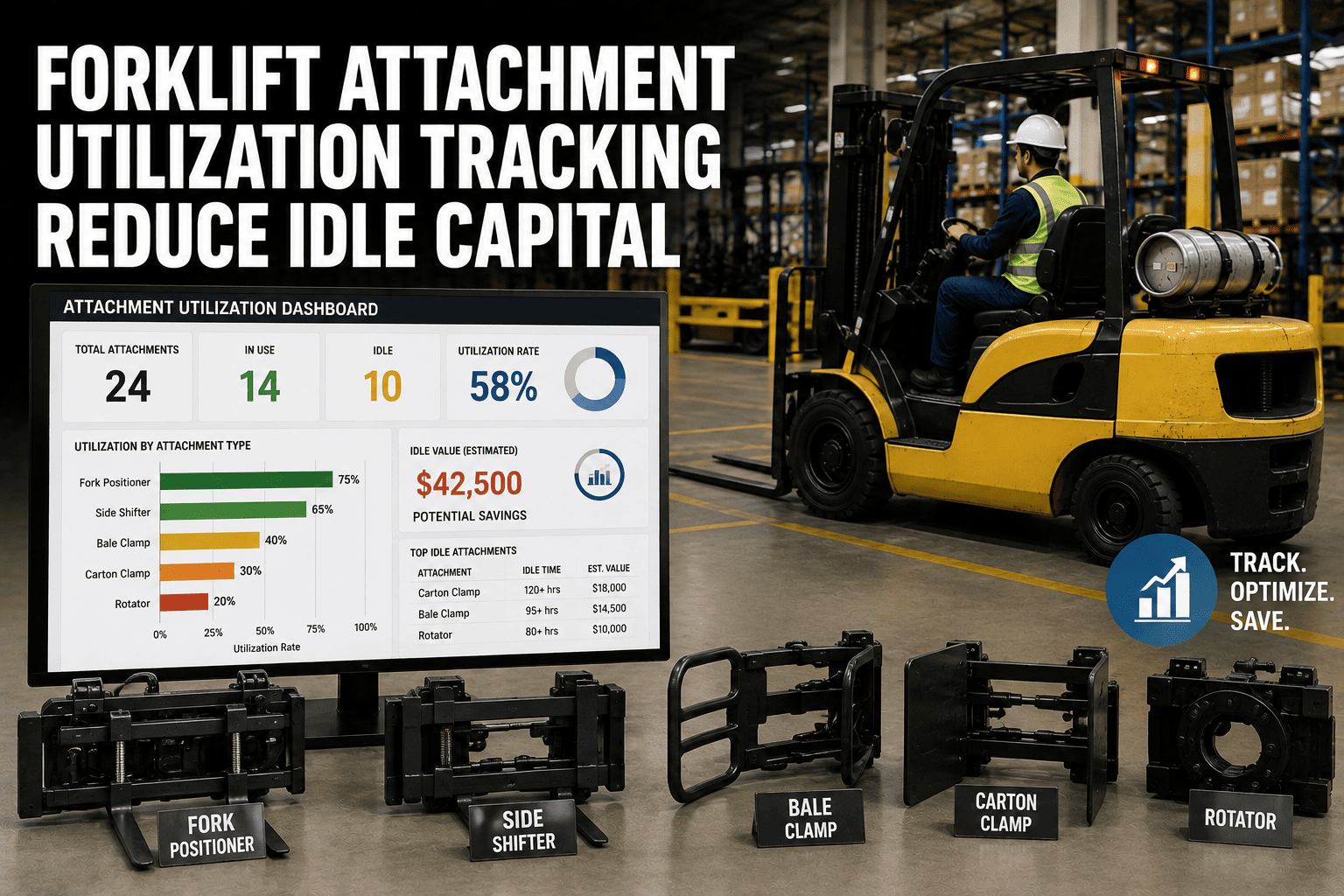
Walk any manufacturing floor and you will see forklifts everywhere, tracked, leased, logged, and reviewed every quarter. Now look at what is bolted onto the front of those trucks. Paper roll clamps, carton clamps, rotators, push-pulls, and sideshifters routinely cost as much as the truck carrying them, yet almost nobody tracks whether that attachment is actually working. It gets swapped between shifts, parked in a corner when a job ends, and forgotten in a cage until someone needs it again. That gap between what a plant owns and what a plant actually uses is idle capital, and it is quietly sitting on your balance sheet right now.
Forklift attachment utilization tracking measures how many hours a clamp, rotator, or push-pull is actually in productive use compared to how many hours it sits assigned but idle. Most plants that measure this for the first time discover 30 to 45 percent of their attachment fleet is underused, representing 25000 to 90000 dollars in idle capital per facility depending on fleet size. Tracking this data lets plants right-size attachment inventory instead of buying new units every time an operator says they need one.
Attachments Are Capital, Not Accessories
Assigned Hours Hide Idle Hours
Nobody Owns the Attachment Count
Why Attachments Disappear Into the Utilization Blind Spot
Forklift fleet reviews almost always stop at the truck. Managers track engine hours, fuel burn, and maintenance intervals for the vehicle itself, but the attachment riding on the carriage plate is treated as a fixed, permanent part of that truck rather than a separate, swappable, and expensive asset with its own usage pattern. In reality, attachments move constantly. A carton clamp gets pulled off Truck 4 for the afternoon shift on Truck 11, then parked overnight near the dock because nobody wants to carry it back across the floor. Multiply that pattern across a facility running 15 to 40 attachments and the count of what is actually working at any given hour becomes a guess, not a fact.
The Swap-and-Forget Cycle
Because attachments are physically detachable, they migrate. An operator grabs whichever clamp is closest rather than the one assigned to their truck, and the paperwork trail that would tell a plant manager which attachment did what work simply does not exist. Over months, this creates duplicate purchasing. Rather than reassign an existing rotator sitting idle in Building B, a supervisor in Building A requests a new one because nobody can quickly confirm what is already on hand and how often it runs. Plants that put real utilization tracking in place, the kind available through FleetRabbit's free trial signup, typically find several attachments they forgot they owned.
What This Costs Beyond the Purchase Price
Idle attachments still depreciate, still require the periodic seal and hose inspections that keep them warranty-compliant, and still occupy staging space that could hold inventory or equipment that is actually earning its keep. An attachment sitting unused for a full quarter has generated zero throughput while accumulating real carrying cost.
FleetRabbit connects to your forklift telematics and attachment tags to show active hours, idle hours, and location for every clamp, rotator, and push-pull on the floor. Stop guessing which attachments earn their keep. Sign up free and see your current attachment picture within days.
What Attachment Utilization Tracking Actually Measures
Utilization tracking for attachments works differently than tracking a truck. Because a clamp or rotator has no engine of its own, tracking relies on a combination of proximity tagging, hydraulic activation signals, and assignment logs that show when an attachment is mounted, moved, and actively cycling. The output is a simple but powerful number: active hours as a percentage of the hours that attachment was assigned to a shift.
| Attachment Type | Typical Unit Cost | Common Idle Risk | What Tracking Reveals |
|---|---|---|---|
| Carton Clamp | 6000 to 12000 dollars | Duplicated across shifts because handoff process is unclear | Real cycle count per shift versus hours assigned |
| Rotator | 10000 to 20000 dollars | Parked after a single job, not reassigned to next demand | Rotation cycles logged against total hours mounted |
| Push-Pull | 7000 to 14000 dollars | Bought for a seasonal run, never redeployed after | Seasonal usage curve showing true annual demand |
| Sideshifter | 2500 to 6000 dollars | Left permanently on a truck regardless of task fit | Task-match rate against jobs that actually need it |
| Fork Positioner | 3000 to 7000 dollars | Redundant units purchased per department silo | Cross-department usage overlap and duplication |
Reading the Utilization Signal
A single utilization number is not enough on its own. What matters is the pattern behind it, because two attachments both sitting at 40 percent utilization can represent completely different situations.
Active-Hours vs Assigned-Hours
An attachment can be assigned to a truck for an entire ten-hour shift while only cycling for three of those hours. Assigned-hours tracking alone would call that fully utilized. Active-hours tracking, which measures actual clamp or rotation cycles, exposes the real seven hours of idle time sitting inside that shift.
Seasonal Demand vs Chronic Idle
An attachment that runs hard for six weeks during peak season and then sits idle the rest of the year is not wasted capital, it is seasonal capacity. The attachment that never climbs above 20 percent utilization in any month, however, is a strong candidate for redeployment or sale.
Calculating Your Idle Attachment Capital
Putting a dollar figure on idle attachment capital gives fleet and plant managers a number that finance teams take seriously. Start by listing every attachment in the facility along with its purchase price, current age, and the department it is assigned to. For each one, gather active-hours data over a 90-day window either from existing telematics integrations or a short manual audit.
Next, calculate a monthly carrying cost for each attachment by combining depreciation, the portion of preventive maintenance budget allocated to it, and the staging space it occupies. Multiply that carrying cost by the number of months the attachment has run below a 40 percent utilization threshold. The result is the idle capital figure for that unit. Add every attachment together and most mid-size plants land in the 25000 to 90000 dollar range in capital sitting idle at any given time, before counting the emergency purchases made because nobody could locate an existing unit that would have worked.
Five Signs Your Plant Is Carrying Idle Attachment Capital
New Purchase Requests Keep Coming In
Supervisors repeatedly request new attachments even though the facility already owns several of the same type.
Nobody Can Answer "Where Is It" Quickly
Locating a specific clamp or rotator takes a radio call and a walk around the floor instead of a dashboard lookup.
Maintenance Records Show Long Gaps
Service logs reveal attachments that have gone months without an inspection, suggesting they simply were not in use.
One Department Hoards, Another Waits
A department stockpiles attachments "just in case" while a nearby line is short on the exact same equipment.
Lease Renewals Happen on Autopilot
Attachment leases renew every year without a utilization review to check if the fleet size still matches demand.
FleetRabbit gives plant managers a live attachment inventory with utilization, location, and maintenance history in one view, so the next purchase or lease renewal is based on data instead of a hallway request. Book a 30-minute demo and walk through your own attachment fleet with our team.
Building a Right-Sizing Program Around Attachment Data
Turning attachment tracking into an ongoing program takes three deliberate steps rather than a one-time audit.
Step One: Establish a Baseline Inventory
Tag every attachment, record its purchase date and cost, and assign a single owner responsible for its location and condition. This step alone often surfaces duplicate or misplaced units within the first two weeks.
Step Two: Connect Active-Hours Data
Link attachment activity to existing forklift telematics or a dedicated tracking layer so active cycles, not just assignment records, feed into a shared dashboard visible to every department, not just the one that purchased the unit.
Step Three: Review Quarterly, Act on Thresholds
Set a clear utilization threshold, commonly 40 percent, and review every attachment against it each quarter. Units below threshold move to redeployment, sale, or retirement rather than sitting idle until someone notices during an annual audit.
Idle attachment capital is one of the few plant expenses that is completely avoidable once it becomes visible. Trucks get tracked because everyone assumes they matter. Attachments deserve the same discipline, because the dollars sitting in a forgotten clamp or rotator are just as real as the dollars sitting in an idle truck. Plants that build attachment utilization into their regular fleet review stop reacting to hallway requests and start making purchase, lease, and redeployment decisions based on what the floor actually needs.
FleetRabbit tracks every clamp, rotator, and push-pull alongside your forklift fleet in one dashboard, so idle capital stops hiding in plain sight. Start free and see your attachment picture within days, no credit card required.