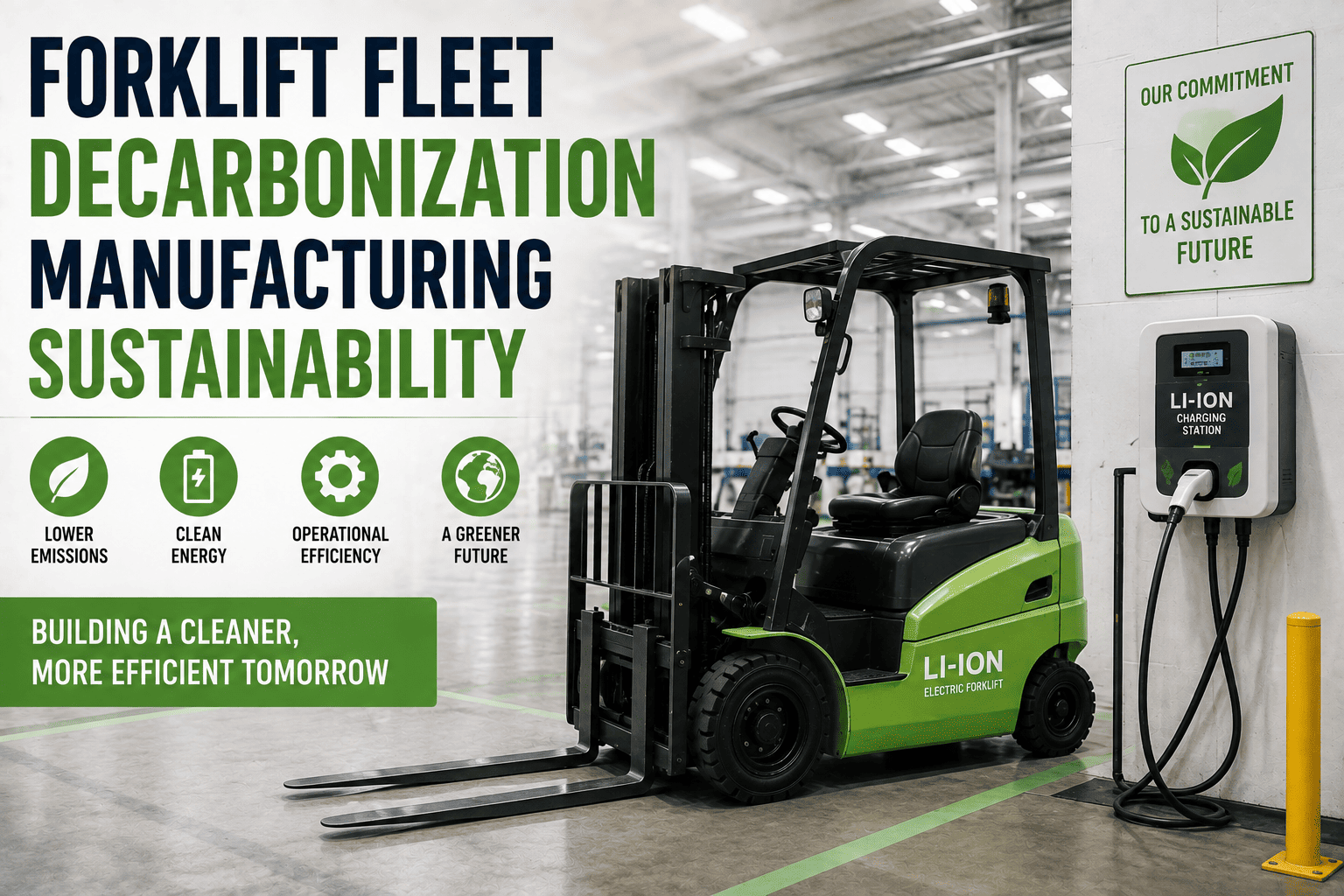
Manufacturing sustainability targets used to stop at the loading dock. That line has moved. Auditors, investors, and customers now want to see emissions data from every corner of the plant floor, and the forklift fleet humming between the warehouse and the production line is no longer invisible. Material handling equipment burns propane, diesel, and electricity every single shift, and every gallon and kilowatt-hour now has to show up somewhere in a sustainability report. For plant and fleet managers, the question isn't whether forklift emissions matter anymore. It's how fast the fleet can be measured, reduced, and proven.
Forklift fleet decarbonization means systematically cutting the fuel and electricity emissions tied to material handling equipment so they support plant-wide sustainability and ESG goals. It typically combines electrification of internal combustion trucks, idle-time reduction, right-sizing the fleet, and continuous emissions tracking. Manufacturers who track fuel, idle, and charging data at the truck level report faster progress toward carbon targets and cleaner ESG audits.
Why Forklifts Suddenly Matter To Your Sustainability Report
Material handling equipment is easy to overlook because it never leaves the property. There's no fuel receipt from a highway stop, no driver log, no obvious paper trail. But a mid-size plant can run 20 to 60 forklifts across two or three shifts, and propane-and-diesel-powered trucks in that range can generate as much annual carbon output as a modest delivery fleet. Regulatory pressure has caught up with this blind spot. Several U.S. states have moved to restrict new sales of large spark-ignition forklifts, and broader climate disclosure rules now require companies above certain revenue thresholds to report emissions across their operations, not just their over-the-road fleets.
At the same time, corporate buyers are asking their suppliers harder questions. A manufacturer bidding on a contract with an automotive OEM or a consumer goods brand increasingly has to answer for the carbon footprint of everything inside the plant walls, including the equipment moving pallets. That makes the forklift fleet a visible, quantifiable line item in supplier scorecards, not a background detail.
The Hidden Cost Of Not Tracking Fleet Emissions
Plants that can't produce forklift-level fuel and energy data usually end up estimating their material handling emissions from industry averages. That approximation rarely survives an external audit, and it puts the sustainability team in the position of defending numbers nobody can verify. A quick demo call is often the fastest way to see what a truck-by-truck emissions baseline actually looks like once real data replaces the estimate.
The Four-Stage Roadmap To A Lower-Carbon Fleet
Decarbonizing a forklift fleet rarely happens in one leap. It moves through predictable stages, and skipping ahead usually means redoing the work later with better data.
FleetRabbit pulls fuel, idle, and charging data from every truck into one dashboard, so your sustainability team gets numbers they can actually defend in an audit. Sign up free and connect your first three vehicles today.
Comparing Your Powertrain Options
Every fleet decarbonization plan eventually comes down to a powertrain decision. Each option trades off differently on emissions, upfront cost, and operational fit, so the right mix usually depends on shift length, indoor versus outdoor use, and charging infrastructure already on site.
| Powertrain | Emissions Profile | Best Fit | Watch Out For |
|---|---|---|---|
| Propane / LPG | Highest direct emissions; combustion byproducts affect indoor air quality | Mixed indoor-outdoor work where charging isn't yet available | Increasingly restricted under state zero-emission mandates |
| Diesel | High emissions; strongest for heavy outdoor lifting | Yard trucks and outdoor container handling | Tier 4 compliance costs and rising fuel volatility |
| Electric (Lithium-ion) | Zero tailpipe emissions; footprint depends on grid mix and charging pattern | Multi-shift indoor operations with predictable routes | Charging infrastructure and upfront capital investment |
| Hydrogen Fuel Cell | Zero tailpipe emissions with fast refueling versus battery charging | High-throughput, round-the-clock distribution centers | Limited refueling infrastructure and higher current cost |
Reading The Table In Context
Lithium-ion electric trucks currently offer the clearest path for most manufacturing plants because charging can be scheduled around shift breaks and the total cost of ownership has closed the gap with propane. Hydrogen remains a strong option for facilities running near-continuous operations where a five-minute refuel beats an hour on the charger, but the surrounding infrastructure is still thin outside a handful of regions.
A Practical Note On Mixed Fleets
Very few plants convert every truck at once. A mixed fleet of electric trucks for indoor, high-frequency work and diesel or propane for occasional outdoor lifting is a normal, defensible middle stage, as long as the plan for retiring the remaining combustion trucks is documented and tracked.
Five Moves That Cut Emissions Without A Fleet Replacement
Not every decarbonization win requires new equipment. Several changes reduce emissions and fuel spend using the fleet you already have.
Turning Fleet Data Into An ESG-Ready Report
Sustainability teams don't just need lower emissions, they need emissions numbers that hold up under scrutiny. That means data at the level of individual trucks, tied to actual fuel purchases and charging sessions rather than fleet-wide averages. Investors, auditors, and procurement teams increasingly expect this granularity, and manufacturers who can produce it move through supplier reviews and disclosure cycles with far less friction.
The plants that get ahead of this treat the forklift fleet the same way they treat the delivery fleet: as an asset that reports its own performance. Fuel consumption, idle hours, charging cycles, and utilization all flow into the same dashboard that feeds the plant's broader carbon accounting, so the sustainability team isn't reconciling spreadsheets from three different departments every quarter.
What Good Fleet Emissions Data Looks Like
Good data is granular, timestamped, and tied to a specific vehicle rather than a fleet-wide estimate. It should be exportable into whatever ESG reporting format your organization already uses, and it should update automatically rather than depending on someone manually logging fuel receipts at month end.
Frequently Asked Questions
FleetRabbit connects fuel, idle, and charging data across your material handling fleet so every emissions number in your next ESG report is backed by real vehicle-level data. Manufacturers using the platform typically move from rough estimates to audit-ready reporting within a single quarter. Book a demo to see it mapped to your own fleet, or sign up and start tracking today.