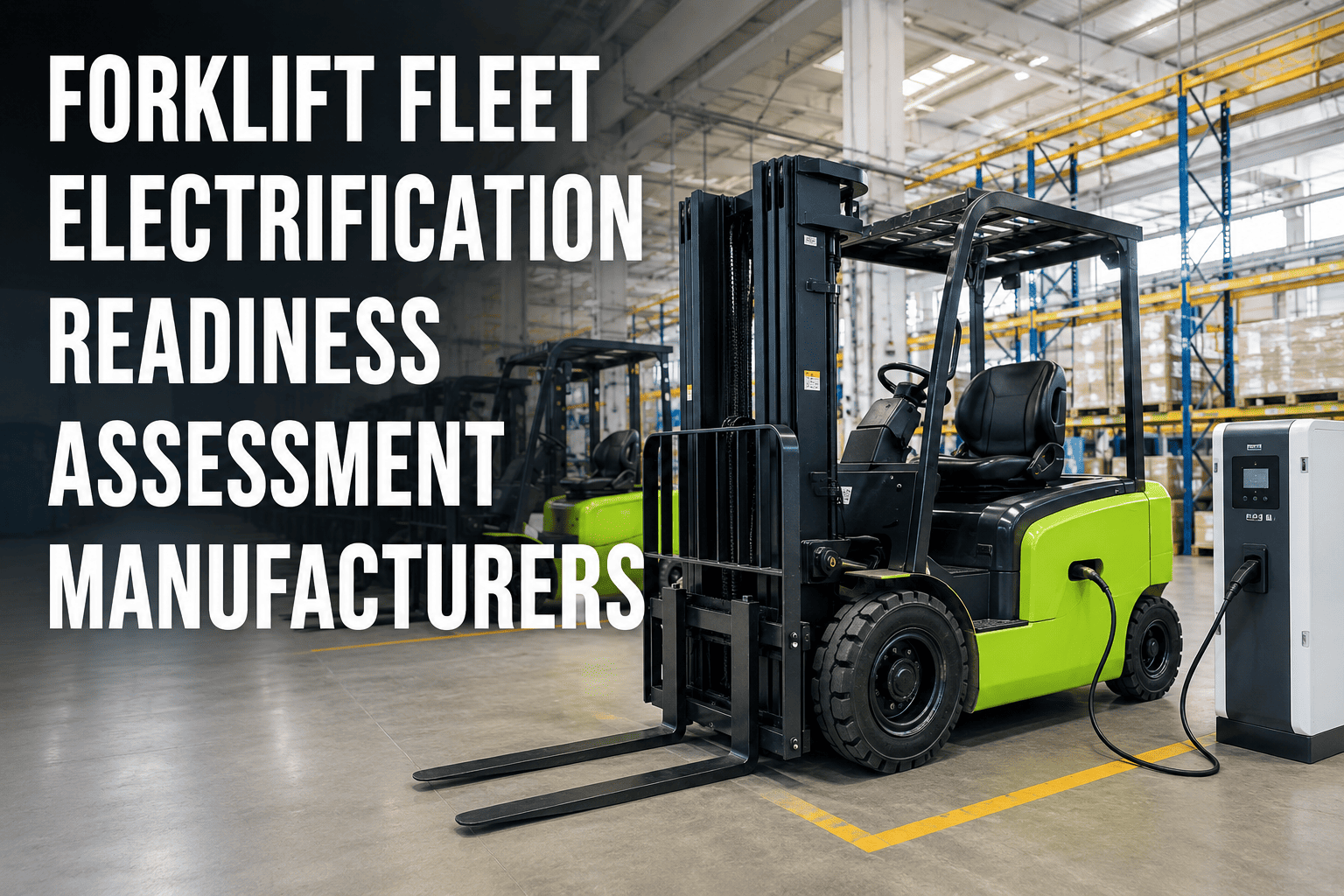
Manufacturing facilities across North America are under increasing pressure from corporate sustainability mandates, incentive programs, and total cost of ownership improvements to transition forklift fleets from internal combustion to electric power. The decision feels straightforward on the surface. Electric forklifts offer lower operating costs, reduced emissions, and quieter operation. But the reality beneath that surface is far more complex. Not every forklift in your fleet is a candidate for electrification, and not every facility is ready to support electric equipment without significant infrastructure investment. A forklift fleet electrification readiness assessment is the analytical process that separates smart transitions from expensive mistakes by evaluating each forklift, each application, and your facility's infrastructure against the specific requirements of electric operation.
Industry data shows that 30 to 45 percent of forklifts in a typical manufacturing fleet are strong candidates for immediate electrification, 25 to 35 percent could transition with moderate infrastructure upgrades, and 20 to 35 percent should remain on internal combustion due to duty cycle demands or outdoor operation requirements. Facilities that assess readiness before purchasing avoid 40000 to 120000 dollars per vehicle in misapplication costs from electrifying the wrong forklifts.
The Five Pillars of Electrification Readiness
An effective readiness assessment evaluates your fleet across five distinct dimensions. Each dimension must be scored independently because a fleet that scores well on duty cycle compatibility may fail completely on charging infrastructure readiness. The five pillars are duty cycle compatibility, charging infrastructure capacity, facility electrical supply, total cost of ownership justification, and operator and maintenance team preparedness. A forklift that passes all five pillars is a confident electrification candidate. A forklift that fails any single pillar requires either a mitigation plan that addresses the deficiency or a decision to defer electrification for that specific unit.
The sequential nature of these pillars matters. Many manufacturers start their assessment at the cost pillar, asking whether electric forklifts save money compared to their current internal combustion units. That question is unanswerable without first confirming that the electric forklift can actually perform the work, that your facility can charge it, and that your electrical supply can support the charging load. Cost analysis on a forklift that cannot complete its shifts without running out of charge produces misleading conclusions. Start with operational compatibility, then move to infrastructure, then evaluate economics. This sequence prevents the most common assessment error which is calculating savings on forklifts that should never have been considered for electrification in the first place. You can sign up for FleetRabbit to run your fleet through an automated five-pillar readiness assessment using your actual utilization data.
Pillar One: Duty Cycle Compatibility Assessment
Duty cycle compatibility is the most critical assessment factor because it determines whether an electric forklift can physically do the job you need it to do. The primary metrics are hours of operation per shift, load weight frequency distribution, travel distance per shift, and the percentage of operation at maximum lift height. Electric forklifts excel in single-shift applications with moderate continuous use, loads within their rated capacity, and travel distances that stay within battery range. They struggle in multi-shift continuous operations without opportunity charging, heavy-load applications that drain batteries rapidly, and outdoor applications where temperature extremes degrade battery performance.
Key Duty Cycle Metrics That Determine Compatibility
| Duty Cycle Metric | Electric-Ready Range | Requires Evaluation | Likely Not Suitable |
|---|---|---|---|
| Hours Per Shift | 5 to 8 hours single shift | 8 to 12 hours with opportunity charging | 16+ hours continuous multi-shift |
| Average Load Weight | Below 75% of rated capacity | 75% to 90% of rated capacity | Consistently at 90%+ of capacity |
| Travel Distance Per Shift | Below 8 miles per shift | 8 to 14 miles per shift | Above 14 miles per shift |
| Max Height Operation | Below 40% of time at max height | 40% to 60% at max height | Above 60% at max height |
| Operating Environment | Climate-controlled indoor | Non-climate indoor or covered outdoor | Exposed outdoor, extreme temps |
| Lift Height Required | Below 20 feet | 20 to 30 feet | Above 30 feet consistently |
Understanding Battery Drain Patterns
Battery consumption in electric forklifts is not linear with time. Lifting heavy loads to maximum height drains battery at three to four times the rate of horizontal travel at the same duration. A forklift that operates 7 hours per shift doing primarily horizontal transport might use only 60 percent of battery capacity. The same forklift operating 7 hours doing high-reach stacking at maximum height might exhaust its battery in 5 hours. This non-linear drain pattern is why simply measuring hours of operation is insufficient for readiness assessment. You need utilization data that breaks down how each forklift spends its time across lifting, traveling, lowering, and idling. FleetRabbit's telematics captures this breakdown automatically, providing the duty cycle detail that manual time studies cannot match. Without this level of granularity, you are guessing at battery compatibility and guessing wrong costs thousands in either idle forklifts during charging or premature battery replacements from deep discharge cycling.
Pillar Two: Charging Infrastructure Assessment
Charging infrastructure assessment evaluates whether your facility can physically accommodate the charging process without disrupting operations. This assessment has three components. First, charging location alignment with forklift parking patterns. Electric forklifts charge where they park, so charging stations must be located where forklifts naturally end their shifts. If your forklifts park in scattered locations across a 200000 square foot facility, you need distributed charging stations rather than a centralized charging room. Second, space adequacy for the charging equipment and the forklifts during charging. A charging station requires clearance around the forklift for connector access, ventilation clearance if using lead-acid batteries that off-gas during charging, and aisle space that does not block material flow while forklifts are parked for charging. Third, floor condition and load capacity at charging locations. Charging stations for large forklifts add significant point loads, and facilities with raised access floors or below-grade areas may require structural reinforcement.
Conventional Charging Versus Opportunity Charging
Your charging strategy fundamentally affects infrastructure requirements and must be determined during the assessment phase, not after purchasing forklifts. Conventional charging uses large lead-acid batteries that charge over 8 to 10 hours, typically during off-shift periods. This approach requires a dedicated charging room with ventilation, battery handling equipment like hoists or transfer carts, and spare batteries for multi-shift operations where the forklift cannot wait 8 hours for charging. Opportunity charging uses lithium-ion batteries that accept partial charges during breaks, shift changes, and brief idle periods without degrading battery life. This approach eliminates the need for dedicated charging rooms, battery changing equipment, and spare batteries but requires charging stations distributed at convenient locations throughout the facility where forklifts naturally pause during their shifts.
FleetRabbit analyzes your actual forklift utilization data, duty cycles, and operating patterns to score each forklift across all five readiness pillars. Get a clear recommendation for every unit: electrify now, electrify with upgrades, or keep on fuel. No guesswork, no misapplication costs.
Pillar Three: Electrical Supply Capacity
This is the pillar that derails the most electrification projects. A manufacturing facility that was designed and wired for internal combustion forklifts often lacks the electrical infrastructure to support charging a fleet of electric forklifts. Each electric forklift charger draws significant amperage. A conventional charger for a 5000-pound capacity electric forklift draws 30 to 40 amps at 208 or 480 volts. If you are converting 10 forklifts and eight of them charge simultaneously during off-shift hours, you need 240 to 320 amps of additional load at your panel. Many manufacturing facilities have electrical panels that are already at 70 to 85 percent of capacity with existing production equipment loads. Adding 300 amps of charging load may require panel upgrades, transformer upgrades, or in some cases utility service entrance upgrades that cost 50000 to 200000 dollars and take months to complete.
Calculating Your Charging Load Requirement
The charging load calculation must account for simultaneous charging scenarios, not just total fleet charging requirements. If your facility operates two shifts with opportunity charging, forklifts from the outgoing shift and incoming shift may overlap at charging stations during shift change, creating peak load periods that exceed the average charging load. The calculation follows a straightforward formula. Multiply the number of simultaneous chargers by the amperage draw per charger, then compare that total to your available panel capacity minus existing loads. The gap between required and available capacity determines whether your electrical supply is ready, needs minor panel modifications, or requires major infrastructure investment. Getting this calculation wrong means either overspending on electrical upgrades you do not need or underestimating the upgrade required and discovering the shortfall after electric forklifts are already on order.
Utility Incentives and Electrical Upgrade Funding
Many utility companies offer incentive programs specifically designed to offset the electrical infrastructure costs of fleet electrification. These programs vary by utility and region but commonly cover 30 to 50 percent of upgrade costs for facilities converting commercial vehicle fleets to electric power. Some programs provide free facility electrical assessments conducted by the utility's engineering team. Others offer reduced commercial rates for electricity consumed during off-peak charging hours. The key is engaging your utility before finalizing your electrification plan because many incentive programs require pre-approval of the project before equipment purchases are made. Retrofit applications rarely qualify. If you are planning an electrification assessment, contacting your utility's commercial accounts team should be one of your first steps alongside the fleet analysis itself.
Pillar Four: Total Cost of Ownership Analysis
Total cost of ownership analysis for forklift electrification must capture every cost difference between internal combustion and electric operation over the full ownership period, typically 7 to 10 years for forklifts. The analysis includes upfront costs, ongoing operating costs, maintenance costs, infrastructure costs, and residual value differences. Electric forklifts carry a 20 to 40 percent higher purchase price than equivalent internal combustion models. They recover that premium through lower operating costs that typically save 3 to 5 dollars per hour compared to propane or diesel operation. For a forklift operating 2000 hours annually, that translates to 6000 to 10000 dollars per year in fuel and energy cost savings. Maintenance savings add another 1500 to 3000 dollars annually because electric forklifts have fewer moving parts, no engine oil changes, no transmission service, and significantly reduced brake wear from regenerative braking systems.
When Electric Does Not Save Money
Electric forklifts do not universally save money. The savings model breaks down in several common scenarios. Low-utilization forklifts that operate fewer than 1000 hours annually may not generate enough fuel savings to recover the purchase price premium within a reasonable payback period. Applications requiring multiple battery changes per shift with lead-acid systems add labor and equipment costs that erode operating savings. Facilities that must invest heavily in electrical infrastructure upgrades may face payback periods exceeding 10 years, which exceeds the typical forklift ownership horizon. Multi-shift operations that require spare batteries and battery changing equipment face higher upfront capital requirements that shift the economics. Understanding these scenarios during the readiness assessment prevents committing to electrification on units where the financial case does not close. A forklift that fails the TCO pillar should be deferred regardless of how well it scores on other pillars, unless non-financial factors like sustainability mandates or regulatory requirements override the economic analysis.
Incentive Programs That Change the TCO Calculation
Federal, state, and local incentive programs can dramatically improve the TCO case for electric forklifts. The federal Investment Tax Credit under the Inflation Reduction Act provides up to 30 percent of the cost of qualified electric vehicle charging equipment for commercial applications. Many states offer additional incentives on top of the federal credit. Some utility programs provide per-forklift rebates ranging from 2000 to 10000 dollars per unit. Industrial development agencies in certain regions offer tax abatements or low-interest financing for manufacturing facilities investing in electrification. These incentives can reduce the effective purchase price premium from 20 to 40 percent down to 5 to 15 percent, shortening payback periods by 2 to 4 years. The readiness assessment should include a thorough inventory of available incentives because they frequently determine whether the TCO pillar passes or fails for borderline applications.
Pillar Five: Operator and Maintenance Team Preparedness
The human readiness factor is the most frequently overlooked pillar and the one that causes the most operational disruption when neglected. Electric forklifts operate differently from internal combustion units in ways that matter to daily operation. Acceleration profiles are different, braking characteristics change with regenerative braking systems, load handling at height may feel different due to the heavier battery counterweight, and the absence of engine noise creates pedestrian safety concerns because workers do not hear the forklift approaching. Operators need specific training on these differences, not just a general forklift certification refresh. The training should cover electric-specific acceleration management, regenerative braking behavior, battery state of charge monitoring, charging connector procedures, and emergency shutdown differences.
Maintenance team preparedness is equally important and frequently more challenging to address. Technicians trained on internal combustion powertrains need to develop competency in high-voltage electrical systems, battery management systems, electric motor controllers, and regenerative braking components. This is not a minor skill addition. High-voltage safety training, specialized diagnostic tools, and different preventive maintenance schedules represent a significant capability development effort. Facilities with small maintenance teams may need to send technicians to manufacturer training programs that take several days and cost several thousand dollars per technician. Some facilities choose to contract electric forklift maintenance to specialized service providers during the transition period rather than developing the capability internally. Either approach is valid but must be planned and budgeted during the readiness assessment, not discovered as a gap after electric forklifts arrive. If you want to understand what your maintenance team readiness gap looks like, book a demo with FleetRabbit and we will walk through the preparedness evaluation framework.
Scoring Your Fleet: The Readiness Matrix
The output of a proper readiness assessment is a per-forklift readiness score that places each unit into one of three categories. Electrify Now for forklifts that pass all five pillars with no significant gaps. Electrify With Upgrades for forklifts that pass duty cycle and TCO pillars but require infrastructure, electrical, or training investments before transition. Keep on Fuel for forklifts that fail duty cycle compatibility, fail TCO even with incentives, or operate in conditions that electric forklifts cannot handle. This three-category classification prevents the most expensive mistake in fleet electrification which is treating the entire fleet as a uniform block rather than evaluating each unit individually. A facility with 20 forklifts might find that 8 units are immediate candidates, 6 units are candidates with infrastructure work, and 6 units should remain on propane or diesel. Attempting to electrify all 20 simultaneously would waste 100000 to 200000 dollars on units that should never have been converted.
Phased Transition Strategy
The readiness matrix naturally produces a phased transition plan. Phase one electrifies the immediate candidates, generating early savings and building organizational experience with electric forklift operation. Phase two addresses the infrastructure gaps identified for the upgrade candidates, completing electrical work, installing charging stations, and training teams while the phase one units demonstrate reliability and savings. Phase three evaluates the keep-on-fuel units annually against improving battery technology, expanding charging infrastructure, and evolving incentive programs that may change their readiness status over time. This phased approach spreads capital expenditure over 18 to 36 months rather than requiring a single large investment, reduces risk by proving the concept with easy wins first, and allows the organization to develop electric forklift competency gradually rather than attempting a wholesale transformation that overwhelms the team.
Common Assessment Mistakes to Avoid
The most damaging assessment mistake is relying on forklift nameplate specifications rather than actual utilization data. A forklift rated for 8 hours of operation on paper may only achieve 5 hours in your specific application due to heavy loads, high lift heights, or travel patterns that drain batteries faster than the manufacturer's standard test conditions assume. The second common mistake is assessing electrical capacity based on a single charger's draw rather than the simultaneous charging scenario that your shift patterns create. The third mistake is ignoring incentive programs during TCO analysis, which makes electric forklifts appear less economical than they actually are. The fourth mistake is failing to account for battery replacement costs in the TCO calculation. Lead-acid batteries typically require replacement every 4 to 5 years at 3000 to 8000 dollars per battery, while lithium-ion batteries last 8 to 10 years but cost 10000 to 20000 dollars per battery. Including these replacement costs in the 7 to 10 year TCO model produces accurate comparisons that omitting them does not.
Connect your forklift data and FleetRabbit scores every unit across duty cycle, charging needs, electrical load, TCO, and team readiness. Get a color-coded electrification roadmap showing exactly which forklifts to convert, in what order, and what infrastructure investments each conversion requires.
Data Requirements for an Accurate Assessment
The accuracy of your electrification readiness assessment depends entirely on the quality of the data feeding it. Manual time studies where observers record forklift activity for a few hours provide anecdotal snapshots that miss the variability in real operations. A forklift might appear to operate 6 hours per shift during a Tuesday observation but actually operates 8 hours on Fridays when production volume peaks. The data requirements for a reliable assessment include at least 90 days of continuous utilization data per forklift showing hours of operation per shift, load weight distribution, travel distance and speed patterns, lift height distribution, and idle time percentage. This level of detailed, continuous data is only available from telematics systems that record forklift activity continuously rather than relying on periodic observation.
Infrastructure data requirements include current electrical panel schedules showing existing loads and available capacity, single-line diagrams of facility electrical distribution, transformer specifications, and utility service entrance capacity. Facility layout data showing forklift parking locations, aisle widths, and floor load ratings at potential charging locations completes the infrastructure picture. Without all three data categories, fleet utilization, electrical capacity, and facility layout, any readiness assessment carries significant uncertainty that can lead to wrong decisions. The cost of gathering this data properly is a few days of engineering time and 90 days of telemics data collection. The cost of making electrification decisions without it can be hundreds of thousands of dollars in misapplication and infrastructure surprises.
The Assessment Is the Investment That Prevents All the Wrong Investments
Every manufacturing facility approaching forklift electrification faces the same fundamental decision. Do you assess first and purchase second, or purchase first and discover the gaps later? The facilities that assess first convert 55 to 80 percent of their fleet successfully, stay within budget, and achieve the projected savings. The facilities that skip the assessment typically electrify 30 to 50 percent of their fleet successfully, exceed budget by 40 to 60 percent due to unplanned infrastructure work, and spend months troubleshooting forklifts that were never suited for electric operation in their specific applications. The difference between these two outcomes is not luck. It is the presence or absence of a structured readiness assessment that evaluates each forklift against the five pillars before any purchasing decisions are made.
The data required for a reliable assessment is more accessible than most manufacturers realize. Telematics systems provide the fleet utilization data. Facility engineering teams have or can obtain the electrical infrastructure data. Facility layout data exists in building plans or can be documented in a few days of site survey work. The only missing ingredient is the analytical framework that ties these three data categories together into per-forklift readiness scores and a phased transition plan. That framework is what transforms raw data into confident electrification decisions. Without it, you have data but no direction. With it, you have a clear, defensible, finance-approved roadmap that takes your fleet from internal combustion to electric in a sequence that maximizes savings and minimizes risk at every step. The assessment costs a fraction of what a single misapplication costs. The question is not whether you can afford to do the assessment. It is whether you can afford not to.
Stop deciding which forklifts to electrify based on gut feeling and manufacturer brochures. FleetRabbit uses your actual utilization data to score every forklift across duty cycle, charging, electrical, TCO, and team readiness. Get a phased electrification roadmap with per-unit recommendations, infrastructure requirements, and payback projections. Start your assessment today.