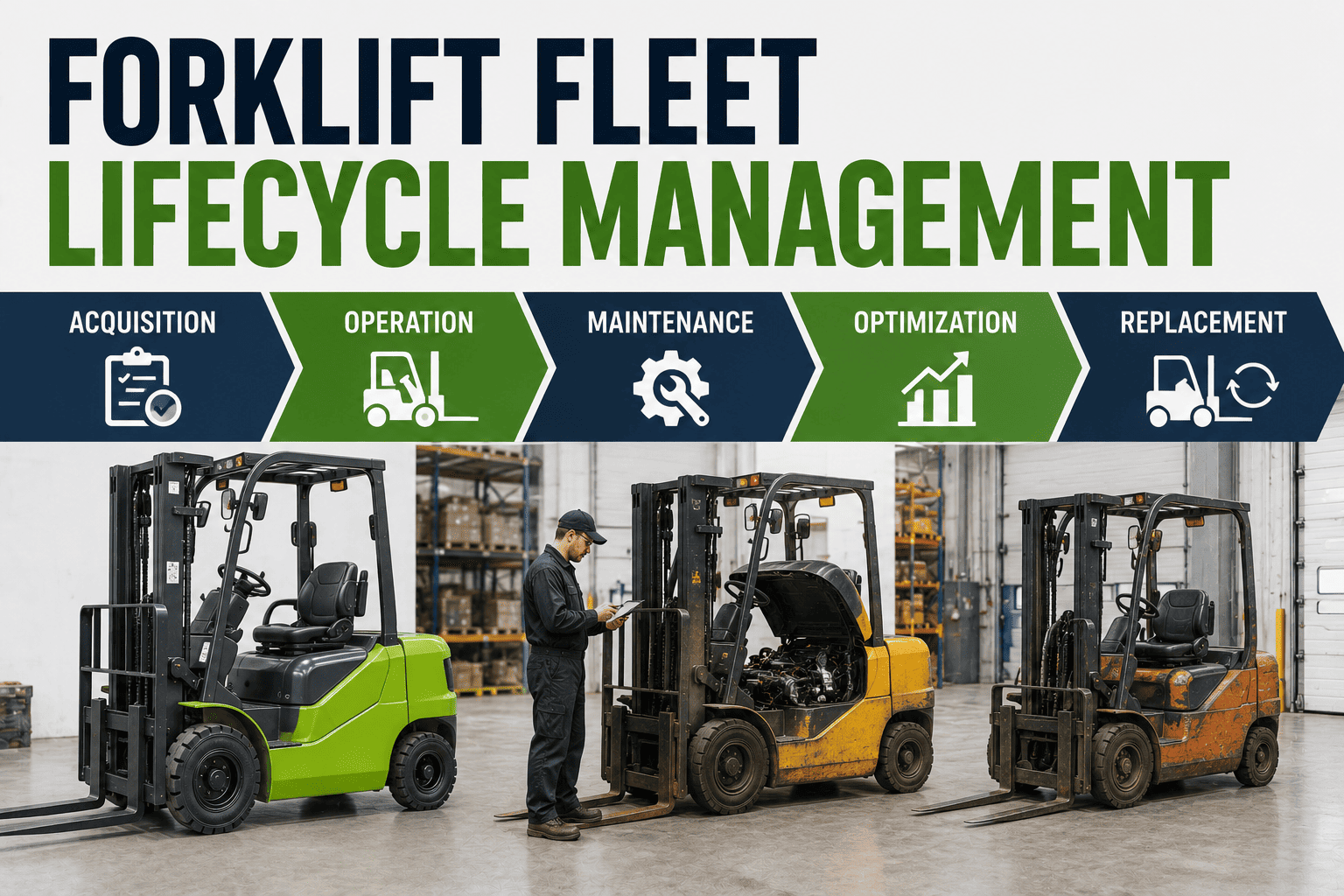
Every forklift you own is running a hidden clock. From the day it rolls off the truck to the day it rolls onto a trade-in lot, it moves through predictable stages of cost, output, and risk. Most warehouses only notice the clock when a lift truck starts breaking down every few weeks, and by then the decision to repair, refurbish, or replace has already been made for you by circumstance instead of data. Lifecycle management flips that script. It treats every forklift as an asset with a measurable beginning, middle, and end, so purchase, maintenance, and replacement decisions are planned instead of forced.
Most forklifts have an economical working life of 10,000 to 12,000 hours for internal combustion units and up to 15,000 hours for electric models, roughly 5 to 7 years at typical usage rates. Ownership cost is calculated as purchase price minus trade-in value, divided by total engine hours, while maintenance cost per hour is tracked separately and watched closely once it starts climbing. Fleets that manage this lifecycle with real usage data instead of a fixed age policy get more working hours out of every unit and avoid replacing trucks too early or holding them too long.
The Five Stages Every Forklift Moves Through
Lifecycle management only works when you can see the whole journey, not just the maintenance ticket in front of you. Every forklift in your fleet is sitting somewhere on this timeline right now, and knowing exactly where changes what decision you should be making.
Why Age Alone Is the Wrong Trigger
A huge share of operations still replace forklifts on a fixed schedule, somewhere between three and seven years, regardless of how the unit is actually performing. A forklift running 500 hours a year in light, indoor duty can still be economical well past that window, while a unit running two shifts in a dusty yard can wear out its economic life far sooner. Fleet age matters, but usage intensity, environment, and duty cycle matter more, and the only way to see all three at once is by tracking hours and repair history against a real baseline rather than a calendar.
FleetRabbit tracks engine hours, PM history, and repair costs for every forklift automatically, so you always know which units are still earning their keep and which are quietly costing you money. Sign up free and see your fleet's lifecycle data in minutes.
The Two Numbers That Should Drive Every Decision
Lifecycle management sounds complicated until you realize it comes down to two calculations most fleet managers already have the raw data for. Ownership cost per hour tells you what the truck costs simply for existing. Maintenance cost per hour tells you what it costs to keep running. Together, they tell you exactly when a forklift stops being an asset and starts being a liability.
Economic Life by Forklift Type
Not every lift truck ages the same way. Power type, duty cycle, and environment all shift where the economic life ceiling actually sits, so a single fleet-wide replacement rule rarely fits every unit on the floor.
| Forklift Type | Typical Economic Life | Primary Wear Driver | Lifecycle Watch Point |
|---|---|---|---|
| Internal Combustion (IC) | 10,000 to 12,000 hours | Engine wear, hydraulic system, transmission cycles | Rising fuel and oil consumption alongside more frequent unscheduled repairs |
| Electric Counterbalance | Up to 15,000 hours | Battery capacity fade, motor and controller wear | Battery no longer holding a full shift charge or requiring more frequent charging |
| Electric Reach / Narrow Aisle | 10,000 to 14,000 hours | Mast and lift chain wear from high-cycle vertical travel | Mast chain stretch and lift speed degradation in high-rack environments |
| Rough Terrain / Yard | 8,000 to 10,000 hours | Tire, axle, and drivetrain stress from uneven surfaces | Frame and undercarriage wear accelerating outdoor replacement timing |
Parts Availability Changes the Math Too
A forklift can still be mechanically sound and financially reasonable to run, yet lose viability the moment a manufacturer stops supporting its model. When technicians start sourcing control boards or hydraulic components secondhand because the OEM no longer stocks them, uptime risk rises even if the cost-per-hour numbers still look acceptable. Lifecycle tracking should flag parts availability as its own signal, separate from cost trends, because a single unsupported part can take a unit out of service for weeks.
Repair, Refurbish, or Replace: A Decision Framework
Every aging forklift eventually lands at this fork. The right call depends on where the unit sits against its expected hours and how its maintenance cost per hour compares to a new or refurbished replacement.
What Deferred Replacement Actually Costs
It is tempting to keep an older forklift running for one more season to avoid the capital outlay, but fleet lifecycle studies across equipment types consistently show the same pattern: postponing replacement past the economic threshold does not save money, it just relocates the spend into repair budgets, and it tends to compound. Units held past their replacement window generally show a steady year-over-year rise in maintenance cost per hour and a growing number of unscheduled repair events, both of which erode the productivity the unit was originally bought to deliver.
As equipment ages past its economic threshold, repair and maintenance cost per operating hour tends to climb year over year rather than staying flat, and each additional year of deferred replacement tends to add more units to the "needs replacing" list rather than fewer. Tracking cost per hour continuously, instead of reviewing it once a year, is what lets a fleet catch that curve early.
Building a Lifecycle Program in Four Phases
FleetRabbit logs every hour, every repair, and every dollar spent per unit automatically, so ownership cost and maintenance cost per hour are always current, not estimated. Book a free demo and walk through your own fleet's lifecycle data with our team.
How FleetRabbit Supports the Full Lifecycle
Manual lifecycle tracking works for a handful of forklifts, but it breaks down fast once a fleet grows past a dozen units spread across shifts and locations. FleetRabbit centralizes acquisition records, PM schedules, engine hours, and repair costs for every unit in one place, calculating ownership and maintenance cost per hour automatically as new data comes in. Instead of digging through spreadsheets once a year to decide what to replace, fleet managers get a live view of which units are approaching their economic ceiling and which ones still have healthy hours left. You can start a free trial to connect your existing fleet records, or book a short demo to see how the lifecycle dashboard works before committing to anything.
What Good Lifecycle Data Looks Like in Practice
Per-Unit Cost History
Every repair, part, and labor hour attached to the specific forklift it belongs to, not buried in a general maintenance ledger.
Hour-Based Alerts
Automatic flags when a unit approaches its type-specific economic hour ceiling, well before cost per hour spikes.
Replacement Planning View
A ranked list of which units are closest to replacement, so capital budgeting happens on a schedule instead of during a breakdown.
Frequently Asked Questions
A lifecycle program built on real hours and real repair costs replaces guesswork with a plan, keeping your fleet productive without overspending on units that still have working life left or holding onto ones that don't. FleetRabbit brings acquisition records, maintenance history, and cost-per-hour tracking into a single live view for every unit you operate.