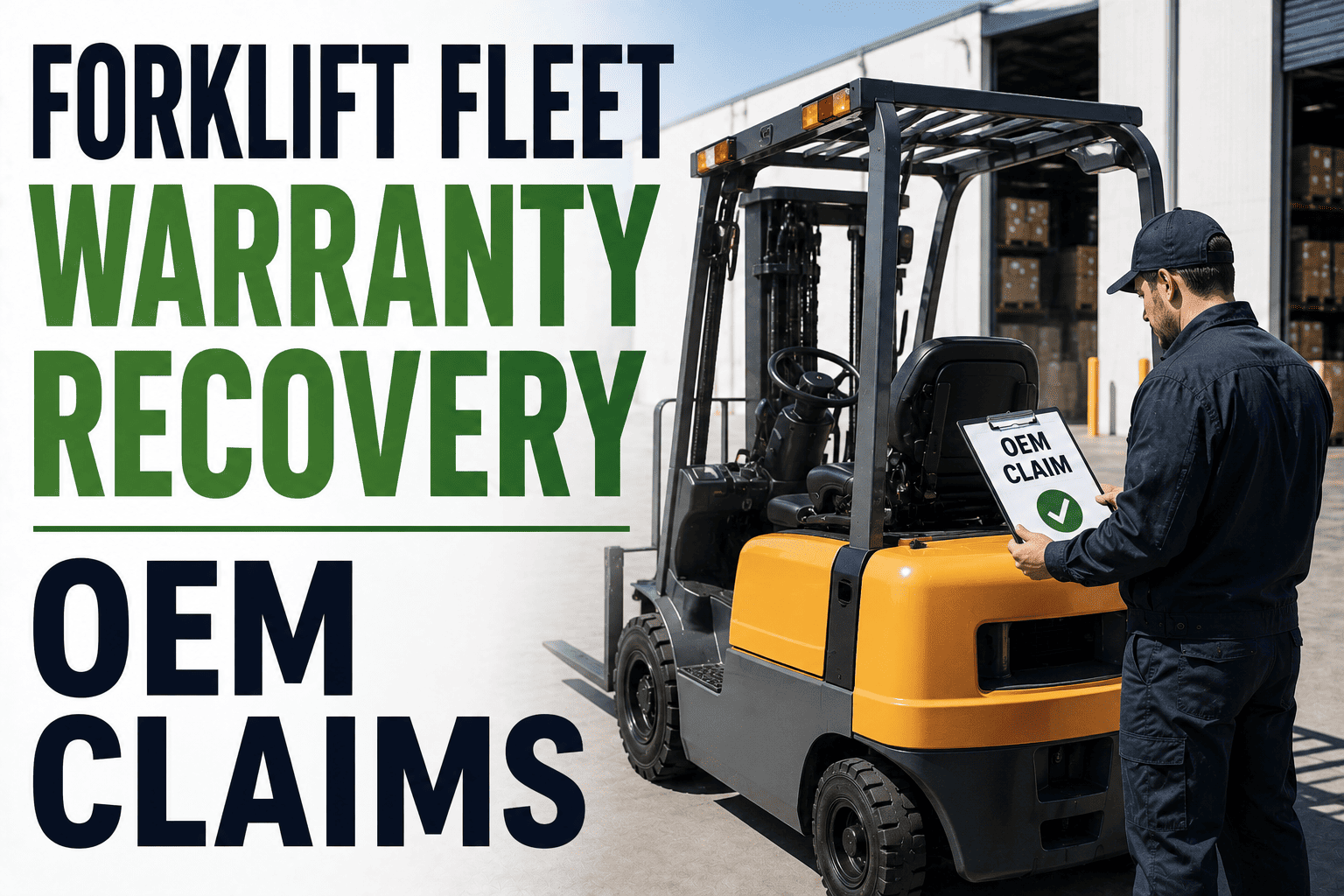
Somewhere in your maintenance budget this year, you probably paid for a repair the manufacturer was supposed to cover. A hydraulic pump failed inside its powertrain warranty window, a battery died while its component coverage was still active, or a control module was replaced without anyone checking the in-service date against the OEM's terms. Nobody made a mistake on purpose, the claim simply never got filed, and the cost quietly stayed on your books instead of the manufacturer's.
Most forklift fleets recover only a small share of what they're actually owed in warranty claims, because coverage windows, documentation, and filing deadlines are tracked on paper or not tracked at all. Fleets that move to automated warranty tracking routinely push recovery rates from under a third of eligible repairs to well over 85 percent. Start a free trial to see how many of your last year's repairs were sitting inside an active warranty window.
Why Forklift Warranty Money Gets Left on the Table
A forklift doesn't carry one warranty, it carries several, stacked on top of each other with different start dates, different mileage or hour limits, and different documentation requirements. There's the base machine warranty, a separate powertrain or drivetrain warranty that often outlasts it, component-level coverage on batteries and control systems from the parts vendor, and sometimes an extended service contract layered over all of it. A fleet manager tracking this by memory or spreadsheet is effectively juggling four or five expiration dates per unit, multiplied across every forklift on the floor.
The failure point is almost never the repair itself, it's the paperwork trail that has to exist before the OEM will pay. Claims get rejected for missing technician failure notes, missing proof of scheduled maintenance, missing photos of the failed part before it was scrapped, or simply because the claim was filed after the deadline had already passed. None of that means the repair wasn't covered, it just means the fleet never proved it was.
What This Actually Costs a Mid-Size Fleet
A fleet running systematic warranty tracking typically recovers the large majority of eligible repair costs. A fleet running on memory and spreadsheets typically recovers less than a third. That gap, applied across a year of hydraulic pump replacements, battery swaps, and control module repairs, is the difference between a maintenance budget that bleeds quietly and one that gets money back every quarter.
FleetRabbit checks every work order against your forklifts' active coverage the moment it's opened, so eligible repairs get flagged before the invoice is approved instead of discovered a year later in an audit. Start your free trial and see your fleet's unclaimed total.
The Coverage Layers Hiding On Every Forklift
Before you can recover a claim, you have to know which of your forklift's overlapping warranties actually applies. Each layer has its own clock, and the clock rarely matches the others.
Base Machine Warranty
Covers general mechanical and structural defects for a set period after purchase, usually the shortest window of the group and the first one people forget expired.
Powertrain and Drivetrain Coverage
Covers the mast, hydraulic system, transmission, and drive components, often running longer than the base warranty. This is the highest-value coverage and the one most frequently missed, because teams assume the base warranty expiring means everything expired with it.
Battery and Component Warranties
Batteries, chargers, and control modules are frequently covered separately by the component manufacturer rather than the forklift OEM, with their own paperwork trail that never makes it into the vehicle's original purchase file.
Extended Service Contracts
Purchased on top of standard coverage, these can extend protection well past the manufacturer's original terms, but only if the fleet keeps proof of the contract and files within its own separate deadline.
| Coverage Type | What It Covers | Why It Gets Missed |
|---|---|---|
| Base Machine | General mechanical and structural defects | Shortest window, expires before other coverage does |
| Powertrain | Mast, hydraulics, transmission, drive components | Assumed expired once base warranty ends, but it usually outlasts it |
| Battery / Component | Batteries, chargers, control modules | Covered by a different vendor, paperwork rarely filed with the unit |
| Extended Contract | Whatever terms were purchased, beyond standard coverage | Contract paperwork gets separated from the vehicle file over time |
Where Claims Actually Get Denied
Manufacturers reject far more claims on paperwork than on actual ineligibility. Knowing where the process breaks down is the fastest way to stop it from happening.
Missing Failure Documentation
A technician's note explaining what failed and why, in the terms the OEM's claim form actually asks for, is often the single missing piece that turns an eligible repair into a denied one.
No Photo Evidence Before Scrapping
Once the failed part is thrown out, the proof goes with it. Photos taken before disposal are frequently the deciding factor in a claim review.
Missed Filing Deadlines
Most manufacturers give 30 to 90 days from repair completion. A claim filed one day late is usually denied automatically, regardless of whether the repair was genuinely covered.
No Proof of Scheduled Maintenance
If a fleet can't show the recommended service intervals were followed, an OEM can argue the failure was caused by neglect, even when the part simply wore out.
Building a Claim-Ready Documentation Trail
A claim only gets paid if the right information exists the moment it's needed, not reconstructed weeks later from memory. Every work order should capture the VIN, current hour meter or mileage reading, itemized parts and labor, a clear failure description, and photo evidence, all tied to the coverage terms for that specific unit. When this lives in one connected record instead of scattered paper folders and technician memory, claims go out complete and on time instead of late, incomplete, or never filed at all.
FleetRabbit builds this trail automatically as repairs happen, matching every work order against the forklift's active warranty coverage and flagging eligible claims before the invoice is approved. Fleet managers who want to see their own exposure can book a demo and walk through a sample of recent repairs live.
FleetRabbit tracks every coverage layer per unit, flags eligible repairs automatically, and keeps the documentation OEMs actually require, so nothing falls through before the deadline closes.
Frequently Asked Questions
Every unfiled claim is money already built into your original purchase price and never collected. FleetRabbit flags warranty-eligible repairs automatically and keeps the documentation OEMs require, so recovery happens in the background instead of an audit two years later.