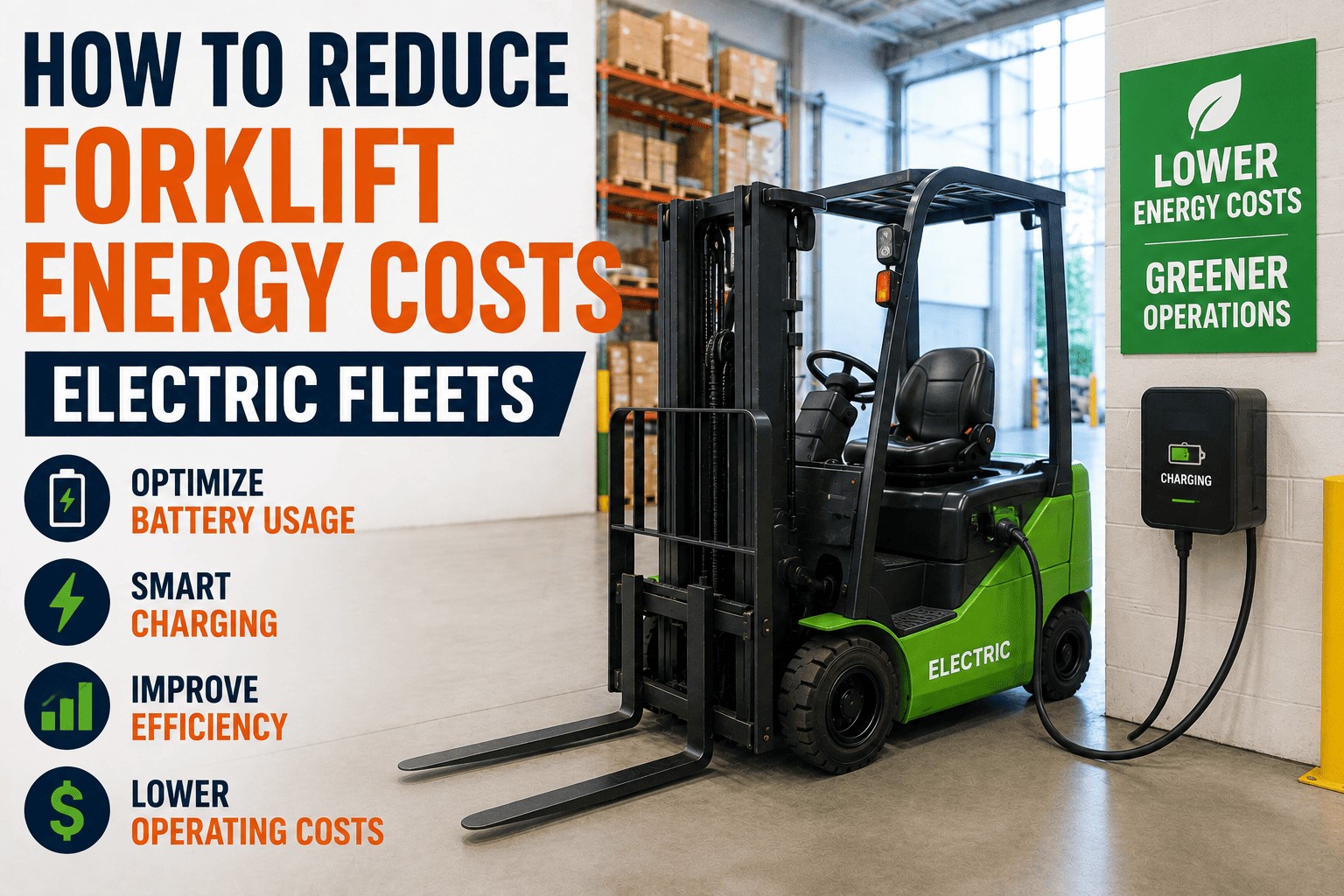
Most plant managers look at an electric forklift fleet's power bill and see one number, the kilowatt-hours consumed. The bigger cost is often hiding in a different line entirely. Demand charges, the fee a utility bills for your single highest 15-minute spike of power draw in a month, can account for 30 to 70 percent of a commercial electric bill, and a charging bay full of forklifts plugging in at shift change is exactly the kind of spike that triggers them. Reducing forklift energy costs is rarely about using less electricity overall. It is about when and how that electricity gets drawn. Sign up free and FleetRabbit will show you exactly where your fleet's charging pattern is costing you the most.
Cutting electric forklift energy costs comes down to three levers: staggering or scheduling charging to avoid peak demand windows, matching battery chemistry and charger size to the fleet's actual duty cycle instead of over-provisioning, and reducing round-trip energy loss by using efficient chargers and healthy batteries. Lithium-ion batteries convert roughly 92 to 96 percent of input electricity into usable energy, compared with 70 to 80 percent for lead-acid, and demand charges alone can make up close to half of a facility's total electric bill when charging is left uncoordinated.
Where Your Energy Dollar Actually Goes
A typical commercial electric bill for a facility running forklift charging has two very different components, and most cost-cutting conversations only address one of them.
The Three Levers That Move the Bill
Each lever addresses a different part of the cost stack above. Scheduling attacks the demand charge side. Chemistry and sizing attack the consumption side. Used together, they compound.
Schedule Charging Away From Peak Windows
Charging overnight or during off-peak utility hours can cut energy costs by roughly 30 to 50 percent compared with daytime rates, and it avoids stacking a charging bay's load on top of a facility's other peak demand at shift change. Staggering start times across chargers, rather than plugging in an entire fleet at once, flattens that spike further.
Match Chemistry and Charger Size to Duty Cycle
A facility that quotes oversized chargers by default, rather than sizing them to actual truck runtime, ends up paying for capacity it rarely uses and often creates a larger demand spike in the process. Reviewing real duty cycle data before specifying charger capacity commonly cuts both capital cost and peak demand.
Reduce Round-Trip Energy Loss
Every charge cycle loses some energy as heat between the wall outlet and the battery. Lithium-ion systems typically retain 92 to 96 percent of that energy, while lead-acid retains closer to 70 to 80 percent, meaning a lead-acid fleet is paying for a meaningfully larger share of electricity that never reaches the forks.
| Factor | Lead-Acid | Lithium-Ion |
|---|---|---|
| Round-Trip Efficiency | Roughly 70 to 80 percent | Roughly 92 to 96 percent |
| Opportunity Charging | Not recommended, accelerates wear | Designed for it, extends battery life |
| Batteries Needed Per Truck | Typically 2 to 3 for multi-shift use | Typically 1, charged during breaks |
| Charge Cycle Life | Roughly 1,200 to 1,500 cycles | Roughly 3,000 to 5,000 cycles |
| Dedicated Charging Room | Required, with ventilation for hydrogen gas | Not required, can charge anywhere with a power drop |
FleetRabbit tracks charging patterns across your fleet, flags peak-window charging that is driving demand charges, and shows which trucks and batteries are losing the most energy to inefficiency. Sign up free and see your fleet's charging pattern in the first week.
Common Ways Fleets Overpay Without Realizing It
Most of the waste in an electric forklift energy bill is not a single bad decision, it is a set of small habits and default settings nobody has revisited since the fleet was installed.
Charging the Whole Fleet at Once
Plugging every truck in at the end of a shift feels efficient, but it is often the single biggest driver of a demand charge spike. Dynamic load-sharing between chargers, or simply staggering plug-in times, spreads that draw out and can eliminate the spike almost entirely.
Sizing Chargers for the Worst Case Instead of the Real Case
A facility that quotes high-output chargers across the board, without reviewing actual average runtime per truck, pays for capacity that goes unused most of the time. Reviewing real duty cycle data before specifying hardware is one of the simplest ways to cut both upfront and ongoing cost.
Turning Charging Data Into Lower Bills
None of these levers require replacing your fleet overnight. Most start with simply seeing when and how your trucks are actually charging today, which is usually the piece missing from a plant's energy conversation entirely. Book a demo and FleetRabbit's team will walk through your fleet's current charging pattern and where the easiest savings are hiding.
FleetRabbit tracks charging schedules, energy consumption, and battery health across your electric fleet, showing exactly which levers will cut your energy bill fastest.