Every quality manager preparing for an ISO 9001 audit faces the same anxiety in the weeks before the auditor arrives: somewhere in the organisation, there is a maintenance record that was never completed, an inspection that was logged on paper and never transferred to the system, or a corrective action that was raised and then quietly forgotten when the next project pressure arrived. ISO 9001 does not require perfection in operations — it requires demonstrable evidence that processes are defined, followed, and continuously improved. The gap between having good maintenance practices and being able to prove them to an external auditor is exactly the gap that digital fleet records close. Paper-based inspection logs, spreadsheet maintenance schedules, and WhatsApp threads about equipment faults do not constitute an audit-ready quality management system — not because the work wasn't done, but because the evidence is incomplete, inconsistent, and impossible to retrieve under audit conditions when an auditor asks for three years of service history on a specific asset within 20 minutes. FleetRabbit's digital fleet management platform generates the inspection records, maintenance histories, corrective action trails, and compliance reports that ISO 9001 audits require — automatically, in real time, across every asset in the fleet. Book an ISO 9001 audit readiness demo with FleetRabbit.
FleetRabbit Fleet Intelligence
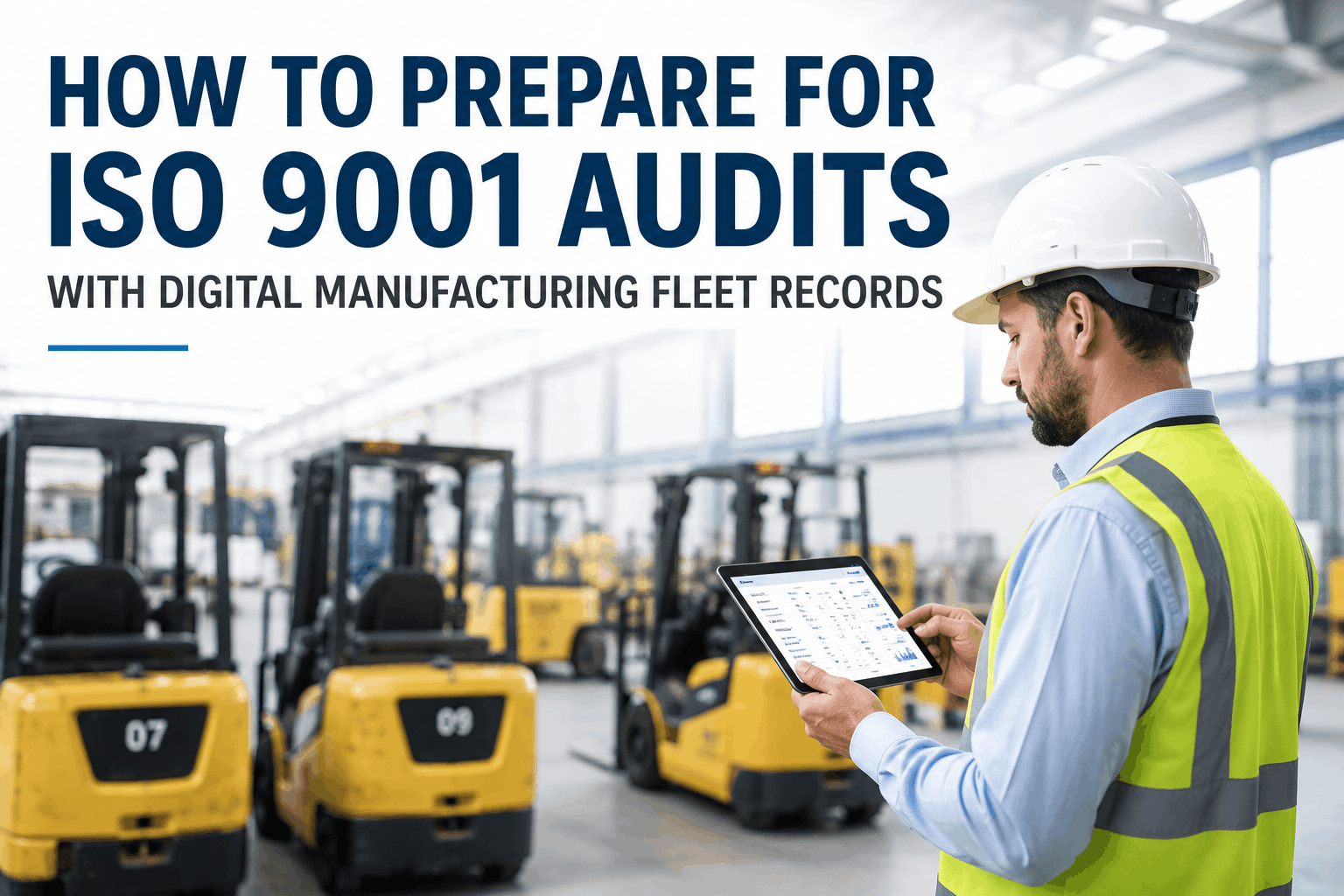
How to Prepare for ISO 9001 Audits with Digital Manufacturing Fleet Records
Build audit-ready compliance with digital inspection records, automated reports, and full audit trails for ISO 9001. How quality managers and fleet operators use digital maintenance records, automated compliance reporting, and complete corrective action trails to satisfy ISO 9001 auditor requirements without last-minute document scrambles.
Clause 7.1.3ISO 9001 Infrastructure Maintenance Record Requirement
3 YearsTypical Audit Evidence Lookback Period Requested
68%Of ISO 9001 Non-Conformances Relate to Incomplete Records
<5 minTime to Retrieve Any Asset History in FleetRabbit
What ISO 9001 Actually Requires from Fleet and Equipment Records
ISO 9001:2015 addresses equipment and infrastructure under Clause 7.1.3, which requires organisations to determine, provide, and maintain the infrastructure necessary to achieve product and service conformity. This clause is deliberately broad — it does not prescribe specific maintenance intervals or record formats — but it creates an auditable obligation: the organisation must be able to demonstrate that its infrastructure is maintained in a condition that supports quality outcomes, and that evidence of this maintenance is retained as documented information. For manufacturing and construction organisations where fleet equipment is part of the production or delivery process, this means maintenance records, inspection logs, fault histories, corrective action documentation, and calibration records must exist, be complete, and be retrievable on demand. The secondary audit exposure comes from Clause 10.2, which requires nonconformities and corrective actions to be documented with evidence of root cause analysis and effectiveness verification — a requirement that catches organisations whose maintenance faults are fixed promptly but never formally closed in a system that an auditor can review.
Clause 7.1.3 — Infrastructure
What Auditors Look For in Equipment Records
Auditors assessing Clause 7.1.3 compliance typically request evidence of planned maintenance schedules for critical equipment, records of completed maintenance activities with dates and technician identification, documentation of equipment breakdowns and the response taken, and calibration or verification records for measurement equipment. The key audit test is not whether maintenance was performed — it is whether the organisation can demonstrate that maintenance was planned systematically, executed consistently, and recorded with enough detail to show that the process is under control rather than reactive. Digital maintenance records with timestamped completion entries, technician sign-off fields, and automated schedule tracking satisfy this test directly. Paper logs and spreadsheets typically fail it on retrieval speed alone.
Clause 10.2 — Corrective Action
Closing the Loop on Equipment Faults and Failures
Every equipment fault that affects or could affect product quality requires a corrective action record under ISO 9001 Clause 10.2 — documenting the nonconformity, the immediate containment action, the root cause investigation, the corrective action taken, and verification that the action was effective. In practice, most organisations fix equipment faults promptly and competently but fail to create the documented trail that ISO 9001 requires. An auditor who finds a pattern of fault records with no associated corrective action closure — or worse, finds that corrective actions were raised but never verified for effectiveness — will issue a nonconformance finding regardless of how well the underlying maintenance programme is actually performing.
Clause 7.1.5 — Monitoring Equipment
Calibration and Verification Record Requirements
Measurement and monitoring equipment used to verify product or process conformity requires calibration records under Clause 7.1.5 — including the calibration standard used, the result, the calibration date, and the next due date. For fleet-dependent manufacturing organisations, this extends to any measurement capability embedded in or attached to production equipment: load sensors, torque measurement systems, temperature monitoring devices, and precision tooling with calibration requirements. Digital asset records that track calibration status, due dates, and calibration history alongside routine maintenance records eliminate the common audit failure of calibration records maintained in a separate system that cannot be cross-referenced to the equipment they apply to.
The Five Documentation Gaps That Cause ISO 9001 Audit Failures
ISO 9001 audit nonconformances related to fleet and equipment records cluster around five recurring documentation gaps — not operational failures, but record-keeping failures that create audit findings even when the underlying maintenance programme is fundamentally sound. Understanding these gaps before the audit cycle begins is the difference between a clean surveillance audit and a corrective action process that consumes quality management time for the following six months. Each gap below has a direct digital remedy available through FleetRabbit's platform that closes the exposure before an auditor has the opportunity to raise it.
01
Incomplete Inspection Records — Tasks Performed but Not Documented
The most common ISO 9001 fleet record failure is maintenance that was performed competently but not documented completely — a technician who completed a service but did not sign off every checklist item, an inspection that was conducted verbally and recorded only as a single completion entry without supporting detail, or a pre-shift check that was done physically but never entered into the system because the paper form was left in the cab. FleetRabbit's digital inspection checklists require field completion before a record can be closed — mandatory fields, photographic evidence attachments, technician signature capture, and timestamp logging are enforced at the point of entry rather than reviewed retrospectively. Incomplete records cannot be submitted, eliminating the documentation gap that paper-based systems create between work performed and work evidenced.
02
Missing Corrective Action Closure — Faults Raised but Never Formally Closed
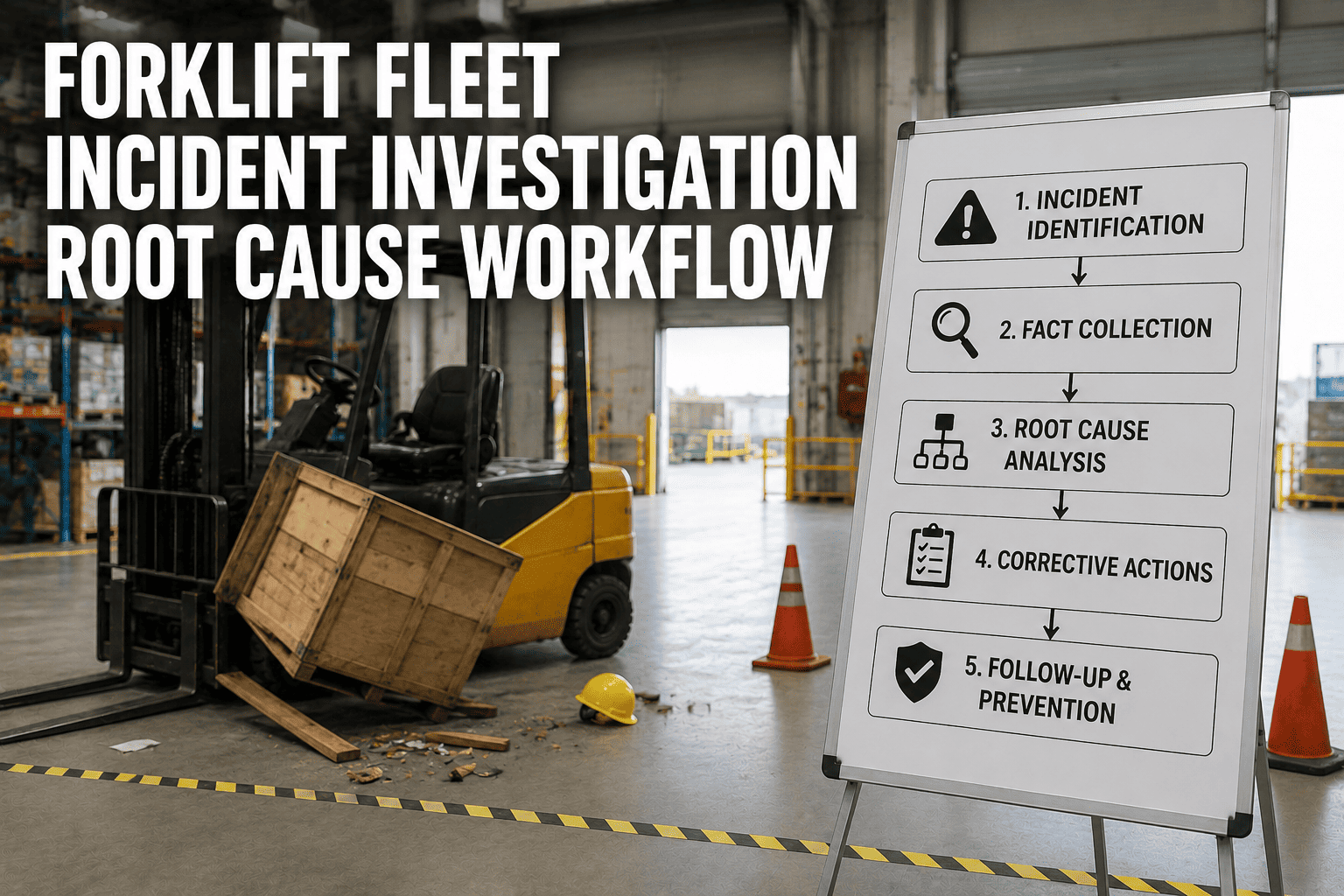
Corrective action records that are opened when a fault is identified but never formally closed with root cause analysis and effectiveness verification are among the most reliable audit finding triggers in ISO 9001 surveillance assessments. Auditors specifically sample open corrective actions from prior periods to test whether the closure process is functioning — an aged open corrective action from 14 months ago with no activity entries is an immediate nonconformance regardless of whether the underlying fault was physically resolved at the time. FleetRabbit's corrective action workflow enforces a structured closure sequence: fault identification, containment action, root cause entry, corrective action description, and effectiveness verification sign-off — with automatic escalation alerts when corrective actions exceed configurable age thresholds without closure progress.
03
Overdue Preventive Maintenance — Scheduled Work Missed Without Documented Deferral
A preventive maintenance schedule that shows overdue work orders without documented deferral justification tells an auditor one of two things: either the maintenance programme is not being followed, or the tracking system is not reflecting reality. Both interpretations result in an audit finding. The critical distinction is between a maintenance task that was genuinely deferred for documented operational reasons — a project deadline, a parts availability constraint, a risk assessment that justified the deferral — and a task that simply slipped without anyone noticing. FleetRabbit's PM scheduling engine generates overdue alerts with configurable escalation thresholds, requires a documented deferral reason when maintenance is pushed past its due date, and maintains a deferral log that shows auditors that schedule deviations were managed deliberately rather than overlooked.
04
Calibration Expiry — Measurement Equipment Used Beyond Its Calibration Due Date
Calibration records that cannot be quickly cross-referenced to the specific equipment they apply to, combined with calibration due dates that are tracked in a separate spreadsheet that does not trigger alerts, create a predictable audit exposure: measurement equipment used beyond its calibration due date without detection. Under ISO 9001, this requires not only a corrective action for the calibration lapse but potentially a product recall or retest assessment for any product measured by the out-of-calibration equipment during the lapsed period — a disproportionate audit consequence for what is fundamentally a record management failure. FleetRabbit tracks calibration due dates alongside routine maintenance records for every asset, generates advance warning alerts at configurable pre-expiry intervals, and flags any equipment that is used in an active work order while its calibration status is overdue.
05
Untraceable Record History — Cannot Retrieve Specific Asset History Under Audit Conditions
An auditor who requests the complete maintenance history for a specific asset over the past three years and receives a response of "we need some time to pull that together" has already formed a view about the organisation's document control maturity. ISO 9001 Clause 7.5 requires documented information to be available and suitable for use where and when it is needed — slow or incomplete retrieval under audit conditions is itself a finding risk. FleetRabbit's asset history view presents every inspection record, maintenance entry, fault log, corrective action, calibration event, and operator check for any asset in the fleet in a single chronological timeline — retrievable by asset serial number, registration, or custom asset ID in under five minutes, in a format that can be exported to PDF for auditor submission without manual compilation.
FleetRabbit ISO 9001 Compliance
Digital Inspection Records. Corrective Action Trails. Calibration Tracking. Audit-Ready by Default.
FleetRabbit's digital fleet management platform generates the complete documented information that ISO 9001 auditors require — maintenance histories, inspection records, corrective action closures, and calibration status — automatically maintained and instantly retrievable for every asset in the fleet.
Building the Audit-Ready Record System: Four Pillars
Audit readiness for ISO 9001 equipment and infrastructure clauses is not achieved in the two weeks before an audit by compiling documents from multiple systems. It is the natural output of a digital fleet management system that captures the right information at the right time, every time, as part of normal operations. The four pillars below define what an audit-ready digital record system needs to deliver consistently — not just in audit preparation months but as the baseline operational state of the fleet management function throughout the certification cycle.
Structured Capture
Every maintenance activity, inspection, fault report, and corrective action is captured through a structured digital workflow that enforces required fields, technician identification, and timestamp logging at the point of entry. Freeform notes and verbal completions are replaced by structured data entries that produce consistent, auditable records regardless of which technician performs the work or which site the asset is operating from. Mandatory photo evidence fields on damage reports and corrective actions provide the visual documentation that supports record credibility under audit review.
Automated Scheduling
Preventive maintenance schedules driven by engine hours, calendar intervals, or kilometre triggers generate work orders automatically — eliminating the manual schedule management that creates overdue maintenance gaps in spreadsheet-based systems. Schedule adherence metrics are visible in real time, showing compliance percentage against planned maintenance for each asset and each maintenance type. Deferral workflows capture documented justification when maintenance is delayed, creating the audit evidence that schedule deviations were managed deliberately rather than missed through system failure.
Closed-Loop Actions
Every fault or nonconformity identified through inspection, operator report, or telematics alert enters a structured corrective action workflow that tracks status from identification through root cause analysis to closure verification. Escalation alerts prevent corrective actions from ageing without progress. Effectiveness verification fields require documented evidence that the corrective action resolved the root cause — not just the symptom — before the record can be closed. The corrective action register provides auditors with a complete view of nonconformity management maturity across the fleet.
Instant Retrieval
Complete asset histories — every maintenance record, inspection, fault, corrective action, calibration event, and operator check — are retrievable by asset identifier in under five minutes in audit-ready format. Compliance summary reports showing schedule adherence, overdue maintenance, corrective action closure rates, and calibration status can be generated for any date range and any asset subset with a single export action. Audit preparation becomes a report generation task rather than a document compilation exercise across multiple systems and locations.
From the Field
"Our previous ISO 9001 surveillance audit was a difficult experience — not because our maintenance programme had failed, but because we could not demonstrate to the auditor's satisfaction that it was systematically managed. We had three separate systems: a spreadsheet for PM scheduling, a paper-based inspection form that got scanned and filed when someone remembered to do it, and a maintenance log in our ERP that the workshop team didn't consistently update. The auditor raised two nonconformances — one for incomplete corrective action closure records and one for calibration records that couldn't be linked to specific equipment at the time of use. We implemented FleetRabbit before the next surveillance cycle. Every inspection is now digital, every corrective action has a structured closure trail, and calibration due dates sit alongside the asset record so there's no separate system to reconcile. When the auditor came back the following year and asked for the maintenance history on our three primary production vehicles going back 30 months, I pulled it up on screen in about four minutes. He reviewed it for 20 minutes and found nothing to raise. That audit closed with zero nonconformances for equipment and infrastructure for the first time in our certification history."
Quality & Compliance Manager
·
Manufacturing & Field Services Organisation — ISO 9001:2015 Certified — 34-Asset Fleet
The ISO 9001 Audit Preparation Checklist for Fleet Records
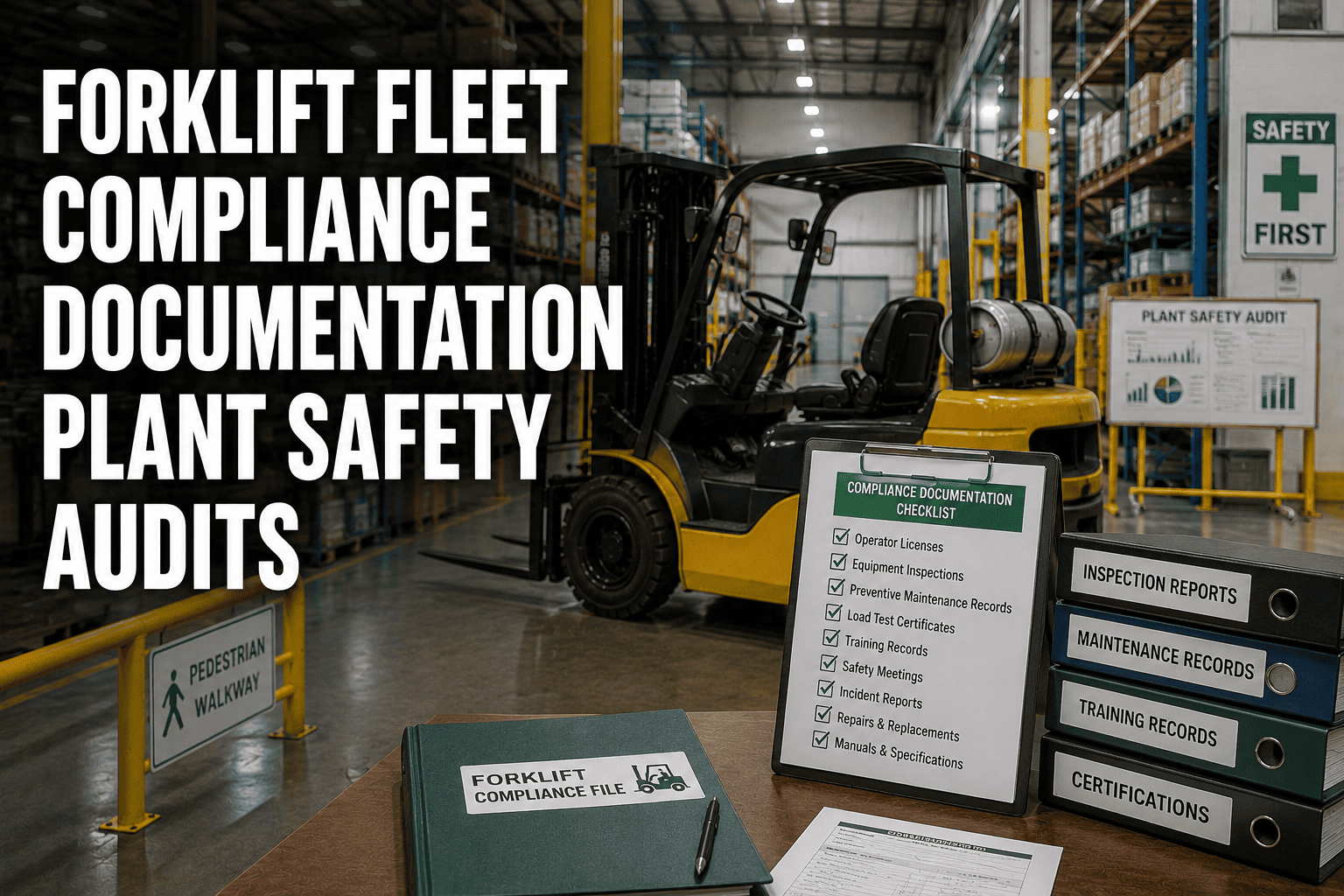
The checklist below maps the specific audit evidence requests that ISO 9001 auditors most commonly make against fleet and equipment records — and the FleetRabbit platform feature that generates each evidence type automatically. Working through this checklist 60 days before a scheduled audit identifies any remaining documentation gaps while there is still time to address them through normal operational activity rather than emergency record reconstruction.
01
Planned Maintenance Schedule Evidence
Auditor request: "Show me your planned maintenance schedule for critical production equipment and demonstrate that it was followed over the past 12 months." FleetRabbit response: Export the PM schedule compliance report for the requested asset group and date range — showing planned maintenance tasks, due dates, completion dates, technician identification, and schedule adherence percentage. Overdue maintenance entries appear with deferral justification records where applicable. The report format is structured for direct auditor presentation without manual compilation or formatting. Preparation action 60 days before audit: review schedule adherence report, address any overdue items with documented deferral or completion, verify that all completed maintenance records have full technician sign-off entries.
02
Corrective Action Register and Closure Evidence
Auditor request: "Show me your corrective action register for equipment nonconformances and provide evidence that actions were closed effectively." FleetRabbit response: Export the corrective action register filtered by asset category and date range — showing each nonconformance, containment action, root cause entry, corrective action description, closure date, and effectiveness verification record. Open corrective actions appear with current status and last activity date. Preparation action 60 days before audit: review all open corrective actions, escalate any that have been inactive for more than 30 days, close any that were physically resolved but not formally documented, and verify that effectiveness verification entries exist for all corrective actions closed in the past 12 months.
03
Calibration Status and History Records
Auditor request: "Show me the calibration records for measurement equipment used in your production process and confirm current calibration status." FleetRabbit response: Export the calibration status report for all assets with calibration requirements — showing last calibration date, calibration standard used, result, next due date, and current status (current, due within 30 days, overdue). Cross-reference to maintenance and work order records confirms that no calibration-overdue equipment was used in active production work orders during the lapsed period. Preparation action 60 days before audit: identify any equipment approaching calibration due dates within the audit window, schedule calibration activities in advance of expiry, and verify that calibration records include the standard reference and result rather than just a completion date entry.
Frequently Asked Questions
QDoes FleetRabbit generate the specific report formats that ISO 9001 auditors require, or do records need to be reformatted before submission?
FleetRabbit's export formats are designed for direct auditor submission without manual reformatting. The PM schedule compliance report, corrective action register, calibration status report, and individual asset history timeline all export to structured PDF and CSV formats that include the data fields — dates, technician identification, asset identification, action descriptions, closure status — that ISO 9001 auditors request when assessing Clause 7.1.3 and 10.2 compliance. The asset history PDF export presents the complete record chronologically with a cover page identifying the asset, the date range covered, and the total number of records in the export — matching the format that auditors typically request when asking for documented evidence of infrastructure maintenance. Custom report templates can be configured for organisations that have specific format requirements agreed with their certification body.
QHow does FleetRabbit handle the transition from an existing paper-based or spreadsheet maintenance system without losing historical records needed for the next audit?
FleetRabbit supports historical record migration through two pathways depending on the format of existing records. Structured spreadsheet data — existing maintenance logs, PM schedules, calibration records — can be imported via CSV template into the platform's historical record store, making prior-period records retrievable from FleetRabbit alongside new digital records from the go-live date. Scanned paper records can be attached to the relevant asset's document library as PDF attachments, timestamped and searchable, providing a single retrieval point for both historical paper and new digital records. FleetRabbit's onboarding team assists with data migration scoping as part of fleet deployment to ensure that the historical record coverage needed for the first post-implementation audit cycle is available from day one of go-live rather than requiring a parallel system to be maintained during the transition period.
QCan FleetRabbit support other management system standards beyond ISO 9001, such as ISO 45001 or ISO 14001, with the same fleet record infrastructure?
Yes. FleetRabbit's digital fleet record infrastructure supports the documented information requirements of multiple ISO management system standards simultaneously — the same maintenance records, inspection logs, and corrective action trails that satisfy ISO 9001 Clause 7.1.3 also address equipment-related requirements under ISO 45001 (occupational health and safety, plant inspection and risk control records) and ISO 14001 (environmental management, plant condition records relevant to emissions or spill risk). Organisations pursuing integrated management system certification — combining ISO 9001, 45001, and 14001 under a single audit cycle — benefit from FleetRabbit's unified asset record approach, which eliminates the common problem of maintaining separate record systems for quality, safety, and environmental compliance against the same physical assets. Inspection checklist templates can be configured to capture the specific evidence fields required by each standard within a single asset inspection workflow.
FleetRabbit ISO 9001 Compliance
Maintenance Records. Corrective Action Trails. Calibration Tracking. Zero Audit Scramble.
FleetRabbit generates the complete documented information that ISO 9001 auditors require — automatically, in real time, across every asset in the fleet — so audit preparation becomes a report generation task rather than a three-week document recovery exercise.
ISO 9001 Clause 7.1.3
Corrective Action Register
Calibration Tracking
Audit-Ready Exports
Complete Asset History
May 22, 2026
By Taylor
All Posts