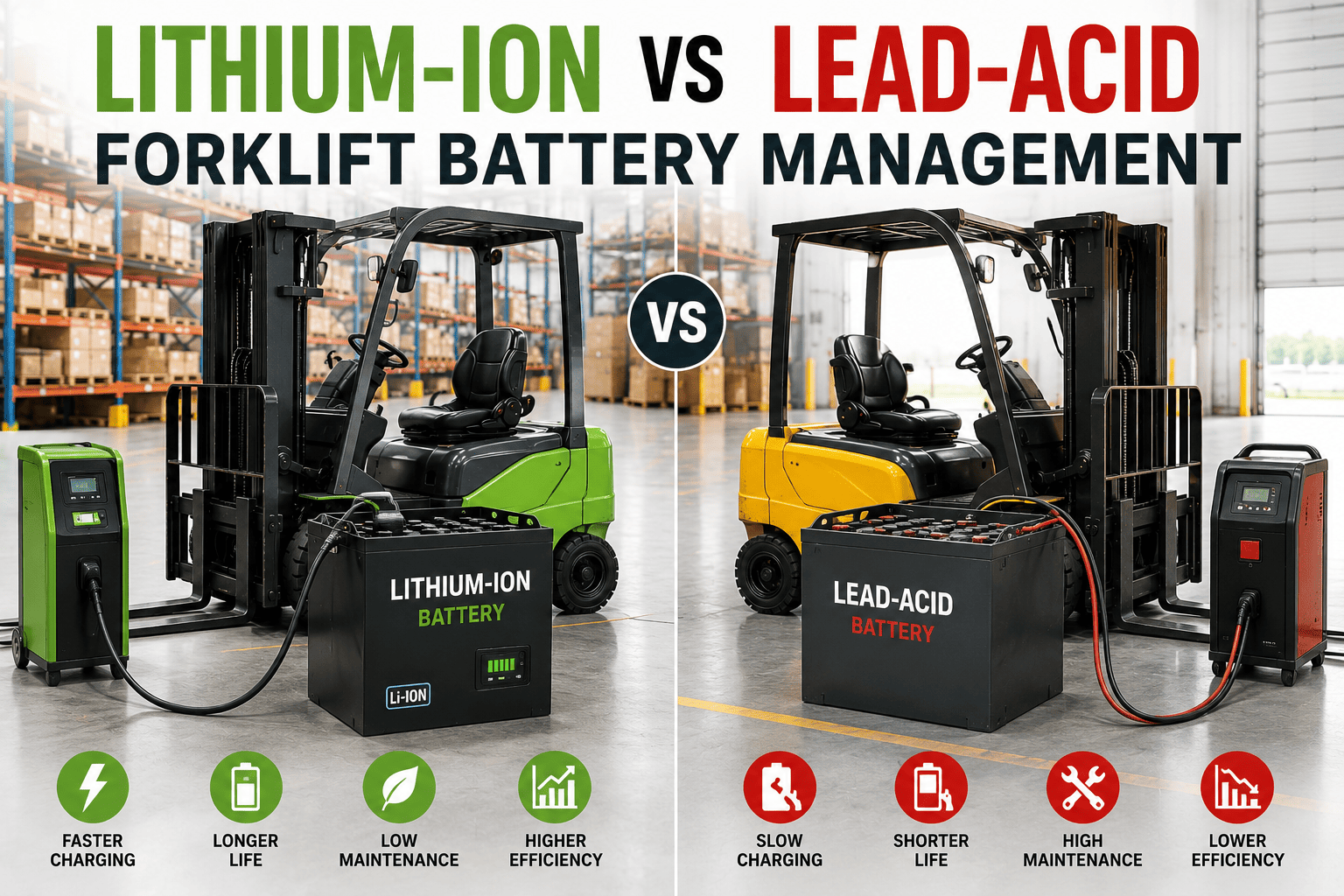
Ask three warehouse managers which forklift battery is better and you will get three different answers, usually depending on which one they bought last. The truth is neither chemistry is universally right. Lead-acid still makes sense in plenty of facilities, and lithium-ion is not automatically worth the higher price tag everywhere it gets installed. What actually matters is how each battery is managed day to day, because that is where fleets either capture the savings or quietly bleed them away.
Lead-acid forklift batteries cost roughly 2000 to 6000 dollars upfront while lithium-ion runs considerably higher, yet lithium-ion typically delivers 20 to 40 percent lower total cost of ownership over five years for multi-shift operations. Lithium charges in 2 to 4 hours with no cooldown, versus 8 hours charging plus 8 hours cooling for lead-acid. The right choice depends entirely on your shift pattern and how well either battery type is monitored.
Two Chemistries, Two Completely Different Playbooks
Lead-acid and lithium-ion batteries do not just differ in price. They demand opposite management habits, and treating them the same way is how fleets end up with premature failures on one end and wasted investment on the other.
- Needs weekly watering and terminal cleaning
- Full 8 hour charge plus 8 hour cooldown
- Rated for roughly 1200 to 1500 cycles
- Requires a dedicated ventilated battery room
- Often needs 2 to 3 batteries per truck for multi-shift work
- Zero watering, sealed maintenance-free cells
- Opportunity charges in 2 to 4 hours, no cooldown
- Rated for 3000 or more cycles
- No ventilation or acid containment needed
- Usually one battery covers a full multi-shift day
Why the Sticker Price Tells the Wrong Story
A lead-acid pack looks like the obvious budget choice next to a lithium-ion unit priced two to four times higher. But that comparison stops at the invoice. Once watering labor, cooldown downtime, battery room infrastructure, and replacement frequency enter the calculation, lithium-ion commonly closes the gap and often comes out ahead over a five-year window, particularly for facilities running more than one shift.
The Real Five-Year Math
One detailed industry comparison found a total cost to own of roughly 30900 dollars for lithium-ion against 34850 dollars for lead-acid on a single truck over five years, once changeouts and downtime were included. Multiply that gap across a fleet of twenty or thirty trucks and the difference stops being a rounding error and starts being a line item worth explaining to finance.
FleetRabbit logs charge cycles, watering schedules, and battery health for lead-acid and lithium-ion fleets side by side, so the total cost of ownership conversation is backed by your own data instead of a vendor brochure. Sign up free to start tracking today.
Where Lead-Acid Fleets Lose Money Without Noticing
Lead-acid batteries are forgiving right up until they are not. Skipped watering cycles, incomplete charges, and deep discharges do not cause instant failure, they cause gradual capacity loss that shows up months later as a battery that no longer lasts a full shift. By the time the pattern is obvious, the battery is already past the point where correction helps.
The Watering and Equalization Trap
Lead-acid cells need water topped up on a strict schedule and periodic equalization charges to prevent sulfation. Skipping either shortens lifespan significantly, yet watering logs in most facilities still live on a clipboard that nobody reviews until a battery dies early. Facilities that digitize this schedule and get alerts when a battery is overdue keep their packs closer to their full rated cycle life.
The Change-Out Labor Nobody Budgets For
Every battery swap in a multi-shift lead-acid operation takes roughly 15 to 20 minutes of labor, and heavy-use trucks may swap two or three times a day. Multiplied across a fleet and a year, that labor cost rarely appears in the original battery budget, which is exactly why total cost of ownership estimates built from purchase price alone are almost always wrong.
| Cost Factor | Lead-Acid | Lithium-Ion | What To Track |
|---|---|---|---|
| Upfront Price | 2000 to 6000 dollars | Considerably higher per unit | Batteries needed per truck for full-shift coverage |
| Charging Time | 8 hours plus 8 hour cooldown | 2 to 4 hours, opportunity charge ready | Charge cycle frequency and completion rate |
| Rated Lifespan | 1200 to 1500 cycles | 3000 or more cycles | Actual cycles logged versus rated capacity |
| Maintenance Labor | Weekly watering, equalization charging | None required | Watering schedule adherence and missed intervals |
| Infrastructure | Ventilated room, acid containment | Standard charging bay, no ventilation | Floor space and setup cost per charging point |
Where Lithium-Ion Fleets Waste Their Advantage
Buying lithium-ion does not automatically produce the promised savings. Operations that opportunity charge inconsistently, ignore battery health data, or size their charging infrastructure incorrectly end up paying the premium price without collecting the full benefit.
Opportunity Charging Only Works If It Actually Happens
The entire economic case for lithium-ion rests on short top-up charges during breaks instead of one long overnight cycle. If operators park trucks without plugging in, or supervisors never enforce the habit, the fleet ends up paying lithium prices while getting lead-acid-style charging discipline, which erodes the payback timeline substantially.
Infrastructure Costs That Get Underestimated
Charging infrastructure is frequently the most overlooked line item in a lithium-ion purchase decision, and it can swing facility costs by tens of thousands of dollars depending on existing electrical capacity. Older buildings sometimes need panel upgrades before lithium charging even becomes possible, a cost that rarely shows up in the initial battery quote.
Building a Management System That Fits Your Fleet
Whether your fleet runs lead-acid, lithium-ion, or a mix during a transition period, the fleets that get the best results treat battery management as an ongoing operational discipline rather than a one-time purchase decision. That means logging every charge cycle, flagging batteries that fall behind their expected performance curve, and giving supervisors visibility into which trucks are draining batteries faster than they should.
Mixed fleets in transition need this visibility more than anyone. Running both chemistries side by side without a unified tracking system makes it nearly impossible to know which battery type is actually delivering the promised savings, which is exactly the gap a proper monitoring platform closes.
FleetRabbit tracks charge cycles, health trends, and watering schedules across lead-acid and lithium-ion trucks together, giving you the real numbers behind your electrification decisions. See how it works on your fleet with a live walkthrough.
Which Chemistry Actually Fits Your Operation
Lithium-ion tends to win clearly in multi-shift warehouses, opportunity charging environments, and facilities looking to reduce battery room labor and floor space. Lead-acid still holds up reasonably well in single-shift operations with plenty of idle time between uses, where the payback period on lithium is harder to justify and existing battery room infrastructure is already paid for and running smoothly.
The honest answer for most fleet managers is that the decision should be revisited on a truck-by-truck or shift-by-shift basis rather than applied as one blanket policy across the whole facility. A high-utilization truck running three shifts is a very different economic case than a backup unit that sits idle most of the day.
Key Takeaways on Battery Management
Neither lead-acid nor lithium-ion is the universally correct answer. Lead-acid remains a sound choice for lighter-duty, single-shift operations with maintenance routines already in place, while lithium-ion earns its higher price tag in multi-shift, high-utilization fleets that commit to consistent opportunity charging. What separates fleets that get the expected returns from those that do not is not the chemistry itself, it is whether charge cycles, watering schedules, and battery health are actually tracked and acted on.
The fleets seeing the strongest results are the ones that stopped treating battery strategy as a one-time purchase and started treating it as an ongoing operational metric, measured the same way they measure fuel cost or maintenance downtime.
FleetRabbit tracks charge cycles, health, and maintenance schedules for lead-acid and lithium-ion batteries alike, so your electrification decisions are backed by real fleet data. Get started with no credit card required.