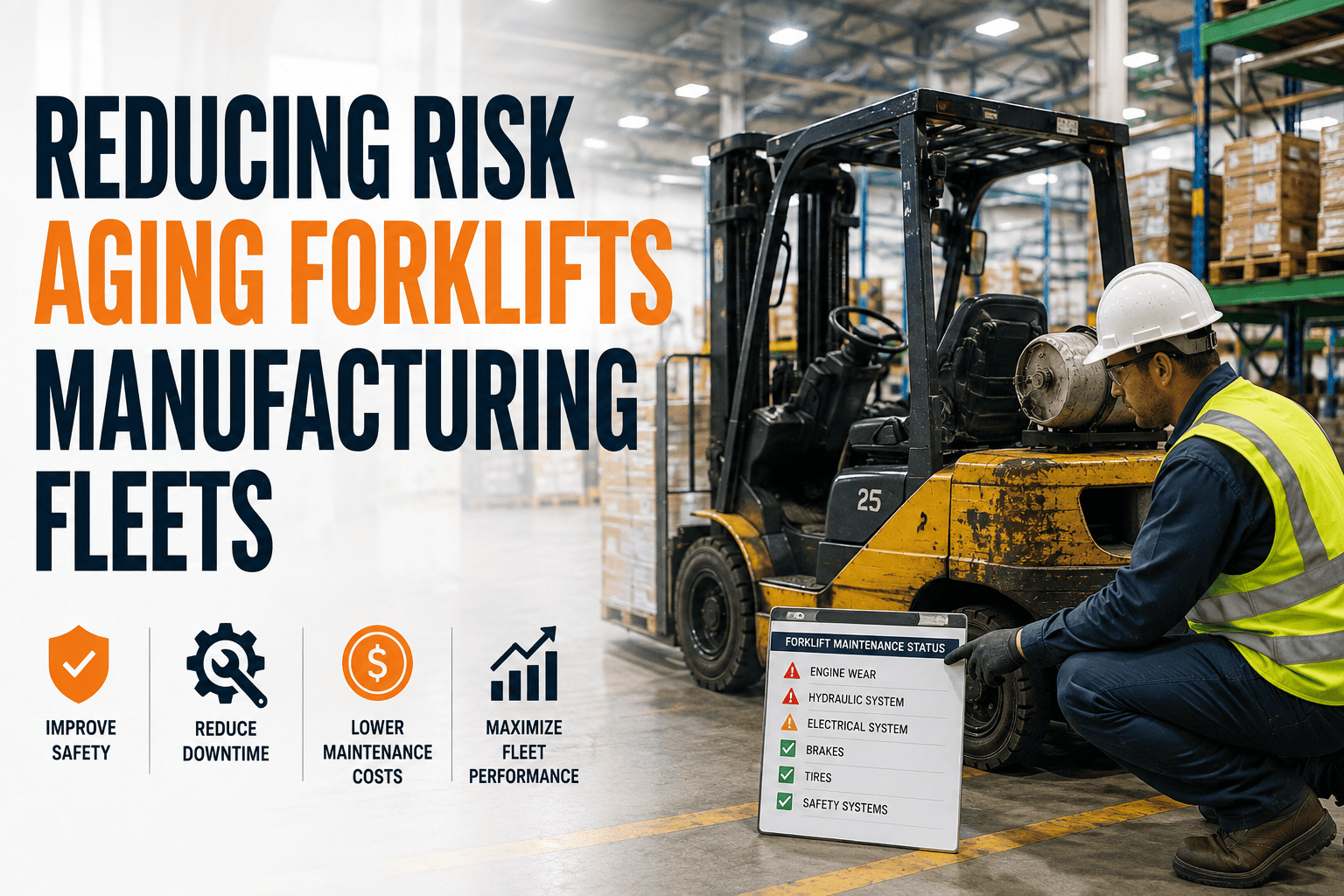
Every manufacturing floor has one. The forklift that starts a little slower each morning, needs a hydraulic hose replaced every other month, and somehow always breaks down the week a big order ships. Fleet managers tend to keep patching these units because each individual repair looks affordable. But aging forklifts rarely fail in one big, obvious moment. They fail in a slow accumulation of small warning signs, and by the time the pattern is undeniable, the fleet has already absorbed months of hidden risk.
A forklift crosses into high-risk territory once it passes roughly 10,000 to 12,000 operating hours for internal combustion units, or 15,000 hours for electric models. Past that point, annual repair spend typically climbs 20 to 40 percent, and maintenance costs on a unit older than seven years can run close to double what a newer truck costs to keep running. Tracking hours, repair spend, and downtime patterns lets you replace units on your terms instead of reacting to a breakdown mid-shift.
Three Signs Your Forklift Fleet Has Crossed Into Risk
Age alone does not condemn a forklift. What matters is how the machine is behaving right now. These three patterns are the earliest and most reliable signals that a unit has moved from routine wear into rising operational risk.
Why Aging Forklifts Cost More Than the Repair Invoice Shows
Most fleet managers evaluate an aging unit by looking at the last repair bill. That number is only part of the picture. Signing up for FleetRabbit gives you the operating-hour and repair-history data needed to see the full pattern behind that single invoice, not just the invoice itself.
The Hour Threshold That Changes Everything
Operating hours, not calendar age, are the real measure of wear. Internal combustion forklifts generally deliver a reliable service life of 10,000 to 12,000 hours, while electric models can often reach 15,000 hours before major components start failing in sequence. A seven-year-old unit that has logged heavy daily use in a three-shift plant can be functionally older than a ten-year-old truck used lightly once a week.
When Maintenance Spend Turns Into a Warning Signal
In the final stretch of a forklift's useful life, repair and parts spend tends to increase 20 to 40 percent, driven by a higher frequency of failures across different systems rather than one recurring issue. A unit older than seven years commonly costs close to double what a newer truck costs to keep running over the same period. That trend line, tracked consistently, tells you far more than any single repair estimate.
| Operating Hours | Risk Level | What Typically Happens | Recommended Action |
|---|---|---|---|
| 0 to 6,000 hours | Low | Routine wear, predictable scheduled maintenance | Continue standard preventive maintenance intervals |
| 6,000 to 10,000 hours | Moderate | Component wear accelerates, repair frequency rises | Track repair cost per hour closely against fleet average |
| 10,000 to 15,000 hours | High | Multiple systems begin failing, parts sourcing slows | Run a repair-versus-replace cost comparison per unit |
| 15,000+ hours | Critical | Major component failure likely regardless of repair history | Plan replacement before the next breakdown forces the decision |
FleetRabbit tracks operating hours, repair spend, and downtime patterns for every truck in your fleet, so you can see exactly which units are drifting into high-risk territory before they strand a shift.
The 50 Percent Rule Fleet Managers Use to Decide
A widely used industry guideline offers a simple gut check: if a single repair estimate runs 50 percent or more of the forklift's current market value, not its original purchase price, replacement is usually the stronger financial move. Market value is what the unit would sell for today, given its age and condition, so the rule avoids the trap of anchoring the decision to what the truck cost years ago.
A Quick Example
A forklift with a current market value of roughly 12,000 dollars needs a hydraulic or transmission repair quoted at 6,000 dollars. That repair sits right at the 50 percent line. Any additional repair spend after that point means putting more money into the machine than it is realistically worth, with no guarantee the next system holds up any longer.
Hidden Risks Aging Forklifts Create Beyond the Repair Shop
The repair bill is the visible cost. The risks underneath it are what actually threaten production schedules, safety records, and operator morale.
How FleetRabbit Helps You Spot Rising Risk Before It Becomes a Breakdown
Lifecycle Data Instead of Guesswork
Rather than reacting to whichever forklift breaks down loudest, FleetRabbit tracks operating hours, repair frequency, and cost per hour for every unit in your fleet, so replacement decisions are based on trend lines instead of the most recent invoice.
Early Warning Before the Shift Is Disrupted
Condition alerts flag units drifting toward the high-risk hour bands so your team can schedule a replacement evaluation on a slow week, not during the middle of a production run. You can book a demo to see how this looks against your own fleet data.
FleetRabbit turns operating hours and repair history into a clear risk picture for every truck in your fleet, so replacement decisions happen on your schedule, not during a shift emergency.