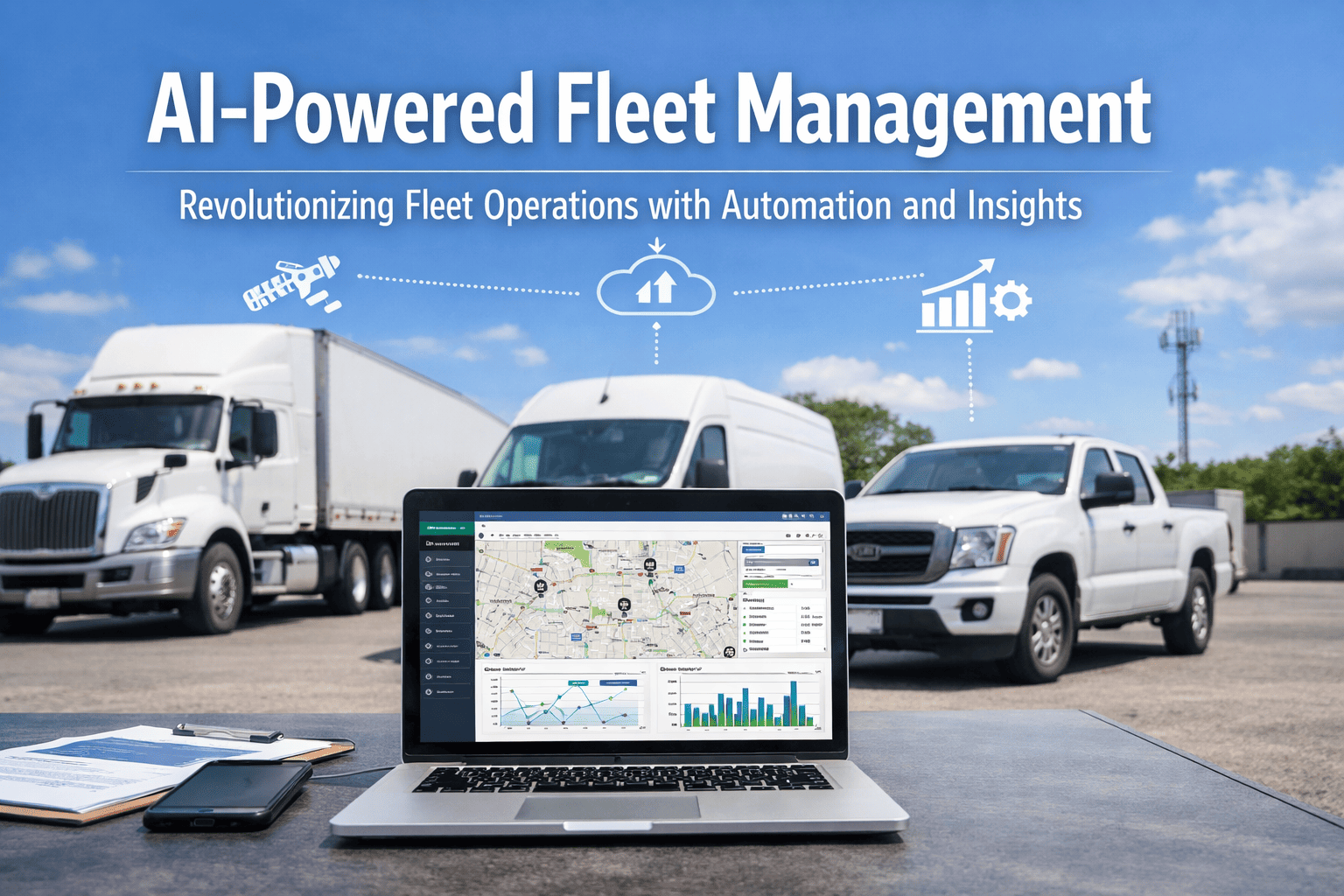
The fleets dominating their markets in 2026 share one thing in common: they stopped managing vehicles manually and started letting AI do the heavy lifting. With 65% of maintenance teams adopting AI by year-end and early adopters reporting 200-500% annual ROI, the question is no longer whether AI fleet management works — it is how quickly you can capture these advantages before competitors widen the gap.
AI-Powered Fleet Management
Automation, Predictive Maintenance & Real-Time Insights
What Is AI-Powered Fleet Management?
AI-powered fleet management uses machine learning, predictive analytics, and automation to transform how fleets operate. Instead of reacting to breakdowns, chasing compliance paperwork, or manually planning routes, AI systems handle these tasks automatically — processing thousands of data points per second to make better decisions than any human dispatcher could achieve alone.
The global fleet management market reached $27 billion in 2025 and is accelerating toward $122 billion by 2035, with AI capabilities driving this explosive growth. Software now commands 49% of the market at 17.1% CAGR, while cloud-based deployments represent 70% of new implementations. For fleet operators of any size, the message is clear: AI fleet management has moved from experimental pilot programs to mission-critical infrastructure.
The AI Adoption Gap: Your Competitive Window
Here's the critical insight reshaping fleet strategy in 2026: while 65% of maintenance teams plan to implement AI capabilities this year, only 27% have actually deployed predictive maintenance systems. This 38-point gap creates a massive opportunity for fleets that move now — a 12-18 month competitive advantage before the majority catches up.
The 38% gap between planning and deployment = your competitive window
Only 5.6% of fleets have deployed AI across multiple functions — maintenance, dispatch, compliance, and safety working together. This small group reports the highest ROI and strongest competitive advantages. Early AI adopters aren't just saving money today; they're building structural advantages that compound over time as their systems learn and optimize.
Six AI Capabilities Transforming Fleet Operations
AI fleet management isn't a single technology — it's an ecosystem of connected capabilities that work together to optimize every aspect of operations. Here's what's actually operational and delivering measurable results in 2026:
Predictive Maintenance
ML models analyze engine diagnostics, sensor readings, and historical data to identify component degradation 20-45 days before failure. Early adopters report 45% fewer breakdowns and 25% lower maintenance costs.
AI Route Optimization
Real-time routing considers traffic, weather, delivery windows, vehicle capacity, and driver hours simultaneously. Routes recalculate in under 30 seconds when conditions change — not the 45+ minutes manual replanning requires.
Smart Dispatch & Load Scheduling
AI evaluates vehicle capacity, driver certification, proximity, and HOS compliance simultaneously. What takes dispatchers 90 minutes manually takes AI under 8 seconds with fewer errors and better resource utilization.
Real-Time Fleet Visibility
Every vehicle, driver, and ETA visible from one dashboard. When breakdowns occur, route deviations happen, or drivers run behind schedule, the system flags issues automatically and suggests interventions.
AI Safety & Driver Coaching
AI dashcams with real-time intervention detect risky behaviors and provide in-cab coaching. Fleets using full AI safety solutions achieve 73% crash rate reduction over 30 months and 80% fewer distracted driving incidents within 90 days.
Automated Compliance
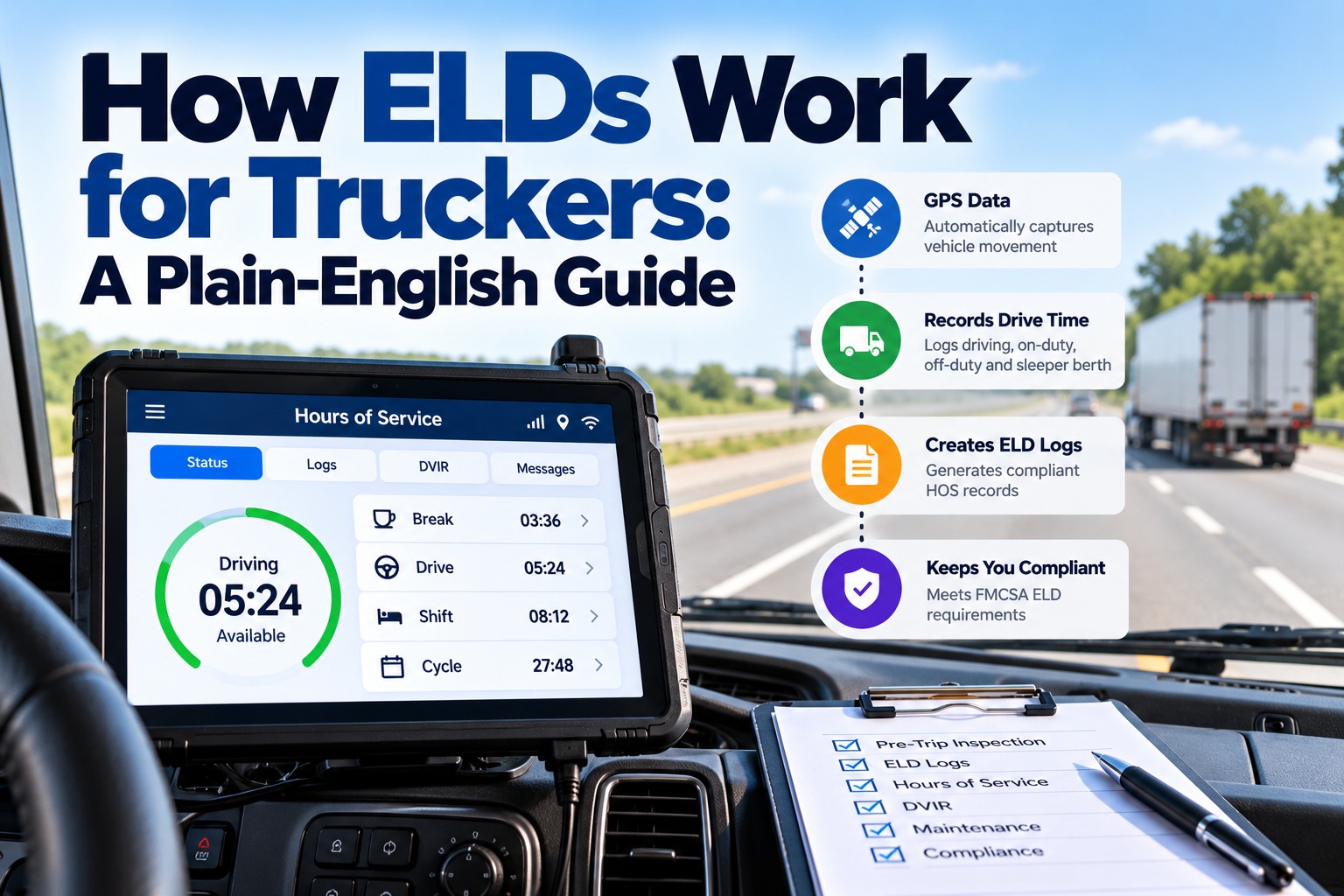
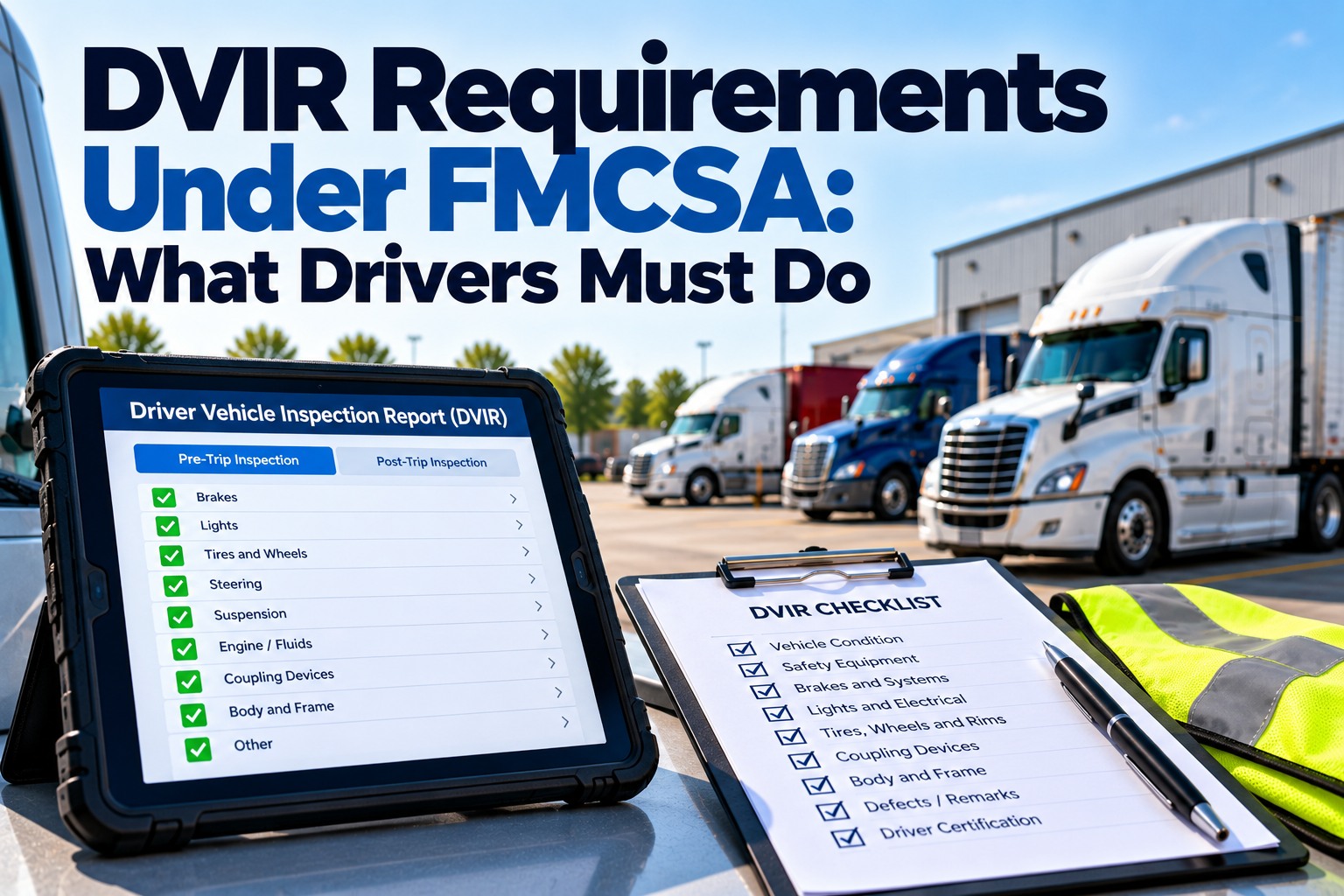
AI handles ELD compliance, DVIR documentation, HOS tracking, and regulatory reporting automatically. Documentation time drops dramatically in the first week, with compliance rates reaching 98%+ without manual intervention.
See AI Fleet Management in Action
Book a personalized demo and see how AI would optimize your specific routes, predict maintenance needs for your vehicles, and automate your compliance workflows.
The ROI Reality: Documented Results from 2025-2026
The ROI conversation for AI fleet management has moved from theoretical projections to documented, auditable results. CFOs and board-level stakeholders increasingly view AI fleet management as a proven operational investment with predictable returns — not a technology experiment.
Combined fuel optimization, predictive maintenance, route efficiency, reduced accidents, and administrative automation
Unplanned breakdowns reduced through AI-powered predictive maintenance
Route optimization and driver behavior monitoring combined
Most fleets see positive returns within the first quarter
Predictive vs. reactive maintenance cost comparison
A real-world example illustrates how returns compound: A 400-vehicle refrigerated fleet's AI system flagged three trucks showing simultaneous coolant temperature spikes and voltage drops — a pattern indicating imminent water pump failure that traditional diagnostics would have missed until roadside breakdown. Preventive service for all three vehicles cost $2,400. Three roadside breakdowns with spoiled cargo would have exceeded $45,000.
How AI Predictive Maintenance Actually Works
The biggest misconception about AI predictive maintenance is that it requires massive infrastructure investment. Most fleets can start generating predictions with hardware they already have — AI platforms integrate with existing telematics providers via standard APIs.
Data Ingestion
Continuous ingestion of engine, brake, transmission, and tire sensor data analyzed against failure baselines 24/7
Starts within 24 hoursPattern Recognition
ML models trained on millions of commercial vehicle failure events predict component risk weeks in advance
First predictions in 72 hoursAutomated Response
When risk crosses threshold, prioritized work orders created and routed to maintenance automatically
Zero manual input requiredContinuous Learning
Models improve continuously as they accumulate data from your specific fleet patterns and outcomes
Accuracy improves over timeModern ensemble machine learning models achieve 85-95% precision predicting major component failures — brakes, engine, transmission, tires, electrical systems — with false positive rates reduced to 5-15%. AI surfaces component failure risks 20-45 days before traditional diagnostics detect problems, giving maintenance teams time to schedule repairs during planned downtime.
Industry Applications: AI Across Fleet Types
AI fleet management delivers value across every logistics segment, but specific applications vary by industry. Understanding how AI addresses your particular operational challenges helps prioritize implementation.
Long-Haul & Regional Distribution
- Predictive maintenance prevents $760+ per-breakdown costs
- HOS compliance enforced automatically in every route
- Fuel stop planning avoids premium price zones
- ELD integration with automatic compliance data flow
Heavy Equipment & Support Vehicles
- Asset utilization tracking across job sites
- Predictive maintenance for high-value equipment
- Fuel theft detection with consumption anomaly alerts
- Equipment location and idle time monitoring
Technician & Service Teams
- Skill-based dispatch matching by certification
- Service window compliance management
- Parts availability factored into assignments
- Emergency jobs inserted without breaking schedules
E-Commerce & Local Distribution
- AI sequences stops for tight delivery windows
- Failed deliveries auto-rescheduled instantly
- Real-time customer ETAs pushed automatically
- Proof of delivery captured digitally
Implementation Timeline: From Day 1 to Full ROI
The phased approach means you can start capturing value immediately while building toward full AI optimization. Most fleets achieve positive ROI within 60-90 days of complete implementation.
Connect & Configure
Integrate existing telematics (Geotab, Samsara, Verizon Connect, Motive). AI begins building vehicle-specific baselines within 24 hours. No new hardware required — 90% of 2026 commercial vehicles ship with factory telematics.
Full fleet visibility from day oneFirst Predictions & Optimizations
ML generates first actionable failure predictions within 72 hours. Initial accuracy 75-80% using fleet-wide pattern data. Route optimization begins delivering 10-15% fuel savings immediately.
First prevented breakdowns and fuel savingsAutomation Activated
Connect alerts to work order management. Auto-generate repair orders, schedule technicians, and order parts automatically. Dispatchers shift from coordination to exception handling.
60% admin time reduction, near-zero errorsFull ROI & Continuous Improvement
Models reach 89%+ prediction accuracy. Analytics surface patterns impossible to identify manually. System recommendations get sharper weekly as it builds your fleet-specific model.
200-500% annual ROI compoundingWhy 2026 Is the Optimal Adoption Window
Three converging forces make this year the optimal moment for AI fleet management adoption. Fleet operators who delay beyond 2026-2027 risk falling permanently behind competitors capturing efficiency advantages that compound over time.
Technology Readiness
AI has crossed from experimental to production-ready. Ensemble ML achieves 85-95% precision. Edge computing enables real-time processing. Integration with existing telematics means deployment without rip-and-replace investments. The technology works, scales, and implementation paths are well-established.
Workforce Pressure
The US faces an 80,000+ driver shortage with 237,600 annual job openings projected through 2034. AI helps existing teams accomplish more — dispatchers manage 3x more vehicles, maintenance coordinators handle larger fleets, managers focus on optimization instead of firefighting daily crises.
Competitive Dynamics
When Amazon, FedEx, major 3PLs, vehicle OEMs, and insurance carriers all invest heavily in AI fleet technology simultaneously, it signals industry-wide recognition that AI isn't optional. Early adopters build data advantages that compound — every month of operational data makes predictions more accurate.
Frequently Asked Questions
Most fleets identify measurable savings within 30-90 days through reduced emergency repairs, lower towing costs, and fewer rental replacements. Compliance automation shows results within the first week as documentation time drops dramatically. Fuel optimization typically shows 10-15% savings in the first quarter. Predictive maintenance benefits compound as AI learns your fleet patterns — most fleets see full ROI payback within 44 days, with ongoing returns of 200-500% annually.
No. Modern AI platforms like FleetRabbit integrate with all major telematics providers — Geotab, Samsara, Verizon Connect, Motive, and factory-embedded OEM systems via standard APIs. In 2026, over 90% of new commercial vehicles ship with factory telematics, so AI platforms access this data with zero additional hardware cost. For older vehicles without telematics, affordable OBD-II devices ($50-150 each) provide the necessary data connectivity.
Absolutely — smaller fleets often see the highest percentage ROI because each prevented breakdown or accident has outsized impact on tight margins. Cloud-based AI platforms have democratized enterprise-level capabilities for fleets of any size. FleetRabbit offers AI-powered maintenance scheduling, inspection tracking, and compliance management starting at $3/vehicle/month with no contracts — compared to enterprise platforms charging $25-50/vehicle with multi-year commitments. A 20-truck fleet can access the same AI capabilities as a 2,000-truck operation.
Modern ensemble ML models achieve 85-95% precision in predicting major component failures — bearings, pumps, motors, alternators, brakes, and transmission issues. False positive rates have been reduced to 5-15% through advanced algorithms. FleetRabbit's ML models begin building vehicle baselines within 24 hours of connection and generate first actionable predictions within 72 hours. Models improve continuously as they accumulate more data from your specific fleet.
Start with your biggest pain point. If breakdowns are killing uptime, start with predictive maintenance. If fuel costs are out of control, start with fuel intelligence. If compliance paperwork is consuming staff time, start with automated reporting. Most fleets see the fastest ROI from predictive maintenance (44-day average payback) or compliance automation (immediate time savings). Start with 5-10 high-value vehicles to prove ROI before expanding fleet-wide.
The Gap Is Widening Every Month
Fleets using AI report 30% less downtime, 12% lower fuel costs, and 89% failure prediction accuracy. The 65% planning AI adoption and the 27% who've deployed it creates a 12-18 month competitive window that closes with every passing quarter. FleetRabbit gives you enterprise-grade AI at a price that makes sense for any fleet size.
Free for 3 vehicles | $3/vehicle/month | No contracts | Works with existing hardware