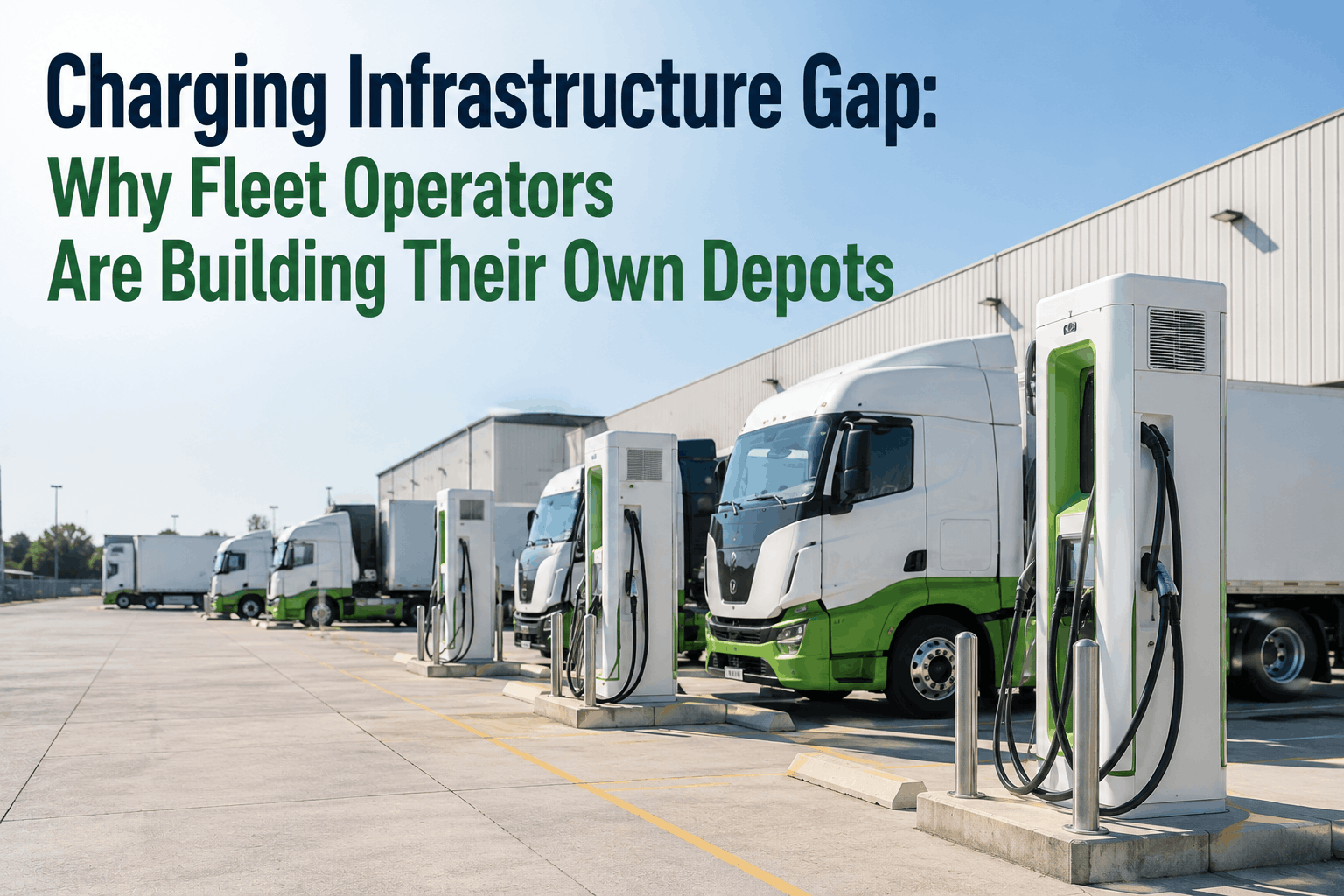
For fleet operators, the transition to electric vehicles (EVs) has always faced a fundamental question: where and how will the vehicles charge? Public infrastructure, while growing, is not designed for commercial fleet needs. It is expensive, unpredictable, and rarely located where your trucks return at the end of a shift. This is why forward-thinking fleet operators are taking matters into their own hands, building private charging depots to power their electric fleets. They are turning the depot into a strategic asset, a controlled environment offering lower costs and resilience that public networks cannot match. The charging infrastructure gap is real, and the solution is depot-based private charging.
Charging Infrastructure Gap: Why Fleet Operators Are Building Their Own Depots
Fleets are opting for captive charging depots to avoid the high costs, grid delays, and operational inefficiencies of public networks. A captive charging setup is an internal cost center, not a profit-making venture, designed to minimize operating costs.
The Public Charging Problem for Commercial Fleets
Public EV charging infrastructure, while essential for consumer adoption, is fundamentally misaligned with commercial fleet operations. It is open to all EV users and typically located at highways, malls, or fuel stations. For a fleet, reliance on public charging introduces significant challenges.
The economics are a primary obstacle. Public charging networks have higher per-kWh costs due to land leases, operational overhead, and a required profit margin. For a logistics company, the total cost of ownership (TCO) for an electric truck already favors diesel alternatives, but high electricity costs can make up 30-50% of that TCO, and public charging only exacerbates this issue. This model introduces variability in availability and integration issues with fleet-wide billing or energy tracking systems, making it impractical for high-mileage fleets.
Beyond cost, public charging is operationally inefficient. Commercial fleets require guaranteed, reliable charging at scale. Sending drivers to find and use public chargers adds dead miles and unproductive time. Furthermore, the high capital expenditure for public stations often requires grid upgrades and navigating complex permitting processes, which can take 12 to 36 months. These challenges are why captive charging, reserved for a specific group, is the preferred model for fleets like buses, delivery vans, and taxis.
Why Fleet Operators Are Building Private Depots
The decision to build a private charging depot transforms the charging challenge into a competitive advantage. This approach aligns with the concept of captive charging, where all infrastructure is reserved for the fleet.
Cost Control & Savings: A private depot allows fleets to purchase electricity at industrial or commercial tariffs rather than retail public charging rates. The savings are significant. Industry analyses show EV fleet vehicles are cheaper over time than diesel equivalents due to lower energy and maintenance costs. This inherent advantage is amplified by depot charging, where a fleet can schedule charging during off-peak hours to benefit from lower tariffs.
Operational Resilience: A private depot provides guaranteed overnight charging, ensuring every vehicle starts its shift with a full battery. This eliminates the unpredictability of public networks and reduces downtime. It also allows for the integration of solar PV and battery energy storage systems (BESS), cutting exposure to grid volatility and lowering carbon intensity.
Scalability and Control: Building a private depot allows the fleet to design and scale the infrastructure to meet its precise needs. As the fleet expands, the charging infrastructure can grow with it. This level of control is impossible with public networks, which are designed for a broad audience rather than specific operational demands. To see how your fleet's TCO could improve with depot charging, book a demo with FleetRabbit and let our specialists model your electrification scenario.
Access to industrial electricity tariffs and off-peak scheduling reduces per-kWh costs by up to 30% compared to public networks.
Eliminates the time and cost of sending vehicles to public chargers, improving operational efficiency and driver satisfaction.
Vehicles recover energy during natural downtime, ensuring they start every shift with a full charge and no impact on routes.
Building the Power Hub: A Strategic Playbook
Building a private depot is a major undertaking, but the operational and financial rewards are substantial. This process should be viewed as building a power hub, a strategic asset designed for your fleet's unique needs.
Following a blueprint can streamline the process. The first step is a thorough site feasibility and fleet analysis. This involves mapping duty cycles, daily mileage, dwell times, and parking patterns to calculate total daily energy (kWh/day) and peak power needs (kW). Understanding the charging mix is critical: overnight AC (up to 22 kW) is cost-effective for most vehicles, while daytime DC fast charging is essential for quick turnarounds.
Next is grid connection and power upgrades. Auditing existing electrical capacity and engaging the utility early is crucial, as connection queues can be lengthy. Mitigation options like phased rollouts, smart load management, and behind-the-meter renewables can help avoid costly upgrades.
Finally, hardware selection must be scalable. Fleets should specify AC chargers for overnight use and DC fast chargers (up to 100-150 kW) for rapid turnarounds. Designing for growth by installing spare switchgear capacity, pre-laid conduits, and OCPP-compliant chargers ensures vendor flexibility and future-proofing.
Financial Incentives and Scalability
The financial case for depot charging is strong, but it can be supercharged through available incentives. In many regions, captive charging explicitly benefits from lower regulatory hurdles and can be installed using existing property and power supply. Captive sites often schedule charging for off-peak tariffs and pair chargers with on-site solar generation to cut costs, optimizing energy use to decouple the fleet's fuel expenses from oil price swings.
In the US, federal incentives like Section 48E ITC and Section 30C credits can significantly reduce the cost of solar and storage. A 30% base credit on PV plus storage, stackable to 50%, can make solar-plus-storage projects feasible and attractive. When combined with MACRS depreciation, the project's tax shield can recover another 25-30% of its value, bringing payback down to 6-9 years. To model the exact incentives available for your fleet, sign up with FleetRabbit and explore our incentive mapping tools.
Case Study: The Solar Depot Model
A 100-van delivery depot in Riverside, California, uses solar-plus-storage to cover its 11.5 MWh nightly load. Using managed charging and a 500 kWp solar array paired with 500-1,000 kWh of storage, the depot reduced demand charges from an estimated $30/kW to a sustainable threshold, delivering a 6-9 year payback. The key was using battery storage to shift daytime solar energy into the overnight charging window.
The Road Ahead: From Bottleneck to Asset
The message is clear. The technology is ready. There are more than 1,000 firm orders for electric trucks from MAN alone, and vehicles are proving more energy-efficient than expected. However, the infrastructure needed to power them is not keeping pace. The bottleneck is the grid and the infrastructure built upon it.
Fleet operators are not waiting. They are partnering with Charge Point Operators (CPOs) to develop high-capacity ultra-fast charging hubs. These hubs, which include bus servicing bays and driver rest areas, represent the future of fleet operations: integrated, efficient, and self-reliant.
By building their own depots, fleets are not just solving a problem; they are future-proofing their operations. They are insulating themselves from volatile fuel prices and creating a resilience that public networks cannot offer. To discuss how your fleet can build its own strategic charging asset, book a demo with FleetRabbit today.
FleetRabbit helps you design, deploy, and manage a private depot charging strategy that reduces costs and keeps your fleet moving.
Frequently Asked Questions
What is the difference between public and captive EV charging?
Public EV charging stations are open to all EV users and are typically located at highways, malls, or fuel stations. Captive (or private) charging is reserved for a specific owner or group, such as a fleet depot, housing society, or office garage, to serve their own vehicles.
How long does it take to get grid connection for a depot?
Utility lead times for grid upgrades often stretch from 12 to 36 months. Proactive planning and early engagement with your distribution network operator are essential to avoid costly delays.
What is V1G managed charging and why does it matter?
V1G (smart unidirectional charging) allows a fleet to control and optimize the charging process. By staggering charging start times and adjusting power levels, a fleet can charge all its vehicles while keeping the peak power demand within site limits, avoiding expensive demand charges.
How can solar power help with depot charging?
On-site solar PV and battery energy storage systems can be paired with depot charging to reduce grid reliance and lower electricity costs. The system captures daytime solar energy in batteries, which is then used to power the fleet overnight, cutting out expensive peak power drawn from the grid.
What is the typical payback for a private EV depot?
Payback periods typically range from 6 to 9 years, depending on fleet size, energy tariffs, and available incentives. With federal incentives and demand charge savings, the ROI can be significantly improved.
FleetRabbit provides the tools and insights to design and manage a private depot charging strategy that works for your fleet's unique needs.