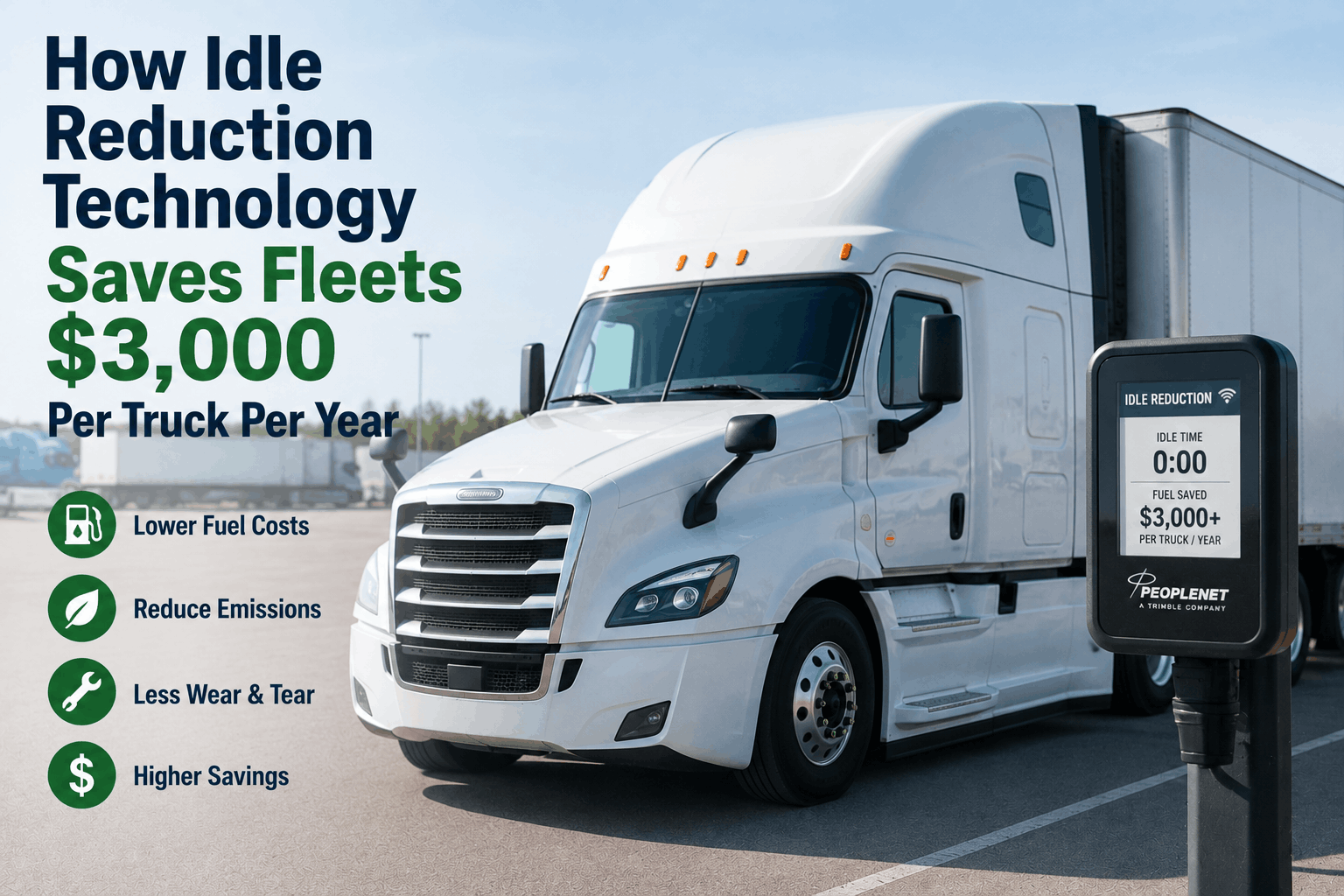
Every night, thousands of trucks idle across America's rest areas, truck stops, and loading docks. The engines run not because they need to, but because drivers need heat, air conditioning, or electricity to power their onboard equipment. This idle time is one of the fleet industry's most expensive habits. Industry data reveals that a single long-haul truck can idle up to 2,000 hours per year, consuming approximately 1 gallon of diesel per hour. At current fuel prices, that's $6,000 to $8,000 worth of fuel wasted on a single truck each year — with nothing productive to show for it. The good news? Idle reduction technology has matured to the point where fleets can now cut this waste by up to 70%, saving over $3,000 per truck annually while reducing emissions and engine wear.
How Idle Reduction Technology Saves Fleets $3,000 Per Truck Per Year
1 hour of idle time = 1 gallon of diesel = $4.00 average. 2,000 idle hours = $8,000 per truck. For a fleet of 100 trucks, that's $800,000 in wasted fuel — every single year.
Understanding Idle Reduction Technology
Idle reduction technology encompasses a range of solutions designed to provide driver comfort and power without running the main engine. These systems fall into three primary categories: auxiliary power units (APUs), battery-based systems, and shore power connections. Each approach has distinct advantages, and many fleets combine technologies to achieve maximum savings across different operating conditions.
Auxiliary power units are small, fuel-efficient diesel engines (or electric systems) that provide heat, air conditioning, and 120-volt AC power for cabin electronics. These units use approximately 0.2 to 0.3 gallons of fuel per hour — 70-80% less than the main engine. Battery-based systems use high-capacity lithium-ion battery banks that recharge while the truck is in motion and provide power during rest periods. Shore power connections allow trucks to plug into external power sources at terminals and equipped rest areas, eliminating engine operation entirely while parked.
Each solution offers different benefits and cost structures, but the common denominator is significant fuel savings. With proper implementation, fleets consistently reduce idle time from 8-10 hours daily to just 2-3 hours, generating substantial annual returns. To determine which solution best fits your fleet's operating profile, book a demo with FleetRabbit and our specialists will analyze your idle patterns and recommend the optimal technology mix.
Small diesel or electric units providing heat, AC, and power. Uses 70-80% less fuel than main engine. Typical cost: $8,000-$12,000 installed.
Lithium-ion battery banks that recharge during driving. Zero idle fuel consumption during parking. Typical cost: $10,000-$15,000 installed.
External power connections at terminals and rest areas. Zero fuel consumption. Requires infrastructure investment and availability.
The Financial Impact of Anti-Idling Solutions
Let's examine the numbers more closely. A typical long-haul truck that operates 300 days per year can accumulate 2,000 idle hours annually — equivalent to 83 full days of engine operation without moving. At an average fuel consumption of 1 gallon per idle hour, that's 2,000 gallons of diesel consumed with zero revenue generation. At $4.00 per gallon, the annual fuel cost of idling exceeds $8,000 per truck.
When an APU or battery system is installed, the fuel consumption during rest periods drops dramatically. An APU consumes approximately 0.25 gallons per hour, reducing idle fuel cost from $8,000 to $2,000 per truck — a $6,000 annual savings. Even after accounting for APU maintenance, which averages $300-$500 per year, the net savings exceed $5,000 per truck. With a typical APU installation cost of $10,000, the payback period is approximately 18-24 months. After that, every dollar saved drops directly to the bottom line. To calculate exact savings for your fleet based on your specific idle patterns and fuel costs, sign up with FleetRabbit and access our idle reduction ROI calculator.
Beyond Fuel: The Hidden Savings
While fuel savings are the headline benefit, idle reduction technology delivers significant secondary savings that many fleets overlook. Engine wear is dramatically reduced when the main engine isn't running during rest periods. This extends oil change intervals, reduces particulate filter regeneration cycles, and extends the life of critical components. Industry data shows that every hour of idle time adds approximately 20-30 miles of equivalent engine wear, meaning 2,000 idle hours effectively adds 50,000 miles of wear annually without any revenue generation.
Maintenance costs decrease proportionally. Fleets that have implemented idle reduction programs report 15-20% reductions in engine-related maintenance expenses. Brake wear, alternator life, and starter motor longevity all improve when the main engine is not idling. Additionally, many states and municipalities offer tax incentives or grants for fleets that adopt idle reduction technology, further improving the ROI. To track all these savings in one comprehensive dashboard, sign up with FleetRabbit and monitor your idle reduction ROI across fuel, maintenance, and regulatory compliance metrics.
Compliance and Regulatory Drivers
Idle reduction is increasingly driven by regulatory requirements. California, New York, and several other states have enacted strict anti-idling laws that limit engine operation to 3-5 minutes in most circumstances, with fines ranging from $500 to $5,000 per violation. For fleets operating in these jurisdictions, idle reduction technology isn't just a cost-saving measure — it's a compliance necessity. The Environmental Protection Agency (EPA) also recognizes idle reduction as a key strategy for reducing emissions and offers programs like the SmartWay Transport Partnership, which provides recognition and resources for fleets that adopt idle reduction technology.
Beyond avoiding fines, fleets with documented anti-idling programs can negotiate better insurance rates, qualify for sustainability grants, and improve their corporate reputation. Many shippers now prefer carriers with demonstrable sustainability practices, and idle reduction is one of the most visible and measurable green initiatives available to fleet operators. To ensure your fleet stays compliant across all operating jurisdictions, book a demo with FleetRabbit and our team will help you build a comprehensive compliance monitoring system.
California Title 13, New York ENV § 24-163, Chicago Municipal Code § 9-56, EPA SmartWay recognition program
Driver Acceptance and Implementation Success
One of the most critical factors in idle reduction program success is driver acceptance. If drivers view anti-idling technology as an inconvenience or a comfort compromise, they may circumvent the system or resist using it properly. The key to successful implementation is involving drivers in the decision-making process and demonstrating how the technology benefits them. Modern APUs and battery systems provide excellent heat, AC, and power quality — often equal to or better than the main engine — while producing significantly less noise and vibration, improving driver rest quality.
Fuel savings can be shared through incentive programs, creating a win-win situation. Many fleets offer drivers a percentage of the fuel savings as a bonus, aligning driver behavior with fleet financial goals. Driver training is essential: showing drivers how to operate the system, explaining the comfort benefits, and addressing any concerns upfront reduces resistance and accelerates adoption. To build a driver-inclusive idle reduction program, sign up with FleetRabbit and access our driver engagement and coaching modules.
Measuring and Maximizing Your Savings
Effective idle reduction requires accurate measurement. You can't manage what you don't measure, and this is especially true for idle reduction. Telematics systems that track idle time, fuel consumption, and APU usage provide the data needed to calculate actual savings and identify opportunities for improvement. Key metrics include idle percentage (idle time as a percentage of total operating time), average idle hours per day, and fuel consumed during idle periods.
Fleets that actively monitor these metrics consistently achieve higher idle reduction than those that install technology and forget it. Regular reporting and communication of results to drivers and management maintains focus on the program's financial impact. With proper measurement, fleets typically see idle reduction of 60-80% within the first year of implementing anti-idling technology. To get real-time visibility into your fleet's idle performance, sign up with FleetRabbit and access our comprehensive fleet analytics dashboard.
Making the Business Case for Your Fleet
The case for idle reduction technology is one of the strongest in fleet management. The technology is proven, the savings are measurable, and the payback is rapid. With a typical investment of $8,000-$15,000 per truck, fleets can achieve annual savings of $3,000-$6,000, delivering an ROI of 30-50% within the first year. Over the 5-7 year lifespan of the equipment, each truck generates $20,000-$40,000 in net savings — money that can be reinvested in the fleet or dropped to the bottom line.
For a fleet of 50 trucks, the cumulative savings exceed $150,000 annually. That's not a marginal improvement — it's a transformation of the fleet's cost structure. And with growing regulatory pressure and increasing fuel costs, the financial case continues to strengthen. The question is no longer whether to implement idle reduction, but how quickly you can deploy it across your fleet. To start building your business case with real fleet data, book a demo with FleetRabbit and let our team model the exact savings for your operation.
FleetRabbit's fuel efficiency platform tracks idle time, APU usage, and fuel consumption to help you maximize savings from every idle reduction investment.
Frequently Asked Questions
How much fuel does a truck consume while idling?
A typical Class 8 diesel truck consumes approximately 0.8 to 1.0 gallons of fuel per hour while idling. This means a truck that idles 8 hours per day uses about 8 gallons of diesel daily — over $11,000 worth of fuel annually at current prices.
What is the most cost-effective idle reduction technology?
Auxiliary power units (APUs) offer the best balance of cost, effectiveness, and driver comfort for most fleets. APUs typically save $5,000-$6,000 annually per truck with a payback period of 18-24 months. Battery systems offer zero-emission operation but have higher upfront costs.
Do anti-idling systems require regular maintenance?
APUs require periodic maintenance similar to small diesel engines — oil changes, filter replacements, and routine inspections. Annual maintenance costs typically range from $300 to $500. Battery systems have minimal maintenance requirements beyond periodic cell balancing and software updates.
What is the ROI of idle reduction technology?
ROI varies by technology and usage patterns, but typical returns are 30-50% in the first year and 100-200% over the 5-year equipment life. For APUs, the payback period is 18-24 months, with significant savings continuing after that point.
Do idle reduction systems work in extreme weather conditions?
Yes. Modern APUs and battery systems are designed to provide adequate heating and cooling in all weather conditions. In extreme cold, APUs have sufficient capacity to maintain cabin warmth, and battery systems can support electric heaters for extended periods.
Are there government incentives for idle reduction adoption?
Yes. The EPA SmartWay program provides recognition and resources. Many states offer grants or tax incentives for fleets that adopt idle reduction technology. California's Hybrid and Zero-Emission Truck and Bus Voucher Incentive Project (HVIP) offers significant funding for eligible vehicles and equipment.
FleetRabbit helps you track idle time, monitor APU performance, and calculate real fuel savings — so you can see the ROI of every anti-idling investment.