A recall starts two clocks at once and you only control one of them. Once a defect determination is made, notification to the regulator is due within five business days, and owner notification letters must be mailed within sixty days of that filing — explicitly whether or not a remedy is available at the time. The legal clock does not wait for your parts. Then, for the following eight quarters, you report publicly on how many of the affected population have actually been repaired. Everything operational sits in the gap between those two clocks, and the width of that gap is set almost entirely by how fast you can scope: how quickly you can say precisely which vehicles are affected, where they are, and what each one needs. Scope slowly and every downstream decision inherits the delay. Talk to a solutions engineer about scoping from your own traceability data.
2026 GUIDE · RECALL EXECUTION
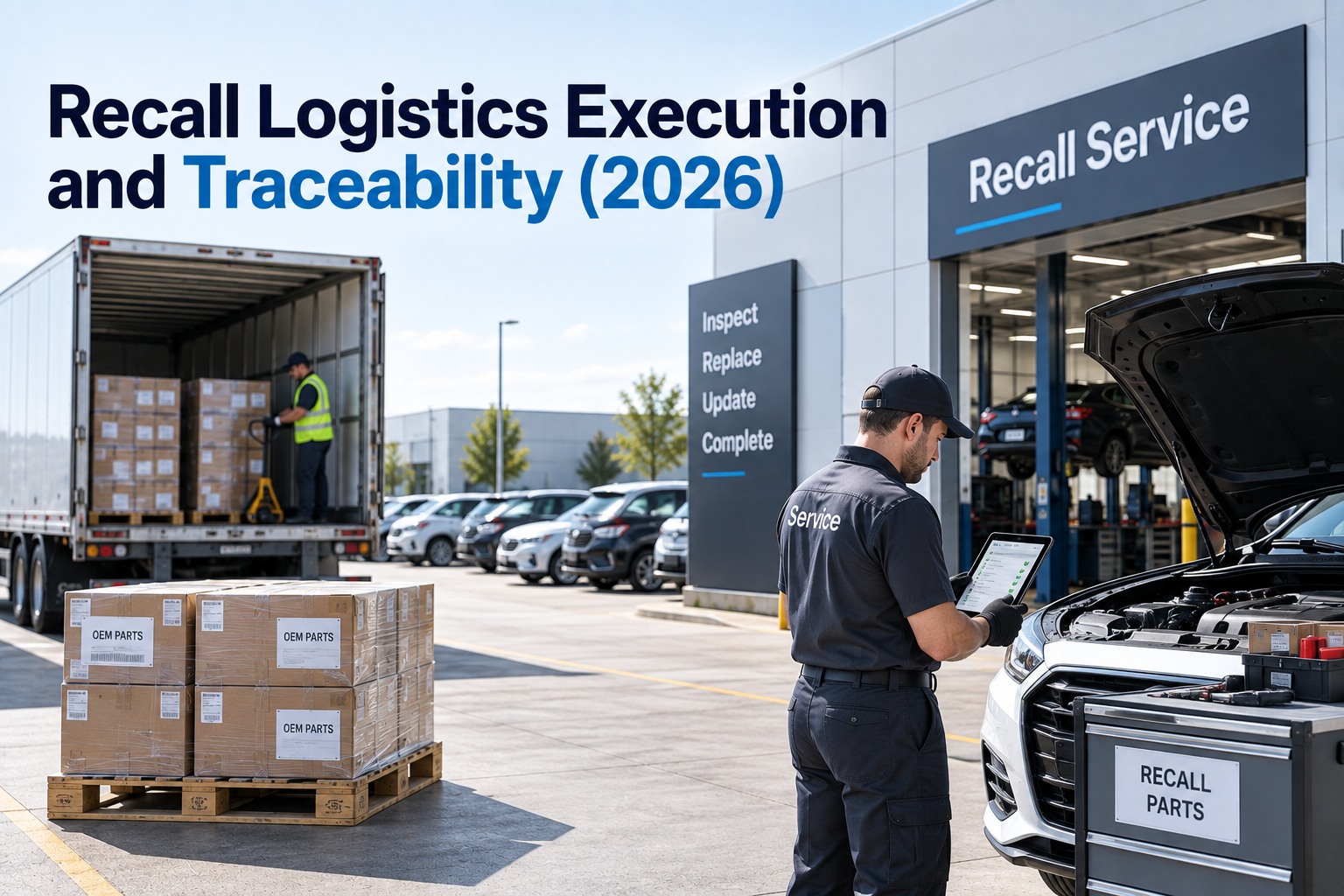
Recall Logistics Execution and Traceability
Faster scoping from traceability data, parts surge planned against dealer geography, and completion tracked per vehicle across the eight quarters you report on.
5 business daysnotify the regulator
60 daysowner letters mailed
8 quarterscompletion reported
None of those three depend on whether your parts are ready
The Deadline That Catches Operations Out
Two of the three are widely understood. The middle one contains a clause that reshapes the whole plan.
Sixty days, remedy or no remedy
Owner notifications must be mailed within sixty days of the manufacturer notifying the regulator — whether a remedy is available at that time or is delayed until a future date. There is no provision for waiting until the parts exist.
Which means you may be telling owners before you can fix them
Where the remedy is not ready, an interim notification goes out — a category that recent data puts at roughly three per cent of recalls, down from around twelve per cent historically. Every one of those generates owner contact, dealer enquiries and appointment requests against a repair that cannot yet be performed, which is a demand surge on your service network with nothing behind it.
And the notification method has its own weakness
Owner notifications go by first-class mail, which the regulator itself observes makes it difficult to confirm whether the owner actually received the notice. You have discharged the obligation and still cannot be sure the message landed — which matters when completion is the measure you are judged on.
Read those together and the operational priority becomes obvious. The only lever that closes the gap between notification and remedy is scoping speed — every day spent establishing which vehicles are affected is a day removed from the parts lead time you have left before owners start calling.
Scoping Speed Decides Everything Downstream
Four consequences flow directly from how precisely and how quickly you can define the affected population.
01
The population size determines the parts volume
A scope defined by date range and build plant is wide and precautionary. One defined by identifier-linked history is narrow and evidenced. The difference is the number of parts you must manufacture, distribute and hold — and it is decided before a single component is ordered.
02
The geography determines the distribution plan
Knowing which vehicles are affected is half the answer; knowing where they are is the other half. Parts allocation is a mapping problem between the affected population and your dealer network, and it cannot start until the population has locations attached.
03
Every scoping day comes out of the parts lead time
The sixty-day notification clock started when you filed. If scoping consumes three weeks, the remaining window for tooling, production and distribution is what is left — not sixty days. Scoping is not a preliminary phase, it is a direct deduction from your supply timeline.
04
Over-scoping costs twice
Once in parts manufactured for vehicles that never needed them, and again in service capacity consumed inspecting units that were never affected. A precautionary population is not a safe choice — it is an expensive one with its own operational risk.
Scoping is a data capability, not an analytical one
The speed at which a population can be defined is set by what was captured at build and through distribution, not by how quickly analysts work after the fact. An organisation that cannot trace a component to specific identifiers will scope by date range because that is all its records support — and no amount of urgency on the day changes what was recorded two years earlier.
The Parts Surge Is Knowable but Not Known
A campaign is the one demand event where you know the part, the volume and the geography — and cannot act on any of it until scoping completes.
You know exactly what is needed
Unlike ordinary service demand, a campaign specifies the component precisely. There is no forecasting question about which part — only about how many and where.
And it arrives all at once
Notification produces a spike in appointments concentrated in the weeks after the letters land. That is a distribution problem shaped very differently from normal replenishment, and one that will collide with routine stock flow unless it is planned separately.
So campaign lines should never arrive as emergencies
Any campaign part reaching a dealer as an urgent order was forecastable and was not forecast. Recall demand is the most predictable volume in a parts network — known component, known affected population, known dealer distribution — which makes emergency campaign lines a planning failure rather than an unavoidable cost.
Reported publicly
Q1Q2Q3Q4
Q5Q6Q7Q8
Eight quarters of your completion rate, published and comparable.
Which means the operational decisions made in the first three weeks are visible for two years. Bring a live or recent campaign to a 30-minute session and we'll map it in Fleet Rabbit — affected population against dealer geography, parts allocation against appointment demand, and completion tracked per unit rather than as a rolled-up percentage.
The Lists You Are Required to Hold
An obligation that is easy to underestimate, because it extends well beyond registered owners.
Owners and purchasersIncluding those registered under state law whose details are reasonably ascertainable through state records or other available sources.
Dealers and distributorsThe network holding and having handled the affected products — which is also your execution channel, so the list serves two purposes.
Lessors and lesseesThe category most often missing from a manufacturer's own records, because the registered party and the driver are different people — and the driver is the one who has to bring the vehicle in.
And the report itself may changeAround a fifth of defect reports involve a change or addition regarding recall components, so the population and the parts requirement should both be treated as revisable rather than fixed at filing.
Completion Is a Two-Year Public Number
Four things worth understanding about how it is measured, because they change what you optimise for.
Eight quarters of reporting
Manufacturers file quarterly reports on vehicles repaired against the total recall population for eight quarters after launch, alongside annual reporting. The figure is monitored throughout, not assessed once at the end.
Recalls do not expire
Repairs performed beyond the eighth quarter continue to raise the completion rate — the reporting window closes, the campaign does not. Vehicles arriving years later still count, which makes long-tail capture genuinely worthwhile.
The comparison is imperfect and public anyway
Completion is influenced by vehicle age, the component involved and the manufacturer — and the regulator acknowledges having incomplete data on the drivers, which makes identifying a genuinely underperforming recall difficult. The number is still published.
Equipment is harder than vehicles
Completion rates for equipment recalls run substantially lower than vehicle recalls, because contacting purchasers is far more difficult. If your campaign covers equipment rather than whole vehicles, expect a different curve and plan the outreach accordingly.
What has actually moved completion
The Takata campaign produced the clearest example: manufacturers were reported to have completed 99.9 per cent of the recall in Australia, in a market where a state authority rejected vehicles at inspection if they carried an unrepaired recalled airbag. Tying recall status to a moment the owner already has to attend is dramatically more effective than a letter. Consumer research also points at friction removal — a free loaner vehicle raises willingness to complete, though it is not a manufacturer requirement.
Coordinating the Dealer Network
Six practices. The first two prevent the failure mode where parts and appointments arrive in different sequences.
1Allocate parts against the affected population per dealerNot evenly and not by historical volume. A dealer with forty affected vehicles in its area needs a different allocation from one with four, and that mapping only exists once scoping has locations attached.
2Sequence notification behind parts availability where you canWithin the constraints of the sixty-day requirement. Where an interim notice is unavoidable, tell dealers first so the network is not learning about the campaign from customers calling it.
3Keep campaign parts out of the emergency channelCampaign demand is predictable by definition, so it should flow through planned replenishment. Every campaign line arriving as an urgent order consumes capacity reserved for genuine vehicle-off-road situations.
4Give dealers a per-VIN view of their own affected unitsWhich of their customers' vehicles are affected, which have been completed and which remain outstanding — so the dealer can chase the remainder rather than waiting for owners to respond to a letter.
5Track completion at unit level, not as a percentageA rolled-up rate tells you how far you are from finished. A per-unit record tells you which vehicles remain and where they are, which is the only view you can act on.
6Handle the units still in your own custody firstVehicles in compounds, in transit or awaiting delivery are the easiest completions available and the ones you fully control. They are also the ones that must be rectified before they can ship, since carriers commonly refuse bookings on units with open campaigns.
That last point connects the campaign to outbound logistics directly. An open recall on a unit awaiting delivery is a shipping blocker before it is a quality item — which means campaign status belongs on the same record as dispatch readiness, not in a separate quality system somebody checks later.
What the Record Has to Support
Seven capabilities. Together they turn a campaign from a project into a query.
Population definition from component historyIdentifier-linked rather than date-bounded, because the width of the population is the largest single cost decision in the campaign.
Location for every affected unitIn a compound, in transit, at a dealer, or with an owner — since the response differs completely for each.
Parts requirement derived from the populationVolume and geography calculated from the affected units rather than estimated, and revisable as the report is amended.
Campaign status against each unitOpen, scheduled or completed, visible alongside dispatch readiness rather than in a separate system.
Dealer-level outstanding listsSo each site can work its own remainder instead of waiting on central reporting.
Completion evidence per unitWhat was done, when and by whom — which is what the quarterly reporting is ultimately built from.
A queryable history after the reporting windowBecause campaigns do not expire and late completions still count, so the record has to outlive the eight quarters of formal reporting.
Twenty minutes on one campaign and you will see where the two clocks diverge
On a working session we'll take a live or recent campaign into Fleet Rabbit and map it end to end — affected population against dealer geography, parts allocation against expected appointment demand, units in your own custody separated from units with owners, and completion tracked per vehicle rather than as a rolled-up rate. You keep the analysis either way, and it is usually the first time scoping speed has been visible as a cost rather than as a preliminary.
Frequently Asked Questions
What are the deadlines we actually have to hit?
Three. A manufacturer determining that a product contains a safety defect or is noncompliant must notify the regulator within five business days. Owner notification letters must then be mailed within sixty days of that filing. And for eight quarters after launch, quarterly reports are filed on how many of the affected population have been repaired, alongside annual reporting. None of the three depends on whether a remedy is available.
What if the parts are not ready within sixty days?
You notify anyway. The requirement applies whether a remedy is available at that time or is delayed until a future date, with an interim notification where the fix is not yet ready — a category recent data puts at around three per cent of recalls, down from roughly twelve per cent historically. Operationally that means owner contact and appointment requests arriving against a repair that cannot yet be performed, which needs planning for on its own terms.
Why does scoping speed matter so much?
Because it comes directly out of your parts lead time. The sixty-day clock starts at filing, so three weeks of scoping leaves whatever remains for tooling, production and distribution — it is a deduction rather than a preliminary. Scope width matters equally: a population defined by date range is wide and precautionary, and every unnecessary unit costs a part manufactured and service capacity consumed inspecting a vehicle that was never affected.
Which lists are we required to keep?
Owners, purchasers, dealers, distributors, lessors and lessees of the products involved in the campaign. The lessor and lessee categories are the ones most often thin in a manufacturer's own records, because the registered party and the person who actually drives the vehicle are different — and it is the driver who has to bring it in. Note also that around a fifth of defect reports involve a change or addition regarding components, so treat the population as revisable.
Does completion stop mattering after eight quarters?
No. The reporting window closes but the campaign does not — repairs made beyond the eighth quarter continue to increase the recall's completion rate, because vehicle recalls do not end or expire. That makes long-tail capture genuinely worth resourcing, and it means the record has to remain queryable well after formal reporting has finished.
What actually improves completion rates?
Attaching the repair to a moment the owner already has to attend. The clearest example is the Takata campaign, where manufacturers were reported to have completed 99.9 per cent in Australia — in a market where a state authority rejected vehicles at inspection that carried an unrepaired recalled airbag. Removing friction also helps: consumer research indicates a free loaner vehicle raises willingness to complete, though it is not a manufacturer requirement. Notification by first-class mail alone is a weak instrument, and the regulator itself notes the difficulty of confirming receipt.
Where should we start?
With the units you already hold. Vehicles in compounds, in transit or awaiting delivery are the easiest completions available and entirely within your control — and they have to be rectified before they can move anyway, since carriers commonly refuse bookings on units carrying open campaigns. That makes campaign status a dispatch field rather than a quality one, and putting it on the same record as delivery readiness is the change with the fastest payback.
Book a session with one campaign and we'll map it with you.
Two Clocks, One Lever
The legal clock cannot be paused and the supply clock cannot start until the population is defined — so scoping speed is the only variable that widens the gap in your favour. Define it from component history rather than date ranges, allocate parts against dealer geography, clear the units you already hold first, and track completion per vehicle, because a percentage tells you the distance and a unit list tells you the way.
Eight quarters of public reporting — and a campaign that never expires
Requirements described here reflect United States federal recall regulation and vary by jurisdiction — this is general guidance rather than legal advice, and the applicable rules for your markets should be confirmed with counsel