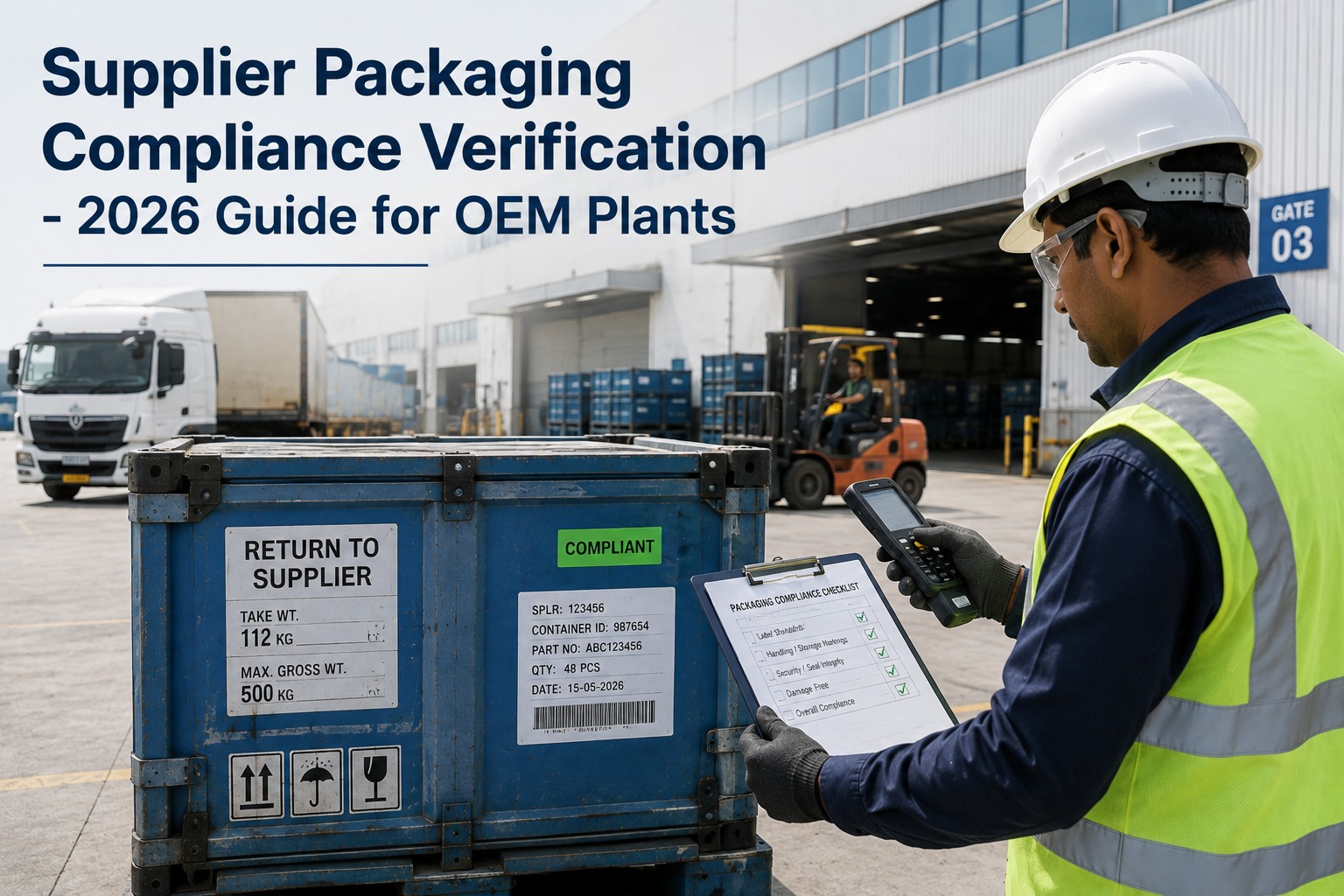
Packaging non-compliance is the cheapest supplier failure to detect and the one most often waved through, because the person who finds it is holding a scanner at a dock face and the person who owns the specification is in another building. The gap is structural rather than careless. Packaging and labelling requirements typically get communicated through a mixture of the RFQ, the purchase order, a supplier manual and emailed instructions, which means the authoritative version lives in four places and the receiving lead has seen none of them. So the pack arrives stacked five high against a three-high limit, the operator notices, decides it is not worth the argument, and the same deviation arrives every week for a year until it finally causes damage that nobody can attribute. Compliance verification is mostly the work of making the specification available where the check happens and giving the finding somewhere to go. Talk to a solutions engineer to design the checks into your own receipt process.
2026 GUIDE · PACKAGING COMPLIANCE
Supplier Packaging Compliance Verification
Specification checks that happen at receipt rather than in an audit, label standards enforced where they are scanned, non-conformance captured with enough detail to act on, and a feedback loop that closes.
SpecificationAs received
Container type A-14A-14
Stack limit 3 high5 high
Qty 48 per unit48
Label, one batch per unit2 batches
Two deviations, both visible in four seconds, both normally unrecorded.
The Specification Has to Be Findable
Before any check can be enforced, there has to be one authoritative version of what is required — and in most supply relationships there is not. Packaging, labelling, shipping and documentation requirements arrive by several routes and get updated on none of them consistently.
Where the requirement usually sits
The RFQ, where it was first stated
The purchase order, sometimes restating it differently
The supplier manual, which is versioned but rarely reread
Emailed instructions, which are current and unfindable
A packaging data sheet held by packaging engineering
Any of these is a legitimate channel. All of them together is the problem.
What a workable version looks like
One record per part number, versioned, with an effective date
Container type, quantity per unit, stack limit, orientation, dunnage
Label standard, placement and identity requirements
Returnable versus expendable, and the return obligation if returnable
Visible at the point of receipt, not only in a purchasing system
The last line is the one that turns a document into a control.
Change control cuts both ways
Suppliers are typically required to communicate any change — engineering or otherwise — before implementation, so that changes can be controlled, verified and validated in advance. The same discipline has to apply to your own packaging specification: a stack limit revised by engineering and not pushed to the supplier produces a non-conformance that is genuinely yours. Version the spec, date it, and confirm receipt.
What to Check at Receipt
Eight checks, all visual or scan-based, all completable inside the normal receipt cycle. The point is not thoroughness — it is that each check has a defined pass condition rather than an operator's judgement.
01Container typeMatches the specified standard for this part. Substitutions are the most common deviation and the one with the widest downstream effect, since racks are built for a container.
02Quantity per handling unitAgainst the standard pack. A shortfall inside a correctly labelled unit is a stated non-conformance trigger in most supplier manuals.
03Stack height and configurationAgainst the stated limit. Over-stacking is visible without opening anything and is a direct cause of transit and handling damage.
04Dunnage and orientationPresent, correct and positioned as specified. Missing dunnage is cheap for the supplier to omit and expensive downstream.
05Label conformanceCorrect standard, correct placement, scannable first time. A label that needs a second attempt is a defect even when it eventually reads.
06One batch per handling unitWhere the standard requires it. Mixed handling units break traceability and are frequently prohibited outright rather than discouraged.
07Container conditionReturnables arriving damaged re-enter the pool and fail later at a supplier. Catch it here or fund it twice.
08Documentation completenessDespatch advice validated, and any certificate of conformance required by the purchase order actually present.
Eight checks, four seconds, one place the finding can go.
A solutions engineer maps your packaging specifications to receipt-point checks, defines the pass condition for each, and wires the finding into non-conformance capture so it reaches supplier quality without a re-key.
Two Tiers of Finding
The most useful mechanism in supplier quality practice is the informal tier — a finding raised as an alert rather than as a formal record, giving the supplier a chance to correct before it becomes official. Used well it keeps the formal channel credible; used as an avoidance mechanism it becomes a way of never raising anything.
Alert — unofficial
Raised and communicated, expected to be investigated and corrected, but not yet an official quality or discrepancy record. The supplier is on notice and has the opportunity to fix it first.
Use forFirst occurrence, low impact, no production consequence
Abuse looks likeEverything staying at alert level indefinitely, with no promotion rule
Official record
A formal problem record issued when the supplier does not conform to set specifications — whether the issue is part quality, process or delivery. It carries a corrective action obligation and appears on the scorecard.
Use forRepeat occurrence, production impact, or failure to act on an alert
Promotion ruleWritten in advance, not decided case by case
Write the promotion rule down. Without it, the alert tier becomes a place findings go to be forgotten, and suppliers learn that packaging deviations carry no consequence — which is exactly the state most plants are already in, just without the alert tier to blame for it.
What the Record Must Contain
A finding that cannot be acted on is administrative work. These fields are what make it actionable at the supplier's end rather than merely accusatory.
← Swipe to see all columns →
The Escalation Ladder
Five rungs. The pattern comes straight from supplier quality practice — and note the timescale on rung two, which is where most packaging findings actually get resolved.
R1Alert issuedUnofficial notification. Supplier investigates and corrects before it becomes an official record. No scorecard effect yet.
R2ContainmentInterim actions protecting the plant until a corrective action is in place — typically required within one day of notification. Sorting, replacement or dedicated inspection.
R3Formal corrective actionA problem record with a structured response — 8-D is the usual preferred format, with alternatives requested where a customer requires them. Root cause, not explanation.
R4Scorecard consequencePerformance reflected in the monthly scorecard. Failure to maintain a positive ranking is itself a trigger for further action in most supplier standards.
R5Management actionWhere the earlier rungs have not insulated the plant from receiving non-conforming material. Business consequences, with defined exit criteria.
Every rung needs an exit
Escalation without published exit criteria becomes one-way, and suppliers stop engaging because they cannot see a route back. State what closes each rung — accepted root cause, a clean period, verified effectiveness — alongside what triggers it. The ladder is a mechanism for changing behaviour, not for recording disappointment.
Closing the Loop
Detection produces data. Feedback produces change. Six mechanisms, and the first two are where packaging compliance most often stalls.
1Findings reach supplier quality automaticallyA deviation recorded at the dock and never transmitted is a deviation that never happened. The handoff from receiving to supplier quality is where most of these die.
2Packaging findings appear on the scorecardAlongside quality and delivery. Where the scorecard covers only those two, packaging compliance has no commercial weight and behaves accordingly.
3Monthly cadence with an exception triggerScorecards maintained after each calendar month, issued when performance is below expectation or on supplier request. Predictable rhythm plus a route for the urgent case.
4Recurrence tracked per supplier per checkThe same deviation appearing after a closed corrective action means the corrective action produced paperwork rather than change.
5Change point control both waysSupplier changes notified before implementation and verified in advance; your specification changes pushed with an effective date and acknowledged.
6Periodic logistics self-assessmentWhere the annual materials planning and logistics self-assessment is required, packaging and labelling capability sits inside it — use the result rather than filing it.
We map your specifications to receipt-point checks with defined pass conditions, structure the non-conformance record so it is actionable, and connect findings to the scorecard without manual re-entry.
What to Measure
Six figures. Findings raised is deliberately not the headline — a rising count can mean detection improved or compliance worsened, and only the pair tells you which. Our analytics and reporting module carries them.
Check completion rateShare of receipts where the checks were actually performed. If this is low, every other figure on this list describes a sample you did not choose.
Non-conformance rate by check typeContainer, quantity, stack, dunnage, label, batch, condition, documentation. The split tells you what to fix; the total tells you nothing.
Findings per supplier, normalisedPer hundred receipts rather than absolute, so high-volume suppliers are not penalised for volume.
Alert-to-official promotion rateHow many alerts became formal records. A rate near zero means the alert tier is absorbing everything and correcting nothing.
Recurrence after closureSame supplier, same check, after a corrective action closed. The only honest measure of whether the loop works.
Containment response timeNotification to interim action in place. Where the standard is one day, measure against it rather than assuming it.
Frequently Asked Questions
Why do packaging deviations go unrecorded?
Because the specification is not where the check happens. Packaging, labelling and shipping requirements typically arrive through some combination of RFQ, purchase order, supplier manual and emailed instructions, so the authoritative version lives in several places and the receiving lead has seen none of them. An operator who cannot confirm what was required will not raise a finding against it. Publishing one versioned record per part, visible at receipt, converts a judgement call into a check.
Should we raise every deviation formally?
No — use two tiers. An unofficial alert lets the supplier investigate and correct before the finding becomes an official record, which keeps the formal channel credible and reserves it for cases that warrant it. What matters is the promotion rule: written in advance, based on recurrence, production impact or failure to act. Without one, everything stays at alert level permanently and suppliers correctly conclude that packaging deviations carry no consequence.
What should a non-conformance record contain?
Part number and revision, the specification clause breached, a should-be-versus-is statement, quantities received and affected, imagery captured at receipt before anything is moved, an impact statement and the disposition. The should-be-versus-is structure matters more than it sounds — "three high required, five high received" supports a decision, while "packaging incorrect" supports an argument. Missing the revision is the most common omission and the one that makes the applicable specification contestable.
How fast should the supplier respond?
Containment first, corrective action second. Interim actions protecting the plant until a corrective action is in place are commonly required within one day of notification — sorting, replacement or dedicated inspection. The structured corrective action follows on a longer clock, usually in an 8-D format, though customers sometimes specify alternatives. Measuring containment response separately from corrective action closure is worth doing, because they fail for different reasons.
Does packaging belong on the supplier scorecard?
Yes, and its absence explains a lot of behaviour. Scorecards typically cover quality and delivery, are maintained monthly and issued when performance falls below expectation or on request — and where packaging compliance is not among the scored dimensions it carries no commercial weight. Failing to maintain a positive scorecard ranking is itself a stated escalation trigger in many supplier standards, so adding packaging gives the finding somewhere to land.
Who owns a deviation caused by our own spec change?
You do, and it is worth saying so explicitly because it protects the credibility of everything else. Change point control runs both ways: suppliers are expected to notify changes before implementation so they can be controlled, verified and validated in advance, and the same obligation applies to your packaging specification. A stack limit revised internally and not communicated with an effective date produces a non-conformance that belongs to the plant, and charging it out is the fastest way to make suppliers contest every subsequent finding.
Where should we start?
With the specification, not the checks. Consolidate packaging requirements into one versioned record per part with an effective date, and make it visible at the receipt point. That single step usually raises detection immediately without any new process, because operators who can see the requirement start recording deviations against it. Add the two-tier finding structure next, then the scorecard connection. Our
integrations overview covers the receipt and quality system connections.
Compliance verification
Put the Specification Where the Check Happens
One versioned record per part, eight defined checks at receipt, findings structured to be actionable, a two-tier escalation with a written promotion rule, and packaging weighted on the scorecard alongside quality and delivery.
Works with GTL and Odette labelling · Connects to your QMS · Runs on existing handsets