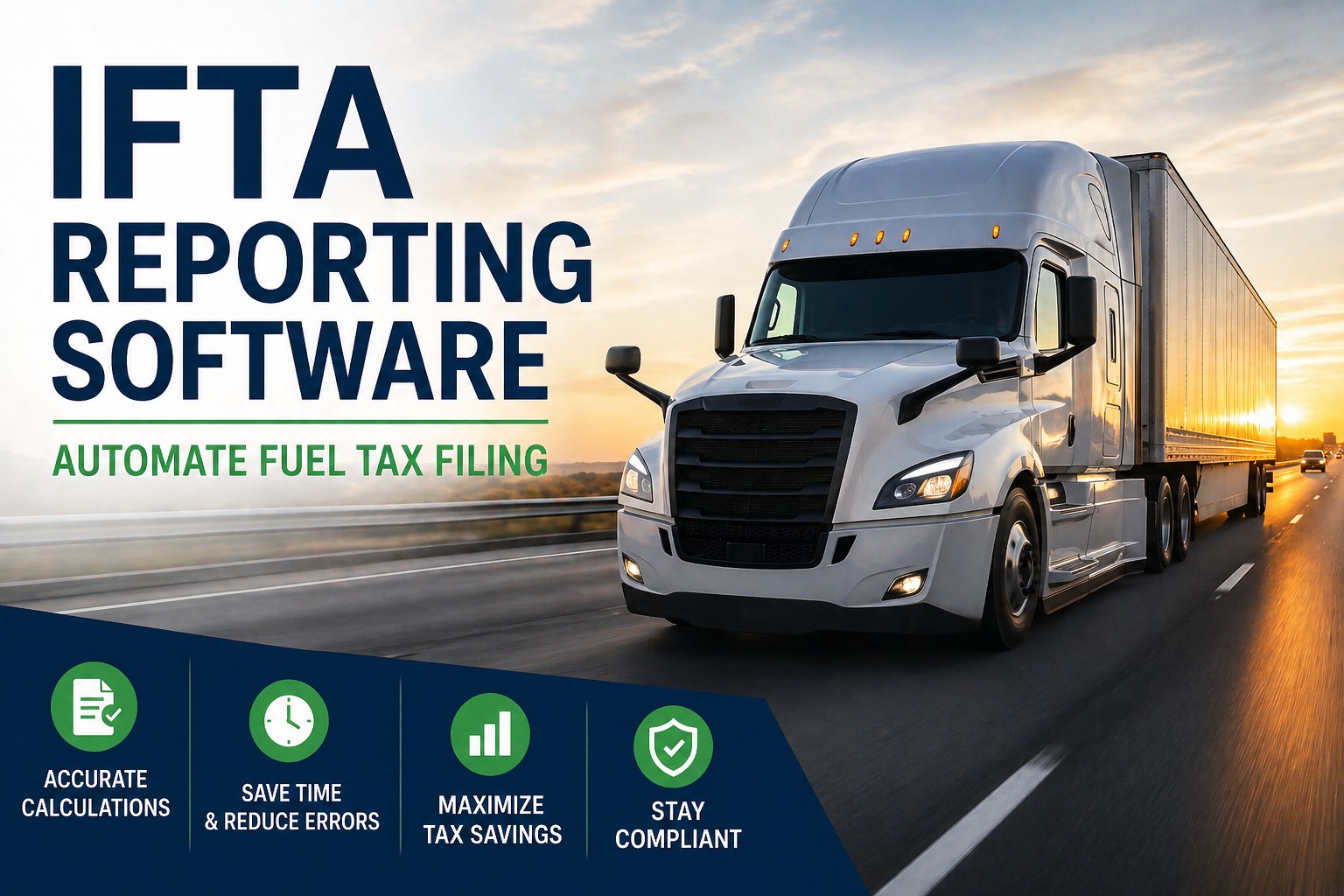
A 35-truck regional carrier spends 22 hours every quarter reconciling paper fuel receipts, mileage logs, and state-by-state trip records to produce one IFTA quarterly return. Two staff members. A spreadsheet the size of a small phone book. Inevitable rounding errors. Three audit inquiries from different jurisdictions in a single year. The math is always close — the documentation is always questionable. And the $4,800 in average quarterly underpayment getting discovered is being matched by roughly the same amount in overpayments never recovered because the calculation is too complex to challenge. This is the operational reality of manual IFTA reporting in 2026 — 88 hours per year of administrative burden per fleet, $50/day late penalties per jurisdiction, 0.75% monthly interest on unpaid tax, and a 4-year audit lookback that demands trip-level detail for every claim. The carriers that turned IFTA from a quarterly headache into a 5-minute report-generation task share one thing: they stopped collecting data manually and started capturing it automatically — GPS-verified jurisdiction mileage, OBD-reported fuel consumption, fuel-card transaction integration, and tax-rate auto-updates from IFTA Inc. This guide breaks down exactly how IFTA works, the eight reporting requirements, the 2026 deadline calendar, the penalty math, the manual-vs-automated time comparison, and how Fleet Rabbit's IFTA module integrates with your GPS and fuel cards to generate audit-ready returns in minutes instead of weeks.
22 Hours of Quarterly Math, Reduced to 5 Minutes of Click & File.
GPS-captured miles by jurisdiction. OBD-reported fuel consumption. Fuel card transactions auto-reconciled. Tax rates auto-synced from IFTA Inc each quarter. Quarterly returns generated in audit-ready format not estimated, not reconciled, not compromised.
The IFTA Equation — How Quarterly Tax Is Actually Calculated
IFTA operates on a single principle: fleets pay fuel tax to each jurisdiction in proportion to miles driven there, regardless of where fuel was physically purchased. If your truck drives 40% in Texas and 15% in Oklahoma, those jurisdictions get fuel tax on 40% and 15% of consumption — even if the driver filled up entirely in Indiana. The math is straightforward; the data collection is not.
The 2026 IFTA Deadline Calendar — Mark These Dates
Quarterly returns are due on the last day of the month following the end of each quarter. Late filing triggers $50 or 10% of net tax (whichever greater) plus 0.75% monthly interest. Even a zero-mileage quarter requires a return — "I didn't drive anywhere" doesn't exempt you.
If a deadline falls on a weekend or legal holiday, due date moves to the next business day. Decals must be displayed on the driver's side of every qualifying vehicle. Annual decal renewal includes a 2-month grace period (Jan-Feb) for carriers awaiting renewal processing.
Who Must File & What Vehicles Qualify
IFTA isn't optional for qualifying vehicles operating across 2+ jurisdictions. The thresholds below define a "qualified motor vehicle" — and every fleet with any of these vehicles needs an IFTA license from their base jurisdiction.
Standard threshold for most over-the-road trucks. Includes Class 7 and Class 8 tractors, straight trucks at or above 26,001 GVWR, and qualifying box trucks.
Triples, quads, heavy specialty equipment. Axle count alone qualifies regardless of weight — applies to construction, towing, and specialty fleets.
Truck + trailer combinations exceeding 26,000 lbs registered or actual weight. Most tractor-trailer rigs qualify under this clause regardless of axle count.
The interstate trigger. 58 IFTA jurisdictions: 48 US states (excluding AK + HI) and 10 Canadian provinces. Operating only intrastate = no IFTA needed.
The 5 Data Inputs You Must Track Per Quarter
FMCSA requires these records retained for at least 6 months (4 years for IFTA audit defense). Manual systems lose them. Digital systems index them. The five inputs below are non-negotiable per quarterly return.
Every state crossed, miles driven in each. Including non-IFTA jurisdictions (AK, HI, MX). Trip permit miles tracked separately.
By fuel type (diesel, gasoline, CNG, LNG, ethanol, propane, biodiesel). Per-truck consumption summed across the fleet.
Every fuel transaction with location, gallons, price, fuel type, vehicle ID. Receipts retained 6 months minimum (4 years best practice).
VIN, fuel type, fleet/unit number per vehicle. Per-trip: origin, destination, route, dates, driver, beginning/ending odometer.
Each jurisdiction sets its own rate; ~15-30 jurisdictions update rates each quarter. Outdated rates produce systematic underpayment audit findings.
Manual vs Automated — Where the 22 Hours Actually Goes
Most fleet managers don't realize how many discrete steps a manual quarterly return requires. Below is the typical workflow comparison for a 35-truck fleet — same data, same return, dramatically different time investment.
The 22-hour saving multiplied by 4 quarters = 88 hours/year recovered. At a $50/hr loaded compliance staff cost, that's ~$4,400/year per fleet just in admin time — before the underpayment recovery, audit-defense documentation, and penalty avoidance. See the Full Workflow Demo →
The Penalty Stack — What Late Filing Actually Costs
Penalties start at $50 or 10% of net tax, whichever is greater — and they compound. Each jurisdiction can assess its own penalty for missing data or underpayment. The math below is the real cost of a single missed quarterly return for a fleet that owes $8,000 in net tax.
Fleet Rabbit's automated reminders fire 30 and 7 days before each deadline. Combined with continuous data capture, missed filings become structurally impossible. See the Auto-Reminder System →
The 4-Year Audit Lookback — What Auditors Actually Want
IFTA audits cover the past 4 years. Auditors don't just want your filed returns — they want the supporting documentation that proves every mile and gallon claim. Manual systems produce filing records but rarely the trip-level detail an auditor demands.
Fleet Rabbit retains full IFTA documentation indefinitely with one-click audit pack export — every quarter, every supporting document, in the format auditors expect. See Audit Pack Demo →
Frequently Asked Questions
Do I file IFTA returns even if I had zero miles in a quarter?
Yes — a "zero return" is mandatory. Failing to file when no operations occurred is treated the same as a late filing — $50 minimum penalty. The reason: IFTA can't tell whether your silence means "no miles" or "didn't bother." File the zero return; it takes 60 seconds.
How does IFTA work with electric trucks?
Currently, IFTA applies to fuel-burning vehicles only. Electric Class 8 trucks (Freightliner eCascadia, Peterbilt 579EV, Volvo VNR Electric) are outside the IFTA scope. However, several jurisdictions are evaluating road-use mileage taxes for EVs — track the discussion as fleets expand electric inventory. Hybrid and CNG vehicles still file standard IFTA returns.
What's the difference between IFTA and IRP?
IFTA is fuel tax — paid to states where miles were driven. IRP (International Registration Plan) is registration — apportioning vehicle registration fees across jurisdictions you operate in. Both run on similar mileage data but go to different agencies and serve different purposes. Most fleets need both. Fleet Rabbit's mileage capture supports both reporting requirements without duplicate data entry. See IRP Reporting Integration →
Can I claim a fuel tax refund?
Yes — when fuel-purchase tax paid in a jurisdiction exceeds tax owed on miles driven there. The quarterly return calculates net owed or net credit per jurisdiction. Most multi-state fleets see credits in some states and balances owed in others; the net rolls into one payment to the base jurisdiction. Accurate GPS-based mileage allocation is essential for capturing every dollar of credit owed.
How do I handle non-IFTA jurisdictions like Alaska or Mexico?
Track miles separately. Alaska, Hawaii, Yukon, Northwest Territories, and Mexico aren't IFTA members. Miles driven in these jurisdictions still need recording for total-mile reconciliation but don't generate IFTA tax obligations. Trip permit purchases for non-IFTA operations are a separate compliance category — document the permit + miles together.
How is Fleet Rabbit's IFTA module priced?
Included in the standard $3/vehicle/month subscription — no per-quarter fee, no per-jurisdiction charge, no separate IFTA module pricing. Fuel card and GPS integrations included. Compare to standalone IFTA tools at $20-$50/truck/month plus per-filing fees. Free tier (up to 3 vehicles) includes full IFTA reporting for testing. Book a Demo to See Pricing →
From 22 hours of spreadsheets to 5 minutes of click & file.
Fleet Rabbit's IFTA module captures GPS-verified miles by jurisdiction, OBD-reported fuel consumption, and fuel card transactions automatically. Tax rates auto-sync from IFTA Inc each quarter. Quarterly returns generated in audit-ready format with full 4-year supporting documentation. Filed via state portal or PDF export. 30-day and 7-day deadline reminders. Free for up to 3 vehicles indefinitely.