When a brake defect gets reported, who handles it? If your answer involves phone calls, group texts, or "whoever's available," you're losing precious hours. The difference between a 4-hour repair and a full-day vehicle sitting idle often comes down to one thing: how your fleet team is organized. Fleets with clear departmental structures and role-based assignments resolve issues 50% faster than those running on chaos. Book a demo to see organized workflows in action, or start free today.
The Problem with "Everyone Does Everything"
In small fleets, it works. The same person who dispatches also orders parts, reviews DVIRs, and calls the shop. But as you grow past 15-20 vehicles, that model breaks. Work orders pile up because nobody "owns" them. Defects get reported but not assigned. Compliance deadlines slip because tracking lives in someone's head.
The fix isn't more people—it is clearer structure. When every task has an owner and every role has defined responsibilities, response time drops dramatically.
Why Fleet Team Structure Matters More Than Ever
Fleet operations have become significantly more complex over the past decade. Regulatory requirements from FMCSA continue to tighten, customers expect faster turnaround times, and the cost of unplanned downtime keeps climbing. According to industry data, a single day of vehicle downtime costs fleets between $500 and $1,000 in lost revenue—not counting repair costs. When your team structure is unclear, those costly delays multiply quickly. Understanding proper work order management starts with understanding who handles what.
The fleets that thrive in this environment share one common trait: clear organizational structure. They know exactly who handles each type of issue, how work flows between departments, and where decisions get made. This clarity doesn't just improve efficiency—it reduces stress, improves employee retention, and creates accountability that drives continuous improvement.
Unclear Ownership
When nobody specifically owns a task, it either gets done twice (wasting resources) or not at all (causing failures). Both outcomes hurt your bottom line.
Communication Gaps
Information gets lost between drivers, dispatchers, and technicians. A defect reported at 8am might not reach the shop until 2pm—if it reaches them at all.
Response Delays
Without clear escalation paths, urgent issues wait in queue with routine tasks. A safety-critical brake problem shouldn't compete with a burned-out dome light.
Compliance Risks
When compliance tasks aren't assigned to specific roles, DVIR reviews get skipped, driver qualifications expire, and your safety rating suffers.
The 4 Core Fleet Departments
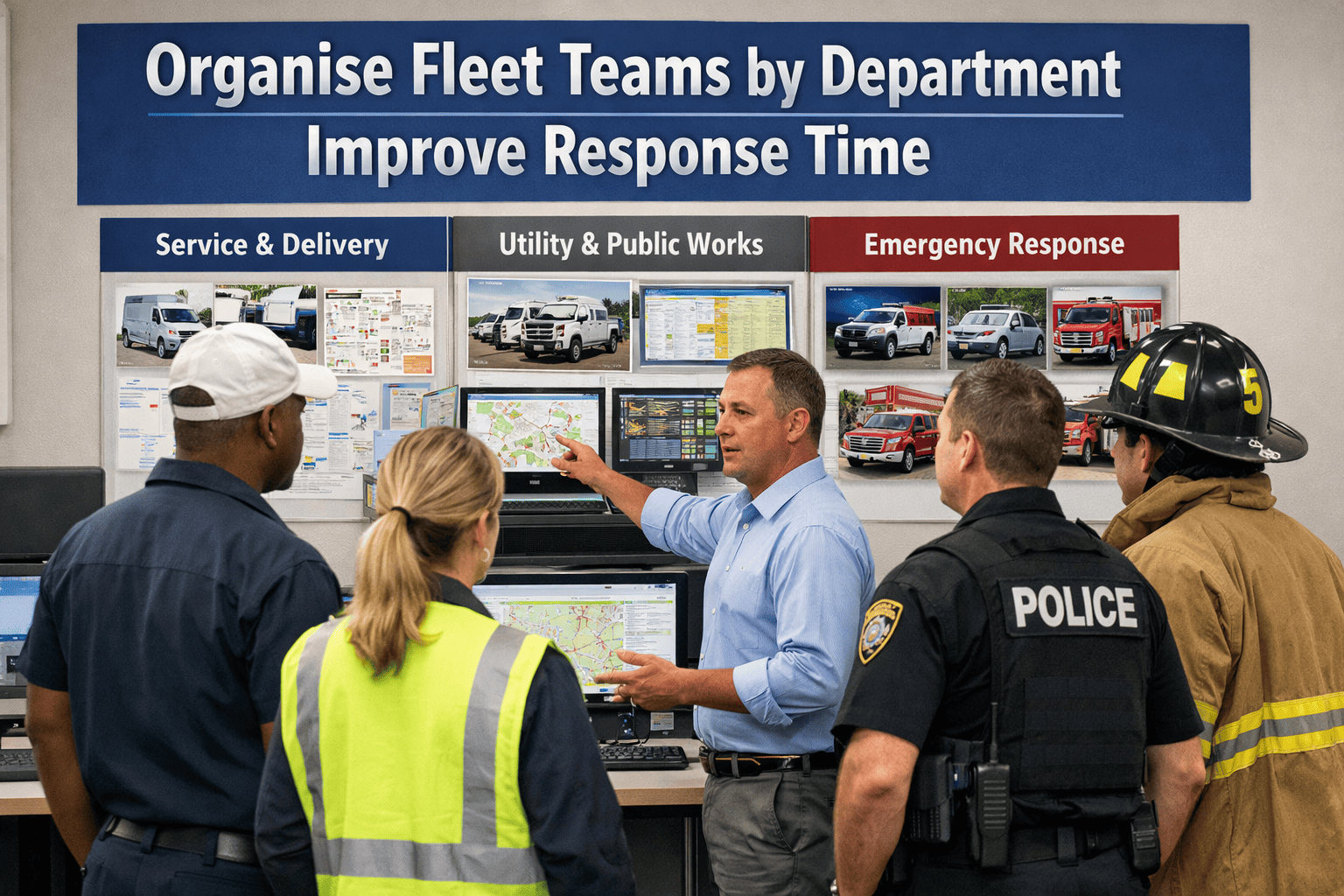
Whether you have 4 people or 40, every fleet operation needs these four functional areas covered. In smaller teams, one person may wear multiple hats—but the functions still need to exist as distinct responsibilities. The key is making assignments explicit rather than assumed. Book a demo to see how FleetRabbit helps you structure these departments digitally.
Operations
Vehicle assignments, driver scheduling, route coordination, dispatch decisions, utilization tracking
Maintenance
Work orders, repairs, preventive maintenance, parts management, shop scheduling, vendor coordination
Compliance
DVIRs, inspections, driver qualifications, DOT documentation, audit readiness, safety protocols
Finance
Cost tracking, vendor management, budget planning, TCO analysis, procurement, invoice processing
Operations Department: The Nerve Center
The Operations department keeps vehicles moving and drivers productive. This team handles the minute-by-minute decisions that determine whether your fleet meets its commitments. When Operations is well-organized, vehicles get assigned efficiently, routes are optimized, and dispatch decisions happen quickly. When it's disorganized, vehicles sit idle while drivers wait for assignments, and customer deliveries get delayed.
Key responsibilities include managing daily vehicle assignments, coordinating driver schedules, handling last-minute route changes, tracking real-time vehicle locations, and communicating with customers about ETAs. Operations also serves as the first point of contact when issues arise—they need to know immediately when a vehicle breaks down so they can reassign work and notify affected customers. Learn how to connect operations with preventive maintenance systems for better coordination.
Maintenance Department: Keeping Vehicles Running
The Maintenance department is responsible for vehicle uptime—the percentage of time your fleet is actually available for work. Industry benchmarks suggest well-managed fleets achieve 95%+ uptime, while poorly managed fleets struggle to hit 85%. That 10% gap translates directly to lost revenue and missed opportunities.
This department handles everything from routine oil changes to major engine rebuilds. They manage the shop schedule, assign work to technicians, order parts, coordinate with outside vendors for specialized repairs, and maintain detailed service records. Most importantly, they need clear communication channels with Operations—when a vehicle needs repair, Operations needs to know immediately so they can adjust assignments.
Compliance Department: Protecting Your Operating Authority
The Compliance department ensures your fleet meets all regulatory requirements—from FMCSA regulations to state-specific rules to company safety policies. This might seem like paperwork, but the consequences of non-compliance are severe: fines ranging from $1,000 to $16,000 per violation, out-of-service orders that ground your vehicles, and damage to your safety rating that can cost you customers. Review our FMCSA compliance checklist to understand the full scope.
Key responsibilities include reviewing and signing off on DVIRs, tracking driver qualification files, maintaining inspection records, preparing for DOT audits, managing hours-of-service compliance, and ensuring all vehicles have current registrations and permits.
Finance Department: Controlling Costs
The Finance department tracks every dollar that flows through your fleet operation—from fuel purchases to repair invoices to insurance premiums. Their goal is to optimize total cost of ownership (TCO) while ensuring the other departments have the resources they need to operate effectively.
This includes processing invoices from vendors and repair shops, tracking maintenance costs by vehicle, analyzing fuel consumption patterns, managing vendor relationships and contracts, preparing budgets and forecasts, and reporting on key financial metrics.
How Department Structure Cuts Response Time
When a driver reports a defect, what happens next determines whether that vehicle is back on the road in 2 hours or 2 days. The difference isn't about working faster—it's about eliminating the delays that come from unclear ownership and manual handoffs. Here's a side-by-side comparison:
- Driver texts group chat about brake issue
- Manager sees it 2 hours later between meetings
- Calls around to find which tech is available
- Tech drives to location, realizes parts needed
- Parts ordered—will arrive next day
- Repair finally completed day 3
- Driver submits defect via mobile app with photo
- System auto-creates work order, notifies maintenance
- Shop supervisor assigns to available technician
- Tech sees parts status before leaving shop
- Repair scheduled and completed same day
- Vehicle cleared, Operations notified automatically
The structured approach isn't magic—it's just clear ownership at every step. The driver knows exactly how to report issues. The system knows exactly where to route them. The shop supervisor knows exactly who's available. The technician knows exactly what parts are in stock. And Operations knows exactly when the vehicle will be ready.
Build Your Department Structure in Minutes
FleetRabbit's role-based system lets you assign team members to departments, set permissions, and route work automatically. Start with 3 assets free, scale to any fleet size.
Role-Based Assignments That Actually Work
The magic isn't just having departments—it's defining who does what within each one. Ambiguous responsibilities create gaps where work falls through. Clear role definitions create accountability and faster response times. Here's how high-performing fleets structure their roles:
Shop Supervisor
The shop supervisor is the traffic controller for all maintenance work. They see the full picture—which vehicles need attention, which technicians are available, which parts are in stock.
Technician
Technicians are the hands-on experts who actually perform repairs and maintenance. Their efficiency depends on receiving clear work orders with complete information.
Fleet Manager
The fleet manager has visibility across all departments and makes decisions that affect the entire operation. They balance competing priorities.
Safety Coordinator
The safety coordinator ensures every vehicle and driver meets regulatory requirements. They review documentation and catch compliance issues early.
Dispatcher
Dispatchers handle real-time coordination between drivers, vehicles, and customer requirements. They make dozens of decisions daily affecting service levels.
Fleet Accountant
The fleet accountant tracks costs, processes invoices, and provides financial data needed for strategic decisions about vehicle replacement and budgets.
This clarity eliminates the "I thought you were handling it" problem that plagues disorganized fleets. Every task has one clear owner. Every escalation has a defined path.
The Defect-to-Repair Workflow
Let's trace exactly how a well-organized fleet handles a driver-reported issue from start to finish. This workflow demonstrates how department structure creates accountability at every step. Understanding this flow is essential for setting up your DVIR compliance process.
Reports Issue
Driver notices brake warning light during pre-trip inspection. Opens mobile app, selects vehicle, chooses "Brake System" category, takes photo of dashboard warning, adds note. Submits in under 60 seconds.
Creates Work Order
System automatically creates work order with all driver-submitted details. Because "Brake System" is flagged as safety-critical, it's marked high priority. Maintenance department receives instant notification.
Reviews and Assigns
Shop supervisor sees new high-priority work order in queue. Reviews driver notes and photo. Checks technician availability. Checks parts inventory—brake pads in stock. Assigns work order to available tech.
Accepts and Diagnoses
Tech receives notification on mobile device. Accepts work order, which starts the labor clock. Performs inspection, confirms front brake pads worn to minimum. Takes photos documenting condition.
Completes Repair
Tech pulls brake pads from inventory (automatically deducted from stock). Performs repair, test drives vehicle. Logs completion: 1.5 hours labor, 1 set brake pads. Marks work order complete.
Vehicle Cleared
System automatically updates vehicle status to "Available." Dispatcher sees vehicle is back in service. Driver receives notification that their reported issue has been resolved.
Total time from report to resolution: 3 hours. No phone calls required. No vehicles sitting idle because information got lost. This is what organized fleet operations look like.
Response Time Metrics by Department
How do you know if your department structure is working? Track these key metrics for each functional area. Fleets that monitor these numbers consistently see improvement within the first 30 days of implementing clear structure.
| Department | Metric | Poor | Average | Excellent |
|---|---|---|---|---|
| Maintenance | Work Order Response Time | >4 hours | 1-4 hours | <1 hour |
| Maintenance | Repair Completion Time | >48 hours | 12-48 hours | <12 hours |
| Operations | Vehicle Reassignment Time | >2 hours | 30min-2hrs | <30 min |
| Operations | Fleet Utilization Rate | <70% | 70-85% | >85% |
| Compliance | DVIR Review Time | >24 hours | 4-24 hours | <4 hours |
| Compliance | Inspection Pass Rate | <90% | 90-95% | >95% |
| Finance | Invoice Processing Time | >14 days | 7-14 days | <7 days |
| Finance | Budget Variance | >15% | 5-15% | <5% |
Start by measuring where you are today, then set improvement targets. Most fleets see 20-30% improvement in response times within the first month of implementing clear department ownership.
Track Your Department Metrics Automatically
FleetRabbit's built-in analytics dashboard tracks response times, completion rates, and efficiency metrics for every department. See exactly where delays happen and measure improvement over time.
Common Mistakes When Organizing Fleet Teams
Even well-intentioned fleet managers make these mistakes when trying to implement department structure. Avoid these pitfalls to ensure your reorganization actually improves response time rather than creating new problems.
Creating Too Many Silos
Departments need boundaries, but walls hurt more than they help. When Maintenance can't see Operations priorities, they might work on a low-priority vehicle while a critical one sits. Build boundaries with windows—each department should see relevant information from others.
Assigning Multiple Owners
"Both Sarah and Mike handle parts ordering" sounds like redundancy, but it's actually a gap. When two people share ownership, each assumes the other is handling it. One owner per task, always.
Ignoring Cross-Department Handoffs
The slowest part of any process is usually the handoff between departments. When a repair is complete, who notifies Operations? Define these handoffs explicitly—ideally with automated triggers rather than manual communication.
Structuring Without Tools
A beautiful org chart means nothing if your team still communicates via group text. Department structure needs to be embedded in your actual workflow tools. Work orders should automatically route to the right department.
Forgetting to Document
Verbal agreements don't scale. "Everyone knows Mike handles tires" works until Mike is on vacation and a tire blows. Document every role assignment, every escalation path, every handoff point.
Setting Up Your Department Structure: 5 Steps
You don't need to restructure your entire organization overnight. Follow this phased approach to implement department structure without disrupting ongoing operations. Start your free trial to follow along with actual tools.
Audit Current Tasks
Spend one week documenting every recurring task in your fleet operation. Who handles it now? How long does it take? Where do delays happen?
Group by Function
Sort your task list into the four core functions: Operations, Maintenance, Compliance, Finance. Note tasks that touch multiple functions as handoff points.
Assign Single Owners
For each task, designate exactly one owner. Even if one person covers multiple functions, make it explicit in writing.
Map Handoffs
Document how work moves between departments. Create simple flowcharts showing: trigger → responsible department → handoff → completion.
Implement in Software
Configure your fleet management system to enforce this structure. Set up role-based permissions and automated routing.
Real Results: Before and After
Here's what fleets typically see after implementing clear department organization. These improvements compound over time as teams get comfortable with their roles.
Average Defect Response Time
When work orders route automatically to the maintenance team instead of waiting in a group chat, response time drops by 74%.
Fleet Availability Rate
Faster repairs mean vehicles spend less time in the shop. Clear scheduling means preventive maintenance happens on time.
Missed Compliance Tasks
When one person owns compliance, expiring licenses and overdue inspections get caught before they become violations.
Maintenance Cost Per Mile
Faster response to small issues prevents them from becoming expensive failures. Better parts management reduces emergency ordering.
Scaling Your Structure as You Grow
The department structure that works for a 20-vehicle fleet won't work the same way for 200 vehicles. Here's how to evolve your organization as your fleet scales:
Multi-Hat Phase
One or two people cover all functions. The key is making assignments explicit even when one person handles multiple roles.
Specialization Phase
Dedicated maintenance staff emerges. Operations and compliance might still share resources, but maintenance needs focused attention.
Department Phase
Full departments with supervisors and specialists. Each function has dedicated staff and clear reporting lines.
Enterprise Phase
Multiple locations, sub-teams within departments, and formal management structures. Standardization across locations is key.
At every stage, the principles remain the same: clear ownership, defined handoffs, and visibility across functions. The tools and team size change, but the structure scales with you.
Ready to Cut Your Response Time in Half?
FleetRabbit makes department organization simple with role-based permissions, automated work order routing, and real-time visibility across every function. Set up departments in minutes, start seeing results in days. Free for up to 3 assets, then just $3 per vehicle per month.