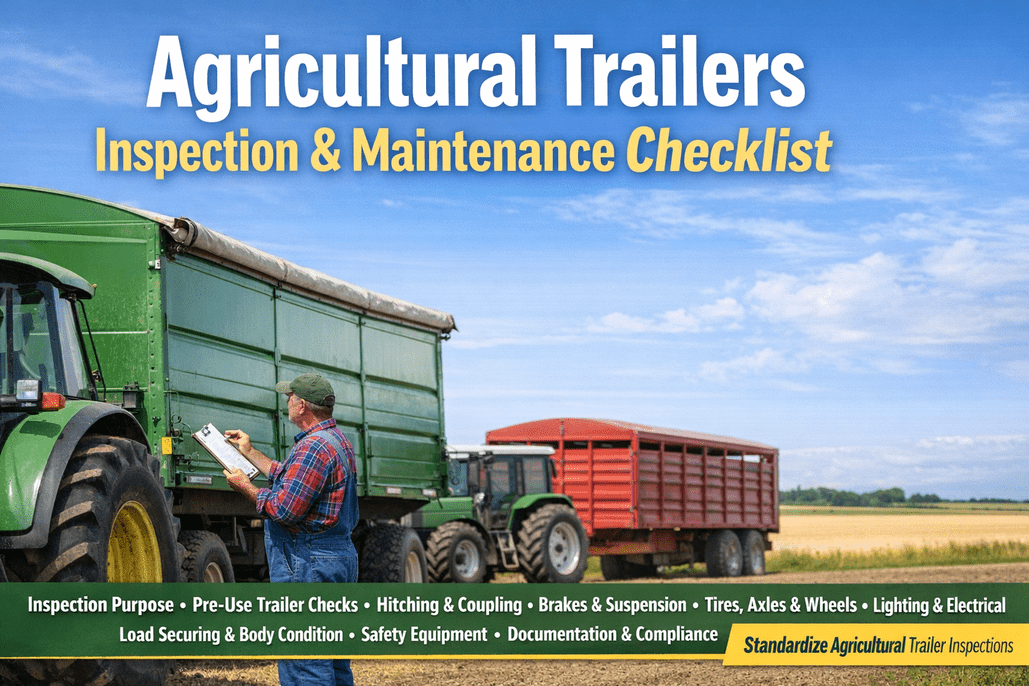
Ensure the safety and reliability of your farm equipment with our comprehensive Agricultural Trailers Inspection & Maintenance Checklist. Designed for farmers, ranchers, and rural fleet operators, this guide covers critical checks for livestock trailers, grain hoppers, and flatbeds. By verifying brakes, hitches, tires, and lighting before hitting the road, you can prevent accidents, avoid expensive repairs, and ensure compliance with agricultural transport regulations. Start your free farm fleet trial
Agricultural Trailer Inspection
Farm Equipment Safety Checklist
Inspection Purpose
Road Safety
- Agricultural trailers often carry heavy, unstable loads on public roads. Verifying brakes and lights prevents catastrophic accidents with passenger vehicles.
Equipment Longevity
- Farm environments are harsh. Regular checks on wheel bearings, suspension, and chassis welds extend the service life of expensive trailers.
Livestock Protection
- For livestock trailers, checking floor integrity and ramp safety is crucial to prevent injury to animals during transport.
1. Tires, Brakes & Lights
Inspect the critical road-safety components:
Wheels & Tires
Brake System
Lights & Electrical
2. Structure, Hitch & Chassis
Verify the trailer's structural integrity and connection points:
Hitch & Coupling
Body Condition
Safety Equipment
3. Hydraulics, Ramps & PTO
Checks for tipping trailers, ramps, and powered equipment:
Ramps & Loading
Bulk / Tipping Body
PTO & Guards
Standardize Farm Fleet Safety
Fleet Rabbit's Agricultural Benefits:
- ✓ Ensure compliance with road transport regulations for farm machinery
- ✓ Track maintenance history for resale value of trailers
- ✓ Prevent downtime during critical harvest seasons
- ✓ Mobile-friendly checklists for field inspections
- ✓ Manage mixed fleets of flatbeds, tippers, and tankers
Why Agricultural Trailer Inspections Matter
Hitch Failures
- Separation Risk: Worn towing eyes or unsecured pins are a leading cause of trailer separation accidents. Checking the hitch daily is critical for public safety.
Hydraulic Safety
- Crush Hazard: Tipping trailers rely on hydraulic rams. A burst hose during operation can causing the body to collapse. Always check hoses for chafing and UV damage.
PTO Guarding
- Entanglement: An unguarded PTO shaft is one of the most dangerous hazards on a farm. Ensuring guards are present and not spinning with the shaft prevents life-threatening injuries.
Frequently Asked Questions
1. How do I check the "Breakaway Cable"?
The breakaway cable is a vital safety device that activates the trailer brakes if it detaches from the tractor. Ensure the cable is free of kinks, not frayed, and securely attached to a dedicated ring on the tractor (not the tow ball).
2. What is the correct tire pressure for farm trailers?
Tire pressure varies by load and tire type. Always refer to the manufacturer's plate or tire sidewall. Under-inflated tires overheat and blow out under heavy harvest loads, while over-inflation reduces braking efficiency on soft ground.
3. Do agricultural trailers need a parking brake?
Yes. All trailers over a certain weight (varies by region, typically 750kg+) must have a functional parking brake to prevent roll-away accidents when uncoupled. Test that the brake holds the fully loaded trailer on a slope.
4. Why check wheel bearings?
Trailers often sit idle for months. Before peak season, jack up the wheel and spin it to check for roughness (noise) or play (wobble). Repack grease if needed to prevent seizing during transport.
5. How often should I inspect the trailer floor?
Inspect the floor before every use, especially for livestock or heavy machinery. Look for rot in wooden decks or rust/cracks in metal floors. A weak floor can cause leg injuries to animals or point-loading failure for equipment.
Standardize Farm Fleet Inspections
Keep your agricultural trailers road-legal and safe with digital inspection logs.


