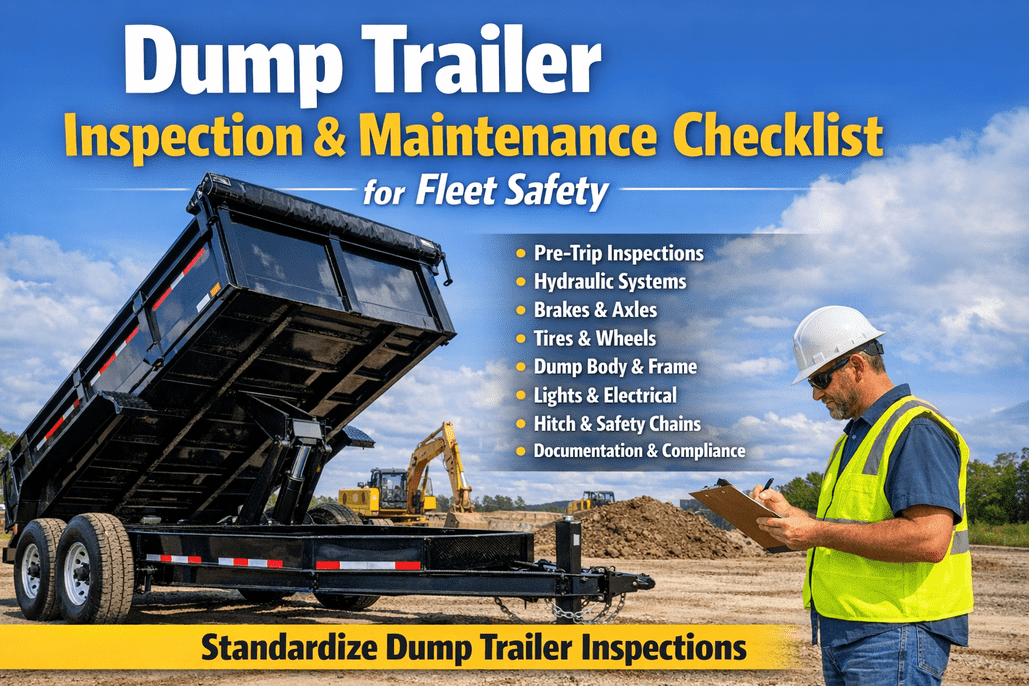
Keep your heavy-duty hauling equipment safe and compliant with our Dump Trailer Inspection & Maintenance Checklist. Designed for construction fleets and landscapers, this guide covers the critical hydraulic, structural, and braking systems unique to dump trailers. Regular inspections prevent dangerous hoist failures, ensure braking efficiency under heavy loads, and verify DOT compliance. Start your free fleet trial
Dump Trailer Inspection
Daily Safety & Maintenance Checklist
Inspection Purpose
Hydraulic Safety
- Dump trailers rely on powerful hydraulic rams to lift tons of material. A failed hose or cylinder seal can cause the bed to collapse during dumping, risking fatal injuries.
Braking Efficiency
- Electric brakes on dump trailers often fail due to corroded magnets or wiring. Verifying brake controller output is essential for stopping safely when fully loaded.
Structural Integrity
- Heavy shock loading damages frames and suspension. Inspecting U-bolts and welds prevents catastrophic structural failure on the highway.
1. Brakes, Hubs & Tires
Verify the stopping power and rolling gear:
Electric/Hydraulic Brakes
Hubs & Seals
Tires & Fasteners
2. Hydraulics & Structure
Inspect the lifting mechanism and frame integrity:
Hydraulic System
Running Gear
Dump Body
3. Electrical & Connection
Verify lights, power, and towing security:
Electrical System
Coupling & Safety
Standardize Dump Fleet Safety
Fleet Rabbit's Construction Benefits:
- ✓ Track hydraulic maintenance intervals to prevent pump failure
- ✓ Mandate "Bed Down" indicators before driving
- ✓ Monitor battery health for reliable dumping in the field
- ✓ Digital archives for DOT brake inspection compliance
- ✓ Manage mixed fleets of dump, flatbed, and equipment movers
Common Defects & Maintenance
Battery Drain
- No Lift: The most common dump trailer issue. If the battery isn't receiving a charge from the truck (via the specific aux pin), it will die mid-job. Regularly test the charge line.
Brake Wiring
- Ground Faults: Dump trailers vibrate heavily. Wiring often rubs against the frame, causing shorts. Use split-loom tubing and secure all hanging wires.
Cylinder Leaks
- Drifting Bed: If the bed lowers slowly on its own, the cylinder seals are likely bypassing or the check valve is leaking. This is a major safety hazard for anyone working under the bed.
Essential Tools
Frequently Asked Questions
1. How do I test the "Breakaway System"?
Pull the pin from the breakaway switch box while the trailer is jacked up (one side). Try to spin the tire. The electric brakes should lock up immediately, powered by the trailer's onboard battery. Reinsert the pin immediately; leaving it out will drain the battery and can melt the magnet coils.
2. What causes the dump bed to rise slowly?
Slow lifting is often caused by low battery voltage (check the truck's charge line), low hydraulic fluid, or a clogged suction filter. In cold weather, using a fluid with the wrong viscosity (like straight 30W oil instead of AW-32) can also cause sluggish operation.
3. Why do I need a "Safety Prop"?
A safety prop (or body prop) is a mechanical brace that holds the bed up during maintenance. Never work under a raised dump bed supported only by hydraulics; if a hose bursts or a seal blows, the bed can fall instantly, causing fatal crushing injuries. Always prop it.
4. How often should wheel bearings be greased?
For trailers used daily or carrying heavy loads, inspect and re-pack wheel bearings every 12 months or 12,000 miles. If the hubs feel hot to the touch after driving, the bearings may be failing or the brakes dragging. Heat buildup is a leading cause of trailer fires.
5. Can I use ATF in my hydraulic pump?
Many dump trailer pumps (like KTI or Bucher) are designed to use Automatic Transmission Fluid (ATF), but others require AW-32 or AW-46 hydraulic oil. Mixing fluids can cause foaming and pump caviaration. Always check the reservoir label before topping off.
6. How do I check if my brake magnets are bad?
If you have weak braking, use a multimeter to check the resistance (Ohms) of the magnets. A typical 12-inch magnet should read between 3.0 and 3.2 Ohms. If it reads zero (short) or infinite (open circuit), the magnet is bad and needs replacing. Also, check for uneven wear on the magnet face.
Standardize Dump Trailer Inspections
Ensure your dump trailers are safe, reliable, and compliant with digital daily logs.


