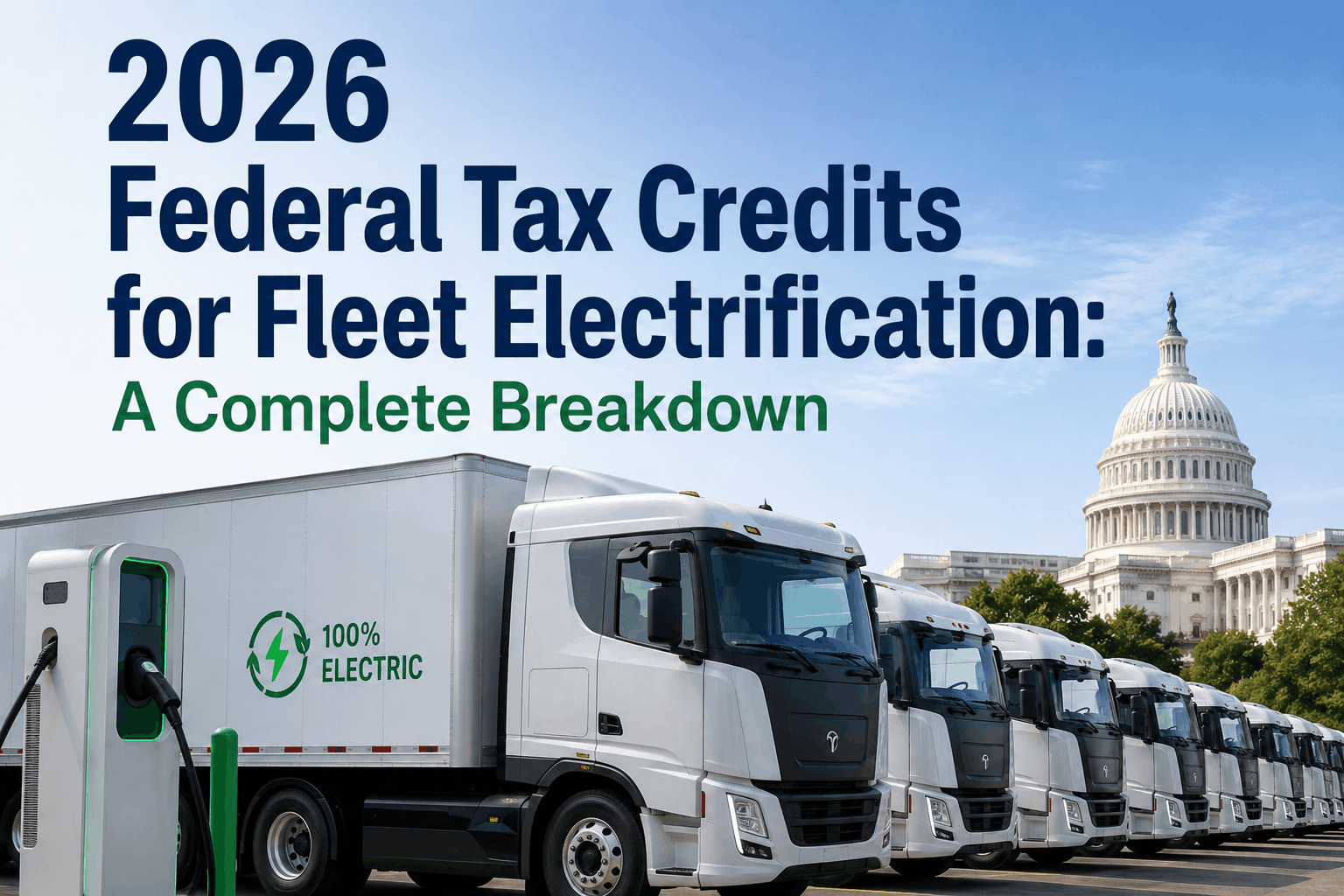
The federal tax credit landscape for fleet electrification has fundamentally changed. With the repeal of the clean vehicle credits for vehicles acquired after September 30, 2025, under the One Big Beautiful Bill Act (OBBBA), fleet managers must now navigate a new reality . While the popular Section 30D consumer credit and the Section 25E used vehicle credit are gone, the commercial clean vehicle credit under Section 45W remains a powerful tool for fleets that acted before the deadline. This complete breakdown covers what's still available, what's expired, and how to maximize your savings in 2026. sign up for our fleet analytics platform to track your electrification ROI.
2026 Federal Tax Credits for Fleet Electrification: A Complete Breakdown
The Inflation Reduction Act of 2022 ushered in a new era of clean vehicle incentives, but the FY2025 reconciliation law (OBBBA) repealed the consumer-facing credits for vehicles acquired after September 2025. However, the commercial clean vehicle credit under Internal Revenue Code Section 45W remains available for vehicles placed in service before the end of 2032, subject to specific rules and the "acquired before October 1, 2025" cutoff. For fleet managers, understanding the nuances of Section 45W is critical to capturing up to 40,000 per heavy-duty vehicle. book a demo to see how our software helps you track eligibility and optimize your fleet's tax position.
Section 45W: The Commercial Clean Vehicle Credit
The Section 45W credit is the primary remaining federal incentive for fleet electrification. It is available to businesses and tax-exempt organizations for qualified commercial clean vehicles placed in service after December 31, 2022, and before January 1, 2033. The credit amount is the lesser of (1) 30% of the taxpayer's basis in the vehicle (15% for plug-in hybrids) or (2) the incremental cost of the vehicle compared to a comparable internal combustion engine vehicle . The maximum credit is 7,500 for vehicles under 14,000 pounds GVWR and 40,000 for heavier vehicles .
30% of basis or incremental cost
30% of basis or incremental cost
Incremental Cost and Safe Harbors
The incremental cost is the excess of the purchase price of the clean vehicle over the purchase price of a comparable gasoline or diesel vehicle . The IRS has provided safe harbors for determining incremental cost, most recently in Notice 2025-9, which incorporates the Department of Energy's January 2025 report . Taxpayers can rely on these modeled incremental costs for vehicles placed in service on or after January 1, 2025 . The safe harbor simplifies what could otherwise be a complex calculation involving retail price equivalents (RPEs) and manufacturer costs. sign up to access our incremental cost calculator and maximize your credit.
Eligibility Requirements for Section 45W
To qualify for the Section 45W credit, a vehicle must meet several criteria: it must be acquired for use or lease (not for resale), be used primarily in the United States, have a battery capacity of at least 7 kWh (for vehicles under 14,000 lbs) or 15 kWh (for heavier vehicles), and be produced by a qualified manufacturer. The vehicle must also be either a motor vehicle for public roads or mobile machinery as defined in the code. Notably, Section 45W does not have the same strict domestic content or sourcing requirements as the repealed Section 30D consumer credit, making it more accessible for a wider range of vehicles . book a demo to learn how our platform helps you track eligibility.
Ready to maximize your fleet's tax credits?
Get real-time eligibility tracking with Fleetrabbit.
Our platform integrates with your fleet data to identify qualifying vehicles, calculate potential credits, and generate reports for your tax filings. Don't leave money on the table.
Leasing and the Section 45W Credit
One of the most powerful features of Section 45W is its applicability to leased vehicles . Businesses that purchase vehicles for lease can claim the credit, and dealers have reportedly used this to lower lease payments for customers. This effectively allows fleets to benefit from the credit even if they don't directly purchase the vehicle. The credit can be passed through to lessees, making electric fleet adoption more affordable. sign up to explore our leasing optimization tools.
Repeal of Consumer Credits and What It Means for Fleets
The One Big Beautiful Bill Act repealed the Section 30D new clean vehicle credit and the Section 25E used clean vehicle credit for vehicles acquired after September 30, 2025 . This means the consumer-facing incentives that many fleet operators relied on for light-duty vehicles are no longer available. However, the commercial credit under Section 45W remains intact, and it covers a broader range of vehicles, including those used for business purposes . Fleets should focus on Section 45W for their electrification plans going forward. book a demo to see how we can help you navigate this new landscape.
Start optimizing your fleet's tax strategy today
No commitment, just data-driven insights.
Fleetrabbit gives you a unified view of your vehicles, their eligibility, and the potential credits you can claim. Join the fleet managers who are already maximizing their electrification incentives.
The federal tax credit landscape for fleet electrification has shifted, but significant opportunities remain under Section 45W. Understanding the incremental cost calculation, eligibility requirements, and the leasing advantage can help you capture up to 40,000 per heavy-duty vehicle. Fleetrabbit's platform is built to help you track and optimize these incentives. book a demo to start planning your electrification strategy today.
Frequently Asked Questions
What federal tax credits are available for fleet electrification in 2026?
The primary credit is the Section 45W commercial clean vehicle credit. It provides up to 7,500 for vehicles under 14,000 lbs GVWR and up to 40,000 for heavier vehicles. The consumer credits (Section 30D and 25E) were repealed for vehicles acquired after September 30, 2025 .
How is the Section 45W credit calculated?
The credit is the lesser of (1) 30% of the taxpayer's basis in the vehicle (15% for plug-in hybrids) or (2) the incremental cost of the vehicle compared to a comparable internal combustion engine vehicle. The IRS provides safe harbors for incremental cost calculations .
Can I claim the Section 45W credit for leased vehicles?
Yes, businesses that purchase vehicles for lease can claim the credit . The credit can be passed through to lessees, making it a powerful tool for fleet electrification.
What are the eligibility requirements for Section 45W?
The vehicle must be acquired for use or lease (not resale), used primarily in the U.S., have a battery capacity of at least 7 kWh (under 14,000 lbs) or 15 kWh (over 14,000 lbs), and be produced by a qualified manufacturer. It must also be a motor vehicle for public roads or mobile machinery.