Plant logistics data lives in the worst possible place for anyone trying to run an operation on it: inside PLCs, dock-door controllers, weighbridges, AGV fleet managers and RFID portals that were each commissioned by a different integrator, in a different decade, speaking a different protocol. OPC UA (IEC 62541) is the standard that makes that data addressable, typed, secured and subscribable without a per-device driver project. But the protocol alone does not deliver an integration — the outcome depends on four design decisions most teams rush: how you model the address space, how you configure subscriptions, how you configure security, and how you bridge OT data into enterprise event streams without turning your broker into a firehose. This guide walks each decision with the parameters, trade-offs and failure modes that show up in real plants. Book an architecture review if you want a second pair of eyes on your topology, or start a free trial to see how plant asset telemetry lands in a maintenance platform.
IEC 62541 · ARCHITECTURE GUIDE
OPC UA for Plant Logistics Data Integration
Information modelling, subscription design, security configuration and the bridge to enterprise event streams — the four decisions that determine whether your OPC UA plant data integration scales past the pilot cell.
OPC UA STACK
Application & Companion SpecsMachinery · AutoID
Information ModelAddress Space
ServicesRead · Sub · Method
SecurityX.509 · Sign+Encrypt
Transportopc.tcp · MQTT
What OPC UA Actually Solves in a Plant Logistics Stack
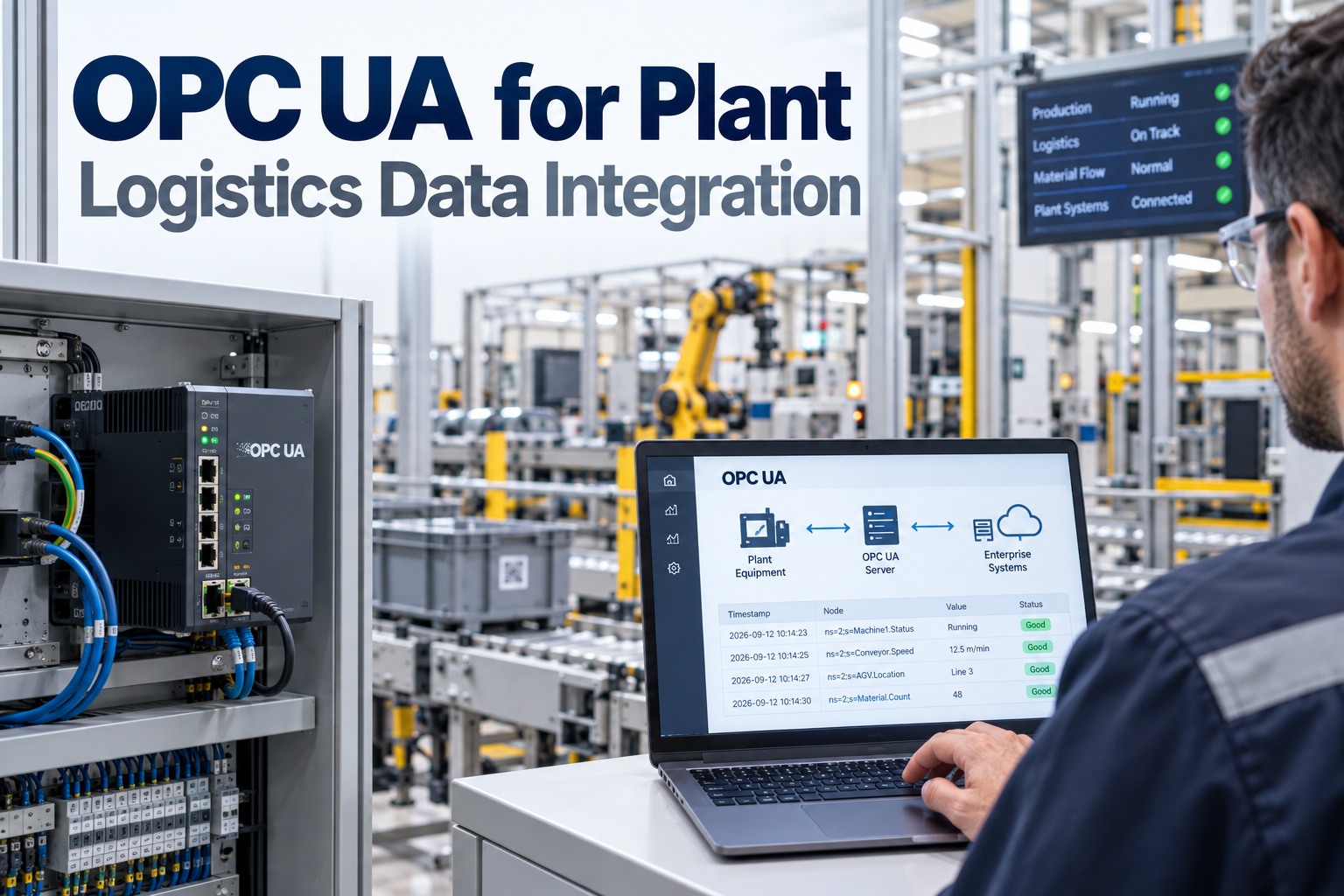
The value is not "another protocol." It is that a tag stops being an anonymous register address and becomes a typed, named, browsable node with units, engineering limits, a status code and a source timestamp attached. Downstream systems can then discover structure instead of being hand-fed a tag list. Below is the path a single dock-door event travels in a well-built OPC UA plant data integration architecture.
1Field DevicePLC, scanner, scale, AGV controller
→
2OPC UA ServerEmbedded or gateway-hosted address space
→
3Edge ClientSubscribes, filters, buffers, normalises
→
4Broker / StreamMQTT, Kafka, cloud event hub
→
5Business SystemsWMS, MES, ERP, asset & maintenance
The integration work is almost entirely in stages 2 and 3. Skip the modelling at stage 2 and every consumer downstream inherits the mess permanently.
Information Modelling: Build the Address Space Before the Integration
A flat list of 4,000 nodes named DB12_INT_47 is not an information model — it is a tag dump with extra steps. Model the plant the way the plant is organised, using ISA-95 style hierarchy, and reuse companion specifications rather than inventing types. OPC UA for Machinery gives you standard machine identification and state; the AutoID companion spec covers RFID and barcode readers, which is what most plant logistics scanning actually runs on.
EXAMPLE ADDRESS SPACE
Site_HamburgObject
Area_InboundObject
DockDoor_07DockDoorType
DoorStatens=3;s=DD07.State
LastScanEPCns=3;s=DD07.EPC
OccupancySecondsns=3;s=DD07.Occ
AcknowledgeFault()Method
Forklift_Charger_02MachineryItemType
OperatingHoursns=3;s=CH02.Hrs
MODELLING RULES THAT PAY OFF LATER
01Type before instance. Define DockDoorType once; instantiate 40 doors. Consumers write one mapping, not forty.
02Use string NodeIds in a dedicated namespace. Numeric IDs shift when the PLC program is recompiled; string IDs survive.
03Expose EngineeringUnits and EURange. Unit-less numbers force every consumer to hardcode assumptions.
04Model methods, not command tags. A Method is atomic and auditable; a write-a-1-to-trigger tag is a race condition.
05Keep BrowseName stable forever. Treat it as a public API contract, because that is exactly what it is.
Subscription Design: Sampling, Publishing, Deadbands and Queues
Most OPC UA performance complaints are subscription misconfigurations, not server limitations. Polling every node at 100 ms because "faster is safer" is the single most common way to saturate a gateway. Set the sampling interval from the physical rate of change of the signal, then let deadbands and queues do the rest.
ParameterWhat it controlsSane starting point
SamplingIntervalHow often the server checks the source value for changeMatch signal physics
PublishingIntervalHow often queued notifications are sent to the client1–2× sampling
QueueSizeNotifications buffered per item between publishes≥ pub ÷ sampling
DiscardOldestWhich value is dropped on queue overflowfalse for events
DataChangeFilterWhether status, value or timestamp changes trigger a notificationStatusValue
DeadbandTypeAbsolute or percent-of-range change required to reportPercent on analogs
KeepAliveCountPublish cycles with no data before a keep-alive is sent~10s equivalent
LifetimeCountCycles before the server drops an unserviced subscription≥ 3× KeepAlive
Interlock & Safety State
Sampling 50–100 ms
Deadband None
Queue ≥ 10
Door states, e-stops, AGV zone occupancy. Every transition matters.
Standard Logistics Telemetry
Sampling 250–1000 ms
Deadband 1–2%
Queue 2–5
Scan events, conveyor throughput, weighbridge readings, dwell counters.
Slow Analog & Condition
Sampling 5–60 s
Deadband 2–5%
Queue 1
Temperatures, battery state of charge, hydraulic pressure, runtime hours.
Security Configuration: Certificates, Policies and Least Privilege
OPC UA ships with real security, and plants routinely switch it off during commissioning and never switch it back on. SecurityMode: None on a production endpoint is an open write channel into process equipment. OT security here is configuration discipline, not extra product.
Security PolicyStatusUse
NoneUnsafeLab and discovery endpoints only
Basic128Rsa15DeprecatedDisable — legacy devices only, segmented
Basic256DeprecatedDisable — plan migration
Basic256Sha256AcceptableWidest device compatibility baseline
Aes128_Sha256_RsaOaepPreferredModern default for new deployments
Aes256_Sha256_RsaPssPreferredHighest assurance where supported
HARDENING ORDER
1SignAndEncrypt on every production endpoint. Sign-only leaks payload contents to anyone on the segment.
2Managed application instance certificates. Self-signed and manually copied trust lists do not survive twenty gateways — use a GDS or your PKI.
3Per-client user identity. Anonymous access disabled; certificate or credential per integration, never one shared account.
4Read-only by default. Write and Method permissions granted node-by-node to the specific clients that need them.
5Reverse connect across the DMZ. The OT server initiates outbound; no inbound firewall hole into the plant network.
6Certificate lifecycle owned by someone. Expiry takes a line down as effectively as a cable cut, and always at 02:00.
Bridging OPC UA to Enterprise Event Streams
Client-server OPC UA is excellent inside the plant and a poor fit for fanning data out to cloud consumers. The bridge pattern you choose decides your latency, your backpressure behaviour and how much work every downstream consumer has to repeat. Here is the honest comparison.
Rule of thumb: exactly one edge client owns the OPC UA session per server. Everything else consumes from the stream. The moment a second business system subscribes directly to the PLC gateway, you have coupled your ERP release cycle to your controls network.
Three Reference Architectures
Which OPC UA plant data integration architecture fits depends less on plant size than on how many consumers need the same data and whether cloud connectivity is permitted at all.
A · Direct Edge Bridge
UA ServerEdge ClientMQTT BrokerPlatform
Fits when: one site, under ~50 devices, one or two consumers, straightforward network.
Fastest to stand upLowest cost
B · Aggregating Gateway
Many UA ServersAggregation ServerEdge ClientStream
Fits when: mixed vendors and legacy PLCs; you need one unified namespace and one security boundary.
Single namespaceProtocol translation
C · Unified Namespace
UA + Non-UANormalisation LayerUNS BrokerAny Consumer
Fits when: multi-site, many consumers, edge-to-cloud manufacturing programme with a long roadmap.
Scales bestHighest governance effort
Not sure which pattern your plant needs?
A 30-minute architecture review covers your namespace design, subscription load, security posture and the bridge decision — with a written summary you can take to your controls team.
✓ Namespace & modelling audit✓ Subscription load estimate✓ OT security gap list
Failure Modes: Symptom, Cause, Fix
These six account for the large majority of post-go-live OPC UA support tickets in plant logistics environments. Each one is a design choice made earlier, surfacing later.
SymptomRoot causeFix
Gateway CPU pegged, notifications lagEvery node sampled at 100 ms with no deadbandRe-tier sampling by signal physics; add percent deadbands on analogs
Values arrive but timestamps are wrongConsumer using ServerTimestamp instead of SourceTimestampMap SourceTimestamp; sync all devices to plant NTP
Data gaps after brief network dropsNo store-and-forward at the edge; queue too smallBuffer at edge, raise QueueSize, set DiscardOldest false for events
Integration breaks after a PLC downloadNumeric NodeIds regenerated on recompileMove to string NodeIds in a stable namespace and freeze BrowseNames
Client cannot connect after months of uptimeApplication instance certificate expiredCentral PKI or GDS with monitored expiry and automated renewal
Bad quality values silently treated as zeroStatusCode discarded during JSON flatteningCarry StatusCode end to end; reject or flag non-Good at ingest
What to Monitor After Go-Live
An OPC UA integration degrades quietly. These are the signals worth alerting on from day one, well before anyone notices a dashboard has gone stale.
Session & subscription count per serverStable baselineGrowth means clients are reconnecting instead of resubscribing
Publish response age< 2× intervalEarliest signal of gateway saturation
Non-Good StatusCode ratioNear zeroRising ratio usually means a field device or wiring fault
Queue overflow / dropped notificationsZeroSilent data loss; never visible downstream without this metric
Certificate days-to-expiry> 30 daysPrevents the most avoidable total outage in OPC UA
Edge buffer depth< 20% capacityTells you whether the bridge, not the plant, is the bottleneck
Frequently Asked Questions
Q1Do I need OPC UA if my devices already support MQTT?
MQTT moves bytes; it does not tell a consumer what those bytes mean. OPC UA adds the typed information model, units, status and timestamps. The two are complementary — OPC UA PubSub and Sparkplug B both run over MQTT specifically so you get transport reach plus semantic structure.
Q2Is there an OPC UA plant data integration API I can call directly?
OPC UA exposes services (Browse, Read, Write, Call, CreateSubscription) rather than a REST API. In practice most enterprise teams consume a REST or streaming interface presented by the edge layer, which owns the UA session. That indirection is deliberate — it stops application changes from touching the controls network.
Q3How many nodes can one server handle?
It depends far more on notification rate than node count. Ten thousand nodes at 30-second sampling with deadbands is lighter than five hundred at 100 ms with none. Size on notifications per second, then load-test with your real subscription profile before committing hardware.
Q4Can I run OPC UA without opening firewall ports into the plant?
Yes. Reverse connect has the OT-side server initiate the outbound connection to the client in the DMZ, so no inbound rule into the OT segment is required. This is the standard approach for edge-to-cloud manufacturing deployments under IEC 62443 zone and conduit models.
Q5What are the strongest plant logistics use cases?
Dock door occupancy and turnaround timing, RFID and barcode scan events via the AutoID companion spec, weighbridge and dimensioning capture, AGV and forklift charger status, and conveyor or sorter throughput. All five are cross-system events where a shared, typed data model removes repeated integration work.
Q6How does this connect to fleet and asset maintenance?
Operating hours, fault codes, duty cycles and charge behaviour are exactly the inputs condition-based maintenance needs. Once they stream out over OPC UA, the same data driving your logistics dashboards can trigger work orders automatically — the approach described in our
predictive maintenance guide.
Turn Plant Signals Into Maintenance Action
Once OPC UA is delivering clean, typed equipment telemetry, FleetRabbit turns operating hours, fault codes and duty cycles into automated PM schedules, work orders and asset history — across plant vehicles, handling equipment and fixed assets. No contracts, no proprietary hardware.