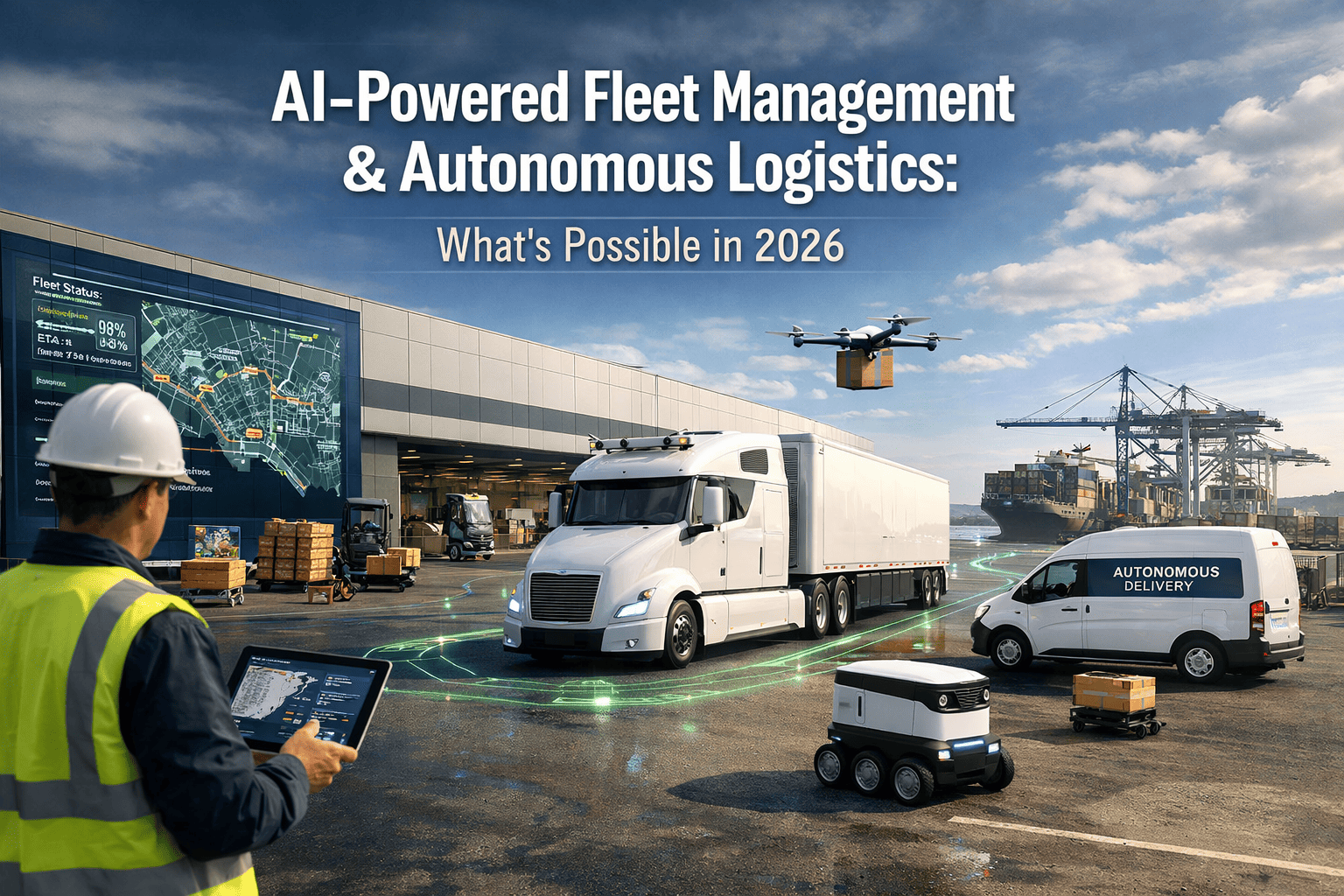
AI in fleet management is no longer experimental - it is operational. In 2026, Aurora's driverless trucks have logged 250,000+ miles with zero collisions. Predictive maintenance catches failures 20-45 days early. AI route optimization delivers 10-15% fuel savings automatically. The global fleet management market hit $27 billion in 2025 and is racing toward $122 billion by 2035 - and AI capabilities are driving this growth. The question is not whether AI will transform fleet operations - it already has. The question is whether your fleet is capturing these advantages or falling behind competitors who are. This guide shows what is actually possible today, what is coming next, and how to start. Book a demo to see AI fleet management in action.
65% of maintenance teams are adopting AI by end of 2026. Fleets using AI see 30% less downtime, 12% lower fuel costs, and 89% failure prediction accuracy. Software now commands 49% of the fleet management market with cloud solutions holding 70% share. Here is what is actually working - and how to implement it.
AI Fleet Capabilities: What Actually Works in 2026
Forget the hype - here is what AI delivers for real fleets today. These are not pilot programs or demos. They are production systems running millions of miles across thousands of fleets. In 2026, Geotab describes AI as an "active work partner" that proactively suggests routes, plans maintenance windows, and coaches drivers in real time. Motive's 2026 report identifies this year as the tipping point for AI real-time intervention in collision reduction. For a deeper dive into specific applications, see our complete AI use cases guide.
AI analyzes engine data, vibration patterns, fluid conditions, and historical failures to predict breakdowns 20-45 days before they happen. Modern systems achieve 89% failure prediction accuracy with false positive rates below 5%. This catches issues traditional diagnostics miss entirely - preventing breakdowns that cost $448-$760 per day in downtime.
Real-time traffic, weather, and delivery window analysis. AI recalculates routes continuously - not just at trip start. Adapts to conditions faster than any dispatcher. Companies using AI route optimization report 12% drop in fuel costs and 30% reduction in delivery lead times. The system considers vehicle type, load weight, driver hours remaining, and customer time windows simultaneously.
Computer vision analyzes dashcam footage for distraction, drowsiness, phone use, following distance, and lane departure. Real-time alerts intervene before incidents - not after. Motive calls 2026 the "tipping point" for AI collision reduction. Systems provide in-cab coaching and generate targeted training based on actual driver behavior patterns.
AI correlates GPS location, fuel card transactions, and tank sensor data to detect siphoning, card fraud, and buddy fueling in real-time - within 5-10 seconds, not weeks later during reconciliation. 95% of fraudulent transactions caught instantly. Learn more in our fuel theft detection guide.
AI handles routine dispatch decisions - load matching, driver assignment, schedule optimization, and exception routing. Humans focus on complex situations and strategy. Leading fleets already have 40% of dispatching decisions made by AI. The system learns from dispatcher corrections to continuously improve recommendations.
Virtual replicas of entire fleets for what-if analysis. Test route changes, maintenance schedules, capacity additions, and staffing scenarios without real-world risk. Optimize before you execute. Digital twins process millions of data points to simulate outcomes across thousands of variables simultaneously.
Ask "Which vehicles need attention this week?" or "Why did overtime spike last Tuesday?" instead of navigating complex dashboards. AI generates custom reports, answers operator questions, and automates administrative documentation. The generative AI in transportation market grows from $1.2B (2025) to $2.83B by 2030.
AI processing moves from cloud to in-vehicle, enabling real-time decisions without connectivity dependency. Reduces latency from minutes to milliseconds for safety-critical predictions. Expect sub-second response times for autonomous features and instant alerts even in areas with poor cellular coverage.
FleetRabbit brings AI-powered maintenance, predictive analytics, and smart scheduling to fleets of any size - starting at $3/vehicle/month with no contracts. The foundation every fleet needs before advanced AI. Book a 15-minute demo to see what AI can do for your operation, or start free with up to 3 vehicles.
Autonomous Trucks: Where We Actually Are in 2026
Autonomous trucks are no longer theoretical - they are hauling real freight on real highways right now. Aurora launched commercial driverless freight in April 2025 and has tripled its route network by early 2026. The autonomous long-haul market reached $2.7 billion in 2024 and is projected to grow at 32% CAGR to $42.6 billion by 2034. Here is the current state of commercial driverless operations.
How Hub-to-Hub Autonomous Freight Actually Works
Autonomous trucks in 2026 do not drive door-to-door. They operate in a hub-to-hub model where self-driving trucks handle long-haul highway segments between logistics transfer points, and human drivers manage first-mile and last-mile operations. This approach leverages autonomy where it delivers the most value - predictable highway environments - while human drivers handle complex urban navigation, loading docks, and customer interactions. For detailed integration strategies, see our autonomous fleet integration guide.
1,000-mile Fort Worth to Phoenix in 15 hours vs 2+ days with human driver HOS breaks
Autonomous trucks run day and night, potentially doubling fleet utilization
250,000+ driverless miles with zero AV-attributed collisions across all operators
Ready to Start Your AI Journey?
FleetRabbit gives you AI-powered maintenance, digital DVIR, compliance automation, and cost analytics - the foundation every fleet needs before advanced AI. $3/vehicle/month. No contracts. Free for up to 3 vehicles forever.
The AI Adoption Timeline: Where to Start
You do not need autonomous trucks to benefit from AI today. Here is the practical adoption path most fleets follow - from immediate wins to long-term transformation. The shift from reactive to predictive maintenance represents the most immediately quantifiable AI fleet value. Learn more about getting started with predictive maintenance implementation.
- Predictive maintenance alerts (20-45 days advance warning)
- AI dashcam safety coaching (25-40% accident reduction)
- Automated compliance reporting (DVIR, ELD, DOT)
- Smart fuel monitoring and theft detection
- Real-time vehicle health monitoring
- Driver behavior analytics and scorecards
This is where 89% of enterprise fleets are today - and where the fastest ROI exists.
- AI route optimization with real-time traffic adaptation
- Automated dispatch for routine load assignments
- Demand forecasting and capacity planning
- GenAI assistants for reporting and documentation
- Integrated parts ordering and inventory
- Cross-fleet performance benchmarking
Gartner predicts 70% of large organizations will adopt AI demand forecasting by 2030.
- Autonomous capacity on qualifying long-haul routes
- Mixed human-AV fleet management platforms
- 24/7 operations without HOS constraints
- AI-driven end-to-end supply chain visibility
- Fully automated exception management
- Predictive safety systems that prevent accidents
Companies investing in AI platforms now are building data infrastructure for autonomous integration.
Why AI Adoption Is Accelerating in 2026
Three converging forces make 2026 the optimal AI adoption window. Fleet operators who wait risk falling behind competitors who are capturing these advantages now.
The US faces an 80,000+ truck driver shortage with 237,600 annual job openings projected through 2034 - driven overwhelmingly by retirements. Average driver age is 46-47 years old, well above the national workforce average of 42. AI extends existing workforce capacity - predictive maintenance means fewer breakdowns and less driver frustration, route optimization means more deliveries per driver, and safety coaching improves retention by reducing accidents and incidents.
Predictive maintenance delivers 34% cost savings versus reactive approaches with 44-day average ROI payback. Each avoided roadside breakdown saves $448-$760 per day in direct downtime costs - not counting missed deliveries, customer impact, and driver frustration. At 89% prediction accuracy with false positives below 5%, the ROI is no longer theoretical. It is documented across thousands of fleets and millions of vehicle-miles.
70% of new fleet software deployments are cloud-based with software commanding 49% of the total fleet management market. This democratization means AI capabilities that required enterprise budgets and IT departments are now accessible to any fleet size. No proprietary hardware required. No multi-year contracts. Just software that learns your fleet patterns and improves continuously. The technology barrier has collapsed.
Industry Adoption by Vertical
AI fleet management adoption varies by industry, with transportation and logistics leading but other sectors catching up fast. Commercial vehicles represent 74% of fleet management revenue, while oil and gas shows the fastest growth at 14.1% CAGR.
Market leader in AI adoption. Route optimization, predictive maintenance, and safety coaching drive competitive advantage in tight-margin operations where every percentage point of efficiency matters.
Predictive maintenance prevents costly equipment failures on job sites. Fuel monitoring critical for high-consumption machinery. Remote site visibility enables better resource allocation across projects.
Fastest growth at 14.1% CAGR as operations demand fleet intelligence for remote and high-risk environments. Kodiak currently operates the largest industrial AV fleet in the Permian Basin oilfields.
Dispatch optimization critical for service response times and customer satisfaction. Mobile workforce management and compliance tracking drive adoption across distributed service territories.
AI vs Traditional Fleet Management: Real Numbers
The difference between AI-powered and traditional fleet management is not marginal - it is transformational. Here is what the data shows across thousands of fleet implementations.
See how FleetRabbit delivers these AI advantages to fleets of any size - from 3 vehicles to 3,000. No hardware required. No contracts. Book a 15-minute demo to see your potential ROI.
Frequently Asked Questions
No. Autonomous trucks are the most visible AI application, but the immediate value comes from predictive maintenance, route optimization, fuel monitoring, and safety coaching - capabilities available today for any fleet size at $3-10/vehicle/month. These deliver measurable ROI in weeks, not years. Autonomous capacity integration comes later, built on the data foundation you create now. 89% of enterprise fleets using AI today are focused on these foundational capabilities, not autonomous vehicles.
Modern systems achieve 89% failure prediction accuracy, surfacing issues 20-45 days before traditional diagnostics would catch them. False positive rates are below 5%, meaning you are not chasing phantom problems. This translates to 30% less unplanned downtime and 34% lower maintenance costs with 44-day average ROI payback. The key is sufficient data - AI improves as it learns your specific fleet patterns, typically reaching full accuracy within 60-90 days of implementation.
FleetRabbit starts at $3/vehicle/month with AI-powered features included - no contracts, no hardware requirements, free tier for up to 3 vehicles. Enterprise platforms like Samsara run $25-45/vehicle/month plus $100-200 hardware per vehicle and typically require 36-month contracts. The ROI math is straightforward: if AI prevents one breakdown per vehicle per year ($448-$760 saved per day of downtime), it pays for itself many times over. Most fleets see positive ROI within 44 days.
Commercial driverless operations are live now on specific routes - Aurora has 250,000+ miles across 10 Sun Belt lanes, Gatik completed 60,000 orders for Walmart, Kodiak operates 20 driverless trucks in the Permian Basin. Widespread availability depends on regulatory expansion and production scaling. Aurora targets 200+ trucks by end of 2026 with capacity fully booked through Q3. For most fleets, autonomous capacity will be accessed through freight networks and partnerships rather than owned vehicles.
Start with the data foundation. AI and autonomous systems require historical maintenance records, route data, driver performance metrics, and vehicle telematics. Fleets using platforms like FleetRabbit today are building the data infrastructure needed to manage mixed human-autonomous fleets later. Focus on digital DVIR, predictive maintenance, and integrated fleet management now - these capabilities deliver immediate ROI while positioning you for autonomous integration when routes become available in your operating area.
The AI Fleet Advantage Starts Today
65% of maintenance teams are adopting AI by end of 2026. Early adopters are capturing 30% downtime reduction, 10-15% fuel savings, and 25-40% fewer accidents. The global fleet management market is racing toward $122 billion by 2035. The technology is proven. The ROI is documented. The only question is when you start building your AI advantage.