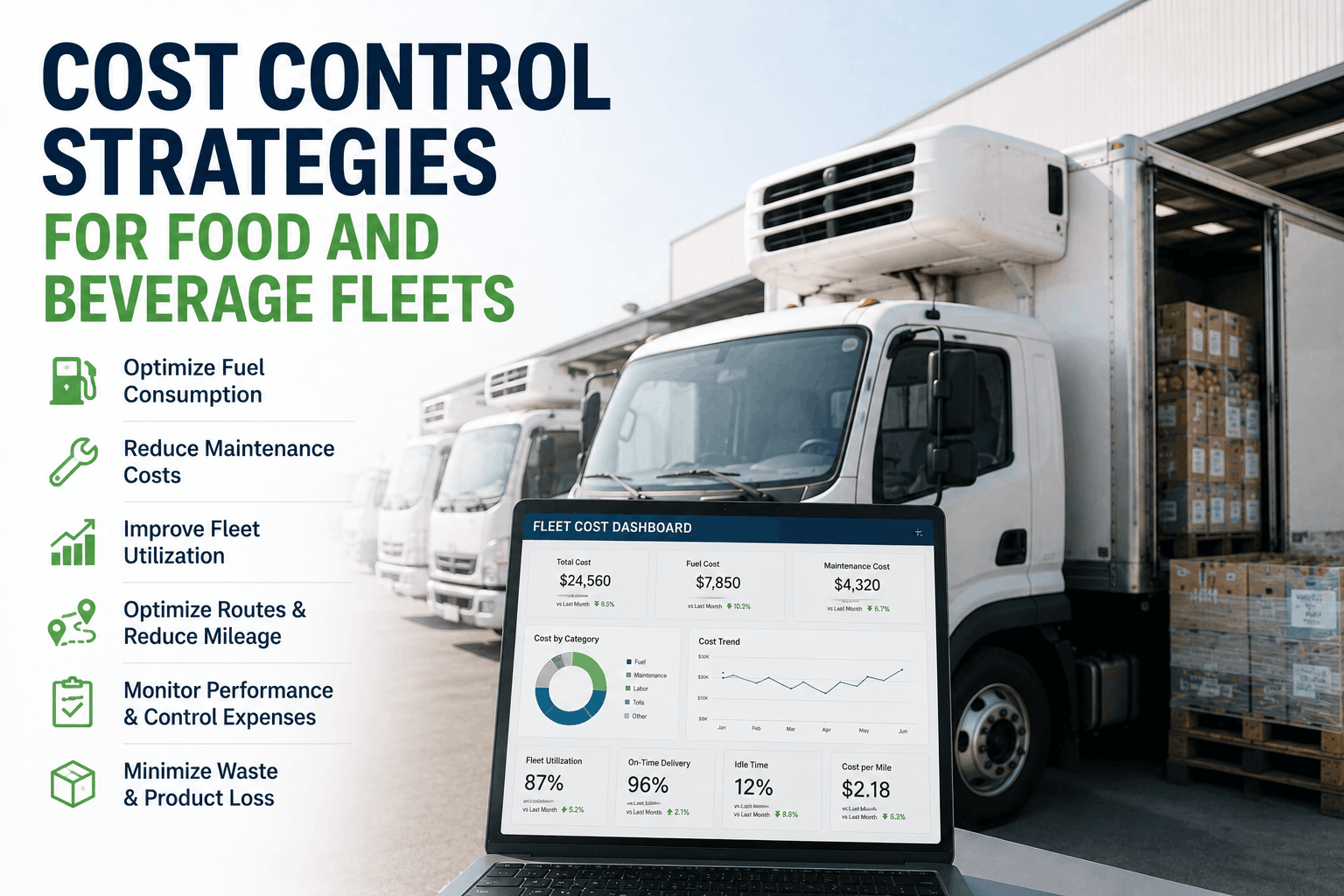
In food and beverage logistics, margins are measured in pennies, and every mile carries a cost that extends far beyond fuel. The combination of rising fuel prices, increasing insurance costs, and the ever-present risk of product loss creates a challenging environment for fleet operators. A recent industry analysis revealed that insurance costs per mile have jumped 47% in the last decade, while fuel accounts for up to 40% of vehicle-based expenses. For refrigerated fleets, the stakes are even higher—a single temperature excursion can destroy an entire shipment, turning a profitable route into a significant loss. This guide explores proven cost control strategies that help food and beverage fleets reduce cost-per-mile, minimize product loss, and protect profitability through better cold chain and maintenance management.
Understanding the True Cost of Food Fleet Operations
Many food and beverage companies underestimate their true transport costs, overlooking hidden expenses that erode profitability. Beyond obvious costs like fuel and driver wages, hidden costs include wasted management time, inefficient routes, product spoilage, cargo theft, and the financial impact of failed deliveries. A full, honest assessment of your true costs provides the foundation for making good decisions toward a more efficient solution.
Key cost drivers in food fleets include:
- Fuel Consumption: Poor driving habits are responsible for up to 40% of extra fuel costs. Harsh braking, rapid acceleration, and excessive idling all contribute to higher fuel consumption.
- Product Spoilage and Cargo Claims: Food and beverage theft is on the rise, with CargoNet reporting a massive increase in F&B-related theft—particularly meat products and beverages.
- Reefer Maintenance and Breakdowns: Refrigeration unit failures can result in spoiled cargo, emergency roadside service, and lost revenue. The average cost of a single reefer compressor failure can exceed $24,000.
- Inefficient Route Planning: Fleets that aren't optimized waste valuable time and money taking inefficient routes, and have a higher incidence of lost or misplaced deliveries.
Leveraging Visibility for Cost and Compliance Advantage
Visibility has moved from a competitive advantage to a baseline requirement in food logistics. Inflationary pressures, shelf-life sensitivity, and heightened regulatory oversight have made blind spots increasingly expensive. Item-level visibility provides food and beverage shippers with real-time insight into temperature compliance, inventory by SKU and lot, waste patterns, forecasting accuracy, and true total landed cost.
These insights are increasingly informing SKU rationalization efforts, helping companies eliminate unprofitable pack sizes and refocus portfolios following divestitures. Companies leveraging item-level visibility have achieved significant cost savings through smarter production planning, inventory discipline, and distribution strategies. With FSMA 204 traceability expectations continuing to evolve, defensible real-time data is no longer optional—it is essential to protect brand trust and avoid costly recalls or rejections. Sign up to discover how FleetRabbit provides item-level visibility for your fleet.
Strategic Consolidation and Multi-Temperature Logistics
Rising transportation costs paired with uneven demand remain one of the most persistent challenges for food and beverage shippers. Underutilized trucks, missed tenders, and escalating spot rates are eroding margins, even as networks struggle to keep capacity aligned with volume fluctuations. More sophisticated consolidation strategies are helping address this imbalance by combining smaller or multi-supplier shipments into fuller, more efficient truckloads. The result is better use of available capacity, lower cost per unit, reduced handling, and faster transit times that help preserve freshness.
Product complexity is another defining characteristic of the food and beverage landscape in 2026. Expanding portfolios now routinely include fresh, frozen, refrigerated, and ambient items moving through the same distribution networks. Each additional temperature requirement introduces new points of failure, increasing the risk of spoilage, claims, and service disruptions. Multi-temperature logistics solutions are enabling shippers to manage this complexity more effectively by allowing different temperature zones to move within a single, optimized network. As temperature monitoring becomes more rigorous, these capabilities are no longer optional—they are what make assortment expansion possible without adding disproportionate cost or operational risk. Book a demo to see how FleetRabbit supports multi-temperature fleet operations.
Cost Control Technologies for Food Fleets
Fuel Efficiency and Reefer Performance
With fuel costs accounting for up to 40% of vehicle-based expenses, fuel efficiency is a critical lever for cost control. Advanced telematics technology provides information on fuel use, including data on excessive idling in vehicles and the inappropriate use of vehicles, such as vehicles being used out-of-hours or drivers going off-schedule. By analyzing driver behavior in real time, fleets can identify the factors that lead to over-consumption and implement personalized eco-driving strategies.
For refrigerated fleets, the choice of refrigeration equipment directly impacts fuel consumption. Recent head-to-head trials demonstrated that advanced temperature-controlled units can deliver more than 30% greater fuel efficiency in continuous operation and more than 20% in start/stop operation compared to equivalent competitor units. This translates to a direct reduction in fuel spend and emissions for real-world fleet operators. New technologies like self-charging cooling systems, which recover energy during braking, can reduce CO2 emissions by up to 12 tonnes per year for distribution trailers while eliminating the need for connection to external power grids.
Preventing Product Loss Through Better Maintenance and Monitoring
Product loss is one of the most significant cost drivers in food fleets. Cargo theft is on the rise, and a single refrigeration unit failure can destroy an entire shipment. Preventive maintenance and proactive monitoring are essential for protecting cargo integrity. Telematics systems can monitor reefer zones in real time, detect unsafe driving before it leads to an accident, automatically stop fraud in real time, and easily track maintenance needs.
Understanding your key metrics is also critical. Do you measure efficiency performance such as your cost per delivery or your DIFOT score? The latter is important for controlling costs because the more accurate you are in delivering items in full, on time, the less likely you will be dealing with customer complaints and incurring extra costs from re-delivering items. Prioritizing flexibility is another key strategy—a more flexible, responsive delivery solution helps to control costs and make the most of business opportunities. On the other hand, an inflexible arrangement can be a drain on profitability. Sign up to learn how FleetRabbit helps you track key metrics and prevent product loss.
Building a Cost-Conscious Fleet Culture
Technology alone is not enough to sustain cost reduction—it must be accompanied by a culture that values cost awareness and continuous improvement. Drivers who understand the cost implications of their behavior are more likely to drive efficiently and report issues early. Dispatchers who have visibility into fleet cost metrics can make better scheduling decisions. Management teams that track cost-per-mile as a key performance indicator can allocate resources more effectively and demonstrate accountability for fleet performance.
Creating this culture requires leadership commitment, clear communication, and incentives tied to cost performance. Sharing cost data transparently across the organization helps build a shared understanding of financial objectives and encourages collaboration toward common goals. Regular reviews of cost-per-mile trends, combined with recognition of improvement achievements, reinforce the importance of cost-conscious operations and maintain momentum over the long term. Book a demo to explore how FleetRabbit's analytics tools can help you build a data-driven cost management culture.
Ready to Take Control of Your Fleet Costs?
Real-time visibility, cold chain monitoring, and predictive analytics—all in one platform to protect your margins and your cargo.
Frequently Asked Questions
The most effective approach combines multiple strategies: implementing telematics for real-time visibility, optimizing routes to reduce miles driven, monitoring driver behavior to improve fuel efficiency, and using preventive maintenance to avoid costly breakdowns. Item-level visibility also helps reduce waste and improve inventory planning.
Reducing product loss requires real-time temperature monitoring with alerts for deviations, preventive maintenance for refrigeration units, driver training on cold chain best practices, and proactive security measures to prevent theft. FleetRabbit integrates all these capabilities into a single platform.
Hidden costs include wasted management time, inefficient routes that increase fuel consumption, product spoilage from temperature excursions, cargo theft, failed deliveries that require reattempts, and the financial impact of accidents and insurance claims.
Consolidation combines smaller or multi-supplier shipments into fuller truckloads, resulting in better use of available capacity, lower cost per unit, reduced handling, and faster transit times that help preserve freshness. It also provides predictability in a volatile market.
FleetRabbit provides real-time visibility into vehicle location, temperature monitoring, driver performance, and maintenance needs—all in a unified platform. The system helps identify cost-saving opportunities, automate preventive maintenance, and provide actionable insights for reducing cost-per-mile and product loss.
Join 2,500+ Fleets Using FleetRabbit
From cost-per-mile tracking to cold chain compliance and preventive maintenance—FleetRabbit helps you protect your margins and your cargo.