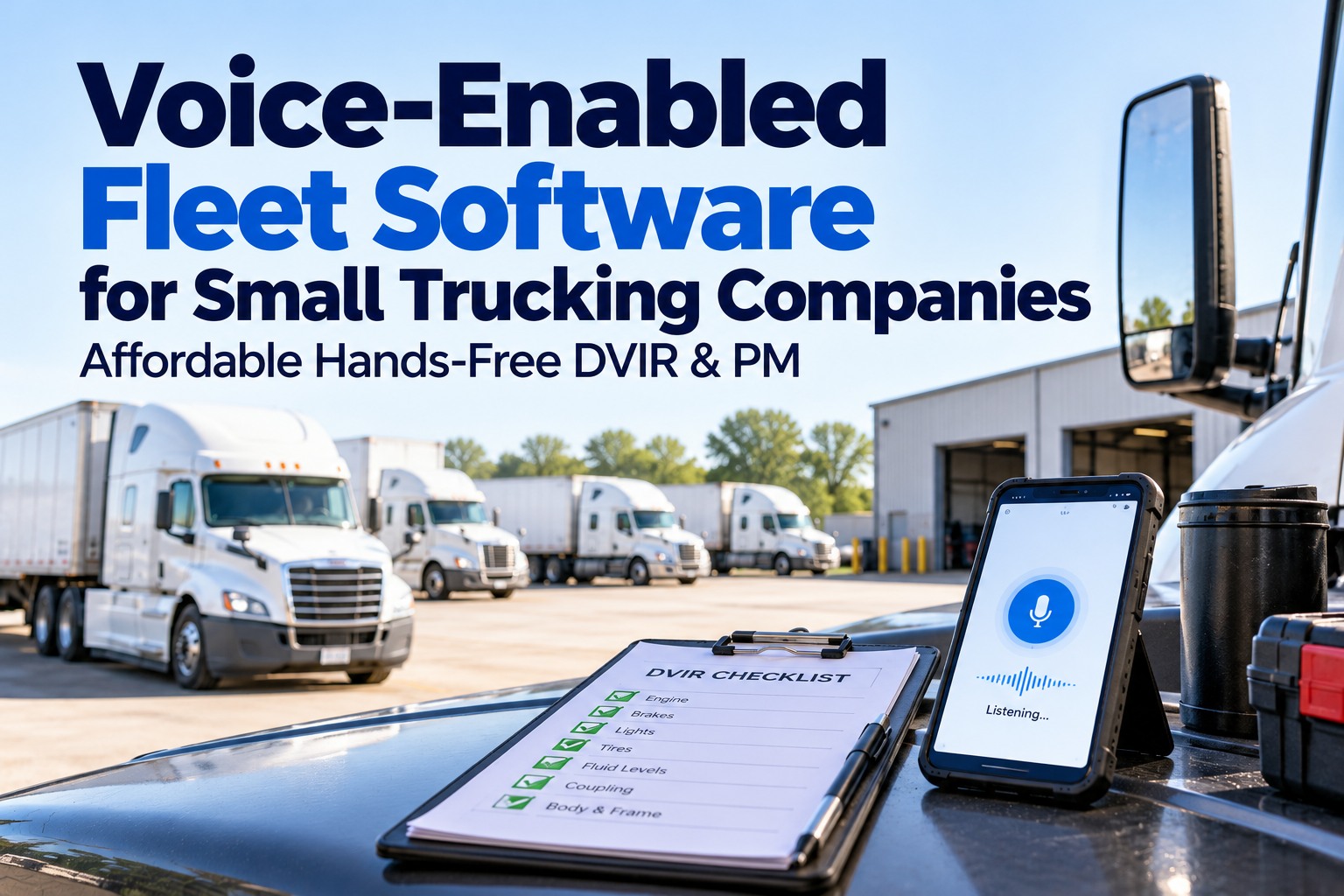
Starting February 2026, FMCSA's final rule on electronic Driver Vehicle Inspection Reports explicitly authorizes digital DVIRs under 49 CFR 396.11 — but "electronic" is not the same as "compliant by default." A roadside officer or auditor can still reject an eDVIR that lacks a verifiable driver signature, tamper-evident storage, or same-day defect notification to the motor carrier. This guide breaks down the four hard requirements every fleet must meet, the audit exposure of paper logs, and how modern DVIR software closes the gap. Most carriers can digitize within 14 days and retire paper forms entirely — you can Start Free Trial to run a pilot on up to three assets at no cost.
Your paper DVIR book is about to become an audit liability
The final rule didn't ban paper — but it gave inspectors a digital yardstick to measure you against. Carriers still on clipboards face rejected reports, CSA points, and out-of-service orders that digital-first fleets avoid by default.
What the 2026 rule actually requires of an eDVIR
The final rule didn't rewrite the regulation — it clarified how the existing requirements apply to digital formats. Here are the four pillars an auditor will check, and where paper and half-built apps fall short.
Verifiable driver signature
The driver's electronic signature must be bound to a credential — typically the same login used for ELD. A typed name or a generic "submitted" timestamp does not satisfy the rule. Inspectors look for an audit trail linking the signature event to a specific driver identity, device, geolocation, and UTC timestamp.
49 CFR 396.11(b)Tamper-evident 12-month storage
Every report — including defects noted, no-defect affirmations, and repair certifications — must be retained for at least 12 months from the date of the report. The storage must prevent post-hoc edits; any correction must create a new version with the original preserved and visible.
49 CFR 396.11(d)(2)Same-day carrier notification
When a driver notes a defect, the motor carrier must receive the report the same day — not when the truck returns to the yard. Email attachments and paper folders fail this test by design. The rule expects push delivery with a receipt log the carrier can produce on demand.
49 CFR 396.11(b)(2)Repair certification with mechanic identity
Before the vehicle operates again, the carrier must certify that the defect was corrected or that no correction was needed. The certification must name the mechanic or official who reviewed it, the action taken, and the date. A checkbox that says "fixed" with no attribution is non-compliant.
49 CFR 396.11(c)A 40-truck carrier spending $28K a year on paper DVIR gaps
Consider a regional carrier running 40 power units, each filing one DVIR per day for 300 operating days. That's 12,000 reports a year — and the hidden costs live in the gaps, not the paper itself.
Where paper DVIRs fail the 2026 audit standard
A side-by-side audit view of the seven criteria an FMCSA inspector or civil investigation will test. Paper is not illegal — it just fails five of seven tests by default.
| Audit criterion | Paper DVIR | Digital eDVIR (compliant) |
|---|---|---|
| Driver signature verifiable to identity | Illegible handwriting, no identity binding | Credential-bound, timestamped, geolocated |
| Same-day carrier notification of defects | Days later, if at all | Push delivery in seconds with receipt log |
| 12-month retention, original preserved | Boxes in the office, prone to loss | Cloud-stored, version-locked, exportable |
| Repair certification names mechanic & action | Usually a checkmark, no attribution | Mechanic sign-off workflow built into app |
| Audit retrieval time | Days of manual searching | Filterable export in under 60 seconds |
| Tamper evidence on corrections | White-out and overwritten fields | Immutable original + new version chain |
| Defect trend visibility for CSA mitigation | Invisible until a roadside event | Dashboard flags repeat defects by unit |
Run your first compliant eDVIR in under 14 days
Pilot the platform on up to three assets — full signature, storage, and audit export — at no cost. Most fleets are live before the paperwork for a paper trial would even be printed.
The seven things a DOT inspector pulls on day one
When FMCSA opens a compliance review, they don't read every report — they sample strategically. Knowing the sample pattern tells you what to harden before the letter arrives.
The last 30 days of DVIRs for a random 20% of power units
Inspectors pull a recent window to test for completeness and same-day filing. If even one unit has a gap, they expand the sample. Digital systems block gaps at the source — drivers cannot end their trip in the app without submitting.
Repair certifications for every defect noted in the sample
For each defect the driver flagged, the auditor wants to see who fixed it, when, and how. Paper shops lose here because the repair ticket and the DVIR live in different buildings — literally. Digital links them by report ID.
No-defect reports — are they actually being filed?
A unit with zero defects across 30 straight days is a red flag, not a clean bill of health. Inspectors know drivers rubber-stamp "no defects" on paper. eDVIR apps can require a tire-by-tire and brake-by-brake confirmation, making a false clean report harder to file than a real one.
Timestamp integrity across driver and carrier receipt
The rule wants evidence the carrier saw the defect report the same day. Inspectors compare the driver submission timestamp to the carrier's acknowledgment. Email folders and verbal "I told the shop" don't survive this comparison.
Corrections and version history
If a report was edited after submission, the original must still exist. Paper systems fail this the moment someone uses white-out. Digital platforms keep a cryptographic chain — the auditor sees both versions side by side.
What carriers saw in the first 90 days of digitizing
"We cut our audit prep from two weeks to an afternoon. The last FMCSA review, the inspector asked for 90 days of reports — we handed over a filtered export before she finished her coffee. Zero findings."
"Roadside violations dropped 40% in the first quarter. The app flags repeat defects by unit number, so our shop manager sees a failing brake adjuster on truck 14 before the next level-one, not after."
eDVIR rule questions, answered straight
Does the 2026 rule ban paper DVIRs entirely?
No. Paper DVIRs remain legal under 49 CFR 396.11, but the final rule sets the digital format as the de facto audit standard. Carriers using paper must still prove same-day defect notification, 12-month retrievable storage, and repair certification with mechanic attribution — requirements paper struggles to meet consistently. Most carriers switch not because paper is banned, but because defending it in an audit costs more than the software. You can pilot the digital alternative with a Start Free Trial on up to three assets.
What counts as a valid electronic signature on a DVIR?
A valid e-signature is bound to a verified driver identity — typically the same credential used for ELD login — and captures a UTC timestamp, device ID, and geolocation at the moment of signing. A typed name, a shared tablet PIN, or a generic "submitted" button does not meet the standard. The signature event must be logged in an audit trail the carrier can export.
How long must electronic DVIRs be stored, and in what format?
Reports must be retained for a minimum of 12 months from the date of the report, in their original form. If a correction is made, the original must be preserved alongside the new version — not overwritten. The storage must be tamper-evident and retrievable on demand during an audit or compliance review. Cloud-based DVIR platforms handle this by default; on-premise spreadsheets typically do not.
Do no-defect reports need the same signature and storage as defect reports?
Yes. A no-defect DVIR is still a DVIR under the rule — it must carry the driver's electronic signature, be stored for 12 months, and be retrievable. Fleets that only digitize defect reports are non-compliant. The rule treats the absence of defects as a certified statement, not a blank field, and auditors specifically sample no-defect reports to check for rubber-stamping.
Can our existing ELD provider's DVIR module satisfy the rule, or do we need a standalone app?
It depends on whether the module produces tamper-evident storage, credential-bound signatures, same-day carrier push notification, and a repair certification workflow with mechanic attribution. Many ELD-bundled DVIRs cover signatures and storage but stop short of the repair-side workflow. If your provider's module fails any of the four pillars, a standalone DVIR platform that integrates with your ELD is the safer path. Book a Demo to see a side-by-side gap analysis.
Be audit-ready before the February 2026 deadline
Spin up a compliant eDVIR pilot on up to three assets today. Full signature capture, 12-month tamper-evident storage, same-day defect push, and one-click audit export — live in under 14 days.
Free up to 3 assets — No credit card required