Only 7% of motor carriers pass an FMCSA compliance review without a single violation. The remaining 93% face fines averaging $7,155 per case, with penalties reaching $19,277 per Hours of Service infraction and up to $125,000 for serious compliance gaps. FMCSA conducted 8,340+ investigations through mid-2025 alone, generating 62,000+ violations across 865 different codes — and 2026 enforcement intensified further with the elimination of paper medical certificates for CDL drivers, three ELD devices delisted, MC numbers retired entirely, and a CSA scoring overhaul that splits Vehicle Maintenance into two separate categories. The carriers that pass audits aren't lucky. They have a system that tracks 8 distinct compliance areas, retains the right records for the right duration, runs Clearinghouse queries on schedule, and produces requested files within 48 hours of any auditor request. This guide covers all 8 FMCSA compliance areas in 2026, the specific documents required per area, the retention windows that trip up most fleets, the new 2026 regulatory changes, and how Fleet Rabbit consolidates the entire compliance stack — DVIR, HOS, DQF, drug testing, maintenance records, and accident registers into one always-current system.
93% of Carriers Fail Audits. The 7% Have a System.
Eight compliance areas. Hundreds of documents. Multi-year retention windows. 48-hour audit response requirement. Manual tracking misses things — and FMCSA finds them. This guide covers every requirement, every deadline, and every document you need ready before the auditor calls.
The Cost of Non-Compliance — What Violations Actually Cost
FMCSA penalties have escalated significantly. The numbers below are 2026 maximums per violation — and most audits find multiple violations, not one. Stack two or three of these and a single audit becomes a six-figure event.
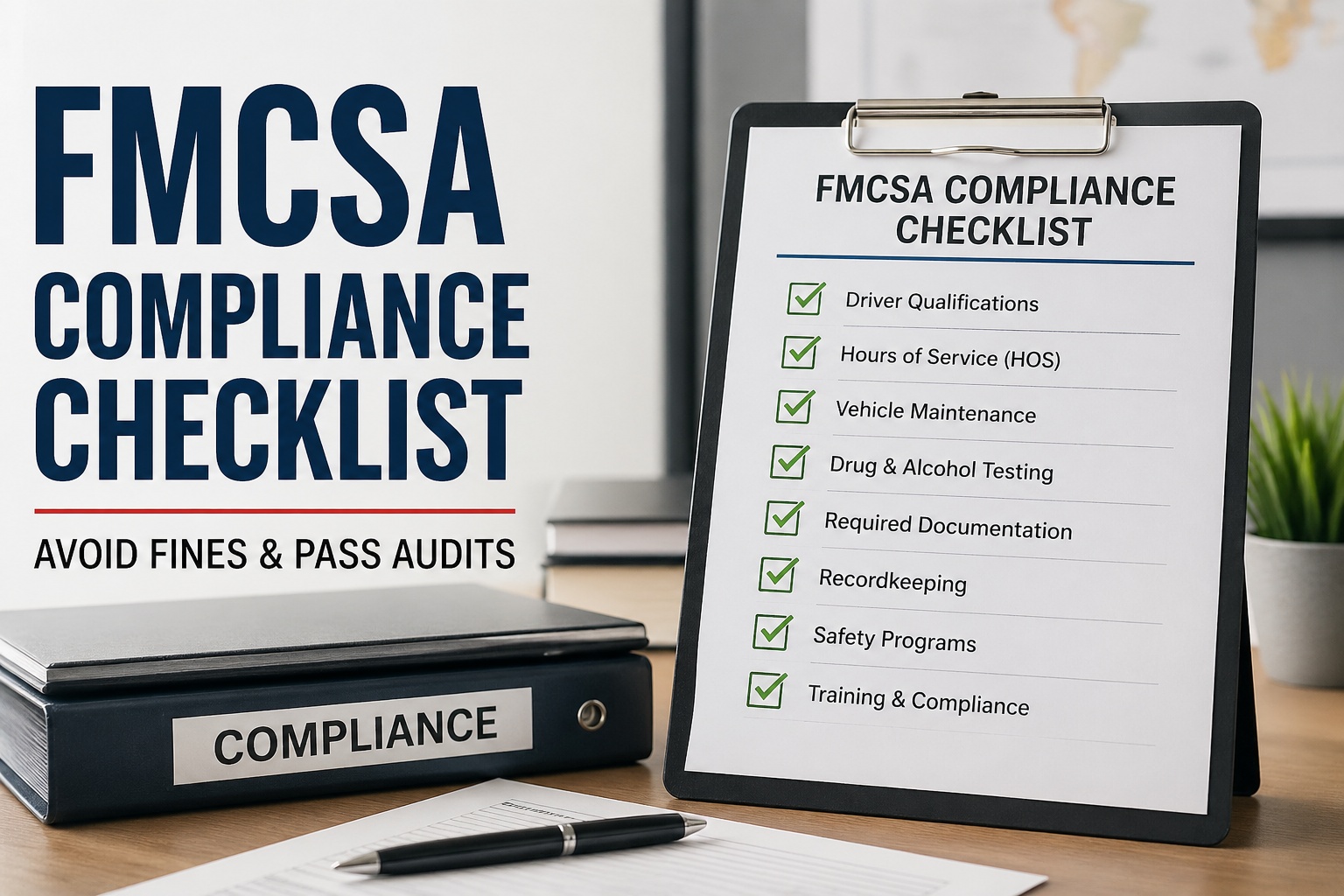
The 8 FMCSA Compliance Areas — What Auditors Inspect
Every compliance review evaluates these eight areas independently. A gap in one area can trigger deeper investigation across all the others. The retention windows below are the hard regulatory minimums — best practice is longer, but never shorter.
USDOT number registered, MC authority retired (Oct 2025), BOC-3 process agent filed, insurance per cargo class ($750K-$5M).
Application, MVRs, MEC, road test/CDL, employment verification, Clearinghouse queries, annual MVR review per driver.
FMCSA-registered ELD, four HOS clocks tracked, malfunction protocol, supporting documents (BOLs, fuel, tolls).
Pre-employment query, annual limited query, random pool 50%/10%, post-accident, RTD/SAP records, written policy.
DVIR archive, annual inspection certificate, PM records per vehicle, repair documentation, electronic-DVIR authorized.
All DOT-recordable accidents for 3 years: date, location, injuries, fatalities, hazmat involvement, citations issued.
HM-181 placards, HM training records (every 3 years), shipping papers, security plan, emergency response info.
Written safety policy, corrective action documentation, driver training, safety meeting logs, CSA score monitoring.
The 2026 Regulatory Changes — What's New This Year
FMCSA enforcement intensified in 2026 with the most significant updates since the ELD mandate. The changes below are already in effect — fleets still operating under prior rules are accumulating violations.
For all CDL drivers, FMCSA now verifies medical certification exclusively through state MVR/CDLIS — paper MEC no longer accepted. Carriers must build a 90-day pre-expiration verification process. Non-CDL drivers continue with paper MEC from the National Registry.
PSS ELD, Black Bear ELD, and RT ELD Plus removed from FMCSA's registered ELD list. Carriers using these devices were required to replace them by Feb 7. Continued use creates HOS violations up to $19,246 per occurrence.
FMCSA transitioned to USDOT numbers as the sole federal identifier. Operating authority is now designated through suffixes attached to USDOT numbers via the new Registration Modernization system. Outdated MC references on DOT applications, contracts, and ID cards must be updated.
Vehicle Maintenance split into two BASIC categories: general maintenance, plus a new "driver-observable defects" category covering issues drivers should have caught at pre-trip. Recent violations weighted more heavily. Scoring window shrinks from 24 to 12 months. 950+ violation codes consolidated to 116 groups.
State DMVs now actively revoke or deny CDLs for drivers with unresolved "prohibited" status in the FMCSA Drug & Alcohol Clearinghouse. Carriers must complete pre-employment full queries before any CDL hire and annual limited queries on every active driver on a rolling 12-month basis.
The DQF Walkthrough — 7 Required Documents Per Driver
Driver Qualification Files account for ~12% of all FMCSA citations. Each CDL driver must have a complete file from day one of employment through 3 years after separation. Below are the seven core documents auditors check first.
Signed and dated. 10-year employment history for CDL drivers (3 yrs for non-CDL). Includes every CMV employer, all accidents in past 3 years with dates/locations/severity, all license suspensions or revocations.
Pulled from every state where driver held a license in past 3 years. Obtained within 30 days of hire. Annual MVR review documented every 365 days with supervisor signature retained for 14 months.
For CDL drivers: verified through state MVR/CDLIS only — no paper. For non-CDL: paper MEC from National Registry examiner, valid up to 24 months. Track expiration with 90-day pre-renewal alerts.
Required with driver electronic consent before driver performs any safety-sensitive function. Must be completed BEFORE the first dispatch. Documentation retained showing query date and result.
Inquiry sent to every CMV employer for past 3 years covering drug/alcohol testing history. Document the inquiry, date sent, and any non-response. The obligation is to ask — not to force a response.
Valid CDL serves as alternative to road test certification. CDL copy must be current — license suspensions or expirations create immediate compliance gaps. Verify renewal dates quarterly.
Required every 12 months on rolling basis for every active driver. If limited query returns information, full query required within 24 hours. Annual lapse triggers FMCSA finding plus driver disqualification risk.
DQF gaps are the #1 finding in FMCSA audits — entirely preventable with structured tracking. See How Fleet Rabbit Tracks DQFs Automatically →
The 48-Hour Audit Response — What Auditors Ask for First
FMCSA expects records produced within a reasonable timeframe — typically 48 hours for remote audits. The sequence below is the actual order auditors request documents in. Carriers who can't produce within the window are treated the same as carriers who never created the records.
Auditor selects 5-15 drivers from your roster and requests complete files. This is the gateway test — incomplete files trigger deeper review across all areas.
Random driver-day samples pulled. Looks for: missed-break violations, 14-hour clock breaches, malfunction periods, supporting document alignment with ELD.
Pre-employment queries, annual queries, random pool selections, post-accident tests, RTD/SAP documentation. Missing Clearinghouse queries are common audit-killers.
Random vehicle samples. DVIR retention 3 months minimum (12 best practice). Annual inspection certificates for all CMVs. Repair records following any DVIR defect.
Three years of recordable accidents. Current MCS-90, certificates of insurance per cargo class. Operating authority verification through USDOT system.
Paper-Based vs Digital Compliance — The Honest Comparison
Paper-only compliance fails 92% of modern FMCSA audits per industry data. The retention windows are too long, the volume too high, and the 48-hour production requirement too tight. The table below shows where digital changes the math.
| Capability | Paper / Spreadsheet | Fleet Rabbit Digital |
|---|---|---|
| DQF document storage | Filing cabinets, manual organization | Indexed, searchable, role-based access |
| Medical cert verification (CDL) | Manual MVR pull each renewal | Auto-sync with state MVR/CDLIS |
| Annual Clearinghouse queries | Calendar reminder, manual login | Auto-scheduled with rolling 12-mo tracking |
| HOS / ELD record retention | Spreadsheet exports + email | 6-month archive + 1-click audit pack |
| DVIR retention & retrieval | Paper forms in driver pouches | Photo-verified, GPS-stamped, indexed |
| Audit response time | Days of preparation | Minutes per category |
| Expiration tracking | Manual calendar entries | 90/30/7-day automated alerts |
| Cross-area pattern visibility | Impossible at scale | Risk scorecard updated daily |
| Audit pass rate (industry) | ~8% pass without finding | ~91% pass without major finding |
The audit-readiness gap isn't ideology — it's structural. FMCSA's 48-hour rule was written assuming digital systems. See the Live Compliance Dashboard →
Frequently Asked Questions
What triggers an FMCSA compliance review?
Five common triggers: poor CSA Safety Measurement System scores (above intervention thresholds in any BASIC category), high crash rates, high-profile accidents, citizen complaints, or random selection. New entrants automatically receive an audit within 12-18 months of obtaining USDOT authority. In 2026, FMCSA increasingly uses focused audits targeting specific compliance areas where data shows problems — auditors arrive already knowing your weak spots.
How long do I need to keep DQF records after a driver leaves?
3 years after separation per 49 CFR 391.51. Safety Performance History records: employment + 3 years. Drug/alcohol test results requiring 5-year retention: positive results, refusals, RTD documentation. ELD records: 6 months minimum. DVIRs: 3 months regulatory minimum (12 best practice since CSA looks at 24-month violation history). Accident register: 3 years from event. Annual inspection reports: 14 months. See Auto-Retention Configuration →
What are the random drug testing rates for 2026?
FMCSA-regulated employers: 50% of drivers tested annually for drugs, 10% for alcohol. Selections must come from a valid pool, occur at the required rate, and spread throughout the year — not bunched in one quarter. Pool management failures (terminated drivers left in too long, new drivers added late, year-end math off) are the #1 audit finding in this area.
What happens if a previous employer refuses to provide safety performance history?
Document the request, the date sent, and the non-response. Your obligation is to make the inquiry and document it — not to force a response. FMCSA auditors look for evidence of the attempt, not just successful responses. Keep all outreach in the file. Treating the request as fulfilled simply because the employer didn't respond is a finding.
How quickly must I produce records during an audit?
FMCSA expects records producible within a reasonable timeframe — typically 48 hours for remote audits. Carriers who can't locate files are treated the same as carriers who never created them. Paper-only systems fail this window 92% of the time per industry data. Digital storage with organized retrieval and indexed search is now strongly recommended by FMCSA itself. See 48-Hour Audit Pack Demo →
What's the new electronic DVIR rule (FMCSA-2025-0115)?
Effective March 23, 2026, FMCSA explicitly authorizes electronic DVIRs with timestamps, GPS stamps, and photo evidence — they now have clear regulatory standing equal to paper. Digital DVIRs satisfy 49 CFR 396.11 automatically. Photo evidence creates dispute-proof records. Most fleets transitioning to digital DVIRs report 60-80% reduction in DVIR-related audit findings.
How is Fleet Rabbit's compliance tracking priced?
Included in the standard $3/vehicle/month subscription — no per-driver fee, no per-document fee, no audit-prep surcharge. Free tier (up to 3 vehicles) includes full DQF, DVIR, HOS, and Clearinghouse tracking for testing. Compare to standalone compliance platforms at $50-$200/driver/month. Book a Demo to See Pricing →
Be in the 7%, not the 93%.
Fleet Rabbit consolidates all 8 FMCSA compliance areas into one always-current system. DQF auto-tracking. Clearinghouse query scheduling. Electronic DVIR with photo + GPS. ELD-agnostic HOS archive. PM/maintenance records. Accident register. Insurance + authority verification. 48-hour audit response with one-click document packs. Free for up to 3 vehicles indefinitely.