Most fleets that ask about trailer tracking already have trailer trackers. The dot is on the map, the geofence fires, and the dispatcher can find the unit. What has not changed is that the trailer is still invisible to every other system you run — no inspection history, no PM schedule that reflects the months it sat at a customer yard, no defect record, no compliance file. That gap has a specific cost, because periodic inspection requirements apply to all trailers in commercial service including units that are not moving but are still available for dispatch. A dropped trailer accumulating brake, tyre and lighting defects is not off the hook; it is simply undocumented until a roadside inspection turns a three-hundred-dollar maintenance event into a several-thousand-dollar out-of-service order. Start free with three vehicles and put the location data next to the inspection and PM records it should have been driving.
INTEGRATIONS · TRAILER GPS TRACKERS
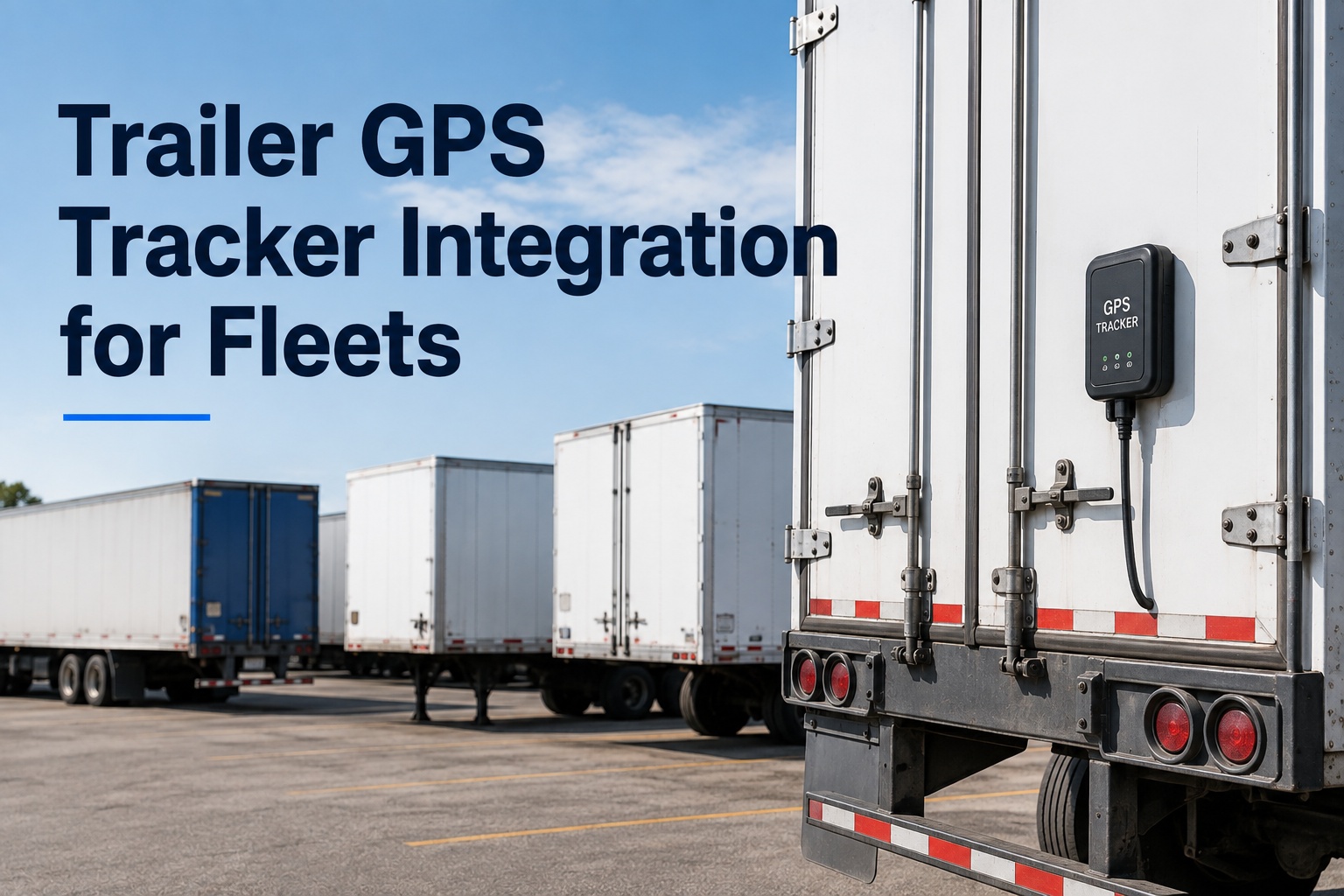
Trailer GPS Tracker Integration for Fleets
Bring tracker data together with inspections, maintenance and compliance records — so knowing where a trailer is also tells you whether it is legal, serviced and earning.
Trailer record · what you actually have
Current locationTracked
Last inspectionNot recorded
PM dueNot recorded
Open defectsNot recorded
Four fields on one asset. One of them is full. The tracker was never the missing piece — the record was.
The Invisible Asset Problem
Trailers outnumber tractors in most fleets and receive a fraction of the management attention, which produces a consistent and expensive set of outcomes.
~60%
Average trailer utilisation across US fleets — meaning roughly four hours in every ten, the asset is doing nothing at all
$15.1bn
Annual cost of detention and idle time to US trucking — split between lost productivity and direct expense
39%
Share of all stops where drivers were detained, in the most recent industry study
8–15%
Annual depreciation on a typical dry van — accruing whether the unit is running or sitting
The paradox worth naming
Carriers complain about equipment shortages while their own trailers sit idle for a substantial share of every operating day. Idle units also accumulate unevenly — a surplus builds in one market while another runs short and pays premium rates to rent capacity that technically already exists inside the fleet. Utilisation calculated per unit rather than as a fleet average is what makes that visible.
What the Tracker Gives You, and What It Does Not
Worth separating honestly, because the second column is where the money and the risk both sit.
← Swipe to see all columns →
The pattern is consistent: the tracker answers where and the record answers whether. Both questions get asked about the same asset on the same day, usually by the same dispatcher — and answering only the first is how a non-compliant trailer gets dispatched to a customer with perfect location visibility all the way there.
Where Trailers Fall Out of Compliance
Four failure paths, and every one of them starts with the unit being somewhere other than your yard when a schedule came due.
01
Dropped units miss their inspection window
Periodic inspection applies to all trailers in commercial service, including units not actively moving but still available for dispatch. A trailer parked at a customer for three months does not pause its obligation — it simply stops being visible to whoever tracks the schedule.
02
Defects accumulate unobserved
Brake, tyre and lighting issues develop on parked units and go undetected until the trailer is dispatched. Nobody inspected it because nobody was near it, and the defect surfaces at the least convenient possible moment.
03
The roadside multiplier
When a defect is found at a roadside inspection rather than in your shop, an out-of-service order and violation compound what would have been a few hundred dollars of maintenance into a several-thousand-dollar incident — plus the load disruption and the score impact.
04
Inspection records exist on paper somewhere
Completed, signed, and in a cab or a folder rather than against the asset. Perfectly valid and entirely unhelpful when the question is which of ninety trailers is currently overdue.
4 in 10
hours idle, on average
A trailer sitting idle is also a trailer you could be inspecting.
Bring a list of your longest-dwelling units to a 30-minute call. We'll cross them against inspection due dates in Fleet Rabbit and show which ones are sitting still, overdue, and one dispatch away from a roadside problem. Most fleets find the same handful of units appear on both lists.
Turning Dwell Into Billed Detention
The clearest revenue case in trailer tracking, and the one most often left partly implemented — because dwell data in a tracking portal is not the same as a charge on an invoice.
The problem it solves
Without dwell monitoring at customer locations, detention fees the fleet is contractually owed simply go unrecorded and unbilled — month after month. The cost lands twice: once as idle trailer time, and again as unclaimed revenue.
What accurate data changes
Carriers implementing real-time trailer tracking commonly report recovering materially more detention revenue — reported figures land in the region of 20 to 35 percent more — simply by having accurate dwell time to bill from.
Why it must reach the invoice
A geofenced alert firing after a configurable dwell threshold is only useful if it triggers billing capture before the load is closed. Detention discovered during month-end reconciliation is detention that gets written off.
And it makes the charge defensible
Documented arrival and departure timestamps against the contractual free time turn a detention charge from a negotiation into a statement of record — which is what makes customers pay it rather than dispute it.
The same dwell data supports the other side of the conversation. Where a particular customer location consistently exceeds free time, that pattern is an appointment scheduling problem worth raising commercially rather than an accessorial to keep collecting indefinitely. Both uses come from one dataset.
Device Choice: The One Decision That Undoes Everything
Power source determines whether the data exists at all, and it is the most consequential hardware decision on an unpowered asset.
Solar
Self-charges from ambient daylight and keeps reporting on unpowered trailers parked for months. The natural fit for long drop cycles, which is exactly the scenario where visibility matters most and is hardest to maintain.
Battery-only
Simple to fit and requires physical recharging or swapping every few weeks. Manageable on a small fleet with tight yard discipline; punishing across a scattered trailer pool.
Hardwired
Reliable while connected to power, which on a trailer means while it is hooked. Often paired with another source precisely because the drop periods are the gap.
The rule underneath all three
Every device that goes dark is a trailer nobody can see. A tracker that stops reporting during a long drop has failed at the only moment it was genuinely needed — so treat device health as a monitored item rather than assuming coverage.
What a modern trailer reports
Position and geofencing are the baseline. Current sensor suites also cover loaded or unloaded status, door open and close events, and temperature and humidity for sensitive freight — with dual-mode satellite and cellular options where trailers travel beyond reliable coverage. Each of those is another field that belongs on the asset record rather than in a separate dashboard, and reefer status in particular is worth having next to the maintenance history, since a refrigeration failure is a spoiled load rather than a trailer repair.
Using the Idle Time Productively
Five actions on a long-dwell trailer, in the order a dispatcher should consider them. Only the first is about moving it.
1Activate it for a loadThe obvious first question, and one that only gets asked if long-dwell units are flagged for review rather than discovered during a monthly report.
2Bill the detentionIf it is sitting at a customer beyond free time, capture the charge against the load before it closes rather than after.
3Schedule the inspection while it is stationaryA trailer sitting idle anyway is the cheapest possible time to service it. The inspection has to happen regardless; doing it now costs no availability.
4Redeploy across marketsWhere one region is short and another has surplus, moving an idle unit beats renting capacity that already exists elsewhere in the fleet.
5Consider whether to keep itUtilisation calculated as the share of available days spent in active revenue service reveals which specific units are chronically underused — candidates for redeployment, sale or rental rather than continued ownership against 8 to 15 percent annual depreciation.
What to Track
Six figures, all of which require the tracker and the record together rather than either alone.
Utilisation per unitAvailable days against days in active revenue service. Per trailer, not as a fleet average — the average conceals exactly the units you would act on.
Dwell by customer locationWhich sites consistently hold your equipment longest. Feeds both the detention invoice and the commercial conversation about appointment scheduling.
Detention billed against detention incurredThe capture rate. Anything well below full is revenue you were contractually entitled to and did not claim.
Inspection compliance across the whole poolIncluding dropped and remote units, since those carry the same obligation and none of the visibility.
Open defects by trailerWith age. A defect reported three weeks ago on a unit about to be dispatched is the roadside incident you can still prevent.
Device reporting healthTrackers gone silent, by unit and by duration. A dark device is an untracked trailer, and the fleets that catch this quickly are the ones that monitor it deliberately.
Start free · 3 vehicles
Keep your trackers. Give the data somewhere to land.
Fleet Rabbit works with industry-standard trailer tracking hardware — solar, battery and hardwired — and brings position, dwell and geofence events onto the same asset record as inspections, PM schedules, defects and compliance history. Connect three units at no cost and see the complete trailer record before deciding anything about the rest of the pool.
Frequently Asked Questions
We already have trailer trackers. What does an integration add?
The records the tracker cannot hold. A tracker answers where a trailer is and how long it has been there; it does not answer whether the unit is legal to dispatch, when it is next due for service, what defects are open against it, or what its utilisation has been this quarter. Those questions get asked about the same asset on the same day, and answering only the first is how a non-compliant trailer gets dispatched with perfect location visibility all the way to the customer.
Do dropped trailers still need inspecting?
Yes. Periodic inspection requirements apply to all trailers in commercial service, including units that are not actively moving but remain available for dispatch. A trailer parked at a customer yard for months does not pause the obligation — and meanwhile brake, tyre and lighting defects develop unobserved, surfacing when the unit is finally dispatched. That is how a modest maintenance item becomes an out-of-service order and a violation.
How much detention revenue is typically being missed?
More than most fleets expect, because unbilled detention is invisible by definition. Carriers implementing real-time trailer tracking commonly report recovering meaningfully more detention revenue — figures in the region of 20 to 35 percent more are frequently cited — purely from having accurate dwell data to bill against. The industry-level number gives the scale: detention and idle time cost US trucking around $15.1 billion annually, with drivers detained on roughly 39 percent of stops.
Which tracker power source should we choose?
Solar suits long drop cycles best, because it self-charges from ambient daylight and keeps reporting on unpowered trailers parked for months. Battery-only units need physical recharging or swapping every few weeks, which is manageable in a tight yard operation and punishing across a scattered pool. Hardwired is reliable while the trailer is hooked, which leaves the drop periods as the gap. Whichever you run, monitor device health — every device that goes dark is a trailer nobody can see.
Will we need to replace our tracking hardware?
Generally not. Industry-standard trailer tracking devices — solar, battery-powered and hardwired — are compatible with most trailers in commercial service, and if your trailers already carry installed hardware the integration usually works with your existing vendor. The change is where the data lands rather than what produces it, which makes this considerably cheaper and faster than a hardware programme.
How should we measure trailer utilisation?
As the percentage of available days each trailer spent in active revenue service, calculated per unit rather than as a fleet average. Average utilisation across US fleets sits around 60 percent, which means roughly four hours in ten the asset earns nothing while depreciating at 8 to 15 percent a year regardless. Per-unit calculation is what identifies the chronically underused trailers that are candidates for redeployment, sale or rental.
Where should we start?
With three units, at no cost. Pick your longest-dwelling trailers, connect the tracker data, and add their inspection and PM records alongside it. The first thing you will see is which of them are sitting idle and overdue at the same time — a list that is short, obvious in hindsight, and currently spread across two systems that never talk.
Start free with three vehicles and extend once that list is in front of you.
Location Is the Easy Half
Tracker data joined to inspection status, PM schedules, open defects and utilisation on one asset record — so a dwelling trailer becomes a decision about billing, servicing or redeploying it, rather than a dot nobody acts on.
Works with solar, battery and hardwired trailer trackers · Confirm inspection requirements applicable to your own operation · No credit card required
August 25, 2026By Alex Rowan
All Blogs