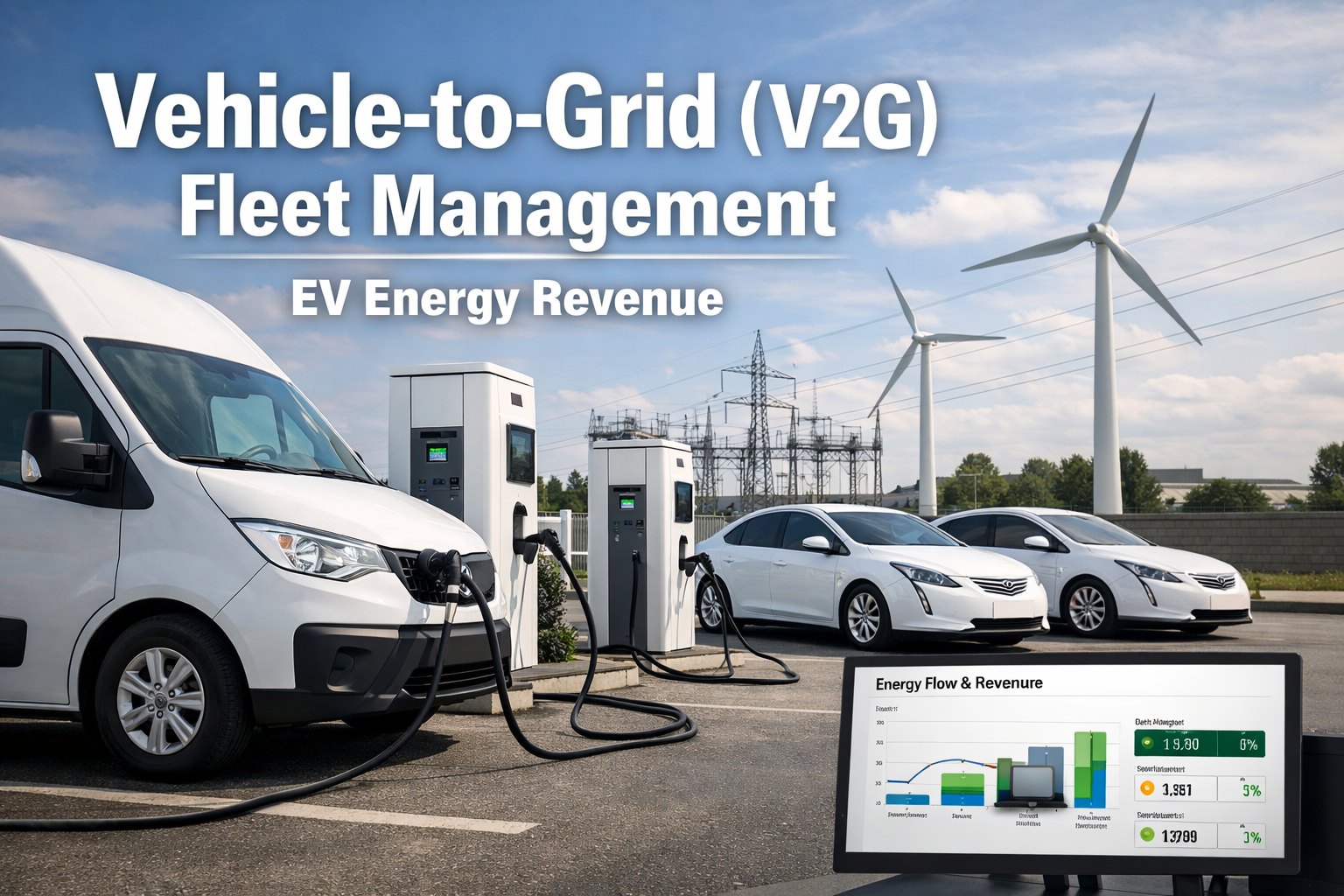
Electric fleets are no longer just transportation assetsthey are mobile energy storage systems capable of generating revenue while parked. Vehicle-to-Grid (V2G) technology enables commercial fleets to sell stored electricity back to utilities during peak demand periods, transforming every EV from a cost center into a potential profit center. With pilot programs demonstrating $1,000–$5,000 annual revenue per vehicle and the global V2G market projected to reach $11.25 billion by 2033, fleet operators who master bidirectional charging today will dominate the economics of electric transportation tomorrow. Start building your V2G-ready fleet strategy - takes 15 minutes.
Transform Your EV Fleet Into a Revenue-Generating Asset
Learn how V2G technology lets commercial fleets earn $1,000–$5,000 per vehicle annually through grid services while reducing electricity costs by 10–25%.
The Hidden Cost Problem for EV Fleets
Commercial fleet depots face unique electricity cost challenges that extend far beyond simple kilowatt-hour charges. When multiple EVs charge simultaneously, they create demand spikes that trigger expensive utility demand charges—often representing 30–50% of total electricity costs.
Demand Charges
Peak 15-minute usage triggers $15–25/kW monthly charges, often 30–50% of total bill
Time-of-Use Penalties
Charging during peak hours costs 2–3x more than off-peak rates
Infrastructure Upgrades
Simultaneous charging exceeds site capacity, requiring $50K–$200K+ upgrades
Missed Revenue
Parked EVs sit idle instead of generating grid services income
How Vehicle-to-Grid (V2G) Technology Works
V2G enables bidirectional energy flow between electric vehicles and the power grid. Unlike traditional one-way charging, V2G systems treat each EV as a distributed energy resource that can both consume and supply power based on grid conditions.
V2G Energy Flow Process
EV Charging
Fleet vehicles charge during low-cost, off-peak hours (typically overnight)
Energy Storage
EV batteries store electricity while vehicles are parked at depot
Grid Demand Signal
Utility sends signal indicating high demand or grid stress event
Bidirectional Discharge
V2G chargers export stored energy from eligible vehicles to grid
Revenue Settlement
Fleet receives payment for energy exported and grid services provided
Smart Recharging
System automatically recharges vehicles before next dispatch
Traditional Charging vs V2G Fleet Management
Traditional Charging
One-Way Only- Grid → Vehicle only (no export)
- No revenue generation (cost only)
- Creates peak demand charges
- Passive electricity consumer
- Manual or time-based scheduling
- Transportation use only
V2G Fleet Management
Bidirectional- Grid ↔ Vehicle (bidirectional)
- $1,000–$5,000 per vehicle annually
- Reduces peaks by 10–25%
- Active grid participant
- Dynamic pricing + dispatch aware
- Transportation + energy storage
V2G Revenue Opportunities
V2G technology unlocks multiple revenue streams that can transform fleet economics. Pilot programs worldwide demonstrate that well-managed fleets earn significant income through various grid services programs.
Frequency Regulation
Millisecond response to grid frequency changes. Highest-value V2G service.
Peak Demand Shaving
Reduce utility demand charges by exporting during peak periods.
Demand Response
Participate in utility programs that pay for load reduction during events.
Energy Arbitrage
Buy low (off-peak), sell high (peak) through time-of-use optimization.
Real-World V2G Revenue Examples:
- Beverly, MA School Buses: 3 buses generated $60,000+ over 3 summers through National Grid's Connected Solutions program
- Massachusetts School District: Earned $23,500 passive income over 2 summer breaks from 10.78 MWh grid export
- University of Delaware: 15 Nissan Leafs earning $2,500–$5,000/vehicle annually since 2013 with no significant battery degradation
- Colorado School District: Generated $12,000 in Q4 2024 alone from V2G bus fleet
Which Fleets Benefit Most From V2G?
V2G works best for fleets with predictable schedules, extended parking periods, and centralized charging infrastructure. Here's how different fleet types compare:
School Bus Fleets
Summer idle periods, large batteries, predictable schedules
Transit Bus Fleets
Depot charging, off-peak availability, high capacity batteries
Delivery Fleets
Overnight parking, morning departures, midday return options
Municipal Fleets
Centralized parking, weekend availability, diverse vehicles
Assess Your Fleet's V2G Potential
Our platform analyzes your fleet's operational patterns to identify V2G revenue opportunities and optimize charging strategies—even before implementing bidirectional hardware.
Does V2G Damage EV Batteries?
Battery degradation is the most common concern among fleet operators considering V2G. However, research increasingly shows that properly managed bidirectional charging has minimal impact on battery life.
University of Delaware (5+ Years)
No significant degradation observed in frequency regulation fleet operation
Applied Energy Study (2025)
V2G increases degradation by only 9–14% over 10 years under managed conditions
LFP Battery Advantage
4,000+ charge cycles without significant degradation—ideal for V2G applications
Battery Degradation Breakdown:
- Calendar aging (time-based): Contributes 85–90% of total degradation without V2G
- Cyclic degradation without V2G: Only 10–15% of total degradation
- Cyclic degradation with V2G: Increases to 20–25% of total degradation
- Mitigation strategies: Conservative discharge limits (SOC above 20%), temperature monitoring, intelligent cycling
- Economic reality: V2G revenues typically exceed degradation costs when properly managed
V2G Preparation Roadmap
Smart fleet operators can begin capturing V2G-adjacent benefits immediately through intelligent charging management, even before investing in bidirectional hardware.
Smart Charging
Implement time-of-use optimization to shift charging to lowest-cost periods
Demand Management
Deploy load balancing to reduce demand charges across fleet
Utility Programs
Participate in demand response programs for load reduction incentives
Full V2G
Deploy bidirectional chargers and participate in grid services markets
Frequently Asked Questions
What is Vehicle-to-Grid (V2G)?
V2G technology enables bidirectional energy flow between EVs and the power grid. EVs can discharge stored energy back to utilities during peak demand, turning fleet vehicles into distributed energy storage assets that generate revenue while parked.
Can fleets really earn money from V2G?
Yes. Pilot programs demonstrate $1,000–$5,000 per vehicle annually through frequency regulation, peak shaving, and demand response programs. School bus fleets with summer idle time can earn even more—some generating $10,000+ per bus annually.
Does V2G damage EV batteries?
Research shows managed V2G increases battery degradation by only 9–14% over 10 years. Calendar aging contributes 85–90% of degradation anyway. With proper management, V2G revenues typically exceed any additional degradation costs.
What chargers support V2G?
Bidirectional chargers from Wallbox, Fermata Energy, Nuvve, ABB, and Siemens support V2G. Costs range from $6,000–$15,000 for AC units to $50,000–$150,000+ for DC fast chargers. V2G-capable vehicles include Ford F-150 Lightning, Nissan Leaf, Kia EV9, and others.
What utility programs pay for V2G?
Programs include frequency regulation markets (PJM, CAISO), demand response (utility-specific), and capacity payments. National Grid's Connected Solutions pays $200/kW for peak capacity. Many utilities offer rebates up to $3,000 per V2G charger.
How do I start with V2G?
Begin with smart charging optimization to reduce costs immediately. Enroll in demand response programs. Collect fleet availability data to identify V2G windows. Plan infrastructure for future bidirectional capability. Deploy V2G chargers when ROI is clear.
Start Your V2G Journey Today
FleetRabbit helps you optimize EV charging costs now while building the foundation for V2G revenue tomorrow. Free tier includes 3 vehicles with all 15 features.