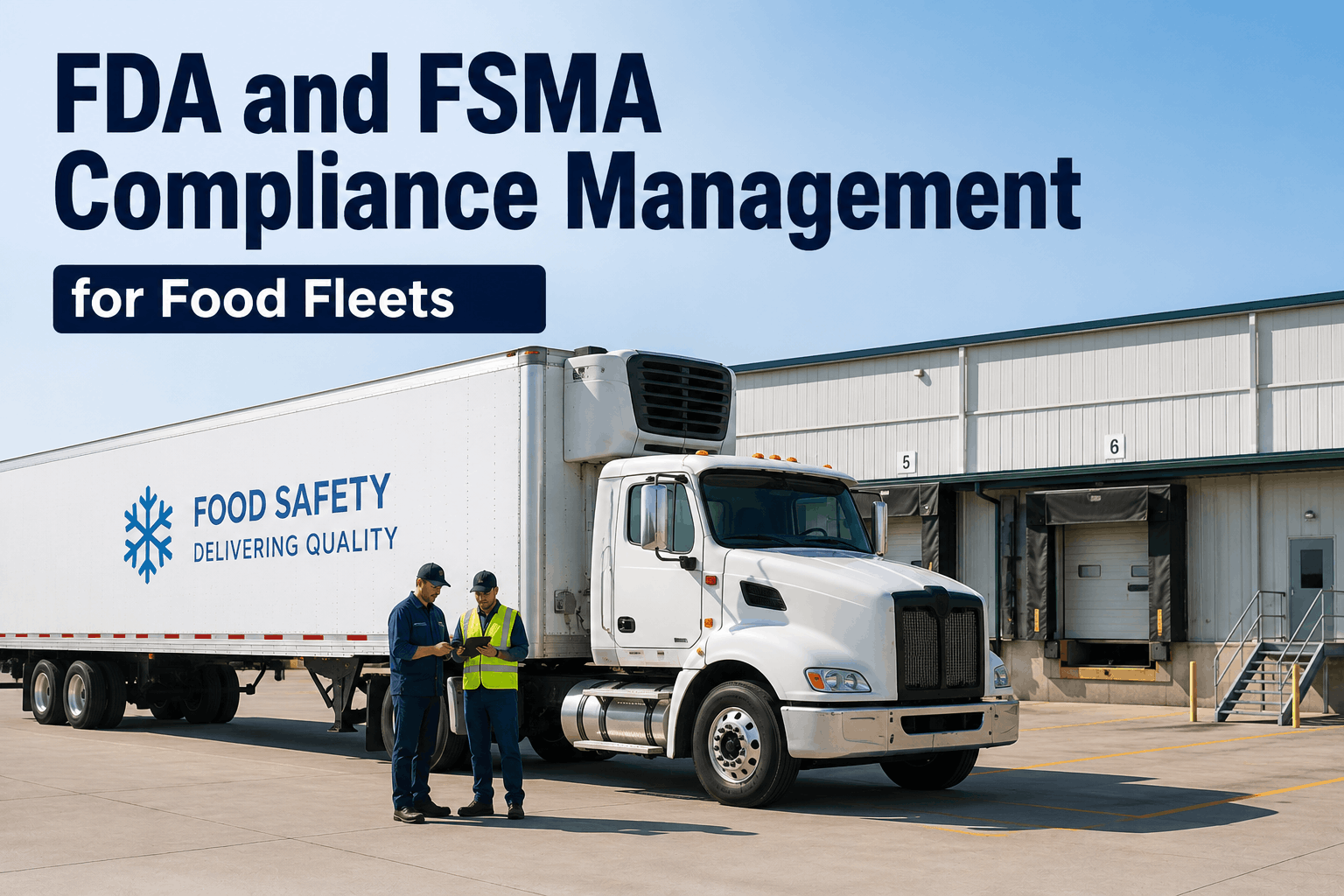
FDA FSMA compliance for food fleets is not a documentation project that runs in parallel to operations — it is an operational requirement that must be embedded into every route, every vehicle, every driver interaction, and every maintenance record that the fleet produces. The Food Safety Modernization Act's Sanitary Transportation of Human and Animal Food rule (21 CFR Part 1, Subpart O) imposes specific, documented obligations on shippers, carriers, loaders, and receivers in the food supply chain — and the gap between a carrier that believes it is compliant and a carrier that can demonstrate compliance under FDA audit is measured in the specificity, completeness, and retrievability of records that most food fleets are not generating. A temperature-controlled carrier with manual pre-trip inspection logs, end-of-route datalogger downloads, and paper cleaning records is operating a food distribution compliance management programme that satisfies the letter of FSMA compliance as those carriers understand it — and fails the practical audit standard that FDA field investigators and customer GFSI auditors actually apply. The failure isn't malicious non-compliance. It's structural: manual systems cannot produce the continuous temperature records, the per-shipment chain of custody documentation, the equipment sanitation audit trails, and the corrective action evidence that constitute a credible FSMA food transport compliance programme under scrutiny. Automated temperature logs for fleets, combined with digital sanitation records, real-time cold chain FDA compliance monitoring, and systemised corrective action documentation, replace the structural gap with a continuously maintained compliance record that answers every FSMA audit preparation question before the auditor asks it. FleetRabbit's food transportation management system was built specifically for the compliance architecture that refrigerated fleet operations require under FSMA — converting operational data into audit-ready compliance records without administrative burden on drivers, dispatchers, or depot staff. Start building your FSMA compliance record with FleetRabbit or book a compliance management demo with our team.
What FSMA's Sanitary Transportation Rule Actually Requires of Food Carriers
The Food Safety Modernization Act's Sanitary Transportation Rule is frequently misunderstood by food carriers as a temperature record-keeping requirement with some cleaning provisions attached. It is substantially more than that — and the specific documentation obligations it imposes on covered carriers extend well beyond what any manual logging programme can consistently produce at scale across a working refrigerated fleet.
§1.908(c) — Vehicles and Transportation Equipment
Equipment condition and pre-load temperature verification
Covered carriers must ensure that vehicles and transportation equipment are in appropriate sanitary condition for the food being transported, and that temperature control equipment is functioning and set to the required temperature before loading. The rule requires documented pre-load verification — not an assumption that equipment that passed last week's check is operating correctly today.
Documentation required
Pre-load vehicle temperature verification record with equipment status, set-point confirmation, and cargo zone pre-cool evidence per shipment
§1.908(d) — Transportation Operations
Temperature control during transport
Carriers must maintain the temperature required by the shipper or by law for the food being transported throughout the transit period — and must have the monitoring records to demonstrate that temperature control was maintained. A single end-of-route temperature reading does not constitute evidence of continuous temperature control during transit.
Documentation required
Continuous temperature monitoring records per zone per trip — sufficient frequency to demonstrate uninterrupted temperature control, not periodic spot readings
§1.908(e) — Training
Driver training and competency records
Carriers must train personnel engaged in food transport operations on sanitary transportation practices and maintain records of that training. The rule specifies training on food safety hazards relevant to the carrier's operations, proper use of temperature control equipment, and recognition of food safety compromises requiring corrective action.
Documentation required
Per-employee training records with content, date, and competency evidence — retrievable per driver for any audit scope
§1.908(b) — Sanitation
Vehicle cleaning and sanitation records
Carriers must adequately clean vehicles between loads where necessary to protect the safety of food — and must maintain fleet sanitation records documenting the cleaning method, the date and time, the responsible party, and the prior cargo that necessitated cleaning. The rule specifically addresses the previous load problem: carriers must assess whether prior cargo creates a contamination risk for the next load.
Documentation required
Per-vehicle sanitation records with prior load disclosure, cleaning method, date/time, responsible party, and inspector sign-off per load sequence
§1.912 — Records
Record retention and accessibility
FSMA requires that carriers retain records for a minimum of 12 months for records that are created within 2 years and 6 months for records that are created more than 2 years prior. Records must be available for review and copying by FDA upon request — and must be retrievable in a format that allows FDA investigators to assess compliance without manual reconstruction from disparate paper sources.
Documentation required
Structured, searchable records retained for minimum 12–24 months and retrievable per shipment, vehicle, driver, or date range within the timeframe FDA inspection requires
§1.908(d)(3) — Corrective Actions
Temperature deviation corrective action documentation
When a temperature deviation is discovered, carriers must take corrective action and document the deviation, the corrective action taken, the outcome, and the disposition of any affected food. A temperature excursion without a documented corrective action record is not just an operational failure — it is a specific FSMA violation that FDA inspectors treat as evidence of a systemic compliance programme deficiency.
Documentation required
Per-excursion corrective action records with deviation detail, response action, resolution timestamp, and affected shipment disposition per regulatory standard
The compliance gap most food carriers don't know they have
A 2023 FDA enforcement review of food transport carriers found that 61% of warning letters issued to refrigerated carriers cited inadequate temperature monitoring records — not temperature failures themselves, but the absence of documentation sufficient to demonstrate that temperature control was maintained. The product may have been perfectly safe. The carrier could not prove it. Under FSMA, the documentation failure is the violation.
61%
Of carrier warning letters cited documentation failure, not product failure
The Five FSMA Compliance Failures That FleetRabbit Eliminates
Food fleet audit readiness fails at five consistent points across refrigerated transport operations — each representing a structural gap between what manual compliance programmes produce and what FDA audit preparation actually requires. FleetRabbit's automated compliance reports food fleet platform was designed with direct architecture for each of these failure mechanisms.
Manual system failure
End-of-route datalogger downloads producing 4–12 temperature readings per 24-hour trip — with no GPS correlation, no zone differentiation, and no evidence of what happened during the 2-hour window between readings where an excursion occurred and recovered. FDA investigators treat sub-frequency records as insufficient evidence of continuous temperature control.
FleetRabbit solution
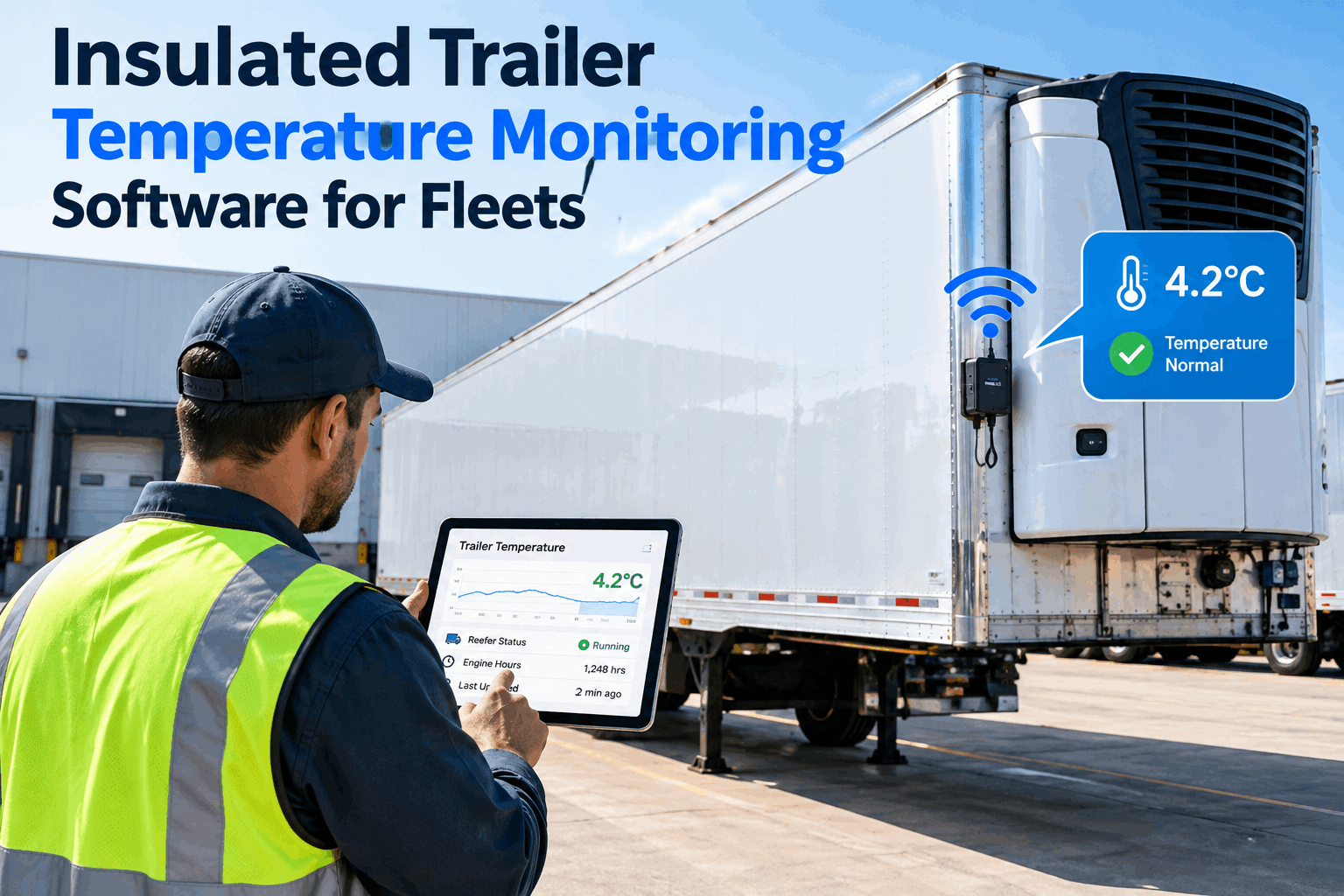
1-minute interval continuous logging across all cargo zones — 1,440 data points per zone per 24-hour route, GPS-correlated and timestamped. Every reading stored with connectivity-loss-proof local buffering and transmitted to the compliance record automatically. FDA-ready continuous temperature monitoring record generated without driver action on every trip.
Manual system failure
Temperature excursion discovered at end-of-route download, reported verbally to dispatch, noted on a paper exception form that is filed in the depot and never linked to the specific shipment record. Three months later, an FDA inspection requests all corrective action records for shipments in the prior 60 days. The paper form cannot be found, the shipment record contains no excursion notation, and the carrier has no evidence that the required corrective action was taken.
FleetRabbit solution
Every temperature threshold breach automatically generates a corrective action record linked to the trip, vehicle, and shipment — capturing breach detection time, deviation magnitude, fleet manager alert timestamp, driver notification, corrective action taken, outcome, and resolution timestamp. Every excursion has a complete, timestamped, shipment-linked corrective action trail that satisfies §1.908(d)(3) without manual documentation effort.
Manual system failure
Vehicle cleaning records maintained in a depot log that records date and vehicle number, with no prior load documentation, no cleaning method specification, no confirmation of who performed the cleaning, and no mechanism to link the sanitation record to the subsequent load. An FDA inspector assessing whether the carrier has adequate sanitation controls cannot trace the cleaning history of a specific vehicle through a specific load sequence.
FleetRabbit solution
Digital fleet sanitation records linked per vehicle per load sequence — prior cargo type, cleaning method applied, date and time, responsible technician, and pre-load inspection sign-off — all retrievable by vehicle ID or shipment reference. The complete sanitation chain of custody for any vehicle across any date range is available in under 60 seconds with the load sequence context FDA requires.
Manual system failure
Pre-trip inspection completed on a paper form with a checkbox confirming "refrigeration unit checked" — no set-point reading, no cargo zone pre-cool temperature, no equipment alarm status, and no confirmation that the temperature was actually at the required level for the specific commodity being loaded. The checkbox is FSMA-meaningless as a demonstration of §1.908(c) compliance.
FleetRabbit solution
Automated pre-load vehicle qualification records capturing cargo zone temperature at the time of loading, reefer unit set-point confirmation, equipment alarm status, and pre-cool duration evidence — timestamped and linked to the outbound shipment record automatically. Every load departure documented with the pre-load verification evidence that §1.908(c) requires, without driver form completion.
Manual system failure
FDA field investigator arrives at a carrier depot requesting all temperature monitoring, sanitation, and corrective action records for a specific vehicle across a 90-day period. Datalogger files are on a laptop in a driver's cab. Paper sanitation records are in three different filing systems across two depots. Corrective action records are in an email thread. The carrier spends three days attempting to reconstruct a record set that is still incomplete and unverifiable at the end of the process.
FleetRabbit solution
All compliance records — temperature logs, sanitation records, pre-load verifications, corrective action trails, training documentation — centralised in the FleetRabbit compliance dashboard, searchable by vehicle, shipment, date range, or record type. Any FDA inspection record request responded to in under 60 seconds with a complete, structured export in the format FDA investigators require. Compliance tracking across the full food logistics operation from a single interface.
How complete is your current FSMA compliance record?
FleetRabbit's food distribution compliance management platform assesses your current documentation against the five FSMA failure points and shows exactly where your record has gaps before an FDA investigator or customer auditor finds them first.
✗Continuous temperature records per zone per trip
✗GPS-correlated chain of custody per shipment
✗Per-excursion corrective action documentation
✗Prior-load sanitation records per vehicle
✗Pre-load temperature verification records
✓All of the above — automated by FleetRabbit
FleetRabbit FSMA Compliance Platform: Full Capability Architecture
FSMA audit preparation for food fleets requires a compliance management system that operates continuously — not a documentation exercise performed in response to an audit notice. FleetRabbit's cold chain management solutions platform delivers every compliance record category that FSMA requires, automatically and continuously, across every vehicle in the fleet.
"
We distribute chilled and ambient food products through a 26-vehicle fleet serving national grocery retailers and food service accounts. Our FSMA compliance programme before FleetRabbit consisted of paper pre-trip forms, end-of-route datalogger downloads that we never had time to review systematically, a manual cleaning log at each depot, and a training register on a spreadsheet that our HR department maintained separately from our fleet records. We believed we were compliant. We were not audited for two years, which reinforced that belief. When our largest retail customer — a national grocery chain with a GFSI requirement in its carrier contracts — conducted a supplier compliance audit of our cold chain operations, the first records request revealed that we had continuous temperature documentation for 61% of shipments in the prior six months. The remaining 39% had either no records, partial datalogger data that didn't meet their frequency requirement, or records that existed but couldn't be linked to specific shipments. We failed the audit. The retailer gave us 90 days to demonstrate continuous, automated temperature monitoring across the full fleet or face contract termination. FleetRabbit was deployed across all 26 vehicles in 18 days. The follow-up audit three months later was answered with a complete FleetRabbit compliance export covering every shipment in the audit window — 100% record completeness, GPS-verified chain of custody, all corrective action records linked to specific shipments. The contract was retained. The platform cost was recovered in the first month from the cargo rejection cost savings alone.
Head of Quality and Compliance
·
National Food Distributor — 26 Vehicles — Chilled and Ambient — FleetRabbit FSMA Compliance Active
Frequently Asked Questions
QWhich carriers are covered by FSMA's Sanitary Transportation Rule, and does it apply to our fleet?
The FSMA Sanitary Transportation Rule (21 CFR Part 1, Subpart O) applies to shippers, loaders, carriers, and receivers engaged in transportation of human and animal food in the United States — with some exclusions. The rule covers carriers that transport food by motor vehicle or rail regardless of whether they also manufacture, process, pack, or hold food. Key exclusions include carriers with less than $500,000 in total annual sales, transportation of food that is completely enclosed in a container and not a raw agricultural commodity, and transportation of live food animals. For the majority of refrigerated fleet operators transporting temperature-controlled human food to retail, food service, or distribution customers, the rule applies in full — covering temperature control documentation, vehicle sanitation records, training requirements, and corrective action documentation. If you are uncertain whether your specific operation is covered,
schedule a compliance review with FleetRabbit's food safety team to assess your coverage status against the current rule text.
QHow does FleetRabbit's automated temperature logging meet the specific frequency and format requirements of FSMA monitoring records?
FSMA's Sanitary Transportation Rule does not prescribe a specific temperature logging frequency — it requires that carriers maintain records sufficient to demonstrate that temperature control was maintained throughout transport. FDA's guidance documents and enforcement precedent establish that periodic spot readings (e.g., 4 readings per 24-hour trip) are generally considered insufficient to demonstrate continuous temperature control, particularly where temperature-sensitive perishables are involved. FleetRabbit's 1-minute interval continuous logging across all cargo zones produces 1,440 data points per zone per 24-hour trip — a record density that satisfies both the FDA's standard of "sufficient to demonstrate continuous control" and the more prescriptive temperature monitoring frequency requirements of GFSI-recognised schemes that many retail and food service customers impose on their carriers contractually. Records include GPS coordinates, timestamps, cargo zone identification, reefer unit set-point and performance status, and door-open event log — the complete chain of custody that FSMA §1.912 record accessibility requirements demand.
QCan FleetRabbit's compliance records satisfy both FDA FSMA requirements and customer GFSI or retailer-specific cold chain audit standards simultaneously?
FleetRabbit's compliance record architecture is designed to satisfy multiple simultaneous compliance frameworks — FDA FSMA Sanitary Transportation Rule, GFSI-recognised scheme requirements (BRC Storage and Distribution, SQF Edition 9, IFS Logistics), EU Regulation 37/2005 temperature monitoring requirements, and customer-specific cold chain standards imposed by major retail and food service customers. The platform's record format and export architecture is configurable to match the specific temperature logging frequency, record retention period, data field requirements, and submission format of different compliance frameworks — enabling a single fleet monitoring deployment to generate compliant records for FDA, a GFSI auditor, and a major retailer's supplier compliance programme simultaneously from the same underlying dataset. For carriers operating across multiple compliance jurisdictions, FleetRabbit eliminates the administrative burden of maintaining separate documentation programmes for each framework.
Create a free account to review the compliance record templates against your specific regulatory and customer requirements.
QHow quickly can FleetRabbit produce a complete FSMA compliance record set in response to an FDA inspection request?
FleetRabbit's centralised compliance record repository retrieves any compliance record in under 60 seconds — by vehicle, shipment reference, date range, record type, or driver. An FDA field investigator requesting all temperature monitoring records, sanitation records, and corrective action documentation for a specific vehicle across a 90-day period receives a complete, structured export within minutes of the request — not days of manual compilation across paper files, datalogger downloads, and email threads. The export format is structured for direct FDA review: temperature records in chronological order per cargo zone with GPS correlation, corrective action records linked to the specific shipments and excursion events they address, sanitation records in load-sequence order with prior cargo disclosure, and pre-load verification records linked to outbound shipments. Compliance tracking for food logistics operations covers the full 12–24 month FSMA record retention period — every record from every vehicle available immediately from the dashboard without archive retrieval.
FleetRabbit · FSMA Compliance Management Platform
Stop Hoping Your Documentation Satisfies FSMA.
Start Proving It Does.
FleetRabbit gives food fleets continuous automated temperature logs, GPS-verified cold chain records, digital sanitation documentation, corrective action evidence trails, pre-load vehicle qualification records, and centralised audit-ready compliance export — satisfying every FSMA record-keeping requirement, automatically, on every trip.
100%
Automated compliance record completeness — every vehicle, every trip, every FSMA requirement
<60s
Any FDA inspection or customer audit record request answered from the compliance dashboard
5 of 5
FSMA compliance failure points eliminated — temperature, corrective action, sanitation, pre-load, records
FSMA Sanitary Transportation
Automated Temperature Logs
Fleet Sanitation Records
Corrective Action Documentation
FDA Audit Readiness
Cold Chain Compliance
June 3, 2026
By Taylor
All Posts