An AI dash cam does not reduce your insurance premium. A documented programme does. That distinction is the whole commercial case for integration, and it has hardened considerably: insurers are described as no longer wanting to see that cameras are installed, but wanting proof the footage is being used to actively reduce risk — declining event frequency, documented coaching completion and tracked exoneration statistics. None of those three are things a camera produces. They are things a system produces by taking camera events, attaching a coaching action, recording the outcome and trending it over time. Fleets that package that evidence achieve reported premium reductions in the region of 5 to 20 per cent, and some carriers now require camera programmes for coverage at all. The hardware is the easy part. Bring your next renewal date to a 30-minute session and we'll show you what your underwriter would actually accept.
Integrations · AI Dash Cams
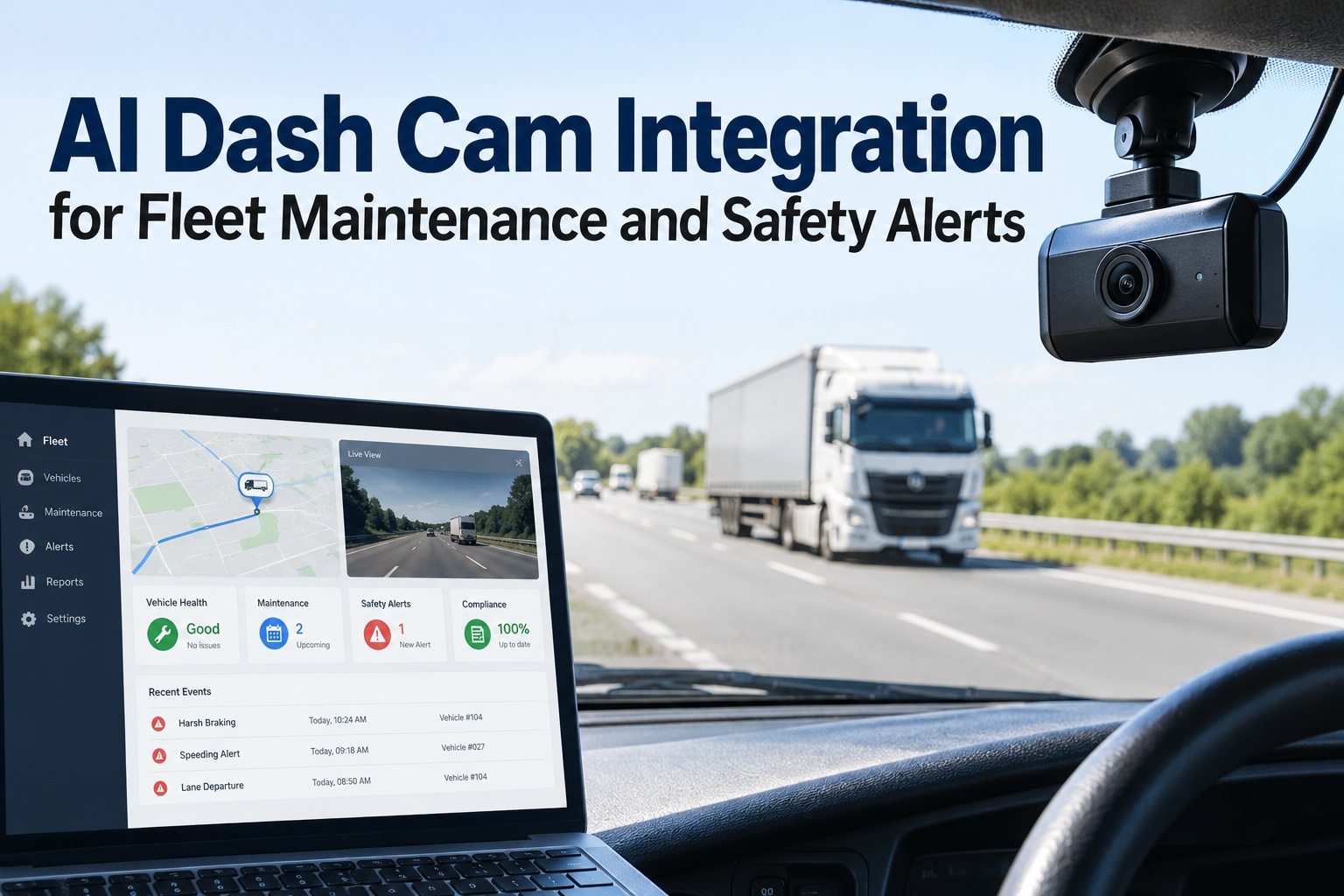
AI Dash Cam Integration for Fleet Maintenance and Safety
Turn camera events into coached actions, audit-ready evidence and maintenance work orders in one platform — so the footage earns its premium reduction instead of sitting in a portal nobody opens.
Where the return actually comes from, per truck per year
$300–$1,200Insurance premium reduction
$400–$2,500Collisions avoided
$200–$1,500Exoneration value
$200–$400Manager time saved
Against a programme cost commonly cited at $480–$780 per truck per year
Why Cameras Alone Stopped Being Enough
The market moved, and the change is specific enough to plan against.
What used to earn a discount
Cameras installed
A basic camera programme could attract a discount in the region of 5 to 10 per cent simply by existing. The insurer wanted to know the hardware was there.
What earns one now
Evidence you are managing risk
Carriers have become data-driven and now want documented proof the footage is reducing risk — declining event frequency over time, documented coaching completion, and tracked exoneration statistics. Fleets that package that narrative are reported to achieve 15 per cent and above, with some sources citing 15 to 25 per cent.
One line from underwriting practice worth repeating internally, because it explains exactly what they are reading for: a simple log of driver name, event type, coaching date and follow-up outcome is read as proof that you are not just watching, you are managing. That log is a software artefact. No camera generates it.
The Five Places the Money Comes From
Worth stacking explicitly, because most business cases lead with the one that is hardest to guarantee and bury the ones that are nearly certain.
Swipe to see all columns
Two honest qualifications, because a business case that overstates gets rejected at the second meeting. Model it on your own claims frequency, your own discount structure and your own coaching capacity rather than on vendor medians — a fleet with low collision frequency already has less headroom and will produce smaller absolute savings. And note the timing: behaviour improvements and collision reductions are reported to begin within the first 30 days, while insurance reductions apply at the next renewal.
Timing matters
90 days
Before renewal is when the safety data should reach your underwriter
Walk us through your renewal calendar and we'll work backwards
The evidence pack has to exist before the conversation, which means the programme has to have been running long enough to show a trend. Tell us when your policy renews and we'll map what needs to be in place, by when, to have declining event frequency and documented coaching ready to present.
Inside Fleet Rabbit: What the Integration Actually Does
Five capabilities, and the third is the one no camera vendor offers because it sits outside their product entirely.
01Camera events land in one queue with everything elseSafety events arrive alongside inspection defects and telematics fault codes on the same asset record, rather than in a separate portal your safety manager checks and your maintenance manager never opens. One vehicle, one history, one place to look.
02Every event gets a coaching action with an owner and an outcomeEvent, driver, date, coaching action taken, follow-up result — recorded as it happens rather than reconstructed at renewal. This is precisely the log underwriters read as evidence of management rather than observation.
03Safety events that indicate a mechanical problem raise a work orderRepeated harsh braking on one unit is a driver conversation or a brake inspection, and the difference matters. Because Fleet Rabbit already runs your preventive schedules, inspections and repair history, a camera event pointing at a vehicle problem becomes a job rather than a note — which is the connection a standalone camera platform structurally cannot make.
04The quarterly snapshot builds itselfVehicle count, monitored miles, event counts by category, coaching actions completed, exoneration record and trend against the prior quarter — the one-pager underwriters want, assembled from data already captured rather than compiled by hand the week before renewal.
05Hardware-agnostic, so your cameras stayFleet Rabbit integrates with existing camera, telematics and ELD providers rather than requiring replacement. If you have already bought hardware, the integration layer is what was missing — not another set of devices.
The third capability is worth dwelling on when you compare vendors. A camera platform can tell you a vehicle braked hard eleven times last month. Only a system that also holds the maintenance record can tell you whether that is a driver pattern or a brake problem — and getting that wrong means coaching a driver for a mechanical fault, which damages the programme's credibility with exactly the people whose cooperation it depends on.
Driver Acceptance Is the Real Deployment Risk
The data here is unambiguous and it should shape your rollout more than any technical decision.
92%
expressed concern about in-cab cameras
In a survey of more than 3,500 professional drivers — citing footage used out of context, use for disciplinary action, data security, and being monitored while working.
92%
would accept cameras that could exonerate them
The same survey. The objection is not to being recorded — it is to how the recording will be used. That is a framing and policy problem, not a technology one.
Approval rises 87%When footage is used for proactive coaching rather than disciplinary action. The same hardware, the same events, a completely different reception.
80%+ acceptance within 60 daysReported by fleets that frame cameras as driver protection rather than surveillance, publish a written privacy policy, and share real exoneration stories.
Baseline approval sits at 2.24 out of 10Which is where you start if you say nothing. The gap between that and 80 per cent acceptance is entirely communication and policy — and it costs nothing except doing it before installation rather than after.
One practical detail that helps considerably: modern edge processing detects phone use, drowsiness, seatbelt compliance and distraction without recording continuously when nothing is triggered. That fact addresses the single most common objection directly, and it is worth stating in the announcement rather than leaving drivers to assume the worst.
What This Looked Like on 310 Vehicles
A published deployment worth reading in full, because the behaviour numbers arrived faster than most people expect.
52%
accident reduction in twelve months
Alongside an 80% reduction in distraction events
Dual cameras, real-time coaching, and an adoption programme
A 310-vehicle operation deployed road-facing cameras for collision evidence and driver-facing cameras with edge AI distraction detection. The results came from the programme rather than the hardware — real-time coaching alerts, gamification, and a deliberately designed driver adoption approach. The cameras detected phone use, drowsiness, smoking, seatbelt compliance and distraction, without recording when not triggered.
How Fast the Numbers Move
Useful for setting expectations with whoever approved the spend, because the sequence is not intuitive.
Swipe to see all columns
Note what has to happen before any of this: document your current accident frequency, average claim cost, insurance premium and cost per vehicle before installation. That baseline is what the programme gets measured against and what you present to your carrier twelve months in. Fleets that skip it end up with improvements they cannot demonstrate.
Send us a month of camera events and we'll build the underwriter one-pager
Vehicle count, monitored miles, event counts by category, coaching actions taken and trend direction — the quarterly snapshot in the format carriers actually read. You keep it whether or not anything follows, and it will tell you immediately whether your current setup can produce that evidence or whether the data is sitting somewhere it cannot be assembled from.
Getting the Rollout Right
Six steps. The first two happen before any hardware is fitted, and skipping them is the most common cause of a programme that never produces its return.
1Baseline everything firstAccident frequency, average claim cost, current premium and cost per vehicle, documented before installation. Without it you cannot prove improvement and cannot renegotiate a rate.
2Announce it as protection, in writing, before installExplain the purpose, publish a privacy policy, and commit in advance that footage is used for coaching rather than discipline. This single decision moves acceptance from a baseline of around two out of ten to above 80 per cent within two months.
3Consider starting forward-facing onlyFor a first deployment or an acceptance-sensitive fleet, forward-facing is the lowest-resistance entry point — it still delivers exoneration value and still attracts a meaningful insurance discount. Driver-facing can follow once the programme has proved itself.
4Share the first exoneration story widelyDescribed as the most effective adoption strategy there is. One clip that cleared a driver of a false claim does more for acceptance than any amount of explanation, and it usually pays for a substantial part of the subscription at the same time.
5Close the loop on every eventEvent, coaching action, date, outcome. Events without a recorded action are events the insurer will not credit and drivers will experience as surveillance — the worst of both positions.
6Package the data 90 days before renewalDeclining event trends, coaching completion and exoneration statistics, presented proactively. This is described as among the highest-return activities a fleet safety manager can perform, and it takes about twenty minutes to pull from a platform that has been capturing properly.
Frequently Asked Questions
Do AI dash cams actually reduce insurance premiums?Yes, but only if you use the data actively. Insurers in 2026 are described as no longer wanting to see that cameras are installed — they want documented proof the footage is reducing risk, meaning declining event frequency over time, documented coaching completion and tracked exoneration statistics. Fleets that package that evidence report reductions of 5 to 20 per cent, with some sources citing 15 to 25 per cent for advanced video telematics. A basic camera with no programme behind it attracts far less.
What does a programme actually cost, and what does it return?Programme costs are commonly cited at $480 to $780 per truck per year across hardware, subscription, installation and coaching overhead. Return stacks from premium reduction of $300 to $1,200, collisions avoided at $400 to $2,500, exoneration value of $200 to $1,500 and manager time saved at $200 to $400 — per truck per year. Most fleets reach positive return within four to six months. Model it on your own claims frequency and discount structure rather than on medians, since an already-safe fleet has less headroom.
How quickly do the numbers move?Faster than most people expect on behaviour, slower on insurance. Behaviour improvements and collision reductions begin within the first 30 days, with reported improvement of 65 to 80 per cent within 30 to 60 days under real-time coaching and distraction events down around 60 per cent by 90 days. Accident reductions of 30 to 50 per cent are reported across twelve months. Insurance reductions, however, apply at your next renewal — which is why the evidence pack matters more than the install date.
Will our drivers accept this?It depends almost entirely on framing. A survey of over 3,500 professional drivers found 92 per cent expressed concern about in-cab cameras — and the same 92 per cent said they would accept cameras if footage could exonerate them. Approval rises 87 per cent where footage is used for proactive coaching rather than discipline, and fleets framing cameras as driver protection report above 80 per cent acceptance within 60 days, against a baseline approval of around 2.24 out of 10. Announce it properly, publish a privacy policy, and share the first exoneration story.
Do we have to replace our existing cameras?No. Fleet Rabbit is hardware-agnostic and integrates with existing camera, telematics and ELD providers. If you have already invested in hardware, the missing piece is usually the layer that turns events into coached actions, maintenance work orders and audit-ready records — not another set of devices. That integration is also what your insurer is asking to see evidence of.
What does the integration add that the camera platform does not?Three things. Camera events arrive on the same asset record as inspection defects and telematics fault codes, so one vehicle has one history. Every event carries a coaching action with an owner and a recorded outcome, which is the log underwriters read as evidence of management. And safety events pointing at a mechanical problem raise a work order — because a pattern of harsh braking on one unit might be a driver conversation or a brake inspection, and only a system holding the maintenance record can tell you which.
Where should we start?Baseline your current accident frequency, average claim cost and premium before installing anything, because that is what the programme gets measured against. Announce the programme as driver protection with a written privacy policy before hardware arrives. Consider forward-facing only for a first deployment, since it still delivers exoneration value at lower resistance. Then make sure every event gets a recorded coaching action from day one — retrofitting that log is the part nobody manages. Set it up free on three vehicles and see the record build.
The Footage Is Not the Asset. The Record Is.
Baseline before you install, announce it as protection rather than monitoring, attach a coaching action and an outcome to every single event, route the ones that look mechanical into a work order instead of a driver conversation, and have the trend ready ninety days before renewal — because a camera that records everything and evidences nothing will not move your premium, and it will cost you your drivers' goodwill on the way.
Cost, premium reduction and outcome figures are drawn from published 2026 industry reporting and vendor case data, and vary considerably by fleet size, duty cycle, claims history and insurer. Verify discount structures with your own carrier before modelling, and build any business case on your own baseline rather than on published medians.