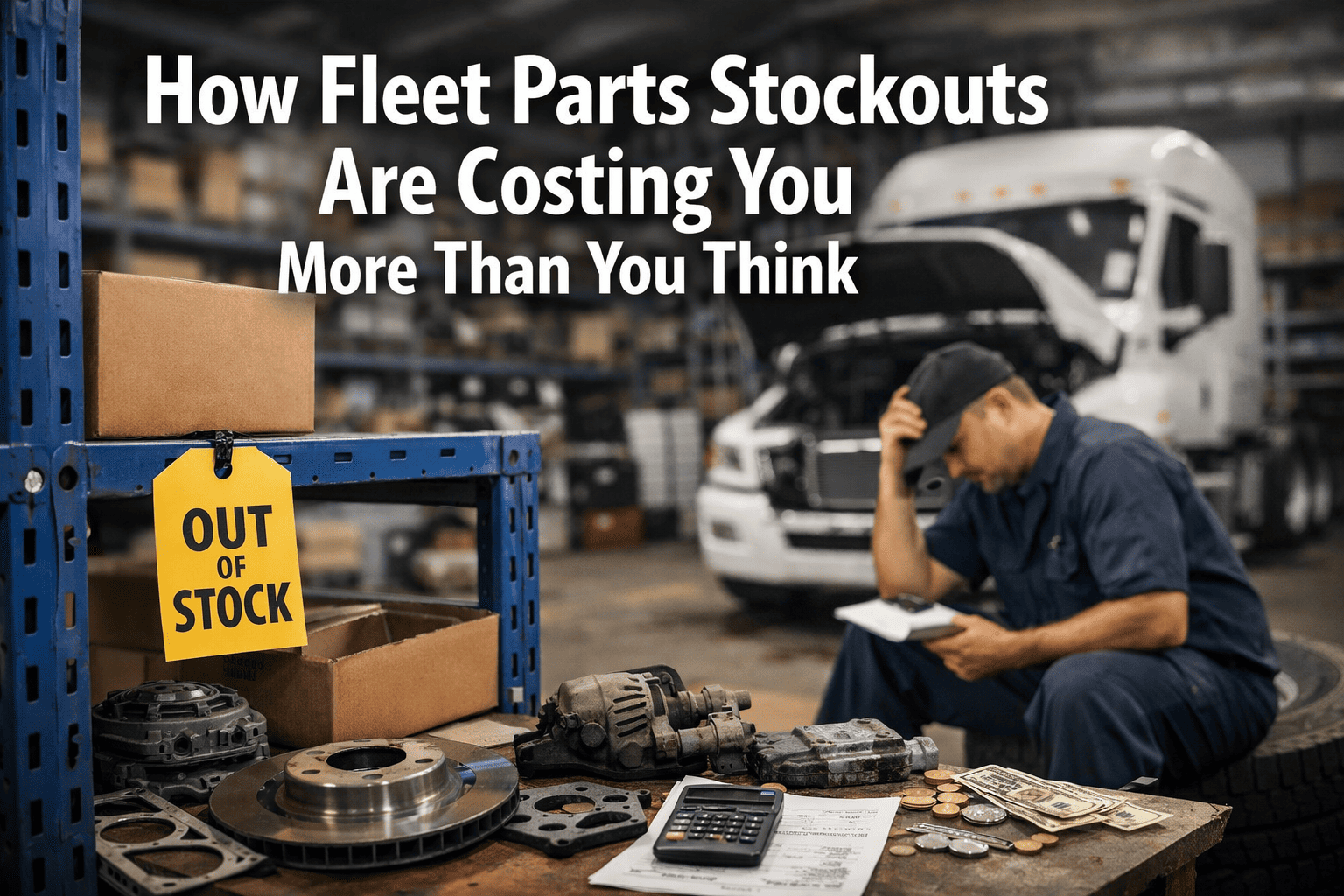
The brake job was supposed to take two hours. Instead, the truck sat in your shop for three days because a $45 brake pad wasn't in stock. By the time the part arrived via overnight shipping ($85 fee), you'd lost $2,280 in vehicle downtime, paid premium labor rates, and had to reassign two routes that frustrated your best customers. This scenario repeats across fleets every single day—not because maintenance teams are incompetent, but because parts inventory is invisible until it's too late. Industry data shows that stockouts force emergency shipping costs of $50-200 per order, while the combined downtime and premium pricing from a single critical part failure can cost $2,000-5,000. Smart inventory tracking eliminates these surprise costs entirely. Book a demo to see how automated parts management prevents stockouts.
That Empty Bin Is Costing More Than You Think
When a $45 part isn't in stock, the real cost isn't $45. It's the $760/day in vehicle downtime, plus $85 expedited shipping, plus the customer who stops calling. Fleet parts stockouts are one of the most overlooked budget drains in maintenance operations—and one of the most preventable.
Research shows that nearly 60% of small and mid-sized businesses lose up to 15% of annual revenue due to supply chain delays. For fleets, those delays start at the parts shelf. Every empty bin represents a potential cascade that multiplies the original part cost by 50x or more before the vehicle returns to service.
What Is a Parts Stockout and Why Does It Matter?
A parts stockout occurs when a maintenance operation needs a specific component but discovers it's not available in inventory. Unlike retail stockouts where customers simply buy elsewhere fleet stockouts create immediate operational paralysis—vehicles can't move, technicians can't work, and revenue stops flowing while everyone waits for a $45 part to arrive.
The financial impact extends far beyond the missing part's cost. When a stockout occurs, fleets face a cascade of compounding expenses: emergency shipping fees that run 3-4x standard rates, premium pricing from vendors who know you're desperate, technician downtime while waiting for parts, vehicle downtime that costs $448-760 per day, and the hidden cost of frustrated customers who may never call again. A single unplanned breakdown averages $8,500 when you factor in towing, emergency repairs, route disruptions, and lost service hours. Schedule a demo to see how real-time tracking prevents these scenarios.
The problem is especially acute for fleets because maintenance can't wait. Unlike a manufacturing operation that might adjust production schedules around a missing component, a fleet vehicle either runs or it doesn't. There's no partial service, no workaround, no alternative—just an asset sitting idle while costs accumulate.
The Anatomy of a Stockout: Where $45 Becomes $2,500
Fleet managers see the parts invoice. What they don't see is the cascade of costs that compounds behind every stockout. Here's exactly what happens when your shop discovers that brake pad isn't in stock:
Part Not in Stock
Technician discovers brake pad BRK-042 shows zero inventory mid-repair. Vehicle is already on the lift with wheels removed.
Vehicle Sits Idle
Truck blocks the bay, preventing other jobs. Vehicle downtime at $760/day accumulates for 3 days while waiting for parts delivery.
Emergency Shipping
Overnight delivery to minimize additional downtime. Standard ground shipping would cost $12; expedited costs $85.
Wasted Labor
Technician spent 30 minutes diagnosing and starting the job before discovering the stockout. Then context-switched to another repair, losing efficiency.
Route Reassignment
Operations team scrambled to cover the routes. Other drivers worked overtime, adding to labor costs and affecting their schedules.
Total Stockout Cost
One missing $45 part generated a 58x cost multiplier. And this doesn't include the customer who received late delivery and may not call back.
This isn't an edge case—it's the typical outcome when critical parts aren't available. The solution isn't buying more parts or building bigger warehouses. It's knowing exactly what you have, what you need, and when to reorder. Smart inventory systems track usage patterns and alert before stockouts occur, breaking the cascade before it starts.
Stop Discovering Stockouts Mid-Repair
FleetRabbit monitors every part in real-time and alerts when stock hits reorder points—before the cascade starts. One prevented stockout pays for a year of tracking.
Why Fleet Shops Keep Running Out of Parts
Parts stockouts aren't random bad luck or unpredictable failures. They're the predictable result of inventory blind spots that exist in most fleet operations. These blind spots persist because they're invisible until they cause problems—and by then, the damage is done. Understanding these patterns is the first step to eliminating them:
Spreadsheet Tracking
Manual counts get stale the moment they're recorded. A part used Tuesday morning might still show "in stock" until someone updates the sheet Friday afternoon. By then, three more jobs have been scheduled assuming that part is available.
Memory-Based Ordering
Someone "usually remembers" to order brake pads when stock gets low. Until they're on vacation, or handling an emergency, or forget that Unit #47 uses a different size than the rest of the fleet. Memory fails exactly when you need it most.
No Usage Visibility
Without linking parts to work orders, you can't see consumption patterns. You don't know which parts get used together, which vehicles consume more of certain components, or how seasonal changes affect demand.
Lead Time Blindness
A part that ships in 2 days needs different reorder timing than one that takes 2 weeks. Most fleets treat all parts the same, reordering at the same threshold regardless of how long delivery actually takes.
The Real Cost Breakdown: What Stockouts Do to Your Budget
Parts inventory problems create costs in places fleet managers rarely track. The invoice shows the part price. It doesn't show the downtime, the expedited shipping, the premium vendor pricing, the wasted labor, or the lost revenue. Industry benchmarks reveal where money actually goes when stockouts become routine:
| Cost Category | Per Incident | Annual (50 vehicles) | Impact |
|---|---|---|---|
| Vehicle Downtime | $448-760/day | $22,400-38,000 | Severe |
| Emergency Shipping | $50-200/order | $3,000-12,000 | Severe |
| Premium Parts Pricing | 30-50% markup | $8,000-15,000 | High |
| Technician Wait Time | $30-50/hour | $9,000-18,000 | High |
| Lost Revenue | Variable | $15,000-45,000 | Severe |
| Total Stockout Impact | — | $57,400-128,000 | Preventable |
These numbers represent a 50-vehicle fleet experiencing typical stockout frequency. Larger fleets see proportionally larger impacts. The striking insight is the final column: every category is preventable with proper inventory visibility. You're not paying for unavoidable costs—you're paying for information you don't have.
How Smart Inventory Tracking Prevents Stockouts
Modern fleet parts management goes beyond counting what's on shelves. It connects inventory to work orders, predicts demand based on historical patterns, and alerts before stockouts can happen. The difference between reactive and proactive inventory management is the difference between discovering problems and preventing them:
Real-Time Stock Tracking
Every part has a live count that updates the moment it's used. When a technician pulls a brake pad from inventory, the count decreases immediately—not when someone remembers to update a spreadsheet. You always know exactly what's on the shelf.
Automated Reorder Alerts
When stock drops to the calculated reorder point, the system sends alerts via email, SMS, or dashboard notification. No one needs to remember to check inventory levels—the system watches continuously and speaks up when action is needed.
Work Order Integration
When a PM service is scheduled, the system checks parts availability first. If the oil filter isn't in stock, you find out when creating the work order—not when the technician reaches for the shelf.
Usage Pattern Analytics
Historical data reveals patterns invisible to manual tracking: which parts fail together, seasonal demand spikes, vehicles that consume more of specific components, and trends that predict future needs before they become urgent.
Know What's in Stock Before Your Technician Doesn't
FleetRabbit tracks every part, sets intelligent reorder points, and alerts before stockouts occur. Real-time visibility means no more emergency shipping fees or idle vehicles waiting for parts.
The ABC Method: Not All Parts Need Equal Attention
Trying to perfectly manage every single part in your inventory is impossible and unnecessary. A fleet might stock hundreds of different components, but they don't all carry equal weight. Smart fleets categorize inventory by criticality and turnover rate to focus attention where it matters most. This ABC analysis approach ensures critical parts never run out while avoiding excess investment in low-priority items:
Parts that fail often and cause immediate downtime when missing. These are the components your technicians reach for constantly—filters, belts, brake components, batteries. A stockout here stops work immediately. These items justify premium shelf space, close monitoring, and never-out policies.
Parts needed regularly but acceptable to occasionally backorder without catastrophic operational impact. These items matter, but a day or two delay won't stop your entire operation. Standard reorder alerts work fine here.
Rare failures that cause extended downtime when they happen. You might not use a water pump for months, but when one fails, the vehicle is down for days waiting for parts. The carrying cost of keeping one on the shelf is trivial compared to the downtime cost of not having it.
Setting the Right Reorder Points
The reorder point is the inventory level that triggers a new order. Set it too low and you risk stockouts during the lead time. Set it too high and you tie up capital in excess inventory. The formula seems simple, but getting the inputs right requires understanding your specific operation's patterns and risks:
Example: Brake Pads BRK-042
The challenge is safety stock. Too little and you risk stockouts during demand spikes or supplier delays. Too much and you waste capital on parts that sit on shelves. The right safety stock level depends on two factors: demand variability (how predictable is your usage?) and supply reliability (how consistent is your vendor?). Vendors with 95%+ on-time delivery justify lower safety stock, while inconsistent suppliers need 30-50% higher buffers to prevent stockouts during delayed deliveries. Book a demo to see how FleetRabbit calculates optimal reorder points automatically based on your actual usage patterns and supplier performance.
Frequently Asked Questions
A single critical stockout costs $2,000-5,000 when you factor in vehicle downtime ($448-760/day), emergency shipping ($50-200), premium parts pricing (30-50% markup), and lost technician productivity. For a 50-vehicle fleet experiencing regular stockouts, annual costs can reach $57,000-128,000—all preventable with proper inventory tracking.
Both waste money, but in different ways. Stockouts create emergency costs and downtime—immediate, visible pain. Overstock ties up capital in parts that may never be used or become obsolete—slow, invisible drain. Smart inventory management balances both, keeping critical parts in stock while avoiding excess that never turns.
The system monitors real-time stock levels continuously. When any part drops to its calculated reorder point, alerts fire automatically via email, SMS, or dashboard notification. FleetRabbit also checks parts availability when work orders are created—so you discover shortages during planning, not during repairs.
Use ABC analysis. Category A (critical, high-turn) parts need 2-3 months supply with automated reordering. Category B (standard, medium-turn) needs 1-2 months supply. Category C (catastrophic, low-turn) keeps 1-2 units despite rare use because downtime costs far exceed carrying costs. Link parts to work order history to see actual consumption patterns.
Yes—and this integration is the key to preventing stockouts. When parts are linked to work orders, the system automatically checks availability before scheduling repairs, reserves components for upcoming jobs, deducts inventory when work is completed, and builds usage history that improves demand forecasting over time.
Every Empty Bin Has a Price Tag—Now You Can See It
FleetRabbit tracks every part in real-time, sets intelligent reorder points based on actual usage, and alerts before stockouts cascade into costly downtime. Start with 3 vehicles free, then $3/vehicle/month. Setup takes 15 minutes.